
An assistance animal is the broad housing-law label. An emotional support animal (ESA) is one kind of assistance animal, and a service animal is the other. A companion animal is simply a pet. The labels used to line up neatly with legal rights, but in May 2026 HUD changed how it enforces them, so the gap between an ESA and a trained service dog now matters more than it did a year ago.
This guide sorts out the vocabulary, shows where each type of animal has legal footing, and explains what the 2026 housing change means if you rent or live in a dorm.
TL;DR
- “Assistance animal” was the Fair Housing Act umbrella term covering both trained service animals and untrained ESAs. “Companion animal” and “comfort animal” are not legal categories.
- Under the ADA, only dogs (and in some cases miniature horses) trained to perform specific tasks are service animals. ESAs can be any species but have no public access rights.
- On May 22, 2026, HUD rescinded its ESA guidance and now pursues housing complaints only for individually trained animals. The Fair Housing Act itself was not amended, and state laws and private lawsuits are unaffected.
- Registries, certificates and ID cards have never been legal requirements. A letter from a licensed clinician is the document that matters.
Table of Contents
- The four terms people mix up
- What counts as a service animal
- What counts as an emotional support animal
- What changed in housing in 2026
- Dorms and college housing
- Public places and air travel
- Side by side: ESA vs. service animal
- Our perspective
- Where to start
- FAQ
- Sources
The four terms people mix up
Search results use these words interchangeably. The law does not.
| Term | What it is | Legal status |
|---|---|---|
| Service animal | A dog individually trained to do work or perform tasks for a person with a disability | Protected under the ADA in public places; covered in housing |
| Emotional support animal (ESA) | Any animal whose presence eases symptoms of a person’s mental health disability, with no task training required | Historically covered in housing only; now contested (see below) |
| Assistance animal | Former HUD umbrella term for both of the above | Fair Housing Act concept, not an ADA one |
| Companion animal | An ordinary pet | No disability-related rights |
| Comfort animal | Usually an animal that visits people in crisis or disaster settings | No individual legal rights |
The ADA Technical Assistance Center’s overview draws the same line: comfort animals work during active crises, therapy animals visit facilities, and ESAs stay with one person without task training. If you came here asking about a “comfort animal,” that is almost certainly the term you want to retire. It carries no legal weight for a renter.
What counts as a service animal
The ADA’s service animal page limits service animals to dogs individually trained to do work or perform tasks for a person with a disability, with a separate provision for miniature horses. The task must be directly related to the disability. A dog that interrupts a panic attack by applying pressure, reminds its handler to take medication, or guides someone through a crowd during a dissociative episode qualifies. A dog whose calming presence helps does not, however real the benefit.
That is why a psychiatric service dog and an ESA can look alike from across a room and sit in different legal categories. If you want to understand the task-training route, our guide to psychiatric service dogs covers tasks, training and rights, and our side-by-side ESA vs. service dog comparison goes deeper on the differences.
What counts as an emotional support animal
An ESA provides therapeutic benefit through companionship and presence. It is not required to be trained, and it is not limited to dogs. The AVMA’s guidance on service, emotional support and therapy animals adds a point many owners miss: loving your pet and feeling better around it does not by itself make it an ESA. The designation depends on a disability-related need documented by a licensed mental health professional, and veterinarians cannot designate one.
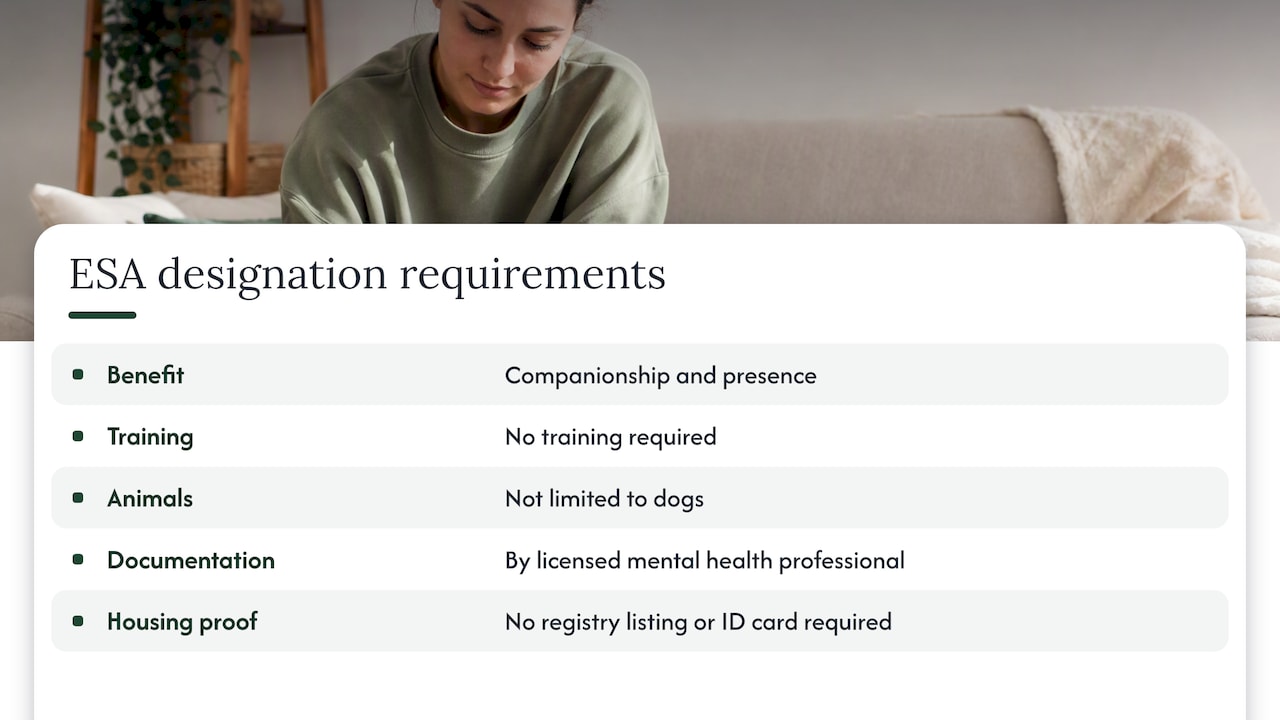
The documentation is a letter, not a product. Housing providers could not demand a registry listing or ID card under the 2020 HUD notice, and the vests and certificates sold online never carried legal weight. If you want to see what a legitimate letter contains, we break it down in our ESA letter sample, and the steps to get one are in how to get an ESA letter.
What changed in housing in 2026
For years, HUD guidance treated ESAs and service animals together as assistance animals that were not pets. Landlords generally could not charge pet fees or apply breed and size limits, and tenants stayed responsible for damage.
That has shifted. According to Holland & Knight’s analysis, HUD’s Office of Fair Housing and Equal Opportunity announced on May 22, 2026 that it was permanently rescinding its 2020 assistance animal notice. FHEO will now find reasonable cause only where the animal was individually trained to provide disability-related assistance, which mirrors the ADA’s service animal definition. Housing providers are no longer expected by FHEO to automatically grant requests, including fee waivers, for untrained ESAs.
Three limits on that change are worth knowing:
- The statute is unchanged. Fisher Phillips notes that the Fair Housing Act itself was not amended and that the memo covers only HUD’s handling of animal complaints.
- Private lawsuits remain possible. The same analysis says a tenant whose request is denied can still sue, and a lawsuit does not require a prior HUD finding.
- State and local laws are not affected. Holland & Knight states this directly. Some states have their own rules, which is why we keep a page on ESA letter laws by state.
HUD also says it intends to pursue rulemaking to align its regulations with the ADA. Expect more movement, and check our page on ESA housing rights for the current picture.
What this means if you rent
Do not assume your landlord must waive pet rent because you hold an ESA letter. Do not assume the landlord can automatically refuse either. A practical approach:
- Check your state and city fair housing rules first.
- Make the request in writing and attach a letter from a licensed clinician who knows you.
- Offer to talk it through. Case-by-case dialogue was the core of the old process and still helps.
- Keep the animal well behaved. Providers could always decline an animal that poses a direct threat or would cause substantial damage that cannot be reduced, per HUD’s assistance animal page.
- If you are refused, document everything and contact a local fair housing organization or a disability rights attorney.
If your dog has task training, you may be on much firmer ground, since that is the category HUD still enforces.
Dorms and college housing
Students face a slightly different framework. Section 504 of the Rehabilitation Act requires colleges to evaluate accommodation requests individually, so a blanket “no animals” answer is hard to defend. An Education Department Office for Civil Rights investigation letter shows how a university’s service animal and accommodation duties are analyzed under federal law.
Start with your campus disability services office, not the housing office, and start early. Housing deadlines run months ahead of the semester. If you are also exploring other supports, this guide to 504 accommodations explains how individualized accommodation plans work in school settings and what documentation tends to matter.
Because Fisher Phillips reports the HUD change affects how college housing offices handle requests, ask your school for its current written policy rather than relying on last year’s advice from a friend.
Public places and air travel
This part of the picture did not change in 2026, and it is where ESA owners most often get caught out.
Restaurants, stores, hotels. The ADA protects service dogs in public places. An ESA letter does not get an ESA through the door. Businesses may ask only two questions about a service dog: whether it is required because of a disability, and what work or task it has been trained to perform.
Airlines. The Department of Transportation’s December 2020 final rule defines a service animal as a dog trained for a person with a disability and no longer treats ESAs as service animals. Airlines can require the DOT service animal form. An ESA now travels under the airline’s ordinary pet policy and fees. Our guide to flying with an emotional support animal lays out what to expect.
Side by side: ESA vs. service animal
| ESA | Service dog | |
|---|---|---|
| Species | Any | Dogs (miniature horses in some cases) |
| Task training | Not required | Required, tied to the disability |
| Restaurants, shops | No access right | Access under the ADA |
| Flights | Pet rules apply | DOT form may be required |
| Housing (federal enforcement since May 2026) | Not pursued by HUD for untrained animals; state law and lawsuits may still apply | HUD still pursues complaints |
| Proof | Letter from licensed clinician | Handler’s answers to two questions; DOT form for flights |
Our perspective
We built Supportpet because the ESA world is full of paid shortcuts: registries, certificates, vests, instant “approvals.” None of it is legal proof of anything. The only thing that ever mattered was an honest conversation with a licensed clinician who knows your situation.
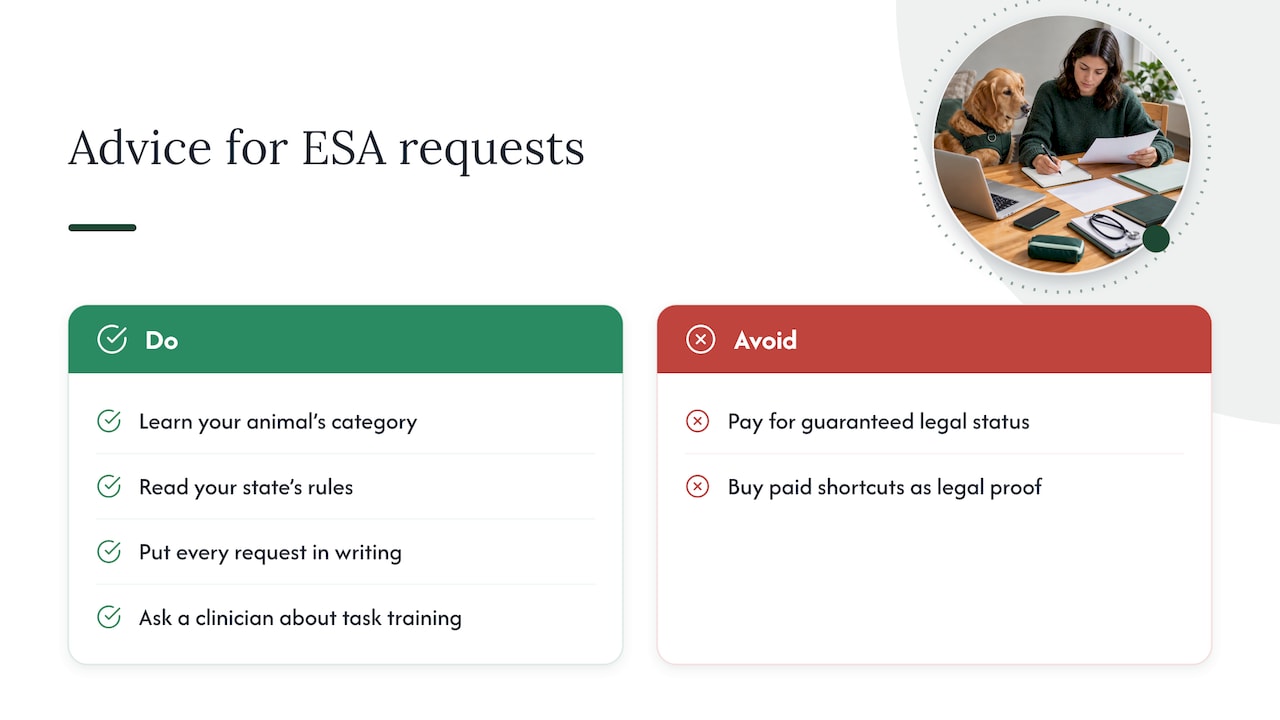
The 2026 housing change makes honesty more important, not less. We think readers deserve to hear plainly that ESA protections are narrower and less certain than they were a year ago, and that this varies by state. We also think the emotional benefit of an animal is real whether or not a federal agency enforces a rule about it. Those two facts can both be true.
Our advice: learn which category your animal fits, read your state’s rules, put every request in writing, and never pay a site that promises a guaranteed legal status. If you have a dog and a need that task training could address, ask your clinician whether a psychiatric service dog is worth exploring.
— Erik
Where to start
If you are deciding whether an ESA letter makes sense for you, our free guide to emotional support animals and ESA letters walks through qualifying, documentation, scams to avoid and your rights by setting. We do not sell letters, registrations or ID cards. We explain how the process works so you can judge any provider yourself.
FAQ
Is an assistance animal the same as an ESA?
Not exactly. “Assistance animal” was HUD’s umbrella term in housing law and included both trained service animals and ESAs. An ESA is the untrained, comfort-providing subset. Since May 2026, HUD’s enforcement focuses on the trained group.
Is a companion animal the same as an emotional support animal?
No. A companion animal is a pet. An ESA is an animal that eases symptoms of a diagnosed disability, supported by a letter from a licensed clinician. Many ESAs began as pets, but the legal difference lies in the documented disability-related need.
Can I just say my dog is an emotional support animal?
You can say it, but a landlord can ask for reliable documentation from a licensed healthcare professional, and online certificates or registrations do not count. In public places, a business can exclude an ESA. Misrepresenting a pet as a service animal is also illegal in many states.
Do I still pay pet fees with an ESA?
It depends on where you live and who you rent from. Under the old 2020 HUD notice, fees were not allowed, but HUD no longer enforces that for untrained animals. Check your state law, then request a waiver in writing with your clinician’s letter.
Sources
- ADA.gov: Service Animals
- ADA National Network: Service Animal or Emotional Support Animal
- AVMA: Service, emotional support, and therapy animals
- HUD: Assistance Animals
- Holland & Knight: HUD Rescinds Emotional Support Animal Guidance
- Fisher Phillips: HUD Pulls the Plug on Emotional Support Animal Guidance
- Education Department OCR letter on service animals in university housing
- DOT: Final Rule on Traveling by Air with Service Animals
- DOT Service Animal Air Transportation Form