
Yes, you can get a legitimate doctor’s note for an ESA, and the requirement that decides everything else is simple: a licensed clinician with a real treating relationship has to determine that your mental health condition causes a functional limitation and that the animal helps. A valid letter needs their credentials, license number, a statement of that relationship, and a nexus between your symptoms and the animal’s role, all on letterhead with a signature. Skip the treating relationship and no letter format will save you.
TL;DR:
- A legitimate ESA doctor’s note requires a licensed clinician with an ongoing treatment relationship, not just a review or questionnaire.
- Valid letters must include specific details such as license information, a clear nexus statement, and a statement of treatment relationship.
- Telehealth can be valid if the clinician is licensed in your state and has conducted sufficient assessment, usually more than one session.
- Common scams include instant approval, lack of license details, out-of-state providers with no relationship, and sale of fake registry products.
- ESA letters are mainly legally significant for housing accommodations under the Fair Housing Act, but they do not grant access to public spaces or airlines after recent regulation changes.
Table of Contents
- Who Can Legitimately Write an ESA Doctor’s Note
- What a Valid ESA Doctor’s Note Must Include
- How to Ask Your Clinician for an ESA Letter
- Common ESA Letter Scams and Red Flags
- Where ESA Letters Work, and Where They Don’t
- How Landlords Verify ESA Letters, and When to Renew
- Supportpet’s Approach to ESA Documentation
- Why Clinical Legitimacy Isn’t Optional
- Get Your ESA Letter Prepared the Right Way
- Sources
Who Can Legitimately Write an ESA Doctor’s Note
Not every clinician can write this letter, and not every letter from a clinician holds up. Licensed mental health professionals are the most common source: psychiatrists, psychologists, licensed clinical social workers (LCSWs), licensed professional counselors (LPCs), and psychiatric mental health nurse practitioners (PMHNPs). In many states, primary care physicians and nurse practitioners can write one too, particularly if they’ve managed your anxiety, depression, or PTSD over time.
The credential matters less than the relationship behind it. A “treating relationship” means the clinician has actually assessed you, not just reviewed a questionnaire and typed a signature. The AAFP’s clinical guidance on ESA documentation recommends confirming that a patient has a genuine impairment before writing anything, and notes that adequate assessment often takes more than one visit. That single detail is what separates a defensible letter from a rejected one.
Telehealth is a legitimate option, but it comes with real limits:
- The clinician must be licensed in the state where you live, not just where they practice.
- Some states require at least one documented session before an ESA letter is appropriate.
- A five-minute video call with a stranger who has never treated you does not meet this bar, regardless of what the website selling the service claims.
What a Valid ESA Doctor’s Note Must Include
A letter is either detailed enough to survive scrutiny or it isn’t, and there’s no in-between. Institutional documentation standards, including guidance used by university disability offices, spell out the same core components:
- Letterhead and contact information identifying the practice or clinician.
- Clinician name, credentials, license type, license number, and state of licensure.
- A statement of the treating relationship, including roughly how long you’ve been under their care.
- Confirmation of a disability or functional limitation described in terms of impact, not necessarily your specific diagnosis.
- A nexus statement explaining how the animal alleviates symptoms or functional limitations, the single most scrutinized line in the entire letter.
- FHA accommodation language, when the letter’s purpose is housing.
- Date and signature.
Pro Tip: Ask your clinician to keep the nexus statement specific but not clinical. “The presence of the animal reduces anxiety symptoms that otherwise interfere with the patient’s ability to maintain stable housing” does more work than a vague line about “companionship.”
Landlords cannot demand a specific form, your exact diagnosis, or medical records. HUD’s assistance animal guidance (FHEO-2020-01) makes that limit explicit: housing providers may request documentation confirming the disability related need, but not the underlying condition itself. Documentation reviewed by institutional templates shows the letters most likely to get flagged are missing a license number, contain a vague or generic nexus statement, or come from an out-of-state provider with no documented telehealth relationship. Any one of those three is enough to sink an otherwise well-intentioned letter.
How to Ask Your Clinician for an ESA Letter
Getting this right starts before you ever bring it up in the appointment room.
- Book a dedicated appointment, not a rushed add-on to an unrelated visit, and tell the scheduler the purpose so enough time gets set aside.
- Bring specifics. Concrete examples beat vague descriptions: “I haven’t been able to sleep through the night in three months” lands harder than “I’ve been stressed.”
- Describe function, not paperwork. Instead of asking, “Can you write me an ESA letter?” try explaining how symptoms interfere with work, sleep, or leaving the house, and how the animal changes that. Clinicians document what they observe and hear, so give them something to work with.
- Share medication and treatment history if you have it, especially if you’re seeing this clinician for the first time.
If your clinician declines, that’s not necessarily the end of the road. Ask for a referral to someone who handles this type of assessment regularly, or consider establishing ongoing care with a mental health professional if you don’t already have one. What you should not do is treat a “no” as a signal to shop for a provider who will say yes without ever examining you. That path leads directly to the scams in the next section.
Common ESA Letter Scams and Red Flags
The ESA letter industry has a well-known scam pattern, and it’s worth being able to spot it on sight.
- Instant approval after a short online quiz. Legitimate clinical assessment, per AAFP guidance, typically takes more than a single rushed interaction.
- No license number listed anywhere on the letter or the site.
- An unverifiable clinician whose name doesn’t turn up in any state licensing database.
- Out-of-state providers offering same-day letters with zero treating relationship.
- “Registration” services selling ESA ID cards, vests, or certificates. The AVMA is explicit that no national ESA registry exists, and none of these products carry any legal weight.
The risk isn’t just wasted money. A landlord who catches a fabricated letter can deny the accommodation outright, and in some states, knowingly misrepresenting an ESA carries its own legal consequences. If you’re holding a letter you’re not confident about, the fix is straightforward: find a licensed clinician, establish a genuine relationship, and be upfront with your housing provider about updating your documentation. Trying to patch over a bad letter with a better story rarely ends well.
Where ESA Letters Work, and Where They Don’t
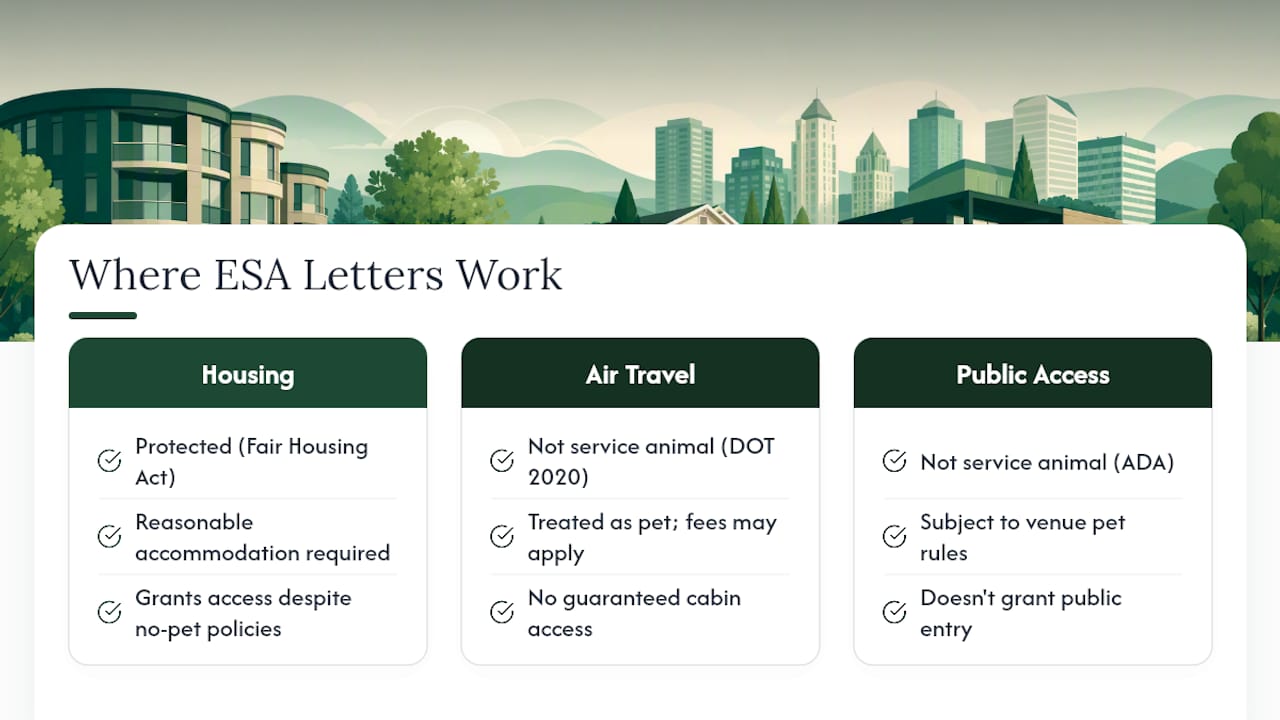
An ESA letter is powerful in exactly one legal context and largely irrelevant in others, which trips up a lot of people who assume it functions like a universal pass.
Housing is where the letter carries real weight. Under the Fair Housing Act, landlords must generally grant a reasonable accommodation for an ESA, even in buildings with no-pet policies, once a qualifying letter is provided. HUD’s guidance limits what a landlord can ask for, and a landlord who denies a properly documented request risks a fair housing complaint.
Air travel is a different story now. Airlines stopped treating ESAs as service animals for cabin travel following the DOT’s 2020 rule change, and most now handle them as pets subject to standard pet policies and fees. Rules vary by airline, so check current policy before booking rather than assuming your letter guarantees cabin access.
Public access is where the letter has no legal power at all. Under ADA guidance, emotional support animals are not service animals, and a doctor’s note doesn’t grant entry to restaurants, stores, or other public spaces that don’t otherwise allow pets. Roughly a third of ADA-related confusion cases involve people assuming an ESA letter functions the same way as a service animal’s task training does, and it simply doesn’t. Bringing your ESA into a grocery store because you have a letter is a good way to get asked to leave.
How Landlords Verify ESA Letters, and When to Renew
A landlord who suspects a letter is fabricated has real options: calling the clinic listed on the letterhead, checking the state licensing board for the clinician’s name and license number, or requesting written clarification about the therapeutic relationship. None of that requires your diagnosis, but a clinician who can’t be reached or verified is a problem you don’t want attached to your housing application.
- Most housing providers generally prefer a recently dated letter, though this is not a fixed federal rule and can vary by property.
- Clinicians often set their own renewal interval based on how your treatment is progressing.
- Keep clinical notes and schedule a re-evaluation before your letter’s usefulness expires rather than after a landlord flags it as stale.
Renewal isn’t paperwork for its own sake. It reflects the same ongoing care relationship that made the original letter valid in the first place.
Supportpet’s Approach to ESA Documentation
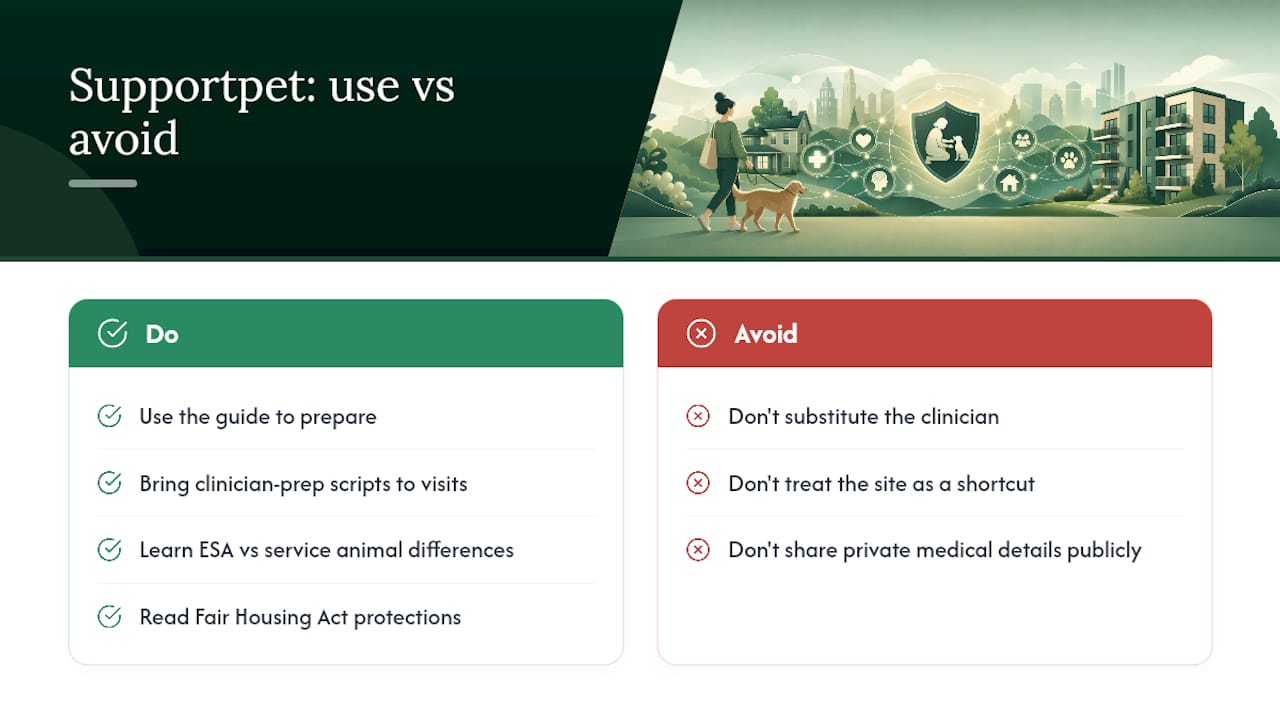
Supportpet builds its resources around one idea: an ESA letter is a clinical document first, and everything else, including housing protections, follows from that. The Supportpet ESA guide breaks down the difference between ESAs and service animals, walks through Fair Housing Act protections in plain language, and flags the scam patterns that trip up first-time applicants.
What Supportpet doesn’t do is replace your clinician. The checklists and clinician-preparation scripts on the site are built to help you walk into an appointment ready, with the right language and the right expectations, not to substitute for a real evaluation. Keep your medical details between you and your provider, and treat any online tool, including this one, as preparation rather than a shortcut around clinical assessment.
Why Clinical Legitimacy Isn’t Optional
The instinct to find the fastest path to a letter is understandable. Housing insecurity is stressful, and a five-minute online form feels a lot less intimidating than an honest conversation about your mental health. But that shortcut puts the clinician’s license at risk, puts your housing accommodation at risk, and, more quietly, cuts you off from the kind of ongoing care that actually helps.
A letter built on a real treating relationship protects your privacy, since your landlord never needs your diagnosis, and it protects the clinician who’s willing to put their license number on the page. Treat the process as what it is: a clinical decision, not an administrative errand. The paperwork should be the easiest part, not the goal.
— Erik
Get Your ESA Letter Prepared the Right Way
Many people don’t need another paperwork mill. They need a clear-eyed explanation of what a legitimate letter requires and the tools to walk into a clinician’s office prepared instead of guessing. Some services fill this gap: not writing letters, but helping ensure appointments result in letters that survive a landlord’s scrutiny.
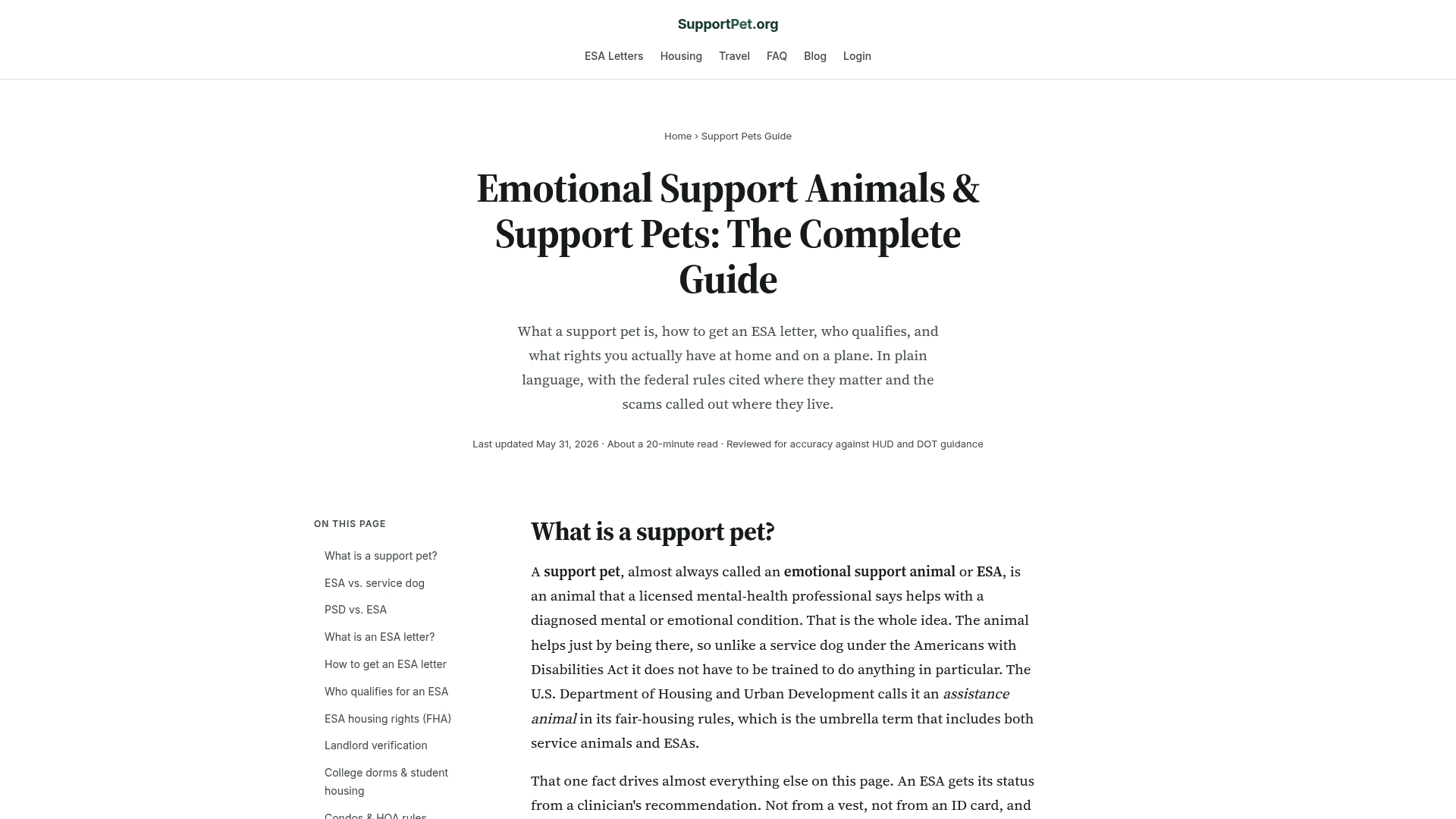
The Supportpet ESA guide includes downloadable checklists, sample nexus language, and a breakdown of Fair Housing Act protections so you know exactly what to expect before you ever schedule an evaluation. If you’re not sure whether your current letter meets the standard, or you haven’t started the process yet, visit the guide and use the templates to prepare for your next clinician appointment.
This article is general information, not a substitute for advice from a qualified doctor. Consult a qualified healthcare professional about your own circumstances before acting on anything here.
Sources
- Emotional Support Animals: Considerations for Documentation (AAFP)
- Documentation Guidelines for Emotional Support Animals (institutional guidance)
- Service animals and emotional support animals (ADA/ADAA guidance summary)