
Emotional support animals can meaningfully ease anxiety, loneliness, and depressive symptoms for some people, mainly through stress reduction, forced routine, and grounding during acute distress. The evidence backing this is real but mixed: strong on qualitative reports, thinner on controlled outcomes. ESAs work best as a supplement to therapy or medication, not a replacement, and they come with legal fine print. Housing law protects them; airlines and most public businesses no longer have to.
TL;DR:
- Emotional support animals are most effective when they align with specific symptoms like social withdrawal, dissociation, or depressive inertia, rather than as a universal fix.
- The strongest legal protection for ESAs is housing accommodation under the Fair Housing Act, while airline and public access rights are limited or no longer guaranteed.
- Valid ESA letters require evaluation by a licensed clinician, including clinical rationale and relationship details, to be legally enforceable and avoid scams.
- Research supports short-term stress relief and routine benefits but is inconclusive on long-term outcomes, emphasizing ESAs as supplementary tools rather than replacements for therapy.
- Managing an ESA involves significant costs and responsibilities, and misuse or difficulty caring for the animal during crises can introduce additional challenges and stress.
Table of Contents
- Emotional Support Animal Benefits Start With a Clear Definition
- The Mechanisms Behind How Emotional Support Animals Help
- What the Research on ESA Benefits Actually Shows
- Who Actually Benefits From an ESA (And How to Tell)
- The Downsides Nobody Mentions on Certificate Websites
- How Legitimate ESA Letters and Clinician Evaluations Work
- Your Next Steps if You’re Considering an ESA
- Why the Conversation Around ESAs Needs More Nuance
- Get Legitimate ESA Documentation Through Supportpet.org
- Where to Read the Primary Research
- Sources
- FAQ
Emotional Support Animal Benefits Start With a Clear Definition
An emotional support animal is a pet that a licensed mental health clinician has determined provides therapeutic benefit to a person with a diagnosed psychological condition, simply by being present. No task training required. That single distinction separates ESAs from the two categories people constantly confuse them with, and getting it straight matters because the legal protections attached to each are completely different.
A service animal, under the Americans with Disabilities Act, is almost always a dog trained to perform a specific task tied to a disability. Guiding someone who is blind, alerting to a seizure, interrupting a panic attack with a trained pressure response. That training is the legal threshold. A service dog can go almost anywhere its handler goes: restaurants, planes, workplaces, retail stores.
A therapy animal is different again. These animals work in clinical or institutional settings, visiting hospitals, nursing homes, or schools under a handler’s direction, often through formal certification programs. UCLA Health’s animal-assisted therapy research describes these as structured clinical interventions with their own training and ethical oversight, distinct from the everyday companionship role an ESA plays in someone’s home.
An ESA does none of that formal work. It doesn’t need obedience certification, a public-access vest, or task training. What it needs is a genuine bond with its owner and a clinician’s professional judgment that the relationship supports treatment. Dogs and cats are the most common ESAs, but rabbits, birds, and even small reptiles show up in practice, as long as the animal is manageable in the person’s actual living situation.
The legal picture splits sharply by setting:
- Housing: The Fair Housing Act requires landlords to make reasonable accommodations for ESAs, even in buildings with no-pet policies, per HUD’s assistance animal guidance.
- Air travel: Since a 2021 Department of Transportation rule change, airlines are no longer required to accommodate ESAs. Most now treat them as ordinary pets, subject to pet fees and carrier rules.
- Public access: Restaurants, stores, and other public businesses have no legal obligation to admit ESAs the way they must for trained service animals under the ADA.
- Workplaces: Accommodation depends entirely on employer policy. There’s no federal mandate comparable to the Fair Housing Act.
That housing protection is the strongest legal asset an ESA carries, and its the one most renters actually need.
The Mechanisms Behind How Emotional Support Animals Help
Ask why an ESA helps, and the honest answer is that it probably helps through several overlapping channels at once, not one clean mechanism. Understanding which one applies to your situation is the difference between an ESA that genuinely supports treatment and one that just adds another responsibility.
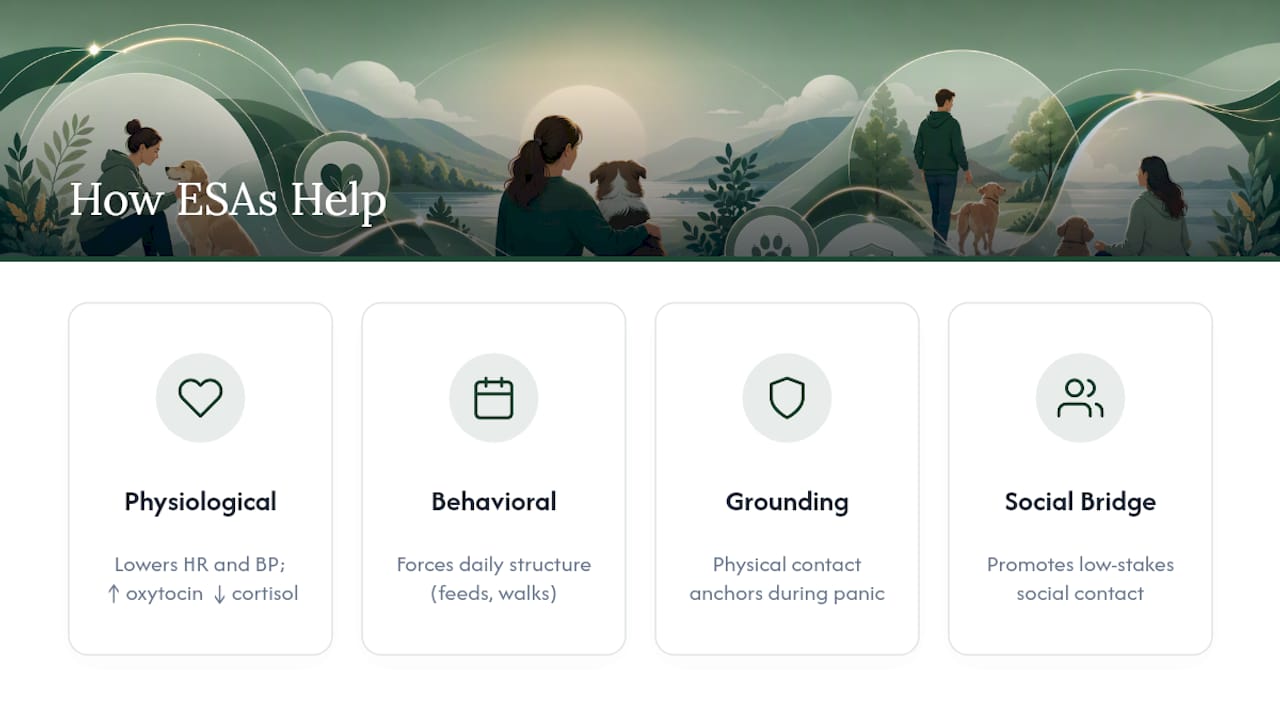
Physiological stress reduction is the most studied pathway. Human-animal interaction reliably lowers short-term physiological stress markers, including heart rate and blood pressure, and shifts hormone patterns in ways that support calm. Research on human-animal interaction links these interactions to oxytocin increases and cortisol decreases, the same chemical signature associated with bonding and reduced threat response. For someone with PTSD, that same body of research points to reduced dissociation and better sensory grounding during acute episodes, meaning a hand buried in fur can pull a person back into the present moment when a flashback starts.
A quick number worth sitting with: short-term animal-assisted interactions have been shown to reduce anxiety, blood pressure, heart rate, and cortisol in the moment, according to Mental Health America’s summary of the research. The effect is immediate, not necessarily durable, and that distinction matters when you’re deciding whether an ESA fits a chronic condition or mainly helps you get through bad days.
Behavioral activation is the second pathway, and it’s underrated. Depression often shows up as inertia: skipped meals, unwashed dishes, days spent in bed. An animal that needs feeding at 7 a.m. and a walk before dark forces a structure onto the day that willpower alone often can’t. This isn’t a metaphor. Behavioral activation is an actual clinical technique used in cognitive behavioral therapy, and a dog is, functionally, a built-in behavioral activation prompt that doesn’t care how you feel about getting out of bed.
Grounding and sensory regulation work differently. For panic attacks, dissociation, or overwhelming anxiety spikes, the physical sensation of an animal (weight, warmth, rhythmic breathing) gives the nervous system something concrete to anchor to. This overlaps with the physiological pathway but deserves its own mention because the timing matters most here: it’s not about long-term stress levels, it’s about surviving the next ten minutes.
Social bridging is the pathway people underestimate the most. Dog owners talk to other dog owners at the park. A cat sitting in a window becomes a conversation starter with a neighbor. For someone whose anxiety or depression has shrunk their world down to four walls, an ESA often provides the first low-stakes social contact they’ve had in weeks, without the pressure of a planned social interaction.
Then there’s the pathway that’s hardest to measure but shows up constantly in patient accounts: nonjudgmental presence. A pet doesn’t ask how the job search is going. It doesn’t need you to perform wellness. The systematic review by Brooks and colleagues found this theme surfacing again and again in qualitative interviews. People describe their animal as the one relationship in their life that carries zero expectation of reciprocity, and that unconditional quality appears to be part of what makes the bond therapeutically distinct from human relationships, which almost always carry some social weight.
Taken together, these mechanisms explain why ESAs show up so often in mental health discussions without any single mechanism being definitively “proven.” They’re not one intervention. They’re five loosely related ones stacked inside a single relationship.
What the Research on ESA Benefits Actually Shows
Here’s where the honest version of this story diverges from the marketing version you’ll find on certificate-selling websites: the evidence for emotional support animal benefits is real, but it’s nowhere near as settled as advocates often imply.
The Brooks et al. systematic review, published in 2018 and still one of the most cited pieces of research on this topic, pulled together studies on companion animals and mental health. Its conclusion is worth quoting because it captures the tension precisely.
Across the studies reviewed, people with mental health problems described their companion animals as providing crucial emotional support, a sense of purpose, and a distraction from symptoms. Yet the quantitative evidence for these benefits remained mixed and inconsistent, and the review called explicitly for more rigorous research designs before firm conclusions could be drawn.
That’s the pattern across most of the literature: strong, consistent qualitative reports paired with weaker, inconsistent quantitative findings. People say their ESA helps. Measured outcomes on standardized depression and anxiety scales don’t always confirm it with the same clarity.
The empirical study that comes closest to bridging that gap is the HARP pilot study, a longitudinal program pairing adults with serious mental illness with shelter animals as ESAs. Participants showed measurable reductions in depression, anxiety, and loneliness scores after placement, alongside biomarker shifts (oxytocin trending up, cortisol trending down) that align with the physiological mechanism described earlier. That’s a meaningfully more rigorous design than most of the studies in the Brooks review, tracking the same people before and after placement rather than relying on retrospective self-report.
But the study’s own authors flagged the limitations, and they matter:
- Small sample size. Pilot studies like this typically involve a few dozen participants, not the hundreds needed to rule out chance findings.
- No control group. Without a comparison group that didn’t receive an ESA, it’s hard to separate the animal’s effect from simply being enrolled in a supportive program.
- Observational design. Participants weren’t randomly assigned, so people who were already improving for other reasons could skew the results.
- Heterogeneous outcome measures. Different studies in this field use different anxiety and depression scales, making it hard to pool results into one clean number.
- Selection bias. People who volunteer for ESA pilot programs may already be more motivated toward recovery than the general population with the same diagnosis.
None of that means the findings are wrong. It means they’re suggestive rather than conclusive, which is a different thing entirely and worth being honest about.
Clinical resource pages from academic medical centers reflect that same careful framing. UMassMed’s overview of emotional support animals describes ESAs as providing comfort, routine, and reduced loneliness, while explicitly cautioning that they function as a complement to professional treatment, not a substitute for it. That’s not hedging for legal cover. It reflects where the actual research sits: a body of evidence strong enough to justify trying an ESA as part of a treatment plan, not strong enough to justify skipping therapy or medication because you got a dog.
The realistic synthesis: ESAs appear to help a meaningful subset of people, particularly with loneliness and short-term stress regulation, and the effect seems most reliable when the animal’s presence maps to a specific symptom (grounding for dissociation, routine for depressive inertia). For generalized long-term outcomes measured against rigorous controls, the field still needs the kind of trial that hasn’t been run yet.
Who Actually Benefits From an ESA (And How to Tell)
Not everyone with anxiety or depression benefits equally from an ESA, and pretending otherwise does readers a disservice. The people who report the strongest results tend to fit one of a few specific profiles.
- You have a clear mechanism match. If your symptoms include social withdrawal, loneliness, or difficulty leaving the house, the companionship and social-bridging pathways are directly relevant. If your symptoms center on dissociation or panic attacks, grounding is the mechanism that matters most. If depressive inertia (missed meals, disrupted sleep, days without movement) is your primary struggle, behavioral activation through a pet’s care needs is the strongest fit.
- You can honestly assess your capacity, including on bad weeks. An ESA needs food, exercise, vet care, and attention even during a depressive episode or a housing crisis. If you can’t picture managing that during your worst week, not just your average one, a lower-maintenance animal or a different form of support may serve you better.
- You treat the ESA as an adjunct, not a replacement. If you’re currently in therapy, on medication, or working with a psychiatrist, an ESA slots in alongside that care. If you’re hoping a pet will replace the need for professional treatment entirely, that’s a red flag worth discussing directly with a clinician, especially if you’re managing suicidal ideation, severe PTSD, or a condition requiring active medical management.
- You’ve tested the relationship before committing. Fostering a shelter animal, pet-sitting for a friend, or volunteering at an animal shelter gives you real data on how the responsibility feels day to day, before you commit to full-time ownership and clinical documentation.
Pro Tip: Before pursuing an ESA letter, spend two weeks fostering or pet-sitting an animal similar to the one you’re considering. It’s the cheapest, lowest-risk way to find out whether the daily care routine energizes you or adds one more obligation to a schedule that’s already stretched thin.
If your mental health symptoms are severe or acute (active suicidal ideation, a recent psychiatric crisis, symptoms that are worsening rather than stabilizing), an ESA is not the immediate intervention you need. Contact a clinician or a crisis line first. An animal can support recovery. It cannot substitute for urgent psychiatric care.
The Downsides Nobody Mentions on Certificate Websites
The upside of emotional support animals gets most of the attention. The downsides deserve equal airtime, because they’re exactly the kind of thing that turns a helpful arrangement into an additional stressor.
- Cost adds up fast. Food, veterinary visits, grooming, pet deposits where they’re allowed to be charged, and emergency vet bills can run into hundreds of dollars a month, on top of the cost of obtaining a legitimate ESA letter.
- Caregiving during a mental health crisis is genuinely hard. The same depressive episode that makes an ESA feel most needed is also when feeding, walking, and cleaning up after an animal becomes hardest to manage.
- Housing conflicts still happen. Even with Fair Housing Act protections, landlords can push back on noise complaints, property damage, or neighbor disputes, and a poorly matched animal in a small apartment can trigger exactly those problems.
- Stigma around ESA misuse is real. Widely publicized abuse of ESA designations (people claiming random pets as ESAs to dodge pet fees or bring animals into no-pet spaces) has made some landlords and airline staff skeptical of every ESA request, including legitimate ones.
- Grief hits differently. Losing an ESA is a genuine bereavement, and for someone whose primary source of daily emotional regulation was that animal, the loss can trigger a mental health setback that needs its own support plan.
- Online certificate mills are a legal trap. Websites selling instant “ESA certification” for a flat fee with no clinical evaluation aren’t producing legitimate documentation. Landlords and airlines have gotten better at recognizing these, and using one can leave you without real protection when you need it most.
- Some states impose provider-relationship rules. A handful of states require a minimum length of clinical relationship with the prescribing provider before an ESA letter is considered valid, which matters if you’re trying to get documentation quickly through a first-time telehealth visit.
How Legitimate ESA Letters and Clinician Evaluations Work
A real ESA letter is a clinical document, not a certificate you print off a website. The distinction matters because it determines whether your housing protection actually holds up when a landlord questions it.
A licensed clinician (a therapist, psychiatrist, psychologist, or in some states a licensed clinical social worker) evaluates a patient across several dimensions before writing a letter. That includes confirming an actual diagnosis, such as an anxiety disorder, major depressive disorder, or PTSD; assessing functional impairment, meaning how the condition affects daily life; identifying which mechanism the animal supports, whether that’s grounding, routine, or reduced isolation; and evaluating the patient’s practical capacity to care for the animal responsibly.
A legitimate letter itself has to include specific elements to hold up under scrutiny:
- The clinician’s name, license number, and license type, printed on official letterhead.
- A clear statement describing the clinician-patient relationship, including how long it has existed.
- A concise clinical rationale explaining how the animal’s presence alleviates specific symptoms.
- No requirement to disclose the specific diagnosis, though many clinicians include it.
- A signature and date, with contact information a landlord or airline could verify if needed.
Clinical guidance on ESA documentation is direct about the biggest scam risk in this space: instant online “certification” services that issue a document without any real clinical evaluation. These carry no legal weight and can leave a tenant exposed when a landlord challenges the letter’s legitimacy. Some states also require a minimum provider relationship period, often a set number of weeks or an in-person or telehealth visit history, before a letter is considered valid, so the exact requirements vary and are worth confirming for your state before you start the process.
Pro Tip: If a website offers you an ESA letter without ever asking about your mental health history, symptoms, or daily functioning, it isn’t a clinical evaluation. Walk away and find a licensed provider instead, even if it costs more or takes longer.
The guides provided by some ESA informational websites walk through what a legitimate clinician conversation looks like, what questions to expect during an evaluation, and how to check a letter against the elements landlords and housing authorities actually look for. That kind of practical, document-focused resource is exactly what closes the gap between understanding that ESAs might help and actually getting protected, valid documentation.
Your Next Steps if You’re Considering an ESA
| Step | Action | Why it matters |
|---|---|---|
| 1. Mechanism check | Identify which symptom an ESA would target: loneliness, routine, or grounding | Matches the animal to your actual clinical need |
| 2. Capacity test | Foster or pet-sit first, especially during a hard week | Reveals whether care feels sustainable, not just appealing |
| 3. Clinician consult | Talk to a licensed provider about your symptoms and functioning | Required for a legitimate ESA letter, not optional |
| 4. Documentation | Confirm the letter includes license info, relationship details, and rationale | Protects you if a landlord challenges the request |
| 5. Housing follow-through | Submit the letter through your building’s accommodation process | Activates Fair Housing Act protections properly |
Move through those five steps in order, not out of order. Skipping the capacity test to jump straight to documentation is how people end up with an animal they can’t sustainably care for and a letter that doesn’t reflect a real clinical relationship. And one thing worth repeating plainly: an ESA supports treatment. It doesn’t replace it, especially if you’re managing a condition that requires ongoing psychiatric or therapeutic care.
Why the Conversation Around ESAs Needs More Nuance
The public conversation about emotional support animals tends to split into two unhelpful camps: people who treat ESAs as a magic fix for any mental health struggle, and people who dismiss the entire category as a loophole for getting pets into no-pet apartments.
The mechanism-based framing matters more than most articles give it credit for. An ESA that provides grounding for someone with PTSD is solving a completely different problem than an ESA that provides behavioral activation for someone with depression, even though both get filed under the same legal category. Treating “emotional support animal” as one undifferentiated intervention is part of why the quantitative research looks messier than the qualitative reports. Researchers are often measuring different mechanisms with the same instrument.
What gets underestimated most is the capacity question. Plenty of people who would genuinely benefit from an ESA’s grounding or companionship effects aren’t in a stable enough position, financially or logistically, to take on an animal’s care during their hardest weeks. That’s not a failure. It’s a reason to consider fostering, volunteering, or a lower-dependency animal instead, and more guidance in this space should say that plainly instead of pushing everyone toward full ownership. This type of site exists to help close the gap between “an ESA might help me” and “I have a legitimate letter and I understand my housing rights,” which is where many people get exploited by scam certificate sites or discouraged by confusing state rules. Closing that gap with honest, mechanism-specific guidance is the actual job.
— Erik
Get Legitimate ESA Documentation Through Supportpet.org
If the mechanism-match and capacity checks above point toward “yes, this could genuinely help,” the next real obstacle isn’t motivation. It’s paperwork done correctly. Supportpet is built specifically to walk you through that process: educational guides on qualifying conditions, checklists for what a legitimate ESA letter must include, and plain-language explanations of your rights under the Fair Housing Act.
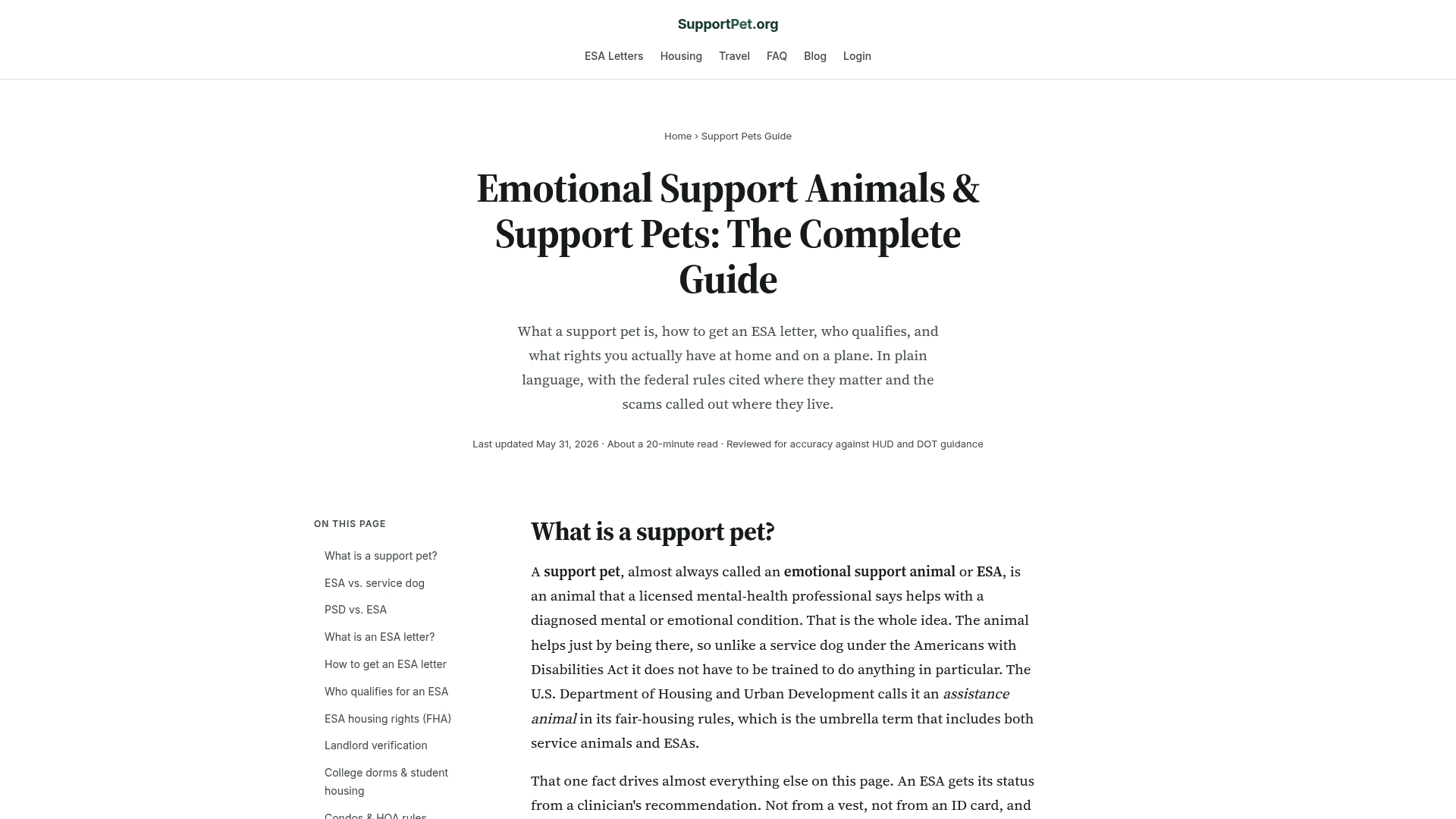
The site’s resources map directly onto the sequence covered above: clinician-conversation guides that help you prepare for an honest evaluation, documentation templates that show you what a valid letter actually looks like, and housing-rights breakdowns that explain what a landlord can and can’t ask for. It’s built to help you avoid the certificate-mill trap entirely while getting the same legitimate protection a proper clinical evaluation provides. Start with the ESA letter and rights guide to see exactly what documentation you’ll need before you contact a clinician.
Where to Read the Primary Research
- Brooks et al., 2018 systematic review: the most cited synthesis of qualitative and quantitative research on companion animals and mental health.
- HARP pilot study: longitudinal empirical data on ESA placement outcomes and biomarker shifts.
- HUD Fair Housing Act guidance: the government source for ESA housing accommodation rules.
- UMassMed’s ESA overview: academic medical center guidance on ESA basics and appropriate use.
- Mental Health America’s summary: patient-facing explanation of how animals affect stress and mood.
Consult a licensed clinician to apply any of this to your specific diagnosis and circumstances.
Sources
- The power of support from companion animals for people living with mental health problems: a systematic review (Brooks et al., 2018)
- Exploring benefits of Emotional Support Animals: a longitudinal pilot study (HARP)
- Human–animal interaction and physiological stress markers (PMC8330800)
- HUD — Assistance animals (Fair Housing Act guidance)
- Emotional Support Animals: The Basics — UMassMed/Transitions ACR
FAQ
What legal perks do emotional support animals get?
ESAs qualify for reasonable accommodation in housing under the Fair Housing Act, meaning landlords generally must waive no-pet policies and pet fees. They do not have guaranteed access to public places, restaurants, or commercial flights, unlike trained service animals under the ADA.
How is a psychiatric service dog different from getting an ESA?
A psychiatric service dog is trained to perform a specific task related to a mental health disability, such as interrupting a panic attack, and qualifies under ADA public-access rules. An ESA requires no task training and offers comfort through its presence, with legal protections limited mainly to housing.
Can you just say your pet is an emotional support animal?
No. A legitimate ESA designation requires a written letter from a licensed mental health clinician who has evaluated you and determined the animal supports a diagnosed condition. Simply calling a pet an ESA without that documentation offers no real legal protection and can backfire if a landlord challenges it.
What are the downsides of having an emotional support animal?
The main downsides are financial cost, the difficulty of animal care during a mental health crisis, housing disputes even with legal protections in place, and the emotional toll of eventual pet loss. Scam certificate websites also pose a real risk, since they issue documents with no clinical weight behind them.
Does research actually support emotional support animal benefits?
Evidence is genuinely mixed but meaningful. Systematic reviews show consistent qualitative reports of emotional benefit alongside inconsistent quantitative results, while a longitudinal pilot study found measurable reductions in depression, anxiety, and loneliness scores after ESA placement, alongside biomarker shifts, though the study had limitations including small sample size and no control group.