
An ESA assessment is a clinical evaluation, done by a licensed mental health or medical professional, that determines whether you have a qualifying mental or emotional disability and whether an animal provides therapeutic support for that condition. The outcome, when the clinician agrees, is a letter you can use to request a reasonable housing accommodation under the Fair Housing Act. No separate registration, certificate, or online quiz can substitute for that clinical judgment.
TL;DR:
- A clinician must establish both a qualifying disability and a clear link between specific symptoms and the animal, using a substantive interview and relevant history.
- A valid letter names the clinician and credentials, links the animal’s support to housing use, and includes a dated signature without disclosing your diagnosis.
- Landlords generally cannot charge pet fees or deposits, but they may request reliable documentation when your need for the animal is not obvious.
- Telehealth can produce a valid letter, but some states require an established clinician relationship or an office visit, and a brief online quiz is insufficient.
- An ESA letter covers housing only; workplace or school accommodations need separate requests, and it grants no public access rights reserved for trained service animals.
Table of Contents
- Who can perform an ESA assessment and what clinical criteria apply
- What happens during an ESA assessment, step by step
- What a valid ESA letter should include
- Your housing rights and what landlords may lawfully request
- Red flags that signal a weak or scam ESA letter
- Telehealth evaluations and rules that vary by state
- How to prepare for your clinician visit
- What to do if your ESA assessment is denied or delayed
- How ESA assessments differ from other disability accommodation evaluations
- Why we push back against shortcuts in ESA assessments
- Get our full ESA rights guide and letter templates
- FAQ
- Sources
Who can perform an ESA assessment and what clinical criteria apply
A valid assessment comes from a licensed clinician: a physician, psychiatrist, psychologist, nurse practitioner, or licensed clinical social worker working within their scope of practice. The clinician is making two distinct determinations, not one. First, do you have a disability, meaning a mental or emotional impairment that substantially limits a major life activity such as sleeping, concentrating, or managing daily routines? Second, is there a genuine nexus between that impairment and the animal, meaning the animal’s presence measurably reduces specific symptoms or improves your functioning?
The American Psychiatric Association advises clinicians to base ESA determinations on substantive clinical evaluation, not a brief form-filling exchange, because the letter carries real legal weight for housing. Housing providers, for their part, generally cannot demand your specific diagnosis or full medical file. They can confirm that a qualified professional made an individualized assessment, but the clinical details stay between you and your provider.
What happens during an ESA assessment, step by step
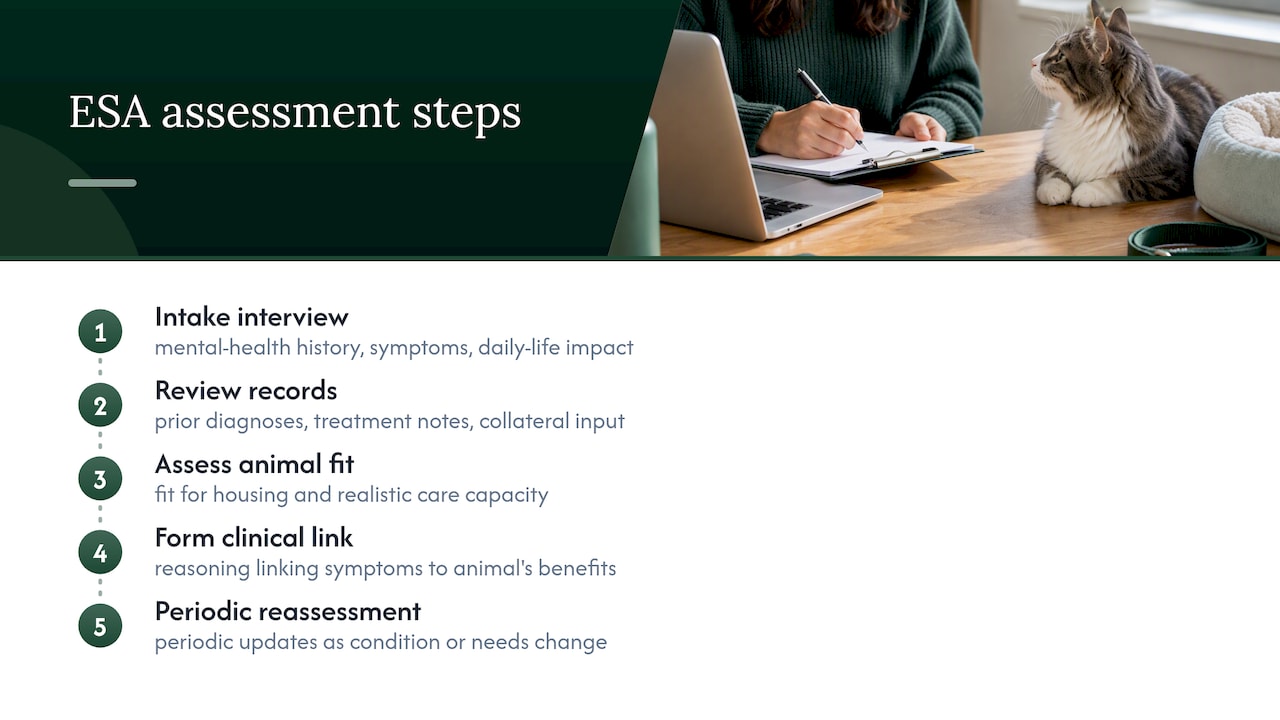
The process usually starts with an intake interview covering your mental health history, current symptoms, and how those symptoms interfere with daily life. A clinician who already treats you may move through this quickly; a new clinician will spend more time establishing the full clinical picture.
Next comes a review of any available records or collateral information, prior diagnoses, treatment notes, or input from another provider if you have been in care elsewhere. This step helps the clinician avoid relying only on self-report, something the APA’s resource document flags as a weakness in low-quality evaluations.
The clinician then considers the animal itself: is it a reasonable fit for your living situation, and can you realistically care for it? This is not a formal pet interview, but it matters, since the letter is asserting that the animal provides support rather than creating new burdens.
Finally, the clinician forms a judgment connecting your specific symptoms to the animal’s effect, for example, reduced panic frequency, better sleep, or lower social withdrawal. A clinically sound evaluation documents current symptoms and impairment, treatment history, the reasoning linking the animal to symptom relief, your capacity to care for the animal, and whether reassessment will be needed later. Letters are typically updated periodically rather than issued once and forgotten, since your condition and needs can change over time.
What a valid ESA letter should include
Once you have a letter in hand, check it against the elements housing providers and HUD’s assistance animal notice expect to see. A letter missing these pieces is more likely to draw scrutiny or a follow-up request.
- The clinician’s name, license type and number, and contact information, so the housing provider can verify the credential if needed.
- A statement, in functional language, that you have a disability and that the animal provides support that alleviates one or more symptoms of it.
- Language connecting the animal’s support specifically to your ability to use and enjoy your housing, not just a general claim that pets are comforting.
- A date, the clinician’s signature, and ideally a note on when the letter should be reviewed or renewed.
Our guide on what clinicians and landlords expect walks through these elements in more detail if you want a side-by-side comparison before your appointment.
Your housing rights and what landlords may lawfully request
Under the Fair Housing Act, assistance animals, including ESAs, are not treated as pets. HUD guidance states that housing providers generally cannot charge pet fees or deposits for an assistance animal used as a reasonable accommodation, and they must conduct an individualized assessment of each request rather than apply a blanket no-pets policy.
When your disability or need for the animal is not obvious, a housing provider may ask for reliable documentation from a licensed professional confirming the disability-related need. What they cannot do is demand your diagnosis, medical records, or details beyond what establishes that need. HUD’s 2020 notice encourages providers to engage in a good-faith dialogue before denying a request, especially when documentation seems incomplete rather than clearly insufficient.
If your request is denied, ask for the denial in writing and the specific reason behind it. From there, you can respond with additional documentation or request a conversation to resolve the gap. If the denial still seems unjustified, filing a complaint with HUD is a formal next step worth knowing about.
Red flags that signal a weak or scam ESA letter
Online services promising an instant letter after a two-minute quiz, with no licensed clinician named anywhere on the site, are the clearest warning sign. A legitimate assessment always involves a real clinical interview, not a checkbox form. HUD has specifically cautioned that commercial registries, ID cards, and certificates are not reliable documentation and are not required under federal law, so paying for one adds cost without adding legal weight.
- No licensed clinician is named, or the “clinician” cannot be verified through a state licensing board.
- The letter is issued within minutes, with no interview about your symptoms or history.
- The site sells a registry listing, vest, or ID card as if it were legally required.
Pro Tip: Before paying for anything, search the clinician’s name and license number on your state’s licensing board website. A real credential should show up instantly.
For more on why training certificates and registries aren’t required by federal law, see our checklist on ESA training requirements.
Telehealth evaluations and rules that vary by state
Telehealth ESA evaluations are common and often valid, but state rules are not uniform. Some states require an established patient-provider relationship or an in-person visit before a clinician can issue an ESA letter, so a video call with a stranger isn’t automatically sufficient everywhere. A proper telehealth assessment still needs a substantive interview, a review of your history, and real clinical judgment, not a shortened version designed just to produce paperwork.
If a clinician declines to write you a letter, it’s often because they can’t make an objective assessment, perhaps the relationship is too new or the symptoms don’t clearly meet the threshold. Ask what would change that, or seek an evaluation from another licensed provider.
How to prepare for your clinician visit
Walking in prepared shortens the process and strengthens the letter’s credibility.
- Write a short, specific description of how the animal helps you, such as reduced nighttime anxiety or fewer panic episodes.
- Bring any prior treatment notes, a current medication list, and previous ESA letters if you have them.
- Ask your clinician directly: What is your license type and state? How will you document the connection between my symptoms and the animal? How long is the letter valid, and what does renewal involve?
Turnaround time and cost vary by clinician and whether you are an existing patient, so ask about both up front rather than assuming a flat rate. Our sample landlord notice and letter templates can help you organize what to bring.
What to do if your ESA assessment is denied or delayed
A clinician may decline to write a letter if they feel they lack enough information to make an objective judgment, if your state requires an established relationship they don’t have with you, or if your symptoms don’t clearly meet the disability threshold. This is not necessarily a final no. Ask specifically what is missing: more history, a longer observation period, or a referral to a specialist who treats your condition more directly.
If the delay is about scheduling rather than clinical judgment, many practices offer expedited intake for mental health concerns, so it’s worth asking. If a clinician declines outright, seeking a second opinion from another licensed provider is standard practice and not something to hide from a future clinician or landlord.
Delays can also happen on the housing side: a landlord may sit on your accommodation request without a clear answer. In that situation, follow up in writing, note the date of your original request, and reference the Fair Housing Act’s expectation of a timely, individualized response. If weeks pass with no answer and no dialogue, that silence itself can support a complaint to HUD. Keep copies of every message, every version of your letter, and every date, since a documented timeline matters if the situation needs to go further than a conversation with your landlord.
How ESA assessments differ from other disability accommodation evaluations
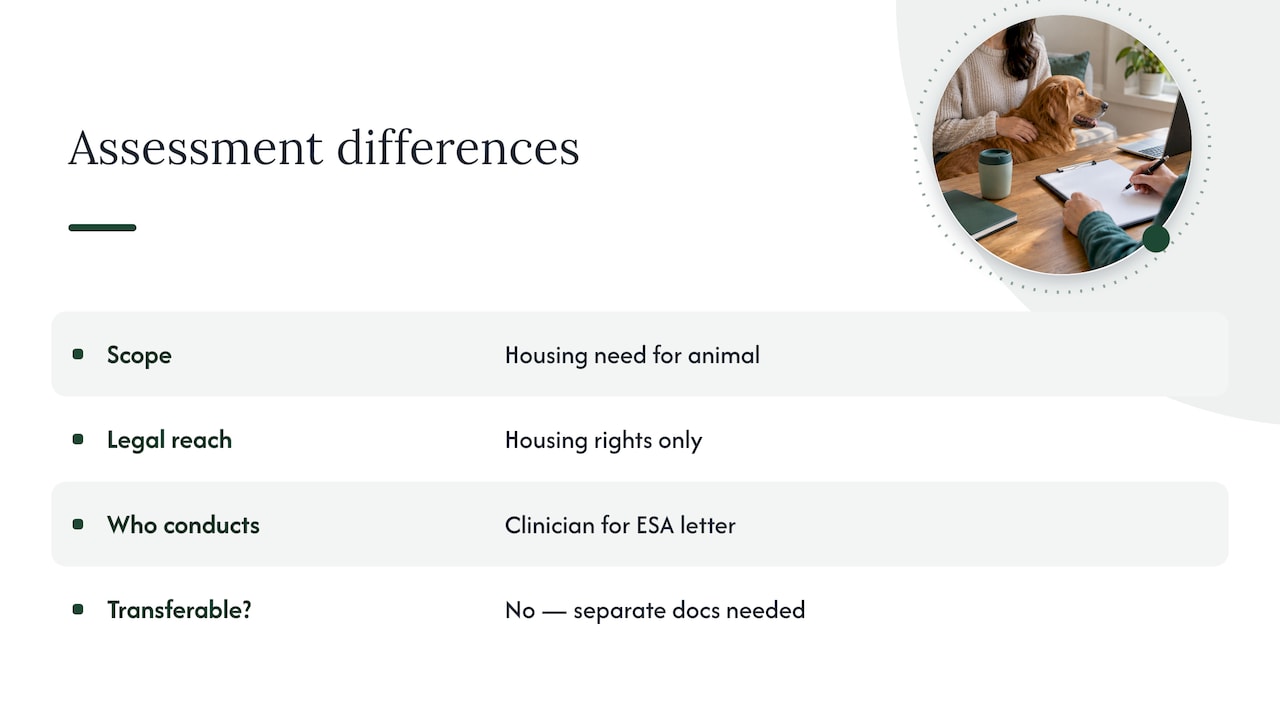
An ESA assessment is narrower than most other disability accommodation evaluations in both scope and legal reach. It focuses on one question: does a disability-related need exist for the therapeutic presence of an animal, specifically for housing. It does not evaluate your ability to perform a job, does not assess physical workplace modifications, and does not confer public access rights the way a trained service animal’s task-based role does under the ADA. The ADA explicitly separates emotional support, therapy, and comfort animals from service animals, since service animals must be trained to perform specific tasks tied to a disability.
Workplace accommodation assessments, by contrast, often involve an employer, sometimes an occupational health provider, and a focus on job function rather than housing. Educational accommodation evaluations for students typically run through a school’s disability services office and follow different documentation standards entirely. An ESA letter does not transfer automatically into any of these other contexts. If you need a workplace or school accommodation involving an animal, that generally requires its own separate request and its own documentation, even if the same underlying mental health condition applies. Our overview of what ESA letters do and don’t cover breaks down the line between housing rights and public access rights in more detail.
Why we push back against shortcuts in ESA assessments
A letter that skips the clinical work isn’t a shortcut, it’s a liability waiting to surface when a landlord or court looks closely. We’d rather you wait a week for a real evaluation than pay for an instant one that falls apart under scrutiny. Jurisdictions vary, and a thoughtful clinician may decline when the evidence doesn’t support a letter. That’s not a failure, it’s the process working as intended.
— Erik
Get our full ESA rights guide and letter templates
We put together Emotional Support Animals & ESA Letters: Your Rights Guide with the clinician checklist, sample landlord notice, and letter templates described above, organized so you walk into your assessment and your landlord conversation prepared instead of guessing.
Browse the full housing rights section or jump straight to sample ESA letters and the clinician checklist to get started today.
This article is general information, not a substitute for advice from a qualified doctor. Consult a qualified healthcare professional about your own circumstances before acting on anything here.
FAQ
What disqualifies someone from getting an ESA letter?
A clinician typically won’t issue a letter if your evaluation doesn’t show a disability-related need for the animal’s support, or if they can’t make an objective clinical judgment about your case. This isn’t a fixed disqualification list; it depends on the individual evaluation and, in some states, on whether an established patient relationship exists.
Can a landlord deny my ESA request?
A landlord can deny a request if your documentation doesn’t establish a disability-related need, or in narrow cases involving objective evidence of a direct threat or likely property damage, under HUD guidance. Otherwise, the Fair Housing Act requires an individualized assessment rather than a blanket refusal.
Is a telehealth ESA evaluation legitimate?
Yes, telehealth evaluations are widely used and can produce a valid letter, but some states require an in-person visit or an established provider relationship first. The evaluation itself still needs a real clinical interview and judgment, not just a quick form.
Can my landlord charge a pet fee for my ESA?
Generally no. HUD guidance states that assistance animals are not pets under the Fair Housing Act, so housing providers generally cannot charge pet fees or deposits for them as a condition of a reasonable accommodation.
Do I need a diagnosis listed on my ESA letter?
No. Your letter needs to state, in functional terms, that you have a disability and that the animal provides support alleviating specific symptoms, but housing providers generally cannot demand your specific diagnosis or medical records.
Sources
- HUD — Assistance animals and service animals
- HUD — Assessing a Person’s Request to Have an Animal as a Reasonable Accommodation Under the Fair Housing Act (Notice)
- American Psychiatric Association — Resource Document: Emotional support animals
- ADA — Service animals FAQ