
ESAs are not automatically allowed in the workplace. Employers handle these requests as accommodation matters under disability law, not as a blanket right to bring an animal to the office. Most requests get resolved through an interactive process, some documentation, and reasonable ground rules — unless doing so creates undue hardship or a genuine safety risk.
TL;DR:
- ESA requests in the workplace are evaluated as disability accommodations, requiring documentation and a demonstrated functional need, not just personal preference.
- Employers can deny ESA requests if they prove undue hardship or real safety risks, such as in sterile environments or safety-sensitive roles.
- Implementing clear ground rules, vaccination checks, containment protocols, and trial periods helps prevent conflicts and legal issues.
- Small employers or those in different jurisdictions may have different obligations, with UK law requiring case-by-case reasonable adjustments.
- Employees should specify their functional need, propose operational details early, and understand that ESA approval is not automatic or guaranteed.
Table of Contents
- Can You Bring an ESA to Work? Employer Obligations Explained
- How to Handle an ESA at Work Request Step by Step
- When Employers Can Legally Say No to an ESA at Work
- Setting Ground Rules: Control, Hygiene, and Trial Agreements
- ESA at Work Rules by Jurisdiction: U.S., California, and U.K.
- How to Ask for an ESA at Work as an Employee
- Employee Rights and Protections Regarding ESA Use at Work
- Coworker Concerns: Handling Allergies, Fear, and Friction
- Common ESA Types and What They Mean for the Office
- Publisher Perspective: Treat Every Request as a Retention Question
- Get Help Preparing an ESA Request or Response
- Sources
- FAQ
Can You Bring an ESA to Work? Employer Obligations Explained
Under Title I of the ADA, employers must provide reasonable accommodations to qualified employees with disabilities unless the accommodation causes undue hardship. An ESA request falls into this bucket. It is not a separate legal category with its own automatic access rights, and it is not treated the way a trained service dog is treated in a retail store.
In the UK, the Equality Act 2010 requires reasonable adjustments for disabled workers, and what counts as “reasonable” gets judged case by case, weighing cost, practicality, and workplace disruption. Coverage generally applies to employers of nearly any size in the UK, while U.S. federal ADA employment provisions apply to employers with 15 or more employees, so smaller U.S. businesses may fall outside Title I’s specific mandate even though state laws can still apply.
- The request must connect to a disability or mental health condition, not personal preference.
- Employers evaluate feasibility against the actual job and workspace, not a generic policy.
- Denial requires a real, demonstrated hardship, not just discomfort with animals in the office.
Pro Tip: Under the ADA, employers with a certain minimum number of employees typically have coverage obligations; smaller employers may have different considerations.
How to Handle an ESA at Work Request Step by Step
Treat this like any other accommodation conversation, not a special case that needs its own rulebook.
- Open a private conversation quickly. Don’t let the request sit in an inbox. Ask what the employee needs functionally, not just what they’re asking for literally.
- Request documentation only if the need isn’t obvious. A clinician’s note describing the functional limitation is usually sufficient. Skip invasive medical history requests.
- Explore alternatives together. Maybe a flexible schedule or remote days solves the same problem without an animal in a shared space.
- Run a trial period. Set a defined length, written expectations, and a review date before making it permanent.
- Document everything. What was requested, what was offered, and why.
JAN’s practical guidance specifically recommends trial periods as a low-friction way to test whether an ESA works in a given space before committing long term.
Pro Tip: Put the trial period in writing, even for a two-week test. A verbal “let’s see how it goes” is the single biggest source of disputes later, because nobody remembers the original terms the same way.
When Employers Can Legally Say No to an ESA at Work
Undue hardship means significant difficulty or expense given the size and resources of the business — not mere inconvenience. Direct threat means a current, demonstrable risk to health or safety, not a hypothetical one.
Realistic denial scenarios include:
- A sterile or infection controlled environment, such as a lab or surgical unit.
- Safety sensitive roles where an animal could interfere with machinery or protective equipment.
- An owner who can’t reliably control the animal’s behavior, creating a documented disruption.
- A coworker with a documented, severe allergy where no reasonable separation is possible.
Before denying anything, an employer should explore alternatives, put the reasoning in writing, and confirm the decision reflects actual evidence rather than assumption. A denial built on “we’ve just never done this before” won’t hold up well if challenged.
Setting Ground Rules: Control, Hygiene, and Trial Agreements
Legal compliance is the floor. The real work happens in the operational details that keep an ESA arrangement from becoming a daily friction point.
Spell out expectations before day one:
- Vaccination records and basic veterinary clearance on file.
- Clear supervision and containment rules (crate, leash, designated area).
- A waste and cleanup protocol, especially in shared spaces.
- A confidentiality plan so the employee’s medical details stay private from coworkers.
For allergy or health concerns from other staff, mitigations like zoned seating, air purifiers, or temporary remote arrangements are frequently enough to resolve the conflict without an outright denial, and they carry far less legal risk than a blanket “no.”
Pro Tip: Build the trial agreement around specific, observable failure criteria (barking during calls, escape from a designated zone) instead of vague language like “if it becomes a problem.” Vague criteria turn every disagreement into a debate.
ESA at Work Rules by Jurisdiction: U.S., California, and U.K.
The legal mechanics shift depending on where the business operates, and treating every location the same is a common mistake.
- U.S. federal (EEOC/ADA): Requests are handled as accommodations. Employers can ask for documentation when the disability or need isn’t obvious, but broad medical file requests go too far.
- California: State agencies including the California Department of Fair Employment and Housing publish guidance that can extend beyond federal minimums, so California employers should check state resources before assuming federal ADA rules are the full picture.
- United Kingdom: The Equality Act’s reasonable adjustments duty drives outcomes, and Employment Tribunal decisions show that having anxiety or a similar condition doesn’t automatically entitle someone to a specific adjustment. Outcomes hinge on the specific facts, the specific workplace, and whether the adjustment was actually reasonable given the practices in place.
A U.K. tribunal case involving a claimant named Ms. Cullingford illustrates this well. The tribunal examined the workplace’s actual practices and whether a barrier truly existed, rather than treating a diagnosis as automatic proof that any requested change was owed.
How to Ask for an ESA at Work as an Employee
Requests land better when they’re specific and easy for HR to act on, not vague or emotionally pitched.
- Describe the functional limitation plainly. What tasks or situations does the ESA help with, specifically?
- Bring a clinician’s recommendation when the connection between the condition and the animal isn’t self-evident.
- Propose the operational details yourself. Offer a trial period, containment plan, and vaccination records upfront rather than waiting to be asked.
- Know your options if denied. Internal HR appeal, mediation, or an external complaint through the EEOC or the relevant UK equivalent are all real paths, not last resorts.
A request that arrives with a plan attached moves faster than one that arrives as a bare ask.
Employee Rights and Protections Regarding ESA Use at Work
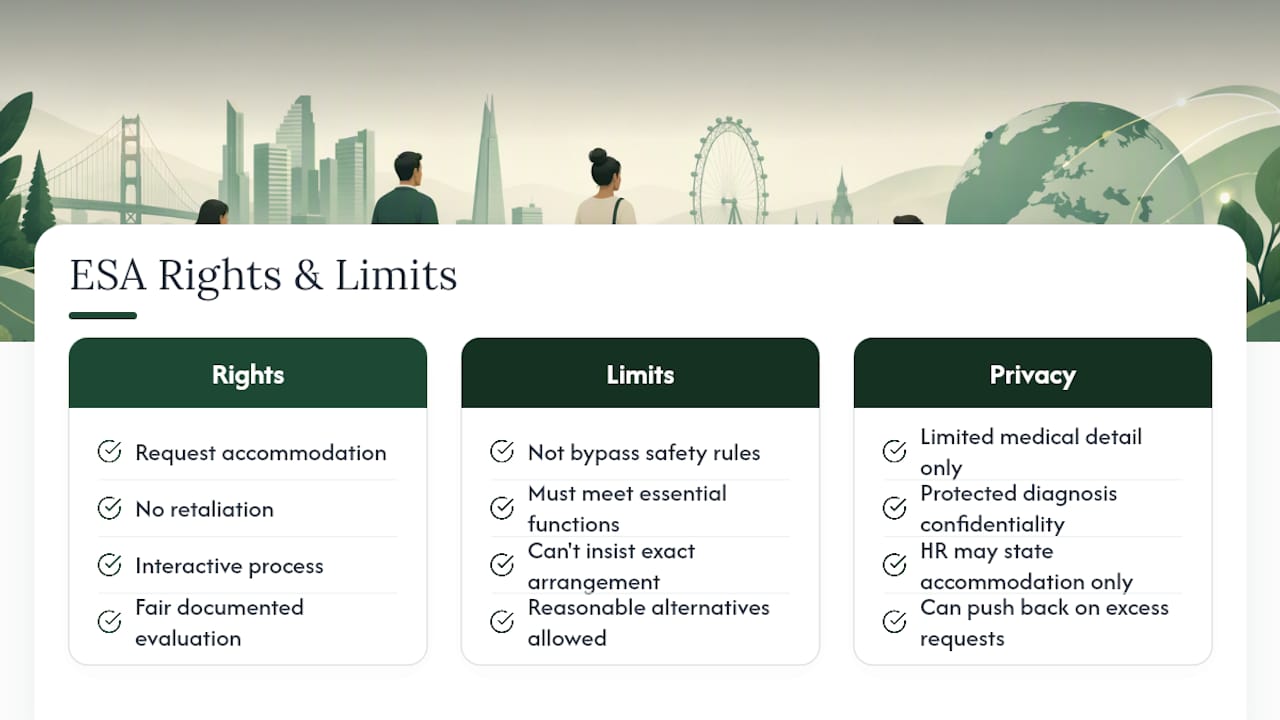
Employees have the right to request accommodation without retaliation, and to expect a genuine interactive process rather than an automatic dismissal. That right doesn’t guarantee approval. It guarantees a fair, documented evaluation of the request against the actual job and workplace.
Employees are also protected from being forced to disclose more medical detail than necessary. A clinician’s letter confirming the functional need is typically enough. An employer pushing for full mental health records, therapy notes, or diagnosis specifics beyond that is likely overreaching, and pushing back on that is a legitimate part of the process, not an obstruction of it.
What employees don’t get is a right to bypass safety rules, ignore essential job functions, or insist on the exact arrangement they originally proposed if a reasonable alternative solves the same problem. The ADA’s employment guidance makes clear that ESAs don’t carry the same automatic access rights as trained service animals under Title I, even though both can be legitimate accommodations depending on context.
Confidentiality matters here too. An employee’s diagnosis or the reasoning behind the request shouldn’t circulate to coworkers. HR can explain that an accommodation was granted without explaining why, and that distinction protects the employee from becoming office gossip.
Coworker Concerns: Handling Allergies, Fear, and Friction
An ESA in a shared workspace affects more than one person, and pretending otherwise sets up conflict down the road.
The most common friction points are allergies, fear of animals, cultural or religious discomfort, and simple distraction in open floor plans. None of these automatically override an approved accommodation, but they’re not irrelevant either. A coworker with a documented severe allergy has their own potential accommodation need, and the employer has to balance both.
Practical fixes solve most of this without a standoff. Physical separation, scheduling adjustments, temporary remote work for the affected coworker, or dedicated animal-free zones in shared spaces address the majority of complaints. When conflict does surface, the right response is a private conversation with each party, not a group email or a policy announced without context.
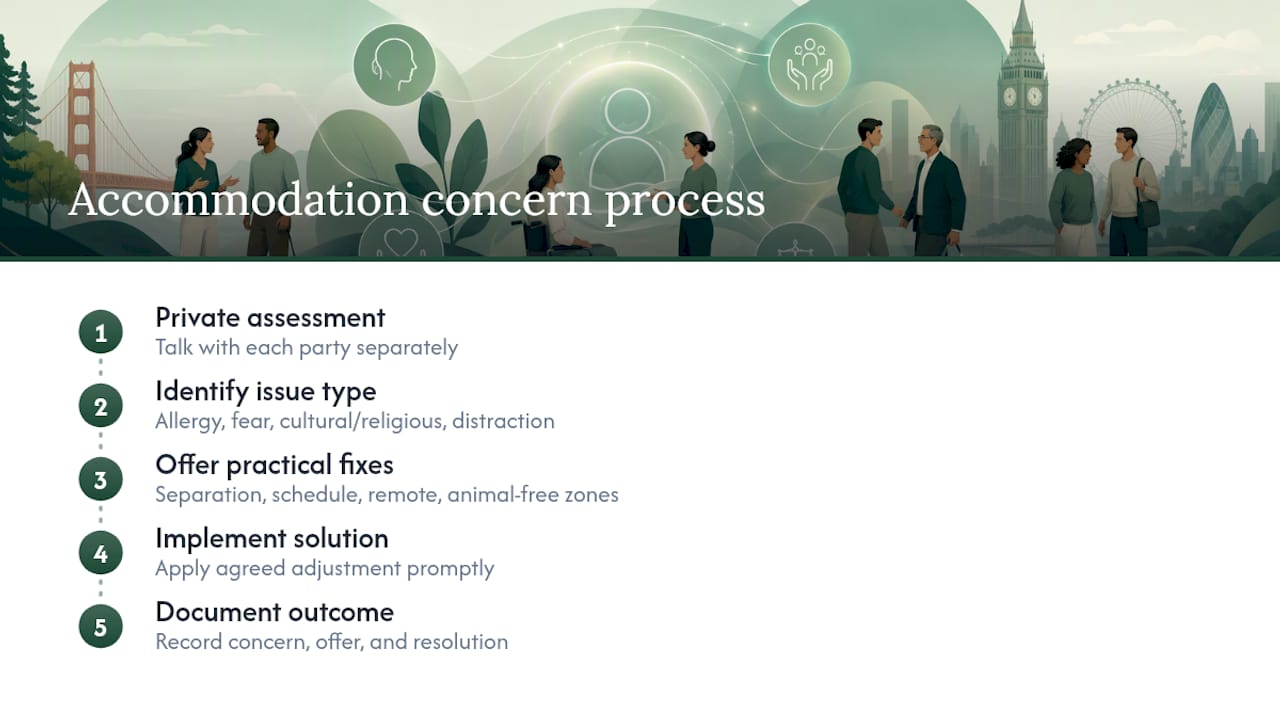
Documentation matters on this side too. If a coworker raises a concern, note it, note what was offered as a solution, and note whether it resolved things. This protects the business if a dispute escalates later, and it gives both employees a paper trail showing the issue was taken seriously rather than ignored.
The goal isn’t zero friction. It’s a process where disagreements get addressed quickly, privately, and with a documented outcome, instead of festering until someone escalates to HR or outside counsel.
Common ESA Types and What They Mean for the Office
Dogs are the most common ESA in workplace requests, and they carry the most straightforward considerations: containment, house training, noise during calls, and allergy exposure. A well-behaved, house trained dog in a private office creates far fewer issues than the same dog in an open floor plan next to a client-facing desk.
Cats show up less often but bring their own set of concerns, mainly litter box logistics and allergy exposure, which tends to be more severe for cat allergies than dog allergies in sensitive coworkers.
Small caged animals, like rabbits or guinea pigs, are generally the easiest to accommodate because containment is built in and disruption potential is low. Birds are trickier. Noise carries, and open-plan offices amplify that fast.
Each type needs the same basic framework: containment plan, hygiene protocol, and a trial period, but the specific risks shift with the animal. A guinea pig in a covered cage under a desk is a very different conversation than a dog that needs regular walks and unsupervised time off leash.
Publisher Perspective: Treat Every Request as a Retention Question
The employers who handle this well aren’t the ones with the strictest policy. They’re the ones who treat each request as a chance to keep a good employee working, not a problem to manage defensively. A short trial period and clear documentation resolve more of these situations than any blanket rule ever will.
— Erik
Get Help Preparing an ESA Request or Response
Whether you’re an employee building a request or an HR team documenting the interactive process, having the paperwork right from the start makes everything faster. There are resources offering plain-language guidance on what a valid clinician recommendation requires, checklist templates for structuring a request, and explanations of how ESA documentation differs from service animal certification.
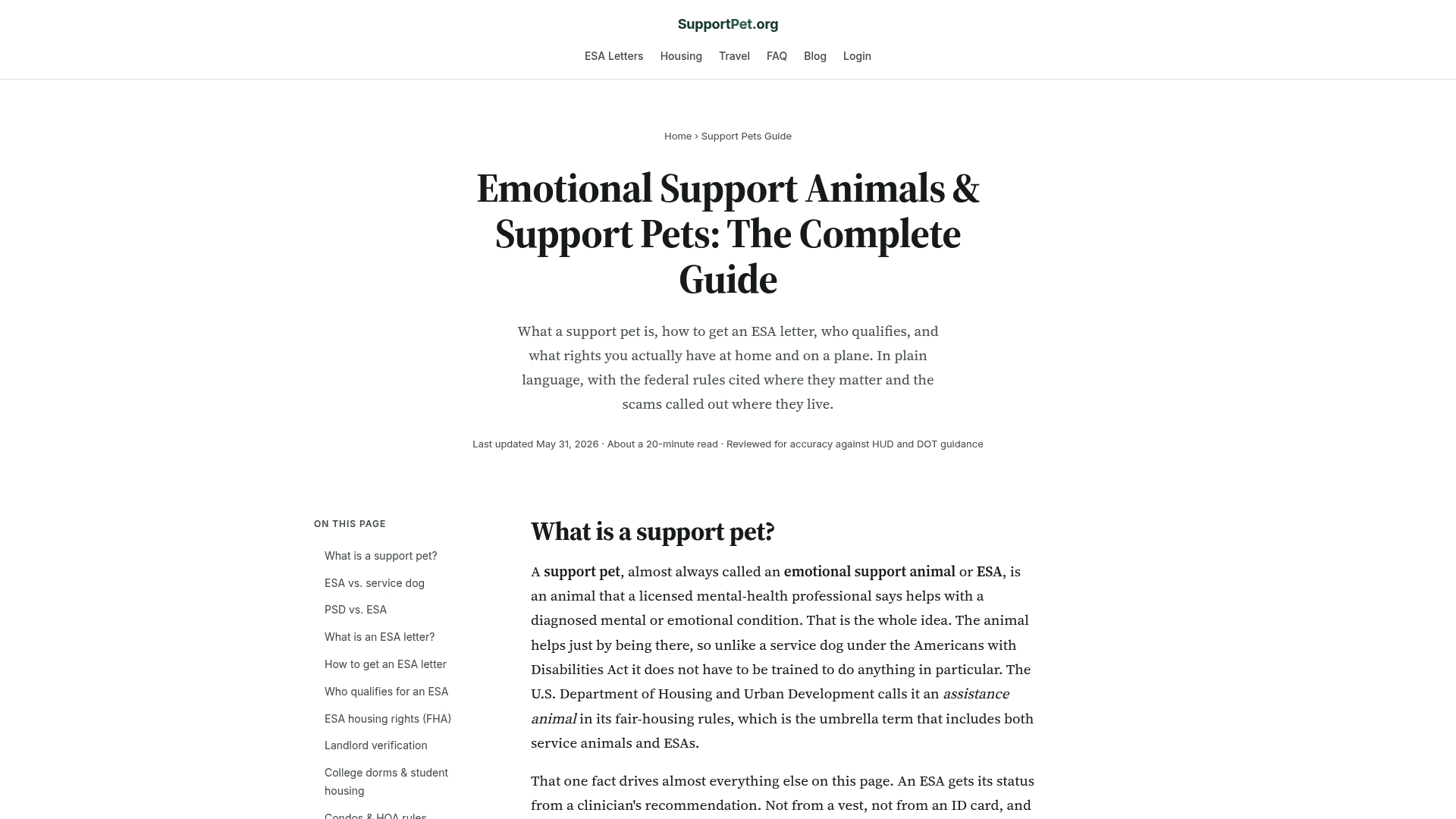
The ESA rights and letter guidance walks through how to get a legitimate clinician recommendation, without the scam certificate sites that flood search results promising instant registration. Employees get a clear path to a defensible request. HR teams get language they can point to when explaining why a documentation standard exists. Start with the ESA letter and rights guide to see what a valid request actually needs before the conversation with HR even starts.
This article is general information, not a substitute for advice from a qualified doctor. Consult a qualified healthcare professional about your own circumstances before acting on anything here.
Sources
- Enforcement Guidance on Reasonable Accommodation and Undue Hardship under the ADA | EEOC
- Emotional Support Animals in the Workplace: A Practical Approach | JAN
- Gov
- Service animals and emotional support animals (employment) | ADATA
FAQ
Is Anxiety a Disability for ESA Purposes?
Anxiety can qualify as a disability under the ADA and the UK Equality Act when it substantially limits a major life activity, which opens the door to requesting an accommodation. Qualification doesn’t guarantee that a specific ESA request gets approved. It just means the employer must go through the reasonable accommodation process rather than dismissing the request outright.
Are Emotional Support Animals Allowed at Work?
Not automatically. Employers evaluate ESA requests the same way they evaluate other accommodation requests, weighing the employee’s need against undue hardship or safety concerns. Many requests succeed through documentation, trial periods, and reasonable operational rules, but there’s no blanket right to bring an ESA into any workplace.
Is It Illegal to Deny a Service Animal?
Denying a trained service animal under Titles II and III of the ADA (public accommodations) generally requires a very high bar, like a direct threat or fundamental disruption. ESAs are different: in the employment context, they’re treated through accommodation rules rather than automatic entitlement, so a denial can be lawful if the employer shows genuine undue hardship or risk.
What Disabilities Qualify for a Service Dog?
Service dogs are trained to perform specific tasks tied to a disability, such as guiding someone with vision loss or alerting to a medical episode. That task-training requirement is what separates a service dog from an ESA, which provides comfort through presence rather than a trained task. In the workplace, both get evaluated as accommodations, but the legal standards and expectations around them differ.
How Should I Bring Up an ESA at Work Request With My Employer?
Start with a private conversation with HR or your manager, describing the functional need rather than just the request itself. Bring a clinician’s note if the connection isn’t obvious, and propose practical details like a trial period upfront. Supportpet’s request guidance and templates can help you structure that conversation before it happens.