
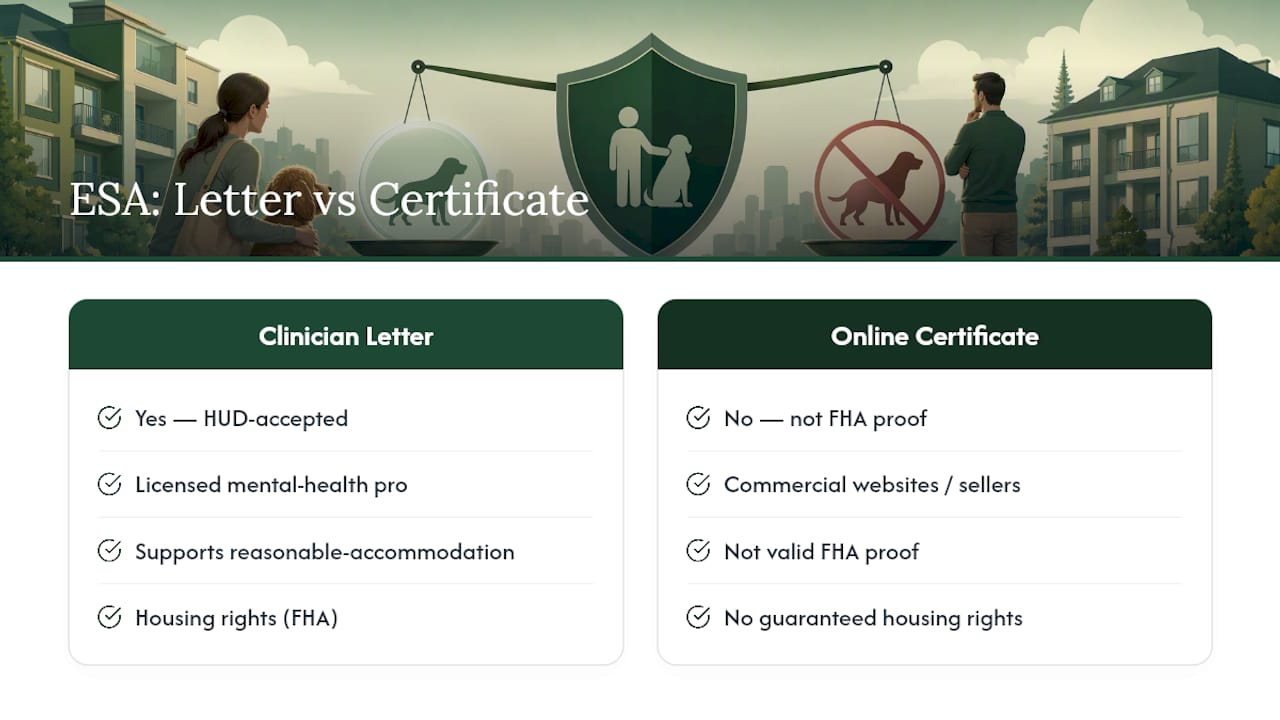
No, ESA certification is not legally required, and no certificate or registry membership carries weight under federal law. What matters is an ESA letter from a licensed mental health professional, which the Fair Housing Act recognizes for housing accommodations. Certificates and ID cards sold online are marketplace products, not legal instruments. The sections below cover what to hand a landlord, how to get a valid letter, and how to spot the scams selling the opposite idea.
TL;DR:
- A valid ESA letter must be issued by a licensed mental health professional with specific details, including license number, diagnosis, and a statement of necessity.
- No federal or state law requires certification, registration, or online certificates for emotional support animals; only a proper ESA letter from a licensed clinician is legally recognized.
- Certificates, registry listings, and ID cards sold online have no legal standing and are often used to create a false sense of legitimacy.
- Landlords can verify the legitimacy of your ESA letter, but they cannot request additional medical information or charge pet fees for a qualifying emotional support animal.
- Getting a genuine, current ESA letter through an actual clinical assessment is essential, and copies should be kept and renewed annually to support your housing rights.
Table of Contents
- What Does “ESA Certification” Actually Mean?
- Is ESA Certification Legally Required Under the FHA?
- What Documentation Do You Actually Need for Housing?
- How Do You Get a Valid ESA Letter?
- How Do You Spot an ESA Certification Scam?
- How Long Does an ESA Letter Last?
- How Supportpet Approaches This Topic
- Why Getting This Right Matters More Than People Realize
- Sources
What Does “ESA Certification” Actually Mean?
Search for “ESA certification” and you’ll land on sites selling laminated cards, digital certificates, and vest patches at various prices. None of it does what the marketing implies. Worth noting too: “ESA” is a crowded acronym. It also refers to Educational Staff Associate credentials in some state teacher-licensing systems and to Ecological Society of America memberships, so double-check that the search results you’re reading actually concern emotional support animals before you act on them.
Inside the pet world, the marketplace terminology breaks down into a few distinct products:
- Certificate: A printed document, often from a for-profit website, stating your animal is registered as an ESA. It has no legal authority.
- Registry listing: An entry in a private database that anyone can pay to join. No government agency checks or recognizes these lists.
- ID card: A wallet card resembling official identification. It signals nothing to a landlord beyond what the seller printed on it.
- ESA letter: A dated, signed statement from a licensed clinician explaining that you have a diagnosed condition and that the animal provides therapeutic benefit tied to that condition.
Registries sell certificates because there’s demand for something that feels official, and a laminated card feels more concrete than a conversation with a therapist. The problem is that a certificate is generic. It says nothing about your specific diagnosis, your specific clinician, or why this particular animal helps you. An ESA letter is individualized medical documentation, written by someone with a license number a housing provider can actually verify. That distinction is the entire ballgame when a landlord pushes back.
Is ESA Certification Legally Required Under the FHA?
No federal or state law requires certification or registration for an emotional support animal. The Fair Housing Act, enforced through HUD guidance, requires housing providers to grant reasonable accommodations to people with disabilities, and the accepted proof is a letter from a licensed mental health professional, not a certificate purchased online.
HUD’s own guidance on assistance animals states that a valid letter supports a request to be exempted from no-pet policies and related fees, provided the person has a qualifying disability and the animal provides disability-related assistance. Nothing in that guidance mentions certification or registration as a prerequisite.
New York City’s animal welfare office puts it plainly: there is no special registration or certification required for emotional support animals, though ordinary pet licensing rules still apply — meaning your dog still needs a standard city dog license even though it needs no ESA credential.
It’s worth separating ESAs from service animals here, because the two get conflated constantly. The ADA governs service animals trained to perform specific tasks for a person with a disability, and those protections extend to public places like restaurants and stores. ESAs provide comfort through their presence rather than trained tasks, so they fall under FHA housing protections, not ADA public-access rights. Airlines and transportation fall under yet another rulebook. The Department of Transportation treats emotional support animals differently from service animals in the air, and most carriers stopped accommodating ESAs as anything other than pets after 2020. Housing rights and travel rights are not the same conversation, and mixing them up is one of the most common mistakes renters make when researching their options.
What Documentation Do You Actually Need for Housing?
A landlord evaluating a reasonable accommodation request is looking for a specific set of elements in your letter, not a certificate number. A letter that’s missing any of these pieces is far more likely to get challenged or rejected outright.
- Clinician identity and license. The letter should be signed by a licensed mental health professional, with a license number and state of licensure clearly stated.
- Professional letterhead or verifiable contact information. A landlord should be able to confirm the clinician exists and practices where they claim to.
- A dated statement of necessity. The letter needs to say the animal is necessary because of a diagnosed mental or emotional condition.
- Individualized findings. Generic language (“many people benefit from pets”) is weaker than specific language tied to your diagnosis and how the animal mitigates symptoms.
Once you submit that letter, the landlord can verify it’s from a legitimate, licensed source, but federal guidance limits how far they can push. They generally cannot demand your full diagnosis, medical records, or details about your treatment beyond what’s necessary to confirm the accommodation is disability-related. They also cannot charge a pet deposit or pet rent for a qualifying ESA, since it’s not legally classified as a pet for these purposes.
Pro Tip: Keep a dated copy of every document you submit and a written record of when and how you sent it (email timestamp, certified mail receipt). If a dispute ever escalates, that paper trail matters more than you’d expect.
Practically, submit your letter early in the leasing process rather than after signing, since some disputes arise simply because a landlord didn’t know about the accommodation before move-in day.
How Do You Get a Valid ESA Letter?
Getting a defensible ESA letter is less about paperwork and more about having a real conversation with a licensed clinician who can vouch for your situation. Here’s the practical path.
- Confirm you have a qualifying condition. Conditions like anxiety, depression, and PTSD commonly qualify, but the key is being able to describe how the animal helps: fewer panic episodes, better sleep, reduced isolation. Concrete examples help a clinician write a stronger letter.
- Find a licensed mental health professional. This means a therapist, psychiatrist, psychologist, or licensed clinical social worker, not a website that issues letters after a five-minute online quiz. Mental Health America’s screening resource is a reasonable starting point for understanding what a real clinical evaluation involves.
- Go through an actual assessment. A legitimate clinician will ask about your symptoms, history, and how the animal fits into your daily coping strategies, whether that happens over one session or as part of ongoing care.
- Request the letter’s specific contents. Ask for the license number, letterhead, diagnosis-related language, and a clear statement of necessity, rather than assuming the clinician knows exactly what a landlord needs to see.
- Plan for renewal. Keep records of your visits and revisit the letter roughly once a year or whenever a landlord requests something more current.
A few things worth flagging before you start:
- Some states require an established client-provider relationship before a clinician can issue an ESA letter, which rules out one-off telehealth calls with someone you’ve never spoken to before.
- Instant-letter services that skip the clinical relationship entirely produce documents that are far easier for landlords to challenge.
- A letter that comes out of real, ongoing care holds up better than one generated the same day you paid for it, according to guidance from Mental Health America.
How Do You Spot an ESA Certification Scam?
The tell is almost always speed. If a website promises approval in minutes with no clinician contact, a phone call, or any real intake process, it’s selling paper, not documentation a landlord has to honor.
Other red flags show up just as often:
- Instant approval with zero clinical screening. A real letter requires an actual evaluation, however brief.
- Generic, boilerplate letters. If the language never changes regardless of who orders it, it’s not individualized medical documentation.
- Claims of “government registration” or “official recognition.” No federal ESA registry exists, so any site claiming otherwise is misrepresenting itself.
Pro Tip: If you already bought a certificate and feel like you wasted money, don’t panic. It has zero bearing on your actual rights. Book time with a licensed clinician, get a real letter, and keep a record showing when you first reached out, in case a landlord questions the timeline.
Certificates and ID cards aren’t legally binding, and their only real value is psychological: some people feel more confident carrying a card, even though it does nothing to strengthen a housing accommodation request.

How Long Does an ESA Letter Last?
There’s no statutory expiration date written into federal law for ESA letters. In practice, most clinicians and housing providers treat a letter as current for about a year, and many landlords will ask for an updated version at lease renewal or if your circumstances seem to have changed.
If your landlord requests fresh documentation, it’s usually not harassment. It’s a normal renewal cycle tied to lease terms. A reasonable rule of thumb: renew your letter if it’s older than 12 months, and stay in regular contact with the clinician who issued it so a renewal is a quick conversation rather than starting over from scratch. Letting the clinical relationship lapse for years and then asking for a signature is exactly the scenario that produces weak, easily challenged letters.
How Supportpet Approaches This Topic
Supportpet built its ESA guidance around the actual legal framework, not registry marketing. That means grounding every recommendation in HUD’s assistance-animal guidance, ADA distinctions between service animals and ESAs, and municipal resources like New York City’s animal welfare guidance, rather than repeating claims from certificate sellers who profit from confusion.
The goal is straightforward: explain what documentation genuinely protects a renter’s housing rights, flag the products that don’t, and be upfront about where clinical judgment belongs. Supportpet doesn’t issue letters or replace a licensed clinician’s evaluation. Every recommendation here points back to consulting a real mental health professional about your specific situation, since only that person can determine whether an ESA is clinically appropriate for you.
Why Getting This Right Matters More Than People Realize
Housing stability and mental health are tangled together in ways that don’t show up in most legal explainers. Losing a stable home, or fighting a landlord over an accommodation, is itself a stressor that can undo the exact benefit an emotional support animal is supposed to provide. That’s the part certificate sellers never mention: the paperwork isn’t the point. The relationship between you, your clinician, and your actual symptoms is what makes a letter defensible when it matters.
Clinician-issued letters reduce disputes because they’re harder to dismiss. A landlord can question a $70 online certificate. They have a much harder time questioning a licensed professional’s signed clinical judgment. That’s not a bureaucratic technicality. It’s the difference between a request that holds up and one that falls apart under scrutiny. For readers ready to take the next step, Supportpet’s guide to ESA letters and housing rights walks through the process in more detail, and resources like DWELR’s tenant guidance can help if a dispute with a landlord escalates further than a straightforward accommodation request.
— Erik
This article is general information, not a substitute for advice from a qualified doctor. Consult a qualified healthcare professional about your own circumstances before acting on anything here.