
To qualify for an emotional support animal under federal housing law, you need a disability that substantially limits a major life activity and a licensed clinician’s individualized assessment linking the animal to that disability. These two pieces, a qualifying impairment and documented clinical necessity, are what housing providers rely on. The clearest next step is scheduling time with a clinician who knows your history well enough to make that connection honestly.
TL;DR:
- Housing providers can request reliable, individualized documentation linking your disability to your need for an emotional support animal, especially when symptoms are not observable.
- A valid ESA letter must include the clinician’s verification, a clear connection between the animal and symptom relief, and come from a provider familiar with your condition.
- It is essential to establish ongoing, in-person or telehealth evaluations with licensed clinicians who know your history well, not just online questionnaires or template letters.
- Disorders like depression and anxiety often appear in ESA requests, but approval depends on demonstrating how the specific diagnosis limits your functioning and how the animal helps address that.
- HUD guidance emphasizes the importance of necessity and specific functional benefits over diagnoses alone, making detailed, personalized documentation crucial for a valid claim.
Table of Contents
- What “disability” means under the Fair Housing Act
- Anatomy of a valid ESA letter and what providers can request
- Who can write the letter and why the relationship matters
- How housing providers evaluate requests and where the limits are
- Common diagnoses behind ESA requests, and why none guarantee approval
- How to get a defensible ESA letter and avoid scams
- State rules and where HUD guidance is heading
- Why clear, lawful ESA guidance matters
- Get ready for your clinician visit with our resources
- FAQ
- Sources
What “disability” means under the Fair Housing Act
The Fair Housing Act defines disability as a physical or mental impairment that substantially limits one or more major life activities, which can include things like sleeping, concentrating, working, or caring for oneself. HUD’s enforcement guidance lists examples such as depression, PTSD, bipolar disorder, autism, and mobility, visual, or hearing impairments, but these examples are not exhaustive and never meant as a checklist of automatic approvals.
The “substantial limitation” piece is doing real work in that sentence. A diagnosis alone does not establish disability under the FHA; the impairment has to actually restrict something significant about daily functioning. This matters because housing providers are evaluating a legal standard, not just reading a letterhead.

There is also a meaningful split between observable and non-observable impairments. When a disability is visible or already known to the housing provider, further medical proof usually is not appropriate to request. When it is not observable, which describes most mental health conditions behind an ESA request, HUD guidance allows housing providers to ask for reasonably reliable documentation confirming the disability and the disability-related need for the animal. That asymmetry shapes almost everything about how ESA letters get written and evaluated.
Anatomy of a valid ESA letter and what providers can request
Housing providers cannot demand your full medical chart, but they are entitled to reasonably reliable documentation when your disability or your need for the animal is not obvious. HUD’s guidance frames this as an individualized assessment: a letter has to connect your specific impairment to how the animal specifically helps, not a generic statement that pets are calming.
A letter that holds up under scrutiny tends to include:
- The clinician’s name, license type, and license number so the relationship can be verified.
- Confirmation that you have a disability as defined by the FHA, without unnecessary diagnostic detail.
- A description of how the animal alleviates one or more identified effects of that disability.
- The date of the assessment and the clinician’s signature.
- Contact information the housing provider can use to confirm authenticity if needed.
Good letters protect privacy while still satisfying the provider. Clinicians can describe functional impact (difficulty sleeping, panic episodes, social withdrawal) without disclosing a full psychiatric history. Additional documentation becomes reasonable mainly when the disability itself is non-observable and the first letter leaves real doubt; it is not reasonable when the disability or the need is already clear.
Who can write the letter and why the relationship matters
HUD guidance and professional practice generally accept recommendations from physicians, psychiatrists, psychologists, nurse practitioners, and physician assistants, provided the clinician actually knows the patient. That last part is the standard that matters most: a bona fide provider-patient relationship, meaning the clinician has evaluated you closely enough to speak credibly about your condition and your need for the animal.
This is not a formality. State licensing boards expect clinicians to have adequate clinical knowledge before issuing a recommendation, and some states go further. Colorado’s counseling board, for example, has specific expectations around in-person contact or telehealth standards before a counselor can issue this kind of documentation, and practices vary by state and by clinician. A letter generated from a one-time questionnaire with no ongoing clinical relationship is the opposite of what this standard calls for. The clinician’s judgment, built on actual familiarity with your symptoms, is what makes the documentation defensible, not a template with blanks filled in.
How housing providers evaluate requests and where the limits are
Once a request lands on a housing provider’s desk, they are weighing it against a specific legal framework, not personal preference. Under HUD’s guidance, a provider can deny a reasonable accommodation only in limited circumstances: if it would impose an undue financial or administrative burden, fundamentally alter the nature of the housing operation, or if the specific animal poses a direct threat that cannot be reduced through reasonable steps.
Necessity is the operative word throughout. The accommodation has to be essential to giving you an equal opportunity to use and enjoy the housing, not simply preferred. This is why documentation that ties specific symptoms to a specific ameliorative benefit from the animal carries far more weight than a letter asserting generic comfort.
Providers sometimes propose alternatives, like pet deposits, behavior agreements, or updated vaccination records, when their concern is really about property damage or safety rather than the legitimacy of the disability. Those alternatives can resolve a dispute without undermining the accommodation itself. The practical takeaway is consistent: documentation that explains the link between your symptoms and the animal’s effect on them is what tends to settle these conversations.
Common diagnoses behind ESA requests, and why none guarantee approval
Major depressive disorder, generalized anxiety disorder, PTSD, panic disorder, and bipolar disorder appear frequently in ESA documentation, which tracks with how common these conditions are. NIMH data on mental illness prevalence helps explain why these particular diagnoses show up so often in housing accommodation requests.
None of them function as an automatic qualifier, though. What matters is the functional limitation the diagnosis creates for you specifically and whether the animal measurably helps with that limitation. A clinician documenting an anxiety disorder, for instance, needs to describe what the anxiety actually restricts (sleep, concentration, leaving the apartment) and how the animal’s presence addresses that, rather than just naming the diagnosis. The label opens the conversation; the function and necessity close it.
How to get a defensible ESA letter and avoid scams
Some websites sell instant certificates with no clinician contact at all, often promising universal acceptance. Treat those as a red flag immediately: HUD’s framework requires individualized clinical assessment, and no online registry or certificate carries legal weight on its own.
A more reliable path looks like this:
- Establish care with a licensed clinician you can see more than once.
- Ask directly for an individualized assessment rather than a form letter.
- Request that the letter document how your specific symptoms connect to the animal’s benefit.
- Keep the clinician’s contact information on file in case a housing provider needs to verify the letter.
Pro tip: Write a short summary of your symptoms and how the animal helps before your appointment, so your clinician can document necessity precisely without digging through unrelated medical history.
State rules and where HUD guidance is heading
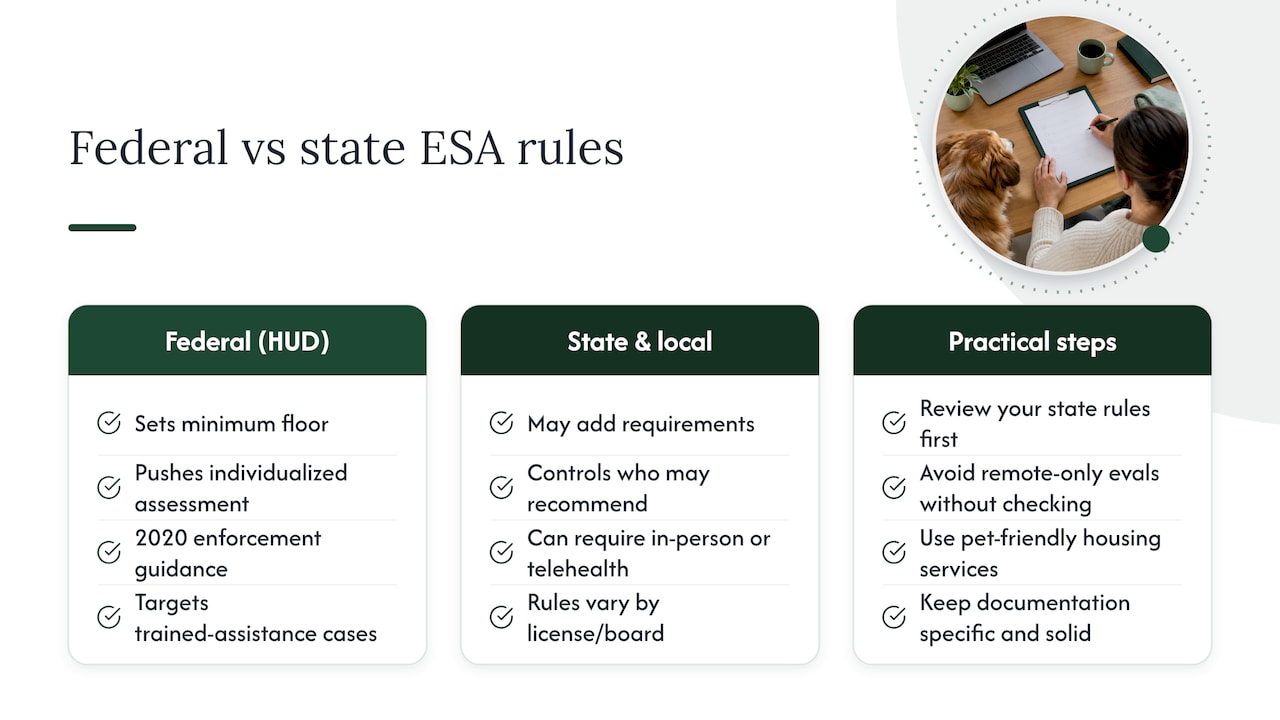
Federal law sets the floor, but states and even individual jurisdictions layer additional requirements on top of it, particularly around who can issue a recommendation and under what conditions. Colorado’s licensing rules for professional counselors are one concrete example: the state has specific language about in-person contact and telehealth that counselors must follow before writing ESA documentation, and clinicians elsewhere may face comparable or different rules depending on their license type and state board. Reviewing your state’s requirements for mental health providers before scheduling a remote-only evaluation is a reasonable precaution.
On the federal side, HUD’s 2020 enforcement guidance remains the operative framework housing providers use to evaluate requests, and it pushes hard toward individualized assessment rather than blanket acceptance or blanket denial. The guidance also signals that HUD may direct enforcement attention toward cases involving trained assistance animals when resources are limited, which indirectly raises the bar for ESA documentation to be solid and specific rather than generic. It is worth separating this from public-access rights entirely: the Department of Transportation excludes animals whose sole function is emotional support from the definition of a service animal, so the protections discussed here apply to housing under the FHA, not air travel or public spaces under the ADA.
If your housing situation involves finding a place that already accommodates pets, working with a pet-friendly roommate matching service can sometimes simplify the process before an accommodation request is even needed.
Why clear, lawful ESA guidance matters
Certificate mills thrive on confusion, selling documents that carry no legal standing while people who genuinely need an accommodation walk away with nothing defensible. Our aim is to replace that confusion with the actual legal standard, so readers walk into a clinician’s office prepared to get an assessment that holds up, not a template that does not.
— Erik
Get ready for your clinician visit with our resources
We built Supportpet around one goal: helping you walk into a clinician’s office prepared, not confused by certificate mills promising instant approval.
Our resources include:
- A printable checklist of what a valid ESA letter needs to contain.
- Examples of letter language that connects symptoms to function without oversharing medical history.
- Privacy guidance for talking to your clinician about what to include and what to leave out.
- Answers to common questions about housing requests and timelines.
Print the checklist, bring it to your appointment, and ask your clinician directly for the documentation items it lists. Visit Supportpet to get started.
This article is general information, not a substitute for advice from a qualified doctor. Consult a qualified healthcare professional about your own circumstances before acting on anything here.
FAQ
What qualifies as a disability for an ESA?
A qualifying disability under the Fair Housing Act is a physical or mental impairment that substantially limits one or more major life activities. HUD guidance lists examples like depression, PTSD, and mobility impairments, but the list is not exhaustive, and a licensed clinician still has to confirm the impairment and its connection to your need for the animal.
What diagnosis qualifies for an ESA?
No single diagnosis automatically qualifies you. Conditions like major depressive disorder, generalized anxiety disorder, PTSD, and panic disorder appear often in ESA requests, but a clinician needs to document how the specific diagnosis limits your functioning and how the animal helps with that limitation without assuming automatic eligibility.
How hard is it to get approved for an ESA?
Approval depends on having a genuine disability and an established relationship with a licensed clinician willing to document necessity individually. It is not hard if you already have an ongoing clinician relationship and a real functional need, but it is not something an instant online certificate can substitute for under HUD’s framework.
What are the 13 disabilities that qualify for an IEP?
That categorization comes from special education law (IDEA) for school services, not from the Fair Housing Act or ESA housing accommodations, so it does not apply to ESA eligibility. ESA qualification instead depends on the FHA’s broader disability definition and an individualized clinical assessment of your specific condition.
Sources
- Subject: Assessing a Person’s Request to Have an Animal as a Reasonable Accommodation Under the Fair Housing Act (HUD)
- Transportation
- Mental illness statistics (NIMH)