
An emotional support animal can be a real comfort when you live with borderline personality disorder (BPD), but it is an add-on to therapy, not a replacement for it. The research is early and small. Dogs show the most promise. And since May 2026, the housing protection that ESAs used to carry has become much weaker at the federal level. This guide covers what the evidence says, what to weigh before you commit to an animal, how a clinician evaluates the question, and where you stand legally today.
TL;DR
- Studies on animals and BPD are limited. Some suggest benefits for emotion regulation and therapy engagement, but none show an animal can replace treatment.
- Psychotherapy is the primary treatment for BPD. An ESA works best as support alongside it.
- An ESA is not a service animal. It needs no task training and has no guaranteed access to public places.
- On May 22, 2026, HUD changed how it handles ESA housing complaints. Check your state’s rules and your lease before you rely on an ESA letter.
- Only a licensed clinician who knows you can recommend an ESA. Registries and instant certificates are not a substitute.
Table of Contents
- What an ESA can and cannot do for BPD
- What the research says
- Before you rely on an animal: a readiness check
- ESA vs. psychiatric service dog
- How to talk to a clinician about an ESA
- Where the law stands on ESA housing now
- Perspective: why we tell people with BPD to go slowly
- Where our guides fit in
- What to do if you are in crisis
- A practical path forward
- FAQ
- Sources
What an ESA can and cannot do for BPD
BPD is marked by intense emotions, fear of abandonment and unstable relationships. The National Institute of Mental Health says psychotherapy is the primary treatment. That is the frame for everything below: an animal can make daily life steadier, and therapy does the core work.
What an animal can plausibly offer:
- Routine. Feeding, walking and cleaning up give the day a structure that does not depend on how you feel.
- Grounding. Touch, warmth and a pet’s steady presence can interrupt a spiral of rumination.
- A low-stakes relationship. An animal does not judge or leave over an argument, which can matter if relationships feel precarious.
- A reason to go outside. Dog walks create contact with other people on your own terms.
What it cannot do: treat the disorder, manage a crisis, or respond to self-harm urges. An ESA is untrained by definition. It is a companion that a clinician has judged to be part of your treatment plan.
What the research says
The honest summary is promising but thin.
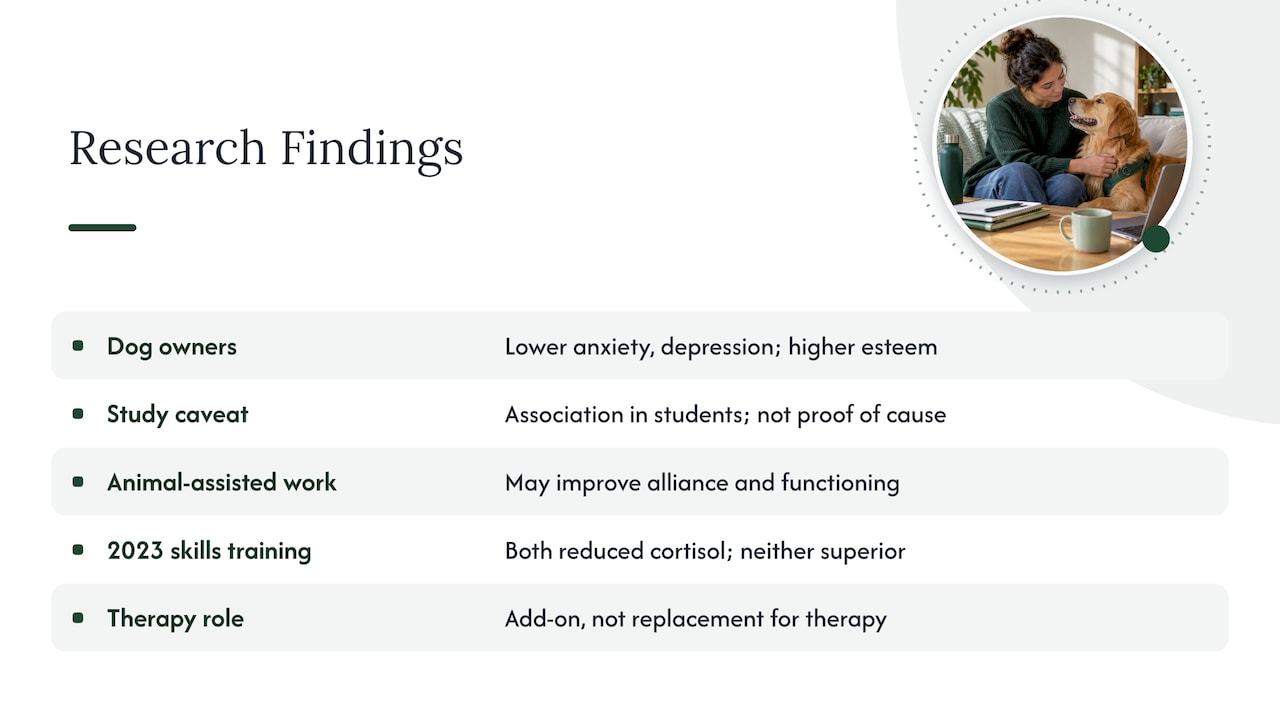
Dog owners did better in one 2026 study. A BMC Psychiatry study of 346 university students found that pet ownership overall did not line up with lower adverse mental health outcomes in BPD. Dog owners, though, reported significantly lower anxiety, depression and somatization, and higher self-esteem. The authors suggest that because BPD often grows from insecure attachment, a dog may act as a secure base, with consistent, non-judgmental affection helping emotion regulation. This was an association in students, not proof that a dog causes improvement.
Animal-assisted work may help therapy itself. A 2025 narrative review from the University of Porto medical school suggests animal-assisted interventions may help build the therapeutic alliance and improve functioning in BPD, while noting the literature is scarce.
Stress biology moved, but not more than with a human. A 2023 study of skills training in people with BPD found that both animal-assisted and human-guided training significantly reduced cortisol. Neither approach was superior. In other words, the skills training mattered; the animal was not a magic ingredient.
Experts call it an add-on. A 2020 review of equine-assisted psychotherapy describes animal-assisted psychotherapy for personality disorders as still in its infancy and recommends treating it as an addition to established evidence-based therapy, not a replacement.
Taken together: a dog or another well-matched pet may help some people with BPD feel steadier, especially alongside therapy. Nobody can promise it will work for you.
Before you rely on an animal: a readiness check
BPD can bring sudden mood shifts, impulsivity and hard stretches where basic tasks slip. That makes honest planning more important, not less. An animal that you cannot care for in a bad month is a stressor for you and a welfare problem for the animal.
The Mental Health America guidance on choosing a pet that meets your needs points to sensory triggers, existing responsibilities, long-term costs and plans for when you are away. It also names food, medicine and emergency veterinary bills as major considerations. Turn that into questions:
- Sensory fit. Does barking, shedding, litter smell or a cage’s noise bother you? A trigger you live with every day wears you down.
- Energy fit. A young high-energy dog needs hours of exercise whatever your mood. A cat, rabbit or older dog asks less.
- Money. Can you cover food, routine care and an emergency vet bill without panic? Cost stress and BPD do not mix well.
- Crisis plan. Who feeds the animal if you are hospitalized or in an intensive program? Name a person, write it down, and tell them.
- Time away. As a guide, RSPCA-backed guidance in England and Wales says no animal should be left unattended longer than is likely to cause suffering, and not beyond 24 hours. That is UK guidance, but it is a sensible yardstick anywhere.
- Emergency vet access. Know your nearest 24-hour clinic before you need it. In the UK, every veterinary practice must ensure 24-hour emergency care, though arrangements vary. In the US, check locally.
If the honest answer to several of these is no, that is useful information, not failure. Mental Health America notes that if pet care would be too much, a plant, a stuffed animal or another form of treatment may suit you better for now. Planning for hospital stays and appointments is also easier when you know how to speak up for yourself, and resources on advocating for yourself with clinicians can help you prepare.
ESA vs. psychiatric service dog
People with BPD often ask whether a service dog is the better route. The two are legally different. An emotional support animal is untrained and recognized under housing law to support a person with a disability. A psychiatric service animal is trained to perform specific tasks that mitigate a disability and has distinct rights under laws like the ADA. Service animals are generally allowed in public spaces. ESAs do not have the same guaranteed public access.
The practical gap is training. A service dog must do trained work, such as interrupting self-harm behavior or providing pressure during panic, and that takes substantial time and cost. Our ESA vs. service dog breakdown walks through the differences in detail.
How to talk to a clinician about an ESA
Start with the professional who already treats you, such as your therapist, psychologist, psychiatrist or licensed counselor. A clinician who knows your history can speak to your needs far more credibly than a stranger on a website.
Academic work on ESA assessments suggests the clinician should be familiar with the clinical criteria and the legal distinctions of disability support. A sound evaluation looks at the specific interaction, verifies the disability, and asks whether the animal’s presence reduces symptoms compared with when the animal is not there. The same paper outlines a four-part model: understanding ESA laws, assessing the individual, assessing the animal, and evaluating the beneficial interaction.
To prepare for that conversation:
- Describe which symptoms are hardest (abandonment fear, emptiness, anger, dissociation, sleep).
- Say what you notice with an animal present, with specific examples.
- Raise the practical limits from the readiness check above.
- Ask how an animal would fit with your current therapy, such as DBT skills work.
- Ask whether they write ESA letters, and what they would need to see.
Some clinicians do not write ESA letters. That is their right, and it is not a judgment of you. Our guide to getting an ESA letter the honest way explains what a legitimate process looks like, and the ESA letter sample shows what a real one contains.
Where the law stands on ESA housing now
This is the part that changed most recently, and it matters if you rent.
For decades, the Fair Housing Act was read to require housing providers to allow an animal that provides emotional support to ease a disability symptom as a reasonable accommodation. The ADA does not cover ESAs for public access.
On May 22, 2026, HUD issued a memo rescinding its earlier ESA guidance. According to the National Association of Realtors, HUD said it would no longer accept complaints from people whose emotional support animals are not individually trained. The disability-rights group DREDF points out that the Fair Housing Act itself has not changed: Congress did not act, and no court has ruled that ESAs are excluded. HUD simply decided to stop pursuing those complaints.
What that means in practice, in plain terms:
- Your landlord may now be more willing to refuse an ESA request, because the federal agency that enforced it has stepped back.
- Some state and local laws, and private legal action, may still protect you. Rules differ by state.
- Documentation still matters. A letter from a licensed clinician who treats you is your strongest record.
We track this on our pages about ESA housing rights in 2026, HUD’s May 22 guidance in four steps and the four state checks that help you verify your rights. If you do request an accommodation, our landlord notification template gives you a starting point. This is general information, not legal advice. For a specific dispute, contact a fair housing organization or a tenant attorney in your state.
On flights, the Air Carrier Access Act is the federal law covering air travel for people with disabilities, since the ADA does not govern commercial airlines. Check your airline’s current policy before you book.
Perspective: why we tell people with BPD to go slowly
We built Supportpet because people were being sold certificates, registries and ID cards that carry no legal weight. People with BPD are especially exposed to this. When you are in distress, an instant fix is tempting.
Our view is simple. An ESA is a legitimate part of some treatment plans. The value comes from a licensed clinician who knows you, not from paperwork. We would never tell you that an animal will treat BPD, because the research does not say so. It says a good match, especially a dog in some studies, may help with mood and attachment, and that it works best beside therapy.
We also think the legal picture deserves honesty. After HUD’s May 2026 memo, an ESA letter is no longer the near-guarantee in housing it was perceived to be. If you rent, read your lease, learn your state’s rules, and plan for the possibility that a landlord says no. Do not adopt an animal you cannot keep.
And if you are choosing between an animal and getting into therapy, choose therapy first. The animal can come later.
— Erik
Where our guides fit in
Supportpet is an independent, free educational resource. We do not sell letters, registrations or certificates. If you are working out whether an ESA is right for you, start with our rights guide for plain-language answers on letters, housing and scams. If a cat suits your energy and space better than a dog, see how a cat becomes an ESA.
What to do if you are in crisis
An animal is not a crisis plan. If you are thinking about harming yourself, call or text 988 in the US to reach the Suicide & Crisis Lifeline, or go to your nearest emergency room. If you have a therapist, ask them to help you write a written safety plan, and include who will look after your animal if you are hospitalized.
A practical path forward
- Stabilize treatment. If you are not in therapy, look for evidence-based options for BPD such as DBT. NIMH identifies psychotherapy as the primary treatment.
- Do the readiness check. Be honest about money, energy and sensory limits.
- Talk to your clinician. Bring specific observations about how animals affect your symptoms.
- Check your housing. Read your lease and your state’s rules before you commit.
- Get documentation only from a licensed professional. Skip registries.
- Start small if unsure. Foster, or spend time with a friend’s pet, before you adopt.
FAQ
Can you get an ESA for borderline personality disorder?
Yes, BPD can be a qualifying condition if a licensed clinician judges that an animal is a helpful part of your treatment. There is no automatic approval for any diagnosis. The clinician must assess you and your situation individually.
Is a dog better than a cat for BPD?
The 2026 study we cited found benefits specifically among dog owners, but it shows an association in students, not cause and effect. The best animal is the one whose care needs and temperament you can sustain, including in bad weeks. For some people that is a cat or a rabbit.
Can an ESA replace therapy for BPD?
No. Psychotherapy is the primary treatment for BPD, and researchers describe animal-assisted approaches as an add-on to established therapy. An animal can support your routine and mood, but it cannot treat the disorder or manage a crisis.
Does an ESA letter still protect me in housing after 2026?
It is less certain than before. HUD said on May 22, 2026 that it will stop pursuing complaints about untrained ESAs, but the Fair Housing Act itself was not amended. State laws and your lease also matter, so check both and consider speaking with a fair housing organization.
Can I take my ESA into stores or restaurants?
Generally no. ESAs lack the public access rights that trained service animals have under the ADA. Individual businesses may allow them, but they are not required to.
Sources
- NIMH: Borderline Personality Disorder
- BMC Psychiatry: Association between pet ownership and mental health
- University of Porto: animal-assisted therapy and service animals review
- PubMed: Effects of human and animal-assisted skills training
- PMC: Psychodynamic equine-assisted psychotherapy review
- Mental Health America: 10 tips for finding a pet
- Mental Health America: How do I get an emotional support animal?
- RSPCA: Care and welfare of pets in emergencies
- RCVS: Emergency and out-of-hours care
- JAAPL: Laws and Ethics Related to Emotional Support Animals
- PMC: Emotional Support Animal Assessments
- Service and emotional support animals handout (2025)
- National Association of Realtors: HUD Issues New Emotional Support Animal Guidance
- DREDF: HUD’s Policy Reversal on Emotional Support Animals
- When Doctors Don’t Listen: caregiver advocacy