
An emotional support animal (ESA) can be part of a treatment plan for panic attacks, but it is not a cure and it does not replace therapy. You qualify through a licensed clinician who decides whether an animal fits your treatment, not through a registry or an online certificate. In the U.S., a valid letter can protect you in housing under the Fair Housing Act. It no longer gives you special rights on airplanes.
This guide covers what the evidence says about animals and panic, how the qualification process works, what the letter does and does not do, and how to avoid the sites that sell worthless paperwork.
TL;DR
- Research on animals and anxiety is encouraging but mixed. Dogs have the most evidence, and an animal works best as a complement to professional care.
- No federal law requires ESA registration, certification or training. Online registries and ID cards carry no legal weight.
- A licensed mental health clinician or physician evaluates you and decides if an ESA suits your treatment. State rules may add requirements.
- The Fair Housing Act may require landlords to make exceptions to pet policies and waive pet fees. Airlines no longer treat ESAs as service animals.
- A psychiatric service dog trained to perform tasks is a different category with broader rights.
Table of Contents
- What panic attacks are, and why people turn to animals
- What the evidence says about animals and panic
- Can panic attacks qualify you for an ESA?
- How to get an ESA letter for panic attacks
- Scams to avoid
- Your housing rights
- Flying and public places
- ESA or psychiatric service dog?
- Which animal fits someone with panic attacks?
- Using an animal alongside other coping tools
- Our perspective
- Where to start
- FAQ
- Sources
What panic attacks are, and why people turn to animals
The National Institute of Mental Health describes panic attacks as sudden periods of intense fear. Symptoms can include a racing or pounding heart, shortness of breath, sweating or chills, dizziness, trembling, and a feeling of impending doom or loss of control. Many people also develop an intense worry about having another attack.
That last part matters for ESAs. Panic is often not only the attack itself but the anticipatory fear that shrinks your life: avoiding the train, the grocery store, the lecture hall, being alone at night. An animal that gives you a reason to get up, a routine, and a calm presence at home can chip away at some of that. It cannot interrupt an attack the way a trained task dog might, and it will not treat the underlying condition.
If you have attacks that keep recurring or that you cannot explain, start with a health care professional. Chest pain, a racing heart and breathlessness can have medical causes, so a proper evaluation comes before any decision about an animal. If you are ever in immediate danger or thinking about harming yourself, call or text 988, the Suicide & Crisis Lifeline, or 911.
What the evidence says about animals and panic
Honest answer: promising, not conclusive. Here is what the better studies show.
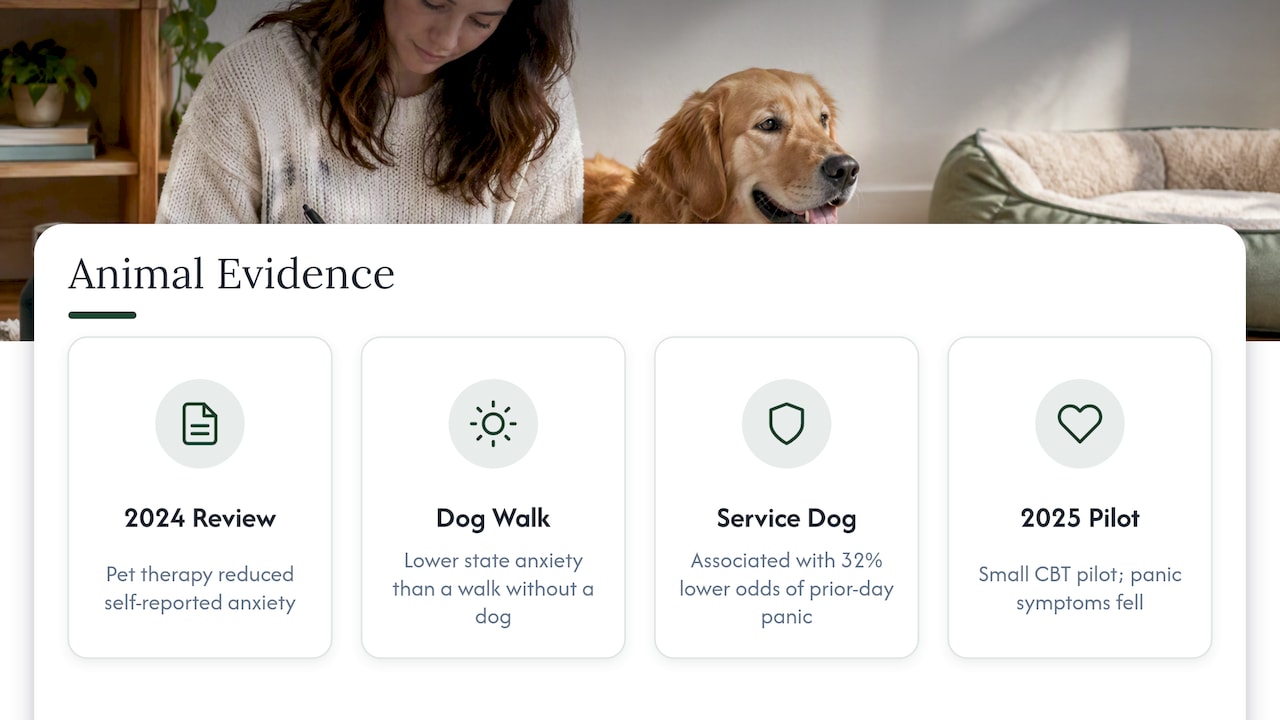
Pet therapy and anxiety in general. A 2024 review in American Family Physician reports that pet therapy notably reduces self-reported anxiety across several age groups, with most studies involving dogs.
Time with a dog. A study from Poland found significantly lower state anxiety after a dog walk than after a walk without a dog. Within the dog-walk group, fear and resting heart rate also decreased.
Panic specifically. A non-randomized clinical trial of military veterans with PTSD found that partnership with a psychiatric service dog was associated with 32% lower odds of having had a panic attack in the prior day. Note that these were trained service dogs, not untrained companion animals. A 2025 pilot study at Swinburne University of Technology in Australia suggested that adding a therapy dog to cognitive-behavioral therapy for panic disorder produced a significant reduction in panic symptoms. It is a small pilot, so treat it as a lead rather than proof.
The caveat. A systematic review calls animal-assisted therapy a promising complementary intervention for anxiety, but notes that variation in methods makes studies hard to compare and that more work is needed on fitting it into mental health care.
Put together: an animal is a reasonable addition for many people, especially next to therapy such as cognitive-behavioral therapy and, where appropriate, medication. It is not a stand-alone treatment, and no study promises it will stop your attacks.
What an ESA can realistically do for you
People who live with panic often describe the benefits in everyday terms:
- Routine. Feeding, walking and caring for an animal creates structure on days when anxiety would keep you in bed.
- Grounding. Petting an animal gives you something physical to focus on when your thoughts spiral.
- Less isolation. Walks and a companion at home reduce the loneliness that tends to feed anxiety.
- A reason to go out. Regular outdoor time works against avoidance.
These are plausible mechanisms consistent with the studies above, not guaranteed results. Some people find an animal adds stress, particularly if they struggle financially or physically to care for it. Be honest with yourself and your clinician about that.
Can panic attacks qualify you for an ESA?
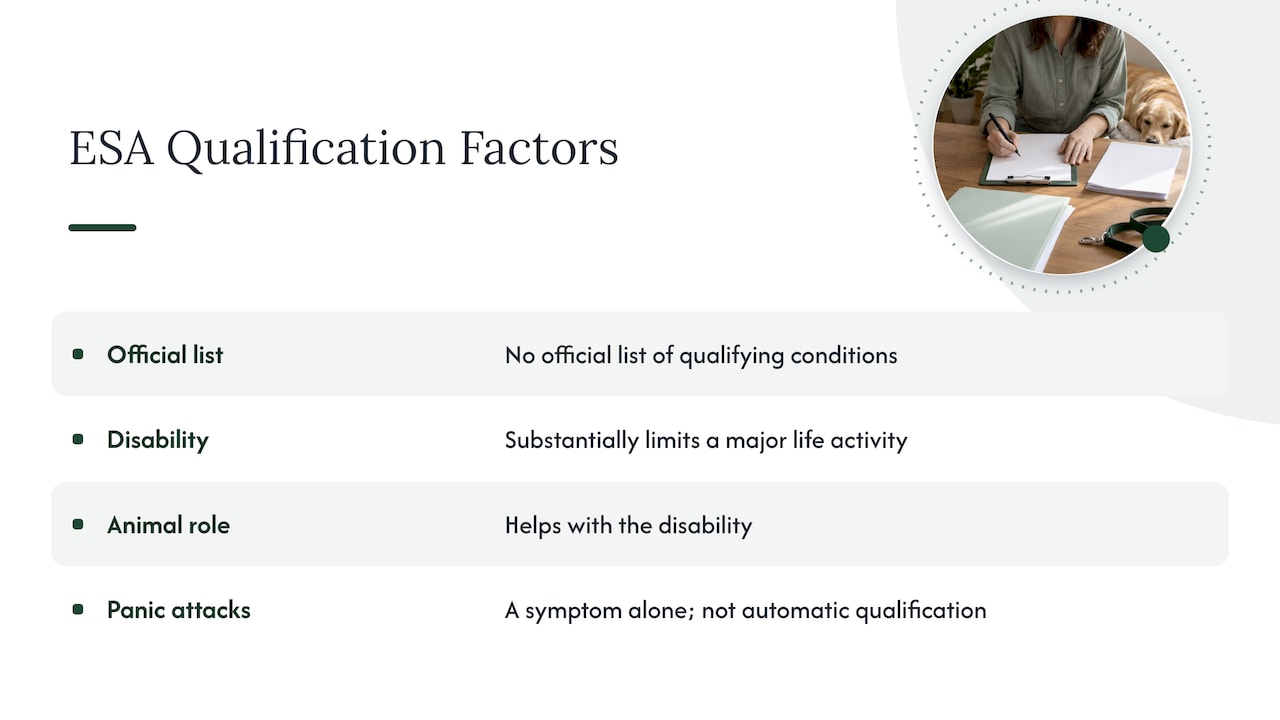
There is no official list of qualifying conditions. Under HUD’s Fair Housing Act guidance, assistance animals are animals that do work, perform tasks, assist, or provide therapeutic emotional support for people with disabilities. What counts is whether you have a disability, meaning a condition that substantially limits a major life activity, and whether the animal helps with it.
Panic attacks on their own are a symptom. A clinician will usually look at the whole picture: whether you have panic disorder, another anxiety disorder, PTSD or depression, how it limits your daily life, and whether an animal would support your treatment. A 2019 survey of psychiatric assistance dog owners in Australia found that anxiety, depression, PTSD and panic attacks were among the most frequently diagnosed conditions, which shows how common these diagnoses are among people who use animals for mental health support. It does not set a U.S. legal standard.
If you want a deeper look at anxiety in general, see our guide on ESAs for anxiety and how to get a valid letter.
How to get an ESA letter for panic attacks
The process is a clinical one. Per American Family Physician, you should consult your licensed mental health clinician or physician, who can perform an evaluation to decide whether an ESA is an appropriate part of your treatment plan. Documentation typically confirms that a disability exists and that the animal is therapeutically necessary for you, while following any state-specific laws.
Step by step
- Talk to a clinician you can work with. If you already see a therapist, psychiatrist or primary care doctor, start there. If you do not, find a licensed provider; a telehealth provider is fine where state law allows it, as long as they actually evaluate you.
- Describe how panic affects your life. Mention missed work or classes, avoided places, sleep problems, and what you have already tried. Be specific.
- Discuss whether an animal fits. Your clinician may ask whether you can care for the animal and whether the animal can behave appropriately in your home.
- Receive a letter if the clinician agrees. It should come from the clinician on their letterhead, with their license details.
- Check your state’s rules. Some states add conditions. Psychiatric Services notes that California’s 2022 rule requires a 30-day established relationship before a clinician can issue a letter, and Florida’s 2020 rule requires an in-person appointment. Our ESA letter laws by state page tracks who can write one and where.
Our honest steps to get an ESA letter walks through this in more detail, and the ESA letter sample shows what a legitimate letter looks like so you can spot a fake.
What a good letter contains
HUD’s guidance says supporting information should be general to the condition but specific to your disability and the therapeutic support the animal provides. In practice, that means the letter confirms you have a disability and a disability-related need for the animal. It does not need to list your diagnosis, symptoms or treatment history, and you should not feel obliged to hand over your medical records to a landlord.
Scams to avoid
This is where most people get burned. A registry, certificate, vest or ID card does nothing legally. Academic reviewers note there is no federal requirement for ESA registration, certification or specific training, and that online services selling these items are often associated with fraud.
Red flags:
- Instant approval. A “letter” in minutes after a checkbox quiz is not an evaluation.
- Selling registration or certification. There is no official database to join.
- No licensed clinician. If you never speak with a licensed professional, the document will be hard to defend.
- Guarantees. No legitimate clinician can promise approval before evaluating you.
- Upsells for vests, ID cards and “lifetime” listings. None are required.
We do not sell letters or registrations. Our job is to explain the rules so you can judge any provider yourself.
Your housing rights
Housing is where an ESA letter carries real weight. Under the Fair Housing Act, HUD’s guidance says housing providers may need to make exceptions to pet policies for assistance animals and may not charge pet fees for them. HUD also confirms that people with disabilities can request a reasonable accommodation for both service animals and other support animals.
This matters for students and renters who live with panic, since a no-pets lease or a dorm policy is often the first obstacle. Make your request in writing, attach your letter, and keep a copy. Our notify-your-landlord template gives you wording you can copy, and our ESA housing rights guide explains what landlords can and cannot ask.
The protection is not unlimited. A landlord can still respond to an animal that poses a direct threat or causes significant damage, and a request can be denied if the supporting information is inadequate. Check your state and local rules, which can add protections or requirements.
Flying and public places
Travel changed. The U.S. Department of Transportation’s 2020 final rule revised ACAA regulations so that emotional support animals are no longer classified as service animals. Airlines may treat them as ordinary pets, with the fees and carrier rules that come with that. The same rule requires airlines to treat psychiatric service animals the same as other service animals: dogs trained to perform tasks for people with mental health disabilities.
See our guide to flying with an emotional support animal for current airline practice. Stores and restaurants generally have no obligation to admit an ESA, because public access rules are built around trained service animals.
ESA or psychiatric service dog?
If your panic attacks are severe and you need an animal that does something specific, a psychiatric service dog may be the better fit. The difference is training: a service dog is individually trained to perform tasks related to your disability, such as alerting you to rising anxiety signs or interrupting behaviors. An ESA provides comfort by being there.
| Emotional support animal | Psychiatric service dog | |
|---|---|---|
| Training | No task training required | Trained to perform tasks |
| Species | Dogs, cats and other domesticated animals | Dogs |
| Housing protection | Yes, as an assistance animal | Yes |
| Airline treatment | Treated as a pet | Treated as a service animal |
| Public access | Generally none | Broader access |
The trade-off is time and cost: task training takes work, and not every dog is suited to it. Read our comparison of ESA vs. service dog before deciding.
Which animal fits someone with panic attacks?
Dogs have the most research behind them, as the reviews above show. But a dog is a daily commitment: walks, training, vet bills and a lease that allows one. Many people with panic do well with cats, which need less exercise and suit small apartments. Our guide on how a cat becomes an ESA covers that route.
Whatever you choose, think about the animal’s side too. American Family Physician notes that owners should consider the animal’s welfare and their ability to care for it, and that physicians may suggest working with a veterinarian to keep health and vaccination records current. A calm, adaptable temperament matters more than breed.
Using an animal alongside other coping tools
An animal is one tool among several. When an attack starts, you want something you can do immediately. Slow, controlled breathing is a common first step, and these breathing exercises for anxiety are easy to practice before you need them. Many people pair that with petting or holding their animal as a grounding anchor.
The NIMH advises that if symptoms do not go away, you should talk with a health care professional, since treatment and medication can help. Therapy is the foundation; the animal supports it.
Our perspective
We get a steady stream of messages from people who are scared, tired and confused. They have panic attacks, someone told them to “just get an ESA,” and the first ten search results tried to sell them a certificate. That is the wrong order of operations.
Our view is simple. An ESA is a legitimate accommodation for a real disability, and for many people with panic it makes daily life more manageable. But the value comes from the relationship with a clinician and with the animal, not from paperwork you can buy in five minutes. A letter from a licensed professional who actually knows your situation protects you in housing. A registry card protects no one.
We also think people deserve honest limits. An animal will not stop a panic attack mid-surge the way a trained service dog might, and some people will do better with a service dog, with therapy first, or with all three. Ask your clinician what makes sense for you, and be skeptical of anyone who promises certainty.
— Erik
Where to start
If you are ready to move forward, our free guide to getting an ESA letter explains the process, the state rules and the red flags, with no registrations or documents for sale.
Browse the full ESA rights guide for housing, travel and letter basics in one place.
FAQ
Can I get an ESA for panic attacks without a diagnosis?
A clinician has to evaluate you, and a recognized condition is typically what supports the need for the animal. Panic attacks are often part of panic disorder or another anxiety condition, so an evaluation is the way to find out. Letters sold without any evaluation are the kind scammers offer.
Does an ESA stop a panic attack?
Not reliably. Studies suggest animal contact can lower anxiety, and trained psychiatric service dogs were linked to lower odds of panic attacks in one veteran trial. An untrained ESA provides comfort and routine rather than interrupting an attack, so it works best alongside therapy.
Do I need to register my ESA?
No. There is no federal registry, and certificates or ID cards carry no legal weight. What matters in housing is a letter from a licensed clinician supporting your disability-related need.
Can I take my ESA on a plane?
Usually not as an ESA. Since the Department of Transportation’s 2020 rule, airlines can treat ESAs as pets. Only trained service dogs, including psychiatric service dogs, get service animal treatment.
Can my landlord charge a pet fee for my ESA?
Under HUD’s Fair Housing Act guidance, housing providers may not charge pet fees for assistance animals. You can still be responsible for actual damage the animal causes, and state or local rules may add details.
Sources
- Panic Disorder: The Symptoms (NIMH)
- Pet Therapy as a Treatment for Anxiety (American Family Physician, 2024)
- Can Dog-Assisted Intervention Decrease Anxiety Level
- Psychiatric Service Dog Placements and Panic Attacks in Veterans
- Incorporating animals in therapy (Medical Xpress, 2025)
- Animal-Assisted Therapy for Reducing Anxiety
- Psychiatric Assistance Dog Use survey (PubMed)
- Emotional Support Animals: Considerations for Documentation (American Family Physician, 2020)
- HUD guidance on assessing a request to have an animal (2020)
- Considerations for the Writing of Certification Letters (Psychiatric Services)
- “Vetting” Service Dogs and Emotional Support Animals
- U.S. DOT final rule on traveling by air with service animals
- Breathing Exercises for Anxiety