
Yes, students with a qualifying mental health condition can pursue an emotional support animal for housing, and often for campus accommodations too. The first move is getting a written recommendation from a licensed mental health clinician, not buying a certificate online. Verify that clinician’s credentials, then submit documentation through your school’s disability services or housing office, using HUD’s Fair Housing Act guidance and FTC scam alerts as your checkpoints.
TL;DR:
- Valid ESA letters must come from a licensed mental health clinician who assesses your condition in person, not from online providers offering instant certificates.
- An ESA qualifies you for pet-free housing without pet fees, but it does not automatically grant access to campus spaces like classrooms or dining halls.
- Most universities require submitting the clinician’s letter through the disability services office before move-in, and an interactive process may follow for approval.
- Scam websites offering instant ESA certificates and registration services are common; avoid paying via gift cards, cryptocurrency, or wire transfers, and verify clinician credentials independently.
- Universities may build limited ESA access in some campus buildings or during high-stress periods, but policies differ sharply, so ask your disability office about specific rights.
Table of Contents
- What sets an ESA apart from a service animal
- Who qualifies and what a valid ESA letter must say
- Housing and campus accommodation rules students should know
- How to get a legitimate ESA letter, step by step
- How to spot and avoid ESA scams
- Living with an ESA in dorms and shared housing
- ESA access on campus beyond your dorm room
- How the accommodation request process usually works
- How we think about ESA guidance for students
- Where to go next for a consolidated checklist
- Sources
- FAQ
What sets an ESA apart from a service animal
An emotional support animal offers comfort and companionship to someone with a diagnosed mental health condition. A service animal is individually trained to perform specific tasks, like guiding someone with vision loss or interrupting a seizure. That distinction changes what rights each animal actually carries.
ESAs are addressed mainly through housing disability law, while service animals carry broader public access rights under the Americans with Disabilities Act. For a student, this matters in a very concrete way:
- An ESA can qualify you for pet-free housing without pet fees, once approved through the right channel.
- An ESA does not automatically grant access to classrooms, dining halls, or other public campus spaces the way a trained service animal does.
- Some universities extend limited ESA access to specific settings, but that is a campus policy choice, not a federal requirement.
Who qualifies and what a valid ESA letter must say
Qualifying starts with a real diagnosis. A licensed mental health clinician, such as a psychologist, psychiatrist, licensed clinical social worker, or licensed professional counselor, has to evaluate you and document a condition like anxiety, depression, or PTSD. The letter then needs to connect that condition to a specific functional need the animal addresses, not just state that a pet would be nice to have.
A legitimate letter includes:
- The clinician’s full name, license type, and license number.
- Verifiable clinic or practice contact information, including a phone number.
- The date the letter was written and the date of your evaluation.
- A clear statement linking your diagnosed condition to the functional need for an ESA.
- The clinician’s signature, on letterhead when possible.
Before you submit anything, confirm the clinician actually exists. Most states run a public licensing board lookup where you can search a name and license number in a few minutes. Call the clinic directly using a number you find independently, not one printed only on the letter itself. Any service that issues a letter in minutes with no evaluation, no phone call, and no license number attached is not producing something a housing office or campus disability office is likely to accept.
Pro Tip: Save a PDF and a printed copy of your letter the day you receive it. You will likely need it again for renewals, transfers, or a new lease.
Housing and campus accommodation rules students should know
The Fair Housing Act requires landlords, including student housing operators, to make reasonable accommodations for people with disabilities, and HUD enforces the FHAct in these cases. That protection generally overrides no-pet policies and pet deposits once a valid request is documented. Section 504 of the Rehabilitation Act can also apply on campuses that receive federal funding, which covers most colleges and universities, and campus disability services offices typically coordinate how that plays out for student housing.
The usual path looks like this:
- Contact your school’s disability services office or housing office before move-in when possible.
- Submit your clinician’s letter along with any accommodation request form the office requires.
- Expect an interactive process where the office may ask follow-up questions about your functional need.
- Agree to reasonable conditions, such as keeping the animal under control and covering any damage it causes.
Timelines vary by institution, so ask directly what to expect and request updates in writing if a decision stalls.
How to get a legitimate ESA letter, step by step
Start by pulling together your treatment history: past diagnoses, therapy notes, and current contact information for anyone treating you. If you do not already have an established clinician, that is your next call, not a website that promises same-day approval.
- Schedule an evaluation appointment with a licensed mental health clinician and be honest about your symptoms and daily challenges.
- Ask specifically for a written recommendation that ties your condition to a functional limitation the ESA would help address.
- Verify the clinician’s license through your state’s licensing board, keep copies of everything, and submit the letter to disability services or your housing office exactly as instructed.
Letters sometimes need updating, particularly for a new academic year or a new lease. If housing denies your request, ask for the specific reason in writing and request the interactive process required under the Fair Housing Act before assuming the door is closed.
Pro Tip: Ask your clinician early in the semester. Evaluation appointments and follow-up documentation can take longer than expected, especially at busy campus health centers.
How to spot and avoid ESA scams
Scam sites selling instant ESA certificates and animal registries are common, and they prey on students who assume paperwork alone confers legal status. No registry, certificate, or ID card is required by law, so anyone selling one as a legal necessity is misrepresenting the rules.
-
A “one-click” letter with no evaluation or license number is a scam indicator, not a shortcut.
-
Payment demands asking for unconventional payment methods such as gift cards, cryptocurrency, wire transfers, or payment apps are a major warning sign.
-
Registries or certificates that claim to carry legal weight on their own, without a clinician’s letter, do not reflect how housing law actually works.
Fraud prevention experts advise consumers to slow down and independently verify identities before paying anyone online, according to the FTC’s June 2026 consumer guidance, which flags gift card, crypto, and wire payment requests as red flags relevant to document sellers of all kinds. The FTC has separately warned that scammers manipulate or fabricate pet images to build trust, and recommends a reverse image search before trusting any unfamiliar seller. If something feels off, report it at ReportFraud.ftc.gov.
Living with an ESA in dorms and shared housing
Talk to your roommates before your ESA moves in, not after. A short written care plan, including feeding schedule, vet contact, and an emergency backup caregiver, prevents most conflicts before they start.
- Budget for food, litter or supplies, and at least one emergency vet visit, since campus health plans will not cover your animal.
- Check your housing contract for break-of-term rules: some dorms require animals to leave campus during extended closures.
- Address allergies and noise concerns directly with your housing office if a roommate raises them, rather than letting tension build.
Pro Tip: Keep your accommodation letter and a copy of your care plan in a shared folder with your roommate, so questions from staff or neighbors get answered fast.
If a dispute escalates, your school’s disability services office or a student ombudsperson is usually the right place to ask for mediation.
ESA access on campus beyond your dorm room
An ESA approved for housing does not automatically travel with you to class, the library, or the dining hall. Housing accommodations under the Fair Housing Act cover where you live, not the rest of campus, and most universities do not extend the same access to comfort animals that they extend to trained service animals under the ADA.
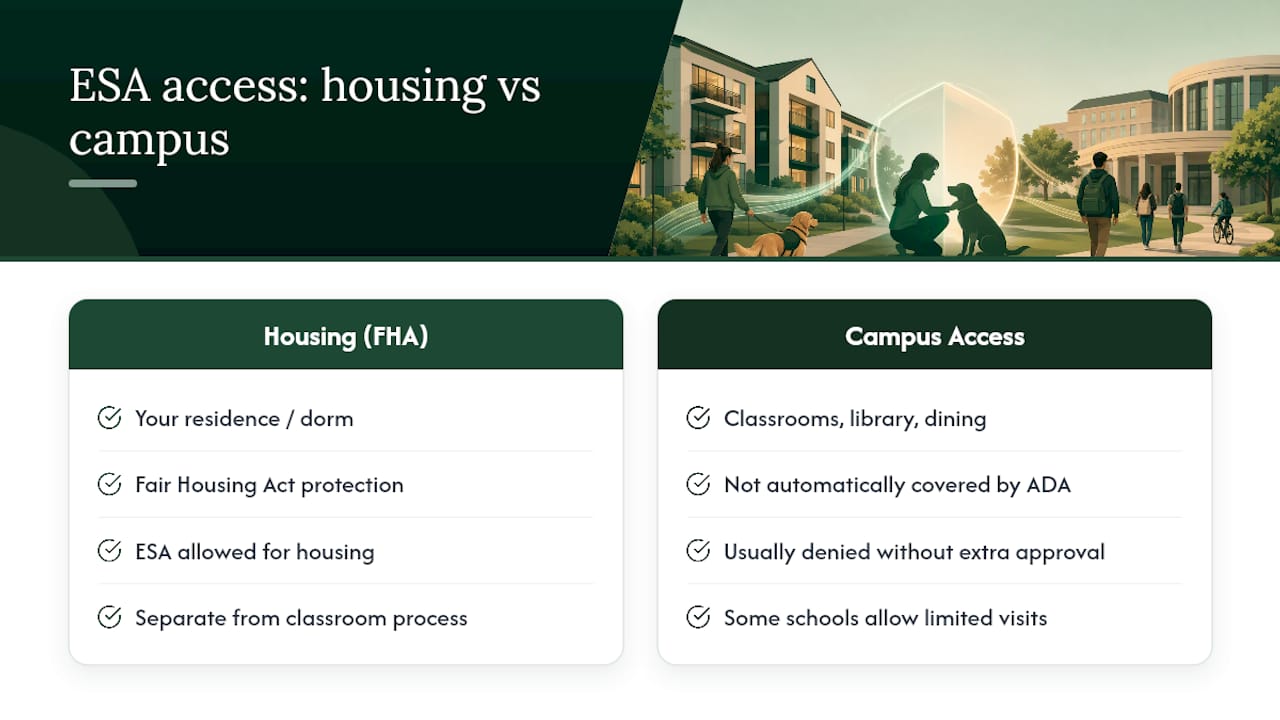
That said, some schools build in limited flexibility. A handful allow ESAs in specific low-traffic academic buildings with advance notice, and some counseling centers coordinate temporary campus visits for a support animal during high-stress periods like finals. None of this is guaranteed anywhere, and policies differ sharply from one institution to the next.
If classroom or facility access matters to you, ask your disability services office directly what their policy actually says, in writing, rather than assuming your housing approval covers it. Many students learn the hard way that an ESA letter accepted by housing gets a flat no from an academic department, simply because the two offices operate under different rules and different staff. Some schools separate the ESA housing process entirely from the broader disability accommodation process used for classroom needs like extended test time or note-taking support, so a student managing both a mental health condition and a learning difference may need to file two separate requests with two separate offices. Ask early which office handles which request, since the answer is rarely obvious from the school’s website alone.
How the accommodation request process usually works
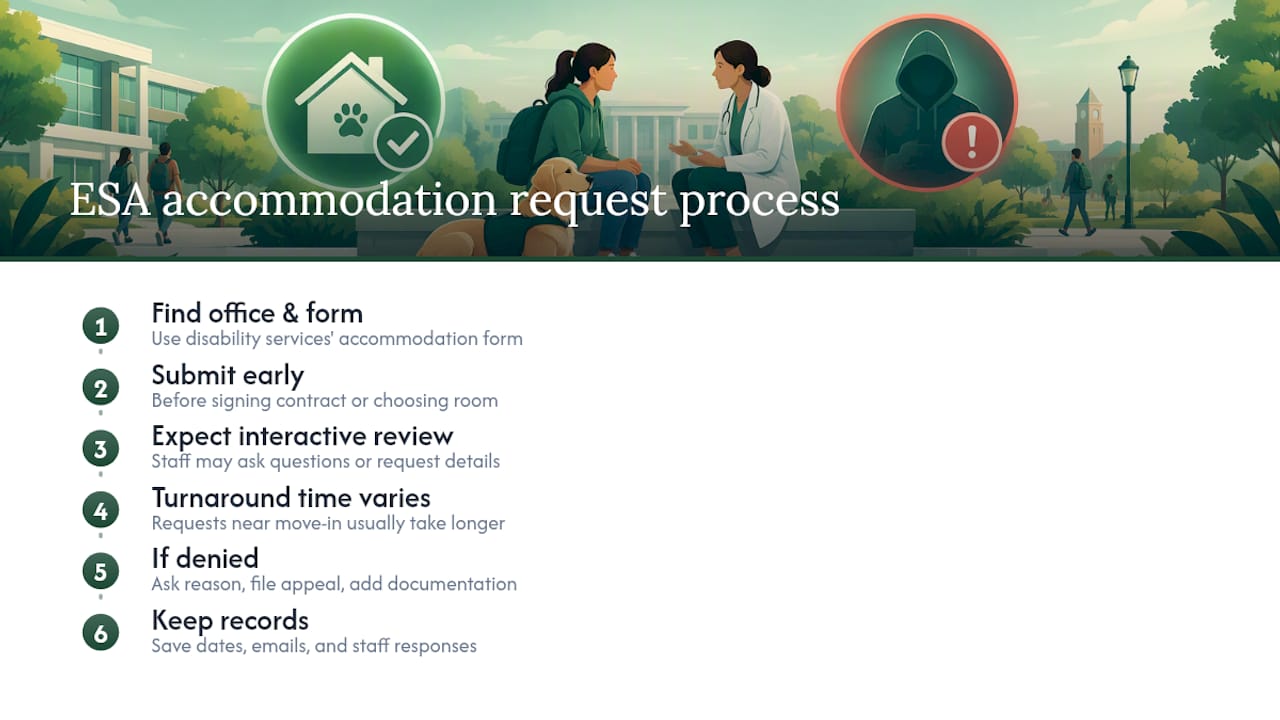
Most universities route ESA housing requests through a disability services office rather than the general housing department, even though the animal will live in a dorm or campus apartment. Start by finding that office’s accommodation request form, which typically asks for your clinician’s letter along with a short personal statement about your functional need.
Submit documentation as early as possible, ideally before you sign a housing contract or select a room, since some approvals affect room assignment or roommate matching. Once submitted, expect an interactive process: staff may follow up with clarifying questions, ask for additional clinician detail, or schedule a short meeting to discuss your request. Turnaround time varies by school and by season, with requests submitted close to move-in typically taking longer due to volume.
If your request is denied, ask for the specific reason in writing and find out whether the school has a formal appeals process. Many disability services offices will reconsider a denial if you provide a clearer clinician statement or additional documentation, so a first no is not always final. Keep a written record of every submission date, follow-up email, and staff response, since that paper trail matters if you need to escalate a dispute later.
How we think about ESA guidance for students
Reliable ESA information starts with the clinician relationship, not the paperwork industry built around it. That is the frame SupportPet.org uses throughout its guidance: a licensed clinician’s recommendation comes first, verification comes second, and scam avoidance runs through both. Plain-language checklists exist to help you evaluate what you are being told, not to replace the judgment of the people actually treating you or reviewing your case on campus.
Nothing here substitutes for a conversation with your clinician or your school’s disability services staff, who know your specific situation and your institution’s actual rules.
— Erik
Where to go next for a consolidated checklist
If you want the letter requirements, verification steps, and scam warning signs in one place, SupportPet’s ESA rights guide pulls them together as a single checklist you can reference while you gather documentation.
Use it alongside, not instead of, a conversation with a licensed clinician and your campus disability services office. The guide is designed to help you understand what a valid letter needs to say and what a housing office may ask for. Start with the full ESA guide before you submit anything to housing or disability services.
Sources
- FTC consumer alerts (June 2026)
- Mental Health on College Campuses: Investments, Accommodations Needed to Address Student Needs
This article is general information, not a substitute for advice from a qualified doctor. Consult a qualified healthcare professional about your own circumstances before acting on anything here.
FAQ
Can college students legally get an ESA in a dorm?
Yes, students with a documented mental health condition can request ESA housing accommodations under the Fair Housing Act, which HUD enforces even in student housing. The request requires a licensed clinician’s letter submitted through your school’s disability services or housing office.
Do I need a special certificate or registration for my ESA?
No, no certificate, registration, or ID card is legally required for an ESA. A licensed clinician’s letter is what housing offices and campus disability services actually need, and any seller claiming otherwise is a scam warning sign the FTC has flagged.
What should I do if a website offers an instant ESA letter?
Treat it as a red flag rather than a shortcut, since a real letter requires an actual clinical evaluation. The FTC’s guidance on spotting pet-related scams applies directly here: avoid any seller demanding gift cards, cryptocurrency, or wire transfers.
Can my ESA come to class with me on campus?
Generally not automatically. Housing accommodations under the Fair Housing Act cover where you live, and most universities do not extend that same access to classrooms or public campus facilities the way they do for trained service animals under the ADA.
What happens if my school denies my ESA housing request?
Ask for the specific reason in writing and request the interactive process that housing law generally requires before a final denial. Many schools will reconsider with clearer clinician documentation, so a first denial is not necessarily the end of the process.