
Yes, veterans can have emotional support animals, and an ESA letter from a licensed clinician can secure housing accommodations under the Fair Housing Act. What surprises most veterans is what the VA does not do: it has no standardized program for issuing ESA letters, so a VA clinician may agree to write one, or may decline entirely. If you need public access rights or task-based help, a psychiatric service dog may fit better than an ESA.
TL;DR:
- Veterans seeking ESA letters should be evaluated by a licensed mental health professional, preferably outside the VA system, to ensure legal validity.
- An ESA provides emotional support within housing but does not grant public access rights like a trained service dog under the ADA.
- The VA does not have a standardized ESA-letter program, and clinicians may or may not agree to write one, so documentation from a private or telehealth provider is often necessary.
- Housing protections require a valid ESA letter from a licensed clinician; online registrations or certificates carry no legal weight and should be avoided.
- An ESA does not impact VA disability ratings or compensation, but VA records can support the need for an ESA during mental health evaluations.
Table of Contents
- ESA vs Psychiatric Service Dog: What Legally Changes for You
- VA Policy and Clinician Letters: Realistic Expectations
- How to Get a Legally Valid ESA Letter as a Veteran
- Housing Protections Under the Fair Housing Act: What Landlords Must and May Do
- Travel, Military Housing, and Deployment: Special Rules Veterans Face
- Avoiding Scams and Registration Myths: What Paperwork Actually Matters
- Supportpet’s Resources for Veterans
- Does an ESA Affect Your VA Disability Rating or Compensation?
- Where Veterans Can Get Help Finding an ESA Letter
- A Note From Erik
- Get Your ESA Letter Documentation in Order
- Primary Sources for Verification
- Sources
- FAQ
ESA vs Psychiatric Service Dog: What Legally Changes for You
The distinction is not paperwork. It’s what the animal is trained to do and where it can legally go with you.
A psychiatric service dog is task-trained under the Americans with Disabilities Act (ADA) and earns public access rights, meaning it can accompany you into restaurants, stores, and most VA facilities. An ESA provides comfort through its presence alone, with no task training required, and its legal protections stop at housing.
- Service dog tasks: interrupting panic attacks, blocking crowds during dissociation, waking you from nightmares, retrieving medication.
- ESA role: reduces anxiety and loneliness through companionship, with no trained behavioral task attached.
- Public access: service dogs go almost everywhere; ESAs generally cannot enter VA health care facilities, restaurants, or stores that bar pets, according to VA news guidance.
- Housing rights: both qualify for FHA accommodations, but only the service dog carries ADA access outside the home.
If your daily struggle is public panic or crowd triggers, a task-trained service dog solves a problem an ESA cannot touch.
VA Policy and Clinician Letters: Realistic Expectations
The VA does not run a formal ESA-letter program. That’s the single fact that trips up more veterans than anything else in this process.
VA Palo Alto Health Care’s guidance states plainly that VA clinicians are not authorized, through their VA employment, to issue ESA letters as a standard service. Some may write one anyway, at their own discretion, but you cannot count on it, and no VA policy obligates them to.
Your VA diagnosis still matters. It just doesn’t replace the letter itself.
- A documented PTSD, anxiety, or depression diagnosis in your VA record strengthens any evaluation you pursue elsewhere.
- If your VA provider declines, a private licensed mental health professional (LMHP) can review those same records and issue the letter.
- Licensed telehealth clinicians are a legitimate option when local access is limited, as long as they’re licensed in your state.
- Vet Centers vary by location. Some counselors will discuss ESA suitability; few will formally issue letters.
The practical path: treat your VA record as supporting evidence, not the letter itself.
How to Get a Legally Valid ESA Letter as a Veteran
Step 1: Gather your documentation. Pull together any VA diagnosis records, treatment notes, or medication history related to your mental health condition. This isn’t required by law, but it speeds up the evaluation and gives the clinician real context.
Step 2: Schedule an evaluation with a licensed mental health professional. This needs to be someone who establishes an actual clinician-patient relationship, whether in person or through state-licensed telehealth. A one-time online form with no real conversation won’t hold up.
Step 3: Confirm the letter includes the required elements. A valid ESA letter states the clinician’s name, license number, and state; confirms you have a disability-related need under the FHA; and explains that the animal provides therapeutic support tied to that need. It should reference an ongoing treatment relationship, not a single transaction.
Step 4: Submit your accommodation request in writing. Give your housing provider the letter along with a brief, dated request for the specific accommodation, such as a fee waiver or breed exception. Keep copies of everything you send and receive.
Pro Tip: Telehealth-issued letters hold up legally as long as the clinician is licensed in your state and has actually evaluated you. What gets rejected is a letter from an out-of-state clinician who never spoke with you directly.
Housing Protections Under the Fair Housing Act: What Landlords Must and May Do
Under the FHA, a valid ESA letter entitles you to a reasonable accommodation. Landlords must waive no-pet policies, pet deposits, and breed or weight restrictions once you provide that documentation, according to HUD’s guidance on assessing accommodation requests.
What they can ask for is limited, and what they cannot ask for is just as important:
- Landlords may request: a letter confirming a disability-related need from a licensed provider with an established relationship to you.
- Landlords may not demand: your specific diagnosis, a notarized form, medical records, or an in-person “proof” visit from the animal.
- If denied: document every email and conversation, give the landlord roughly 10 business days to respond to a follow-up, then file a complaint with HUD if they still refuse.
HUD explicitly warns that online-only certificates, purchased without any real clinical relationship, are not reliable evidence of need. That single sentence in HUD’s guidance is why so many “ESA registration” websites carry no legal weight at all.
Travel, Military Housing, and Deployment: Special Rules Veterans Face
Air travel changed in 2021. The Department of Transportation’s final rule removed ESAs from the legal definition of service animal, so airlines now treat them as regular pets, complete with fees and carrier requirements.
Military housing splits into two very different worlds:
- Privatized on-base housing generally falls under FHA rules, so the same accommodation process applies as any civilian rental.
- Government-run barracks and installations follow Department of Defense and branch-specific policy, and DoD Instruction 1300.27 excludes ESAs from service-dog protections, leaving access decisions to each Military Department.
- PCS moves and deployment require checking your specific installation’s pet policy before you assume your ESA can come with you; boarding or relocation assistance programs may be worth exploring early.
Call your installation housing office before you sign a lease or book a move. Policies differ enough between branches that assuming anything is a mistake.
Avoiding Scams and Registration Myths: What Paperwork Actually Matters
Every ESA “registry,” ID card, and vest you can buy online carries zero legal weight under the FHA or ADA. None of it. These are consumer products, not legal documents, and HUD’s own guidance singles out online-only certificates as unreliable evidence precisely because they skip the clinician relationship that actually matters.
- Confirm your letter comes from a licensed clinician with a real evaluation behind it, not a website questionnaire.
- Skip anything selling a certificate, ID, or vest as if it grants legal status. It doesn’t.
- Keep your letter current and be ready to provide contact information for the clinician who wrote it, since some landlords verify.
Pro Tip: If a website sells you a “certification” before you’ve ever spoken to a clinician, that’s the red flag. Legitimate documentation always starts with an evaluation, never a checkout page.
Supportpet’s Resources for Veterans
Supportpet’s guide to ESA letters and housing rights breaks down each step above in plain language, with an evaluation checklist, a sample accommodation request letter, and a rundown of scam patterns to avoid. It’s built to work whether you’re pulling documentation from VA records or starting fresh with a private clinician, so you have a reference for exactly what your letter needs and how to submit your request without guesswork.
Does an ESA Affect Your VA Disability Rating or Compensation?
No. Having an ESA does not increase, decrease, or otherwise interact with your VA disability rating or monthly compensation. The rating process evaluates your diagnosed condition and its documented impact on functioning, not whether you own a support animal.
Where the connection actually matters is evidentiary. If you’re pursuing or appealing a claim for PTSD, anxiety, or depression, the same VA records that support your disability rating can also support your ESA evaluation with an LMHP. The two processes run on separate tracks, but they draw from the same clinical history.
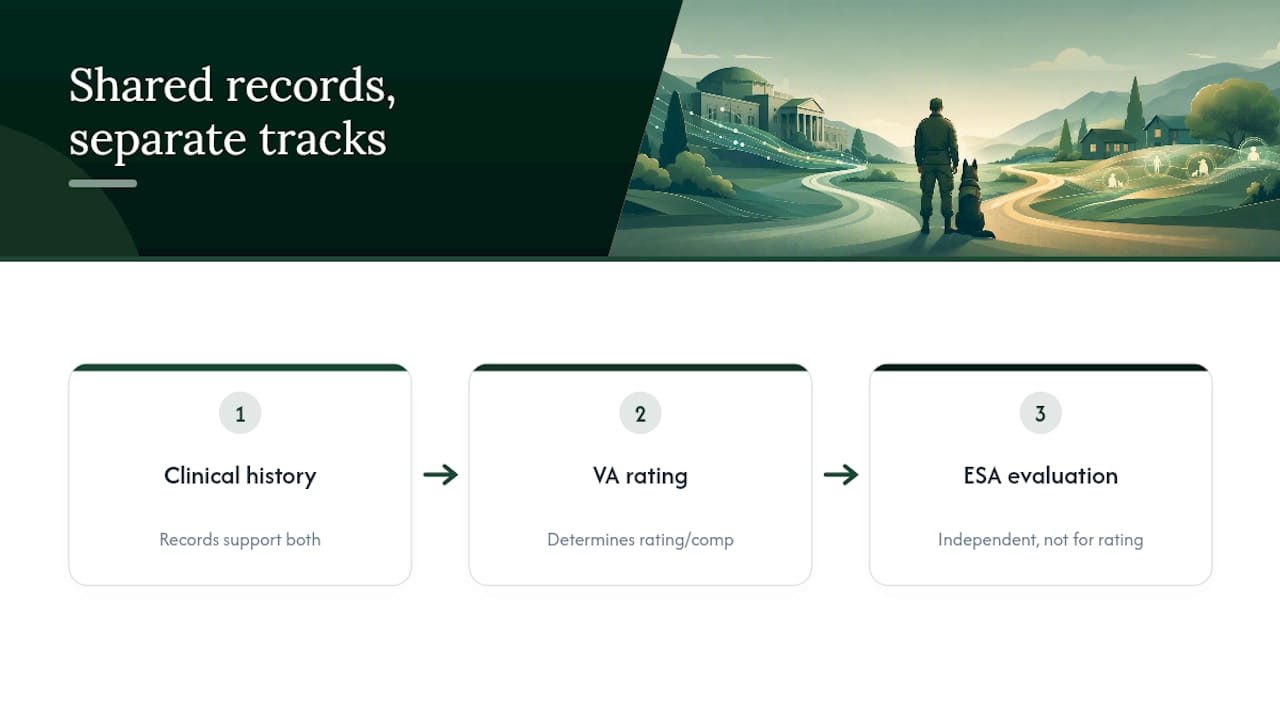
One area worth clarity: an ESA letter is not a substitute for a compensation and pension exam, and clinicians writing ESA letters are not evaluating you for VA rating purposes. Don’t expect the letter to influence a claims decision, and don’t mention it as evidence in a disability appeal expecting it to carry weight it wasn’t designed for. Keep the two processes separate in your paperwork and in your expectations, even though both often stem from the same underlying diagnosis.
Where Veterans Can Get Help Finding an ESA Letter
You don’t have to figure this out alone, and you shouldn’t have to rely on guesswork from a random forum post. A few starting points make the search more efficient.
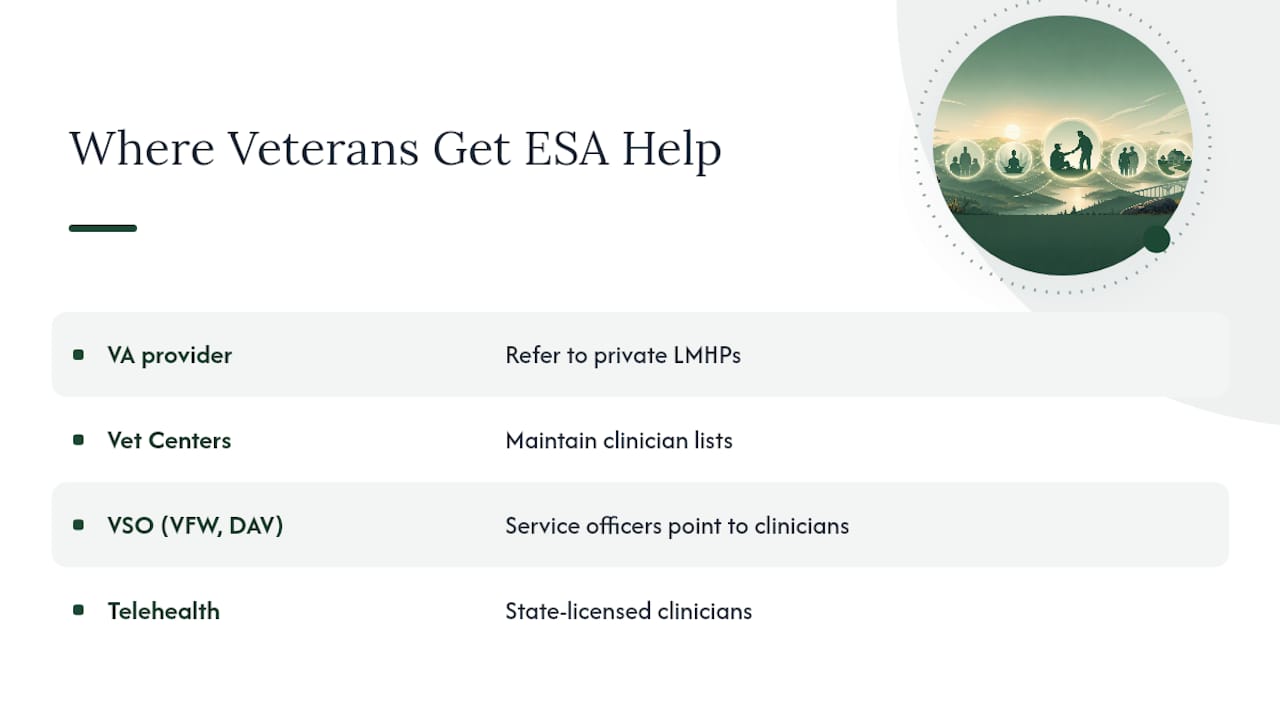
Your VA mental health provider, even if they can’t personally write the letter, can often refer you to a private LMHP who works with veterans regularly. Vet Centers, run separately from VA medical facilities, sometimes maintain lists of community clinicians familiar with military-connected trauma. Veterans Service Organizations like the VFW and DAV don’t issue ESA letters themselves, but their service officers can point you toward mental health resources in your area and help you understand how an ESA fits alongside any benefits claim you’re pursuing.
Licensed telehealth platforms specializing in mental health evaluations are worth considering if you live somewhere with limited access to in-person LMHPs, as long as the clinician is properly licensed in your state. Whichever route you take, the goal is the same: a real evaluation, a real clinician, and a letter that actually holds up when a landlord reviews it.
A Note From Erik
Veterans get tripped up expecting the VA to hand them an ESA letter the way it handles a prescription refill. It doesn’t work that way, and that gap causes real frustration. The fix is straightforward: get evaluated by a licensed clinician, document everything, and loop in your VA housing coordinator or file a HUD complaint if a landlord pushes back on a valid request.
— Erik
Get Your ESA Letter Documentation in Order
Supportpet built its guide to ESA letters and housing protections specifically to cut through the confusion the VA’s discretionary policy creates. Rather than guessing what your letter needs to say or risking money on a registration site with no legal standing, you get sample letters, an accommodation request template, and a documentation checklist that mirrors exactly what HUD and licensed clinicians expect. If you’re ready to start your evaluation or need a template for your housing request, visit Supportpet’s ESA rights guide and download what you need before you contact your landlord.
Primary Sources for Verification
- VA Palo Alto Health Care: Service Animals policy
- PubMed: Service dogs versus emotional support dogs for veterans with PTSD
Sources
- Service Animals | VA Palo Alto Health Care | Veterans Affairs
- Therapeutic and economic benefits of service dogs versus emotional support dogs for veterans with PTSD (PubMed)
FAQ
How Do I Get an ESA Letter as a Veteran?
Get evaluated by a licensed mental health professional, either your VA provider if they’re willing or a private or telehealth LMHP if not, and ask for a letter documenting your disability-related need. The VA doesn’t run a standardized ESA-letter program, so a private clinician is often the more reliable route, according to VA Palo Alto Health Care.
Will the VA Pay for an Emotional Support Animal?
No. The VA does not fund the purchase, training, or care costs of emotional support animals, and it does not operate a standardized ESA-letter program either. VA benefits related to animals focus primarily on trained service dogs, not ESAs.
What Mental Health Conditions Qualify a Veteran for an ESA?
PTSD, generalized anxiety disorder, depression, and similar diagnosed conditions commonly qualify, provided a licensed clinician confirms the animal provides therapeutic benefit tied to that condition. Research on veterans with PTSD shows both ESAs and service dogs can produce meaningful benefits, according to a peer-reviewed comparison study.
Can Active-Duty Military Members Have an ESA?
Yes, but rules differ by housing type. Privatized on-base housing generally follows Fair Housing Act rules, while government-run barracks and installation access fall under Department of Defense and branch-specific policy, per DoD Instruction 1300.27.
Can I Bring My ESA Onto VA Medical Facility Grounds?
Generally, no. ESAs lack the ADA public access rights that service dogs carry, and VA facility guidance treats ESAs as pets rather than access-approved animals inside VA health care buildings.