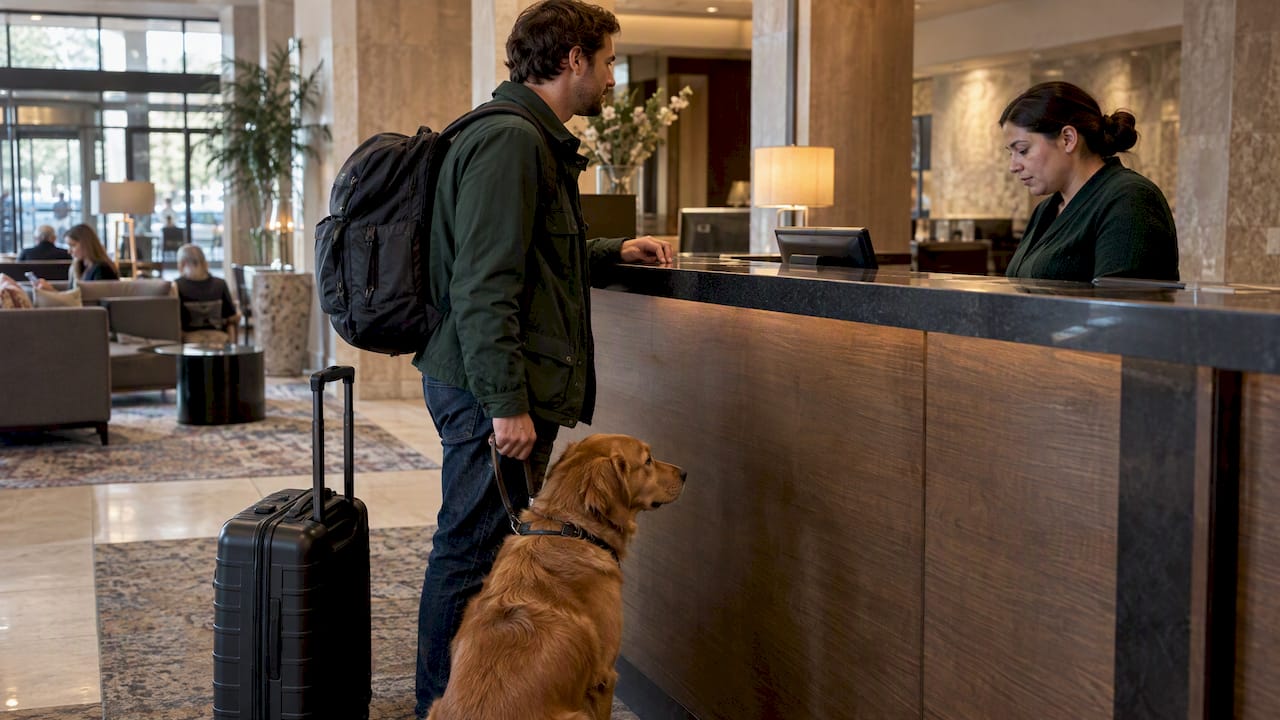
In most travel situations, hotels are not legally required to accept your emotional support animal, because the Americans with Disabilities Act covers only trained service animals, while the Fair Housing Act applies to housing, not transient lodging. Before you book, call the hotel directly, confirm its pet policy in writing, and have current ESA documentation ready.
TL;DR:
- Extended stays, residential hotels, university housing, or agreements involving a lease may trigger housing protections, but managers must assess each arrangement individually.
- Send a current letter from a licensed mental health professional, vaccination records, and reservation confirmation 48 hours before arrival, then request written acknowledgment.
- Hotels may charge ESAs pet fees or deposits; ask whether management will waive them, and rely on written approval rather than a verbal promise.
- If staff deny an agreed accommodation, record names, request a written explanation, and contact corporate support; contact HUD only for covered housing arrangements.
Table of Contents
- How hotels treat service animals vs emotional support animals
- When hotel stays might trigger housing-like protections
- What documentation hotels may request and how to prepare it
- How pet fees and deposits typically apply to ESAs in hotels
- Practical steps to take before booking and at check-in
- If a hotel denies access: immediate steps and next moves
- SupportPet.org guidance, clinician documentation, and ESA scams to avoid
- Why clear documentation and respectful communication matter
- Where our resources can help with letters and travel planning
- FAQ
- Sources
How hotels treat service animals vs emotional support animals
The ADA defines a service animal narrowly as a dog trained to perform specific tasks for a person with a disability, and hotels covered by the ADA must allow these animals in guest rooms and public areas without pet fees. An emotional support animal provides comfort through its presence rather than trained tasks, so it does not meet the ADA’s service animal definition, which leaves ESAs subject to whatever pet policy a hotel chooses to run.
This distinction plays out in predictable ways at the front desk:
- A hotel typically waives its pet fee and room restrictions for a documented service dog.
- The same hotel can charge a pet fee, require a deposit, or limit an ESA to designated pet-friendly rooms.
- Staff may ask what tasks a service animal performs, but they cannot ask the same of a guest who identifies their animal as an ESA without expecting pet-policy terms to apply.
When hotel stays might trigger housing-like protections
HUD’s Fair Housing Act framework requires housing providers to consider reasonable accommodation requests for assistance animals, but this framework was built for housing, not short overnight stays, so a standard hotel reservation rarely qualifies. The analysis can shift, though, when a property starts to function more like a residence than a hotel.
Situations where FHA-style protections become more plausible include:
- Extended-stay hotels or residential hotels where a guest lives for weeks or months.
- University-affiliated housing that happens to operate through a hotel-style booking system.
- Any arrangement with a lease, contract, or landlord-tenant relationship layered on top of the stay.
Each of these requires an individualized assessment of the facts, so travelers in a gray-area situation should keep documentation ready and raise the housing question directly with management rather than assuming either outcome.
What documentation hotels may request and how to prepare it
A valid ESA letter typically comes from a licensed mental health professional, states that you have a mental health condition recognized under relevant diagnostic criteria, and confirms that the animal provides support related to that condition, without listing your specific diagnosis. Hotels that choose to accommodate ESAs as a courtesy may reasonably ask for proof of your reservation, vaccination records, and assurance that the animal is under control, but they cannot demand details of your medical history.
Before check-in, travelers should gather:
- A current ESA letter with the clinician’s license information and date.
- Vaccination and health records for the animal.
- A printed or digital copy of your reservation confirmation.
- Any written email exchange where the hotel acknowledged your ESA in advance.
Pro Tip: Email the hotel your documentation 48 hours before arrival and ask for a written reply confirming receipt, since that reply becomes your best evidence if a question comes up at the desk.
How pet fees and deposits typically apply to ESAs in hotels
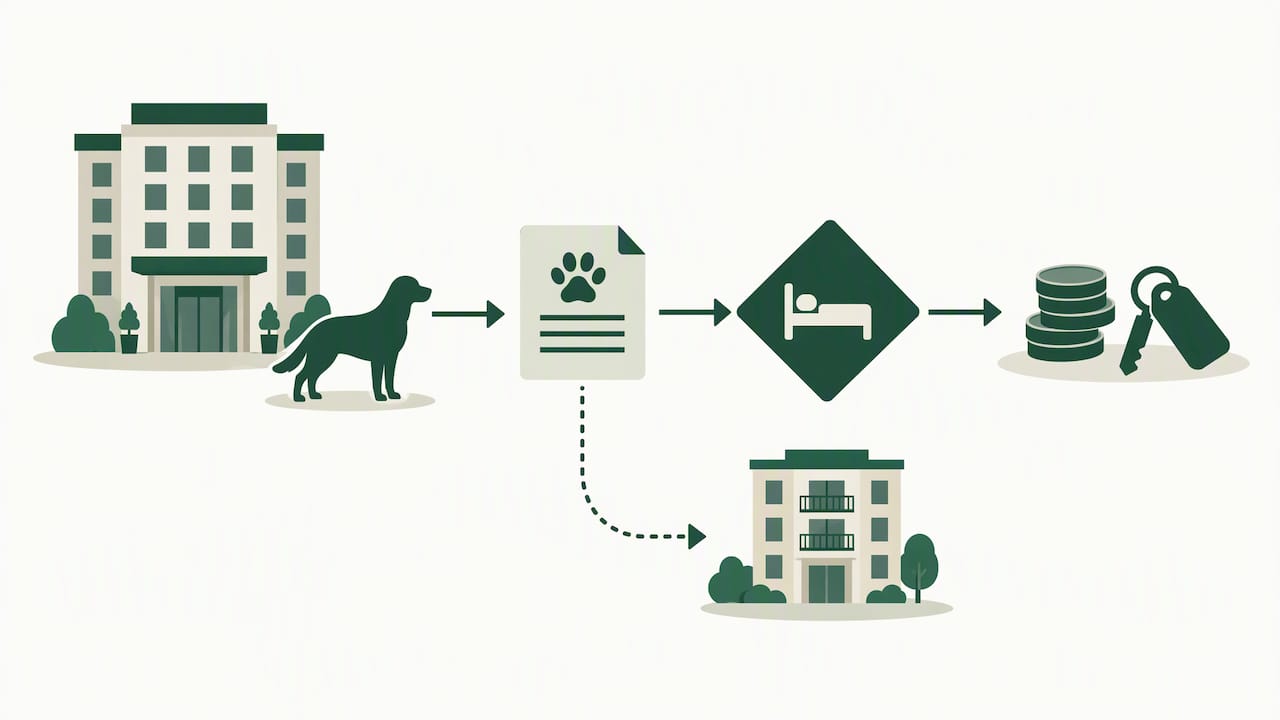
Because transient lodging falls outside FHA housing rules, hotels can generally treat an ESA like any other pet for the purposes of fees, deposits, and house rules. This is the opposite of how assistance animals work in covered housing, where the Fair Housing Act prohibits landlords from charging a pet deposit for a documented assistance animal.
A few habits make fee conversations smoother:
- Ask politely whether the hotel offers a fee waiver for documented ESAs, since some properties do as a courtesy.
- Keep a copy of any email or text where a manager agrees to waive or reduce a fee.
- Treat a verbal promise as provisional until it is confirmed in writing.
Pro Tip: If a front desk agent quotes a pet fee, ask to speak with a manager and reference your written confirmation before paying, since many fee disputes resolve once a supervisor reviews the reservation notes.
Practical steps to take before booking and at check-in
A little preparation before you travel prevents most of the friction that comes up with ESAs at hotels.
- Call the hotel directly and ask about its specific pet and ESA policy rather than relying on the website alone.
- Request written confirmation by email once a manager acknowledges your ESA and any fee arrangement.
- Book a pet-friendly or ground-floor room when one is available, since this avoids last-minute room changes.
- Pack your ESA letter, vaccination records, and reservation confirmation together in one folder or app.
- At check-in, present your documentation calmly, mention the animal is under control, and offer to show vaccination records if asked.
- Bring a travel crate, familiar bedding, and your veterinarian’s contact information in case of an emergency.
- Identify a backup pet-friendly hotel nearby in case your primary reservation falls through.
Travelers who treat these steps as routine, rather than as a reaction to a problem, tend to have calmer check-in experiences and fewer surprises about fees.
If a hotel denies access: immediate steps and next moves
If a front desk employee refuses to accommodate your ESA, start by asking for the manager’s name and, if possible, a written explanation of the denial. Note the time, the names of staff involved, and photograph any posted pet policy, since this record matters if you decide to escalate.
From there, your options depend on the situation:
- Contact the hotel chain’s corporate customer service line, which often has more flexibility than an individual property.
- File a complaint with your state’s consumer protection agency if you believe the denial violated a posted policy or prior written agreement.
- Reach out to HUD only if the stay involves a housing-like arrangement covered by the Fair Housing Act, since HUD’s authority does not extend to ordinary transient hotel stays.
- Save copies of your ESA letter, reservation, any written denial, and contact information for witnesses before you pursue a complaint.
SupportPet.org guidance, clinician documentation, and ESA scams to avoid
We built our SupportPet resources around clinician-signed letters and plain explanations of where ESA protections actually apply, because a strong letter only helps when it comes from someone qualified to write it. Watch for these warning signs before you pay for any ESA documentation:
- Instant online “certificates” or registries that issue a letter without ever speaking to a clinician.
- Sellers who promise guaranteed approval regardless of your actual mental health history.
- Sites that charge for a national ESA “registration,” which no federal law requires.
Pro Tip: A legitimate ESA letter names the clinician’s license and state, states your need for support without listing your diagnosis, and is dated within the last year.
Why clear documentation and respectful communication matter
This site aims to cut through the confusion between service animals, assistance animals, and plain pets, and to call out the scam certificate sites that make legitimate ESA owners look suspicious at check-in. A calm, documented request almost always gets a better response from hotel staff than an argument about what the law technically requires.
— Erik
Where our resources can help with letters and travel planning
We put together guides that walk you through getting a clinician-backed ESA letter and understanding your housing rights when a long stay starts to look more like a tenancy than a hotel visit.
Our site includes:
- Sample wording for notifying a landlord or property manager about an ESA.
- State-by-state checks to help you verify your rights and spot scam letter sellers.
- A travel-focused section with checklists built for exactly the kind of hotel stay covered in this article.
Visit our main ESA guide to find the template or checklist that matches your situation.
This article is general information, not a substitute for advice from a qualified doctor. Consult a qualified healthcare professional about your own circumstances before acting on anything here.
FAQ
How do I travel with my emotional support dog?
Confirm the hotel or airline’s specific ESA policy before you book, since airlines now generally treat ESAs as pets under current rules. Bring a current, clinician-signed ESA letter, your dog’s vaccination records, and a crate or carrier, and keep written confirmation of any accommodation a hotel agrees to.
Can an ESA letter be denied?
A hotel or airline can decline to treat your ESA as anything other than a pet, since neither is required to honor ESA letters the way housing providers must under the Fair Housing Act. A letter itself can also be considered invalid if it was not issued by a licensed mental health professional who evaluated you.
What privileges do emotional support animals have?
ESAs have the strongest legal protections in housing covered by the Fair Housing Act, where a landlord generally cannot charge a pet fee or deposit for a documented ESA. In transient settings like hotels, restaurants, and most stores, ESAs do not have ADA public-access rights and are typically treated as pets.
Do I have to let a hotel know I have a service dog?
You are not required to disclose a specific diagnosis, but hotel staff can ask whether an animal is a service animal required because of a disability and what task it is trained to perform. Letting the hotel know in advance, even though it is not legally required for a true service animal, still helps avoid confusion at check-in.
Sources
- FHEO notice: Service animals and assistance animals for people with disabilities in housing and HUD-funded programs
- Assessing a Person’s Request to Have an Animal as a Reasonable Accommodation under the Fair Housing Act