
Yes, you can apply for ESA housing now. Start by getting a dated letter from a licensed mental health professional, then submit a written reasonable accommodation request to your landlord or housing office. This request draws on protections under the Fair Housing Act, and the clinician letter is the single document that makes or breaks your ESA housing application.
TL;DR:
- Providing a detailed and specific clinician letter that links your disability to the animal’s therapeutic benefit is essential for approval, and it must include professional licensing details.
- Landlords cannot require full medical records, but they can verify the clinician’s license and contact them to confirm the legitimacy of the ESA letter.
- Submitting a written request early, following the landlord’s preferred communication method, and keeping a record of all interactions significantly improve the chances of approval.
- Denials should be responded to with a written request for reasons, possible internal appeal with additional documentation, or a complaint to HUD if necessary, due to legal protections.
- Beware of instant online scams offering cheap or generic ESA certificates, as only letters from licensed clinicians with an established relationship are legally valid and credible.
Table of Contents
- Step-by-step ESA housing application process
- Paperwork checklist: what your ESA letter and supporting documents must include
- Timelines and student housing rules you need to know
- What housing providers can and cannot require
- How to spot ESA letter scams and verify legitimate clinicians
- If your ESA application is denied: appeals and filing a complaint
- Why a clinician relationship is still your fastest path
- How we can help you prepare a stronger application
- FAQ
- Sources
Step-by-step ESA housing application process
Once you understand the legal basis, the actual filing process is straightforward if you follow it in order. Skipping steps, or submitting documentation out of sequence, is the most common reason requests stall.
- Write a clear reasonable accommodation request. State plainly what you are asking for (to keep an emotional support animal in your unit), the animal’s species, and your move-in or current lease dates.
- Get a clinician letter that documents disability-related need. Your letter should connect your diagnosis to a specific benefit the animal provides, not just state that you “would feel better” with a pet.
- Submit through the landlord’s preferred channel. Email, a tenant portal, or a formal accommodation form all work, but always ask for written confirmation that your request was received.
- Provide animal records only when asked. Vaccination proof or a local license may be requested, but a landlord generally cannot demand more than what establishes the animal is safe and well cared for.
- Track the clock and follow up in writing. If a decision takes longer than seems reasonable, send a polite written follow-up referencing your original submission date.
Pro Tip: Keep a simple log with the date you submitted your request, who received it, and any reply, since this record becomes critical if you ever need to escalate a denial.
Housing providers are legally required to respond to reasonable accommodation requests from qualifying individuals, according to HUD’s guidance on assistance animals. That guidance also confirms that a request can be made verbally, though a written version gives you a paper trail that protects you later. Submitting early matters too: landlords and housing offices are not required to process requests overnight, and a rushed timeline increases the odds of a request landing in administrative limbo rather than getting a real answer.
Paperwork checklist: what your ESA letter and supporting documents must include
A weak letter is the number one reason legitimate ESA requests get denied or questioned. Housing providers are looking for a handful of specific elements, and missing even one can trigger a request for more information or an outright rejection.
- The clinician’s full name, license type, and license number, printed on professional letterhead.
- A statement describing the length or nature of the treatment relationship (a one-time telehealth call rarely qualifies).
- Language confirming the individual has a disability as recognized under relevant law, without necessarily naming the diagnosis.
- A statement that the animal provides a therapeutic benefit related to that disability.
- The date the letter was written and the clinician’s contact information for verification.
Beyond the letter itself, many housing offices ask for an animal photo, proof of vaccination, and a local pet license. For dogs in higher-density housing, a basic behavioral assessment is sometimes required to show the animal will not disrupt neighbors.
Your clinician does not need to hand over your full medical chart. HUD and DOJ’s joint guidance on reasonable accommodations makes clear that housing providers may only request documentation that is reliable and necessary to establish disability and need, not a complete treatment history. A focused letter that ties your condition to the animal’s role is sufficient, and sharing more than that only adds unnecessary exposure of your private health information.

Timelines and student housing rules you need to know
College and university housing offices run on their own schedules, and those schedules are often stricter than a typical landlord’s. Many institutions require 30 to 60 days’ notice before move-in, along with a dedicated housing accommodation form rather than a general email request, as outlined by DU Student Affairs’ disability housing accommodations page.
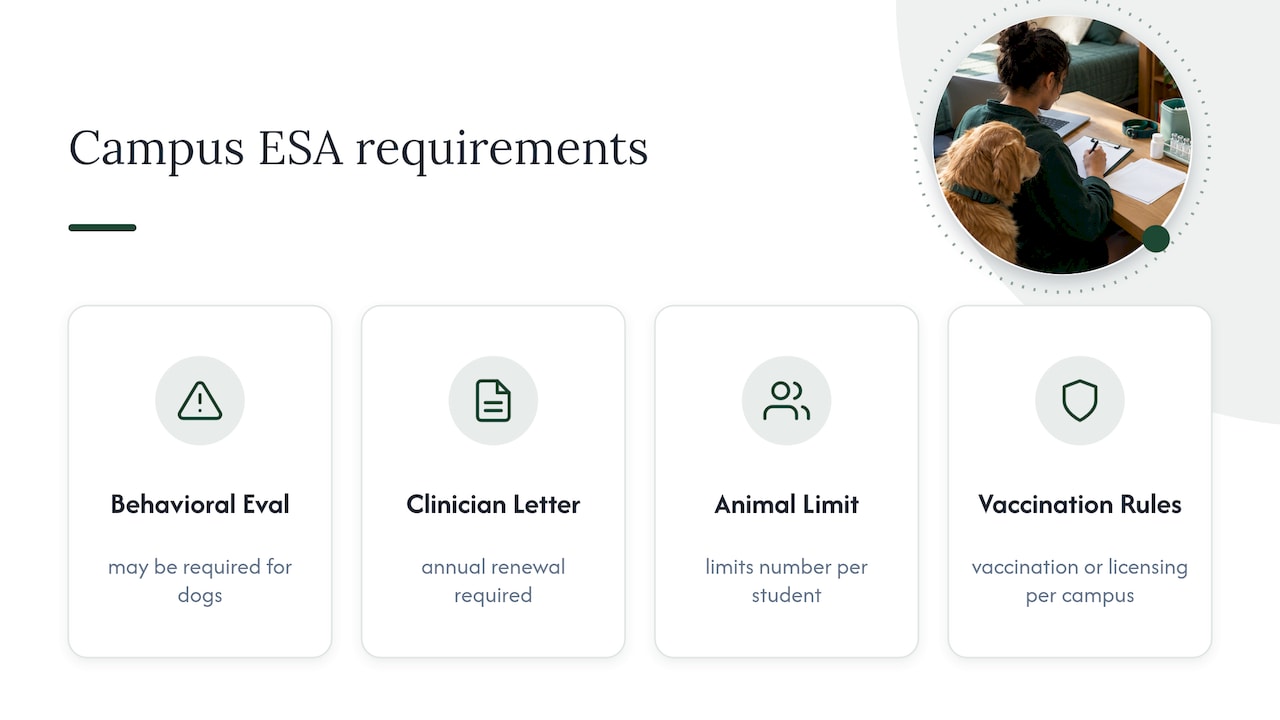
University processes frequently add extra layers: behavioral assessments for dogs, annual renewal of your clinician letter, limits on the number of animals per student, and specific vaccination or licensing rules tied to campus policy. Missing any single form in a portal submission can trigger an automatic delay or denial, so working from the school’s own checklist, not a generic template, is worth the extra time.
If you live in other institutional or HUD-assisted housing, confirm the program’s specific forms and lead times before you commit to a move-in date. These programs sometimes layer additional paperwork on top of the standard reasonable accommodation process, and finding that out after signing a lease leaves you with far fewer options.
What housing providers can and cannot require
Federal guidance draws a fairly clear line between what a landlord or housing office can ask for and what crosses into overreach. Knowing where that line sits helps you recognize a legitimate request for information versus a pushback that is not supported by law.
- Providers generally cannot charge pet deposits or pet fees for a qualifying ESA, though they may bill for actual damage the animal causes, consistent with their normal policies, under HUD’s assistance animal guidance.
- Providers may ask for documentation when your disability or need is not obvious, but they cannot demand full medical records or a specific diagnosis.
- A denial can be lawful if the animal poses a direct threat to others or if accommodating it would create an undue burden, though both of those are fact-specific determinations, not blanket excuses.
If a landlord pushes back, documenting the connection between your condition and the animal’s role, along with a brief treatment history and any mitigation steps like crate training or a behavior plan, often resolves the disagreement without further escalation.
How to spot ESA letter scams and verify legitimate clinicians
No government agency maintains an ESA registry, and no paid certificate, vest, or ID card carries any legal weight under federal housing law. Sites selling instant “registration” are selling something you do not need, and relying on one puts your entire housing request at risk.
Watch for a few consistent red flags: a letter generated instantly after a short online quiz, no license number listed anywhere, and no way to contact the clinician directly. A legitimate letter comes from someone who has actually evaluated you, even through telehealth, and who is reachable if a landlord wants to verify the letter’s authenticity.
Before relying on any letter, check the clinician’s license against your state licensing board, keep a summary of your treatment history, and hold onto dated appointment records. That small amount of diligence upfront is far cheaper than a denied housing request discovered after you have already signed a lease.
If your ESA application is denied: appeals and filing a complaint
A denial is not the end of the process, but how you respond in the first few weeks matters. Moving methodically protects both your housing situation and your legal options.
- Request the denial in writing along with the specific reasons given, and keep copies of everything you submitted.
- Try an internal appeal first. Ask your clinician for a supplemental letter that more clearly ties the accommodation to your diagnosis if the denial cited insufficient documentation.
- File with HUD or your state fair housing agency if the internal appeal fails, using HUD’s housing discrimination reporting page to submit your complaint along with a timeline and copies of all correspondence.
- File promptly. Even with HUD’s enforcement priorities shifting in 2026, filing a complaint still preserves your legal rights and triggers the administrative review process.
Why a clinician relationship is still your fastest path
The applicants who move through this process fastest are not the ones who find a clever template online. They are the ones who build a real relationship with a licensed clinician and let that relationship generate documentation naturally, rather than scrambling for a letter after a denial. A rushed, generic letter invites scrutiny, while a letter grounded in an actual treatment history rarely gets questioned twice.
That is the approach we built our resources around: demystify what the law actually requires, call out the scams that waste people’s time and money, and help you prepare a request that holds up the first time.
— Erik
How we can help you prepare a stronger application
We put together a full rights and application guide that walks through exactly what a clinician letter needs, how to word your written request, and how to spot the registry scams that trip up so many first-time applicants.
If you are a student weighing housing options, matching with a roommate who is comfortable with an ESA can also simplify your search. Roomit’s student roommate matching is worth a look if you are still sorting out where you will live.
Start with an Emotional Support Animals & ESA Letters rights guide for the checklist and sample letter language you can bring straight to your clinician.
This article is general information, not a substitute for advice from a qualified doctor. Consult a qualified healthcare professional about your own circumstances before acting on anything here.
FAQ
How do you get an ESA approved by your landlord?
Submit a written reasonable accommodation request along with a licensed clinician’s letter that connects your disability to the animal’s therapeutic role. Most approvals move faster when the letter is specific and the clinician is reachable for verification.
What conditions qualify for an emotional support animal?
Qualifying conditions are disabilities recognized under fair housing law, often including anxiety, depression, PTSD, and other mental health conditions that a licensed clinician has evaluated and documented. There is no fixed list, since eligibility depends on your clinician’s assessment of your specific situation.
Do landlords actually check ESA letters?
Landlords and housing offices can verify a clinician’s license and contact them to confirm the letter is genuine, and many do exactly that when a letter looks generic or template. A letter from an established treatment relationship, as emphasized by university housing offices like Mount Marty’s ESA accommodation guidance, is far less likely to raise questions.
How hard is it to get an emotional support animal letter?
Getting a valid letter is straightforward if you have an existing or new relationship with a licensed clinician who can document your condition and the animal’s role. It becomes difficult only when applicants try to shortcut the process with instant online certificates, which carry no legal standing and often trigger denials.
Sources
- HUD — Assistance animals
- DOJ & HUD joint statement on reasonable accommodations under the Fair Housing Act
- DU Student Affairs — Accommodations for students who have disabilities (housing)