
Yes, most tenants can still request an ESA accommodation under the Fair Housing Act, and that protection has not been repealed. HUD’s May 2026 enforcement memo shifted how federal complaints get prioritized, not what the law says. If you have an emotional support animal, submit a written reasonable accommodation request now, attach clinician documentation, and keep copies of everything you send.
TL;DR:
- Federal protections for emotional support animals remain intact, but documentation should be thorough and up-to-date, ideally within the last year.
- Landlords cannot charge pet fees or impose no-pet policies once a legitimate accommodation request is made, but they can ask for documentation if the need is unclear.
- The May 2026 HUD guidance deprioritizes loose ESA letter claims but does not change tenants’ legal rights to request accommodations.
- State and local laws may impose stricter standards or additional protections, so tenants should verify rules specific to their location.
- Properly prepared documentation and written requests strengthen tenants’ cases, especially as federal enforcement priorities shift.
Table of Contents
- Federal Baseline: What the Fair Housing Act Actually Protects
- What HUD’s May 2026 Memo Changed (and What It Didn’t)
- What Landlords Can and Cannot Do
- How to Request an Accommodation and What Makes an ESA Letter Valid
- State and Local Rules That Add to Federal Protections
- If Your Accommodation Request Gets Denied
- Avoiding Scams and Building a Request That Holds Up
- Why This Moment Requires More Care, Not More Fear
- How Supportpet Helps You Build a Request That Holds Up
- Sources
Federal Baseline: What the Fair Housing Act Actually Protects
The Fair Housing Act requires housing providers to make reasonable accommodations for people with disabilities, and that duty covers assistance animals, including emotional support animals. An ESA does not need specialized training. A dog that calms someone with panic disorder just by being present qualifies the same as one trained to interrupt a panic attack, as long as a person with a disability needs it for equal use of housing.
That is the core distinction people mix up: ESAs versus service animals under the Americans with Disabilities Act. Service animals are trained to perform specific tasks and carry public access rights into restaurants, stores, and transit. ESAs carry no such public access rights. Their legal protection is narrower but still real, and it lives specifically in housing law, not the ADA.
HUD’s assistance animal guidance spells out which properties the FHA covers and where it doesn’t reach:
- Most rental housing, condos, co-ops, and HOAs fall under the FHA’s reasonable accommodation duty.
- Owner-occupied buildings with four or fewer units are typically exempt under the FHA’s Mrs. Murphy exemption.
- Single-family homes rented without a broker by an owner who holds no more than three such properties can also fall outside FHA coverage.
- Federally assisted housing (Section 8, public housing) is covered and often has its own additional guidance layered on top of the FHA.
If you’re not sure which category your building falls into, that gap matters more than almost anything else in your case, so it’s worth confirming before you assume the law protects you.
What HUD’s May 2026 Memo Changed (and What It Didn’t)
HUD issued guidance in 2026 that redirected federal enforcement attention toward trained assistance animals and away from the informal ESA letter model that had dominated for years. The memo is administrative guidance, not legislation. It cannot repeal the Fair Housing Act, and it does not touch your right to sue a landlord privately or file a state discrimination complaint.
What it does change is practical, not legal:
- HUD may deprioritize or slow-walk federal complaints tied to loosely documented ESA claims.
- Local housing authorities and property managers, uncertain about federal posture, may respond inconsistently to accommodation requests.
- Some landlords will read the memo as license to push back harder, even where state law hasn’t moved an inch.
None of that erases your underlying right. It does mean the burden of proof and paper trail matters more now than it did two years ago. A DOJ overview of the Fair Housing Act still describes the same private right of action it always has: landlords can be sued directly, regardless of what any single federal agency’s enforcement queue looks like this year. Treat the memo as a signal to tighten your documentation, not as a reason to skip the request altogether.
What Landlords Can and Cannot Do
Landlords operate inside real limits here, and knowing where those limits sit saves you from both giving up too easily and demanding something the law doesn’t require.
- They must waive no-pet policies. A blanket “no pets” rule cannot be applied to a legitimate assistance animal once a reasonable accommodation request is made.
- They cannot charge pet fees or pet deposits. Massachusetts guidance confirms assistance animals are exempt from standard pet-related fees, a rule that holds across most state frameworks even though you remain financially responsible for actual damage the animal causes.
- They can ask for documentation when the disability or need isn’t obvious, but they cannot demand your full medical file, a specific diagnosis, or a form drafted by their own attorney.
- They can deny the request if the animal poses a direct threat to others, creates an undue financial or administrative hardship, or violates a local ban on a specific species (certain reptiles or exotic animals, for instance).
- They can still hold you liable for property damage, and can still require leashing or control in shared common areas even after approving the accommodation.
Pro Tip: Put every accommodation request in writing, even if your landlord seems friendly about it verbally. A verbal “sure, that’s fine” evaporates the moment a new property manager takes over the building.
How to Request an Accommodation and What Makes an ESA Letter Valid
Getting the paperwork right the first time avoids weeks of back and forth. Follow this order:
- Write the request. State plainly that you have a disability, that you need the animal to use and enjoy the housing, and that you’re requesting a reasonable accommodation under the Fair Housing Act.
- Attach clinician documentation, if your disability isn’t apparent. This is the step most people botch.
- Keep copies of everything, including the date you submitted the request and any response.
- Follow up in writing if you don’t hear back within a reasonable window, referencing your original request date.
A legitimate ESA letter, from a licensed clinician such as a therapist, physician, or psychiatrist, includes their name, license number, and license state, a statement that you have a disability under applicable law, and a statement that the animal’s presence is necessary to help with that disability. It does not need to name your specific diagnosis, and no legitimate clinician letter requires an “official ESA registration number,” because no such national registry exists.
That last point is where scams cluster. Watch for sites that sell letters after a five-minute quiz with no licensed clinician involved, letters with no license number listed anywhere, or “registration certificates” mailed alongside a vest and ID card you never asked for. Telehealth consultations with a real, licensed clinician are generally acceptable; a form generator with a rubber-stamp signature is not.
Pro Tip: If a service promises an ESA letter in under 24 hours with zero clinical conversation, that’s a letter mill, not a clinician. A real assessment takes time because a real clinician is actually evaluating you.
For a full walkthrough of assembling a request packet, Supportpet’s guide to ESA rights breaks down sample language and common mistakes people make on their first attempt.
State and Local Rules That Add to Federal Protections
Federal law sets the floor, not the ceiling, and several states or cities have built more specific rules on top of it.
- New York City requires that housing providers follow written verification standards, and its Commission on Human Rights fact sheet confirms landlords can ask for basic proof of disability and disability-related need, can apply local vaccination rules, and can deny a request only under an undue hardship standard, not personal preference.
- Pennsylvania’s Act 118 sets documentation standards requiring that letters be based on the clinician’s direct knowledge of the patient, and it creates fraud penalties for anyone who knowingly submits a fabricated letter, a real deterrent against the letter-mill problem.
- Minnesota guidance from its Department of Human Rights confirms no-pet policies generally don’t apply to assistance animals and lays out how tenants file discrimination complaints at the state level, often a faster track than a federal HUD complaint.
- Massachusetts guidance reinforces that assistance animals are exempt from pet fees while making clear tenants stay liable for damage, mirroring the federal baseline almost exactly.
Rules shift by state and even by city, so check your own state human rights agency before assuming any single example above applies where you live.
If Your Accommodation Request Gets Denied
A denial isn’t the end of the process. You have real options, and timing matters for some of them.
- File a complaint with HUD through its online fair housing complaint portal, generally within one year of the alleged discrimination.
- File with your state human rights agency, such as Minnesota’s Department of Human Rights, which often moves faster than a federal queue and may carry its own filing deadline separate from HUD’s.
- Gather your evidence before filing: your written request, the clinician letter, any written landlord response, and a timeline of dates.
- Understand how this interacts with eviction. If a landlord initiates eviction proceedings after you request an accommodation, that timing itself can become evidence of retaliation. A pending reasonable accommodation request is often a valid defense, but you should raise it immediately and, ideally, with an attorney or legal aid office involved.
- Consider a tenant-review platform like DWELR to document landlord responsiveness patterns if you’re weighing whether a dispute is worth escalating or whether it’s time to move.
Avoiding Scams and Building a Request That Holds Up
Letter mills share the same tells: no licensed clinician on staff, instant approval regardless of your answers, and upsells for vests, ID cards, or “registration” that federal law never required in the first place. Verify any clinician’s license number through your state’s licensing board before trusting their letter.
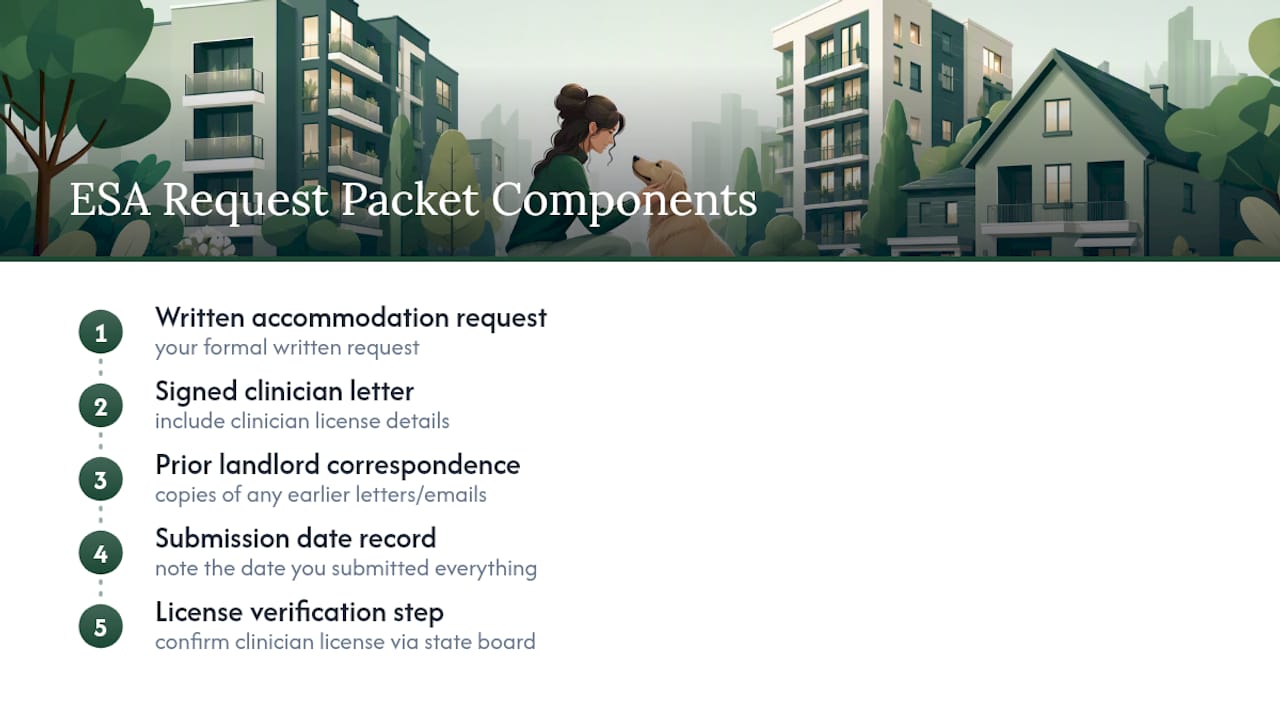
A strong request packet includes your written accommodation request, a signed clinician letter with license details, copies of any prior landlord correspondence, and a note of the date you submitted everything. Telehealth documentation from a licensed provider is typically acceptable, and services like an AI-supported telehealth therapist can connect you with a real clinician if you don’t already have one, though you should always confirm that clinician’s license independently.
Pro Tip: Landlords can reasonably ask for a letter dated within the last year. A three-year-old letter from a clinician you no longer see is an easy target for pushback.
Why This Moment Requires More Care, Not More Fear

The uncertainty around HUD’s 2026 memo is real, and if you’re feeling nervous about whether your ESA is actually protected right now, that reaction makes sense. But nervousness shouldn’t turn into inaction. The law underneath the memo hasn’t moved. What’s changed is how much your paperwork carries the weight of proving your case.
Supportpet built its resources around exactly this gap: plain-language guides, sample accommodation letters, and clear breakdowns of what a legitimate clinician letter looks like versus a scam. Approach your landlord directly and in writing first. Save the formal complaint process for when that conversation stalls, and bring in legal aid if an eviction threat shows up alongside your request.
— Erik
How Supportpet Helps You Build a Request That Holds Up
Supportpet exists for exactly the moment you’re in right now: staring at a blank accommodation letter, unsure what your clinician actually needs to include, and worried one wrong move gives your landlord an excuse to deny you. Unlike the letter-mill sites the memo was aimed at cracking down on, Supportpet walks you through what a licensed clinician’s documentation should say, how to avoid the scams that make landlords suspicious of ESA letters in the first place, and how to phrase a request that stands on its own if it ever ends up in front of a housing agency.
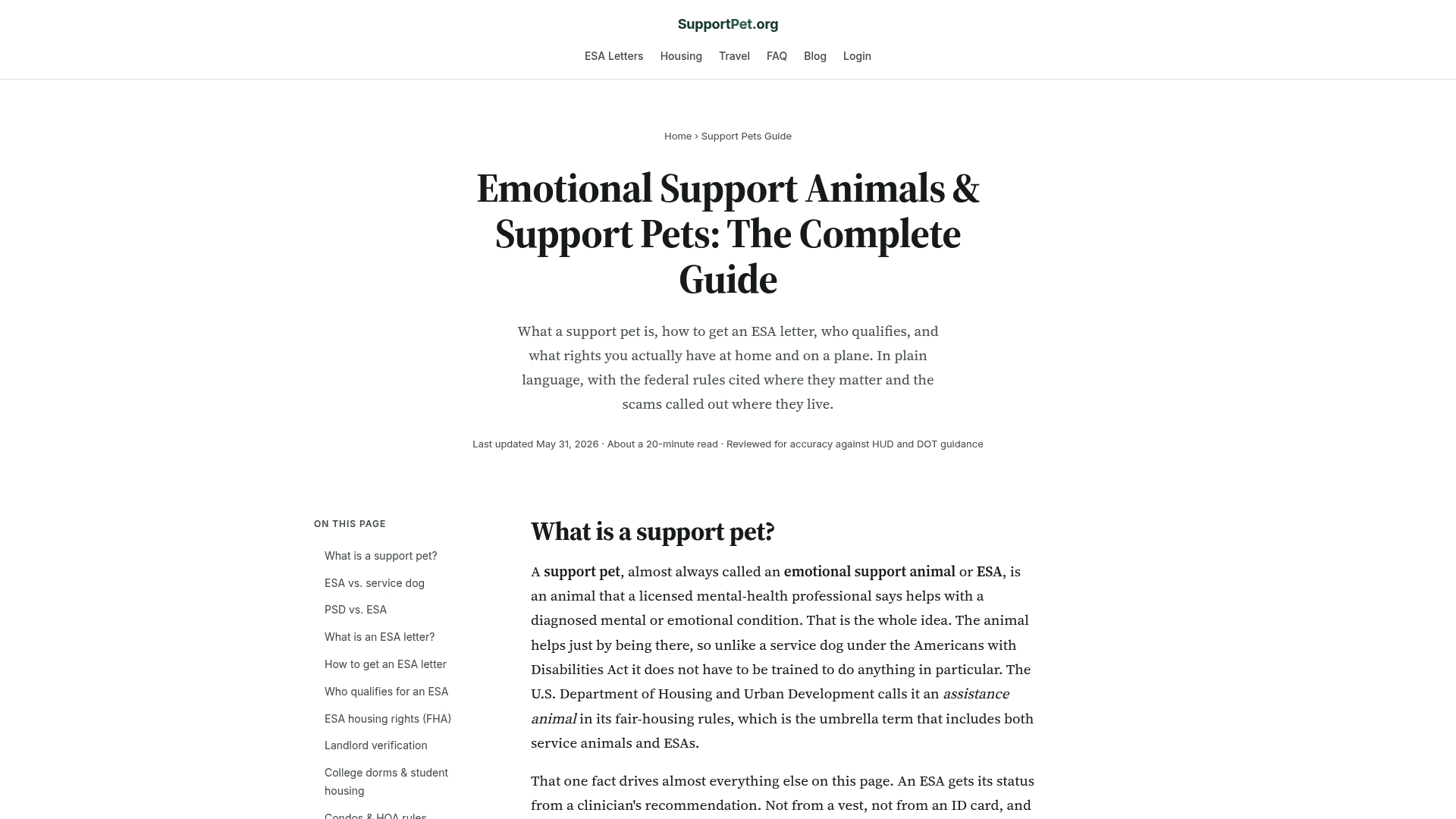
The guides cover sample accommodation letters, red flags to check before paying anyone for documentation, and a breakdown of what counts as a valid clinician statement under current federal and state standards. Start by reading through Supportpet’s ESA rights guide and pull together your request packet before you submit anything to your landlord.
This article is general information, not a substitute for advice from a qualified lawyer. Consult a qualified legal professional about your own circumstances before acting on anything here.
Sources
- Assistance animals | HUD
- Fair Housing Act | U.S. Department of Justice (CRT)
- Emotional support animals: housing fact sheet | NYC Commission on Human Rights
- Mass
- Service and emotional support animals in housing | Minnesota Department of Human Rights