
Expect somewhere between $0 and $500, depending on who writes it. If you already see a therapist, a letter often costs nothing beyond a normal visit. A reputable telehealth evaluation typically runs $89 to $199. An in-person session with a new clinician can hit $500 in expensive markets. Anything under roughly $79 from an online seller is a red flag, not a bargain.
TL;DR:
- Telehealth evaluation platforms charge between $89 and $199 for a real consultation, while in-person assessments often start at $150 and can exceed $500.
- Prices may increase due to factors like clinician type, state laws, number of pets, delivery speed, and platform compliance overhead.
- Less than $79 online options rarely include a live consultation and often do not meet legal standards required by landlords or housing laws.
- Valid ESA letters should be on official letterhead, include clinician license details, and connect your diagnosed condition to animal need, not rely on registration or certification IDs.
Table of Contents
- ESA Letter Cost Breakdown by Path: Therapist, Telehealth, or In-Person
- What Actually Drives ESA Letter Pricing Up or Down
- Which States Make ESA Letters More Expensive to Obtain?
- What Makes an ESA Letter Legitimate, and How Do You Check It?
- Does Insurance Cover an ESA Letter, and What Are the Payment Options?
- How to Spot ESA Letter Mills Before You Pay for One
- Is Paying More for an ESA Letter Worth It? A Quick Break-Even Look
- SupportPet’s Standards for ESA Letter Legitimacy
- SupportPet’s Take on the Smartest Way to Get a Legitimate Letter
- Get Verified ESA Guidance Before You Pay Anyone
- Sources
ESA Letter Cost Breakdown by Path: Therapist, Telehealth, or In-Person
The price you pay depends almost entirely on which door you walk through. Three routes dominate the market, and each comes with a different cost structure, timeline, and level of legal risk if the letter turns out to be worthless.
Your existing therapist or psychiatrist. If you’re already in treatment for anxiety, depression, PTSD, or another qualifying condition, this is usually the cheapest and safest option. Many clinicians write the letter for free as part of ongoing care. Others charge a flat administrative fee, typically somewhere between $0 and $100, since they already know your history and don’t need a new evaluation to justify the recommendation.
Telehealth ESA evaluation platforms. This is where most people who don’t have an existing clinician end up. Reputable services generally charge $89 to $149 for a full evaluation, including a live video or phone consultation with a licensed mental health professional, a clinical write-up, and the final signed letter. Some legitimate platforms price up to $199 for faster turnaround or added support like landlord dispute assistance. What you’re paying for is real clinician time, not a template.
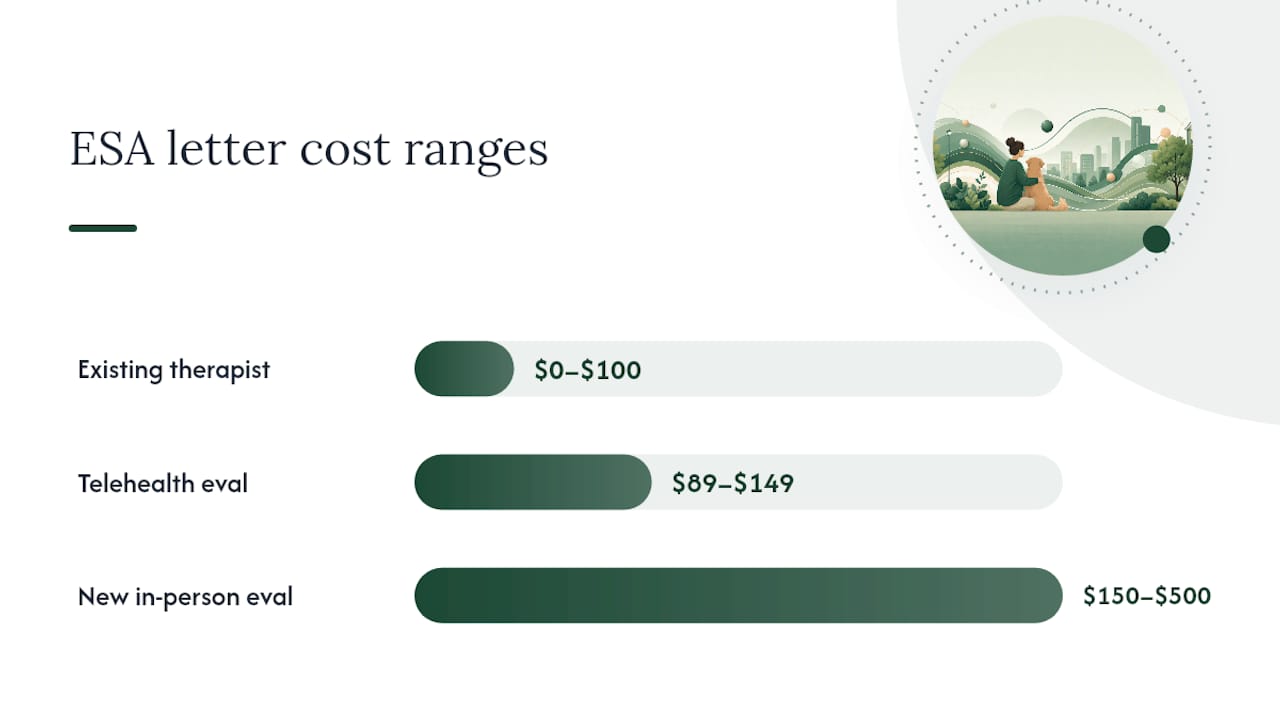
In-person evaluation with a new clinician. Seeing a psychiatrist or psychologist you’ve never met before, specifically to discuss ESA eligibility, tends to cost more. Depending on the clinician’s specialty and your city, initial evaluations commonly run $150 to $500 or more. Follow-up visits and renewal letters are usually cheaper than that first session, since the clinician already has your file.
Beyond the base fee, several add-ons show up across all three paths:
- Multi-pet coverage if you’re seeking documentation for more than one animal, sometimes billed as a small additional fee per pet.
- Rush processing for same-day or next-day letters, often adding $20 to $50 to telehealth pricing.
- Registration or ID kits, which are entirely optional and not required by any federal housing law. Skip these unless you just want a keepsake.
None of these extras affect whether your letter holds up legally. A landlord cares about the clinician’s signature and license, not a laminated ID card.
What Actually Drives ESA Letter Pricing Up or Down
Two people can pay wildly different amounts for what looks like the same document, and the gap usually comes down to a handful of factors.
- Clinician type and rate. A psychiatrist’s hourly rate is typically higher than a licensed clinical social worker’s, and that difference shows up directly in what you’re billed.
- State requirements. Some states legally require an established relationship before a letter can be issued, which forces an extra session (and an extra fee) that other states don’t require.
- Number of animals and housing type. College housing situations sometimes involve additional documentation steps compared to standard rental units, and multiple pets can mean multiple evaluations.
- Delivery speed. Standard turnaround is cheaper than rush service almost everywhere.
- Platform overhead. Telehealth companies licensed to operate across multiple states carry higher compliance costs, and that gets reflected in price.
Pro Tip: Ask upfront whether the quoted price includes the actual clinical consultation or just the paperwork. A price that seems low but doesn’t include a real conversation with a licensed professional isn’t a discount. It’s a missing step.
Which States Make ESA Letters More Expensive to Obtain?
A handful of states have passed laws specifically designed to shut down letter mills, and if you live in one, expect to pay more upfront simply because the law requires more clinical contact before a letter can be written.
- Check whether your state requires an established relationship. California, for example, generally requires that a client have an existing relationship with the clinician, often defined as at least 30 days, before that clinician can issue a valid ESA letter. Arkansas, Iowa, Louisiana, and Montana have adopted similar frameworks aimed at the same problem: instant letters from clinicians who’ve never spoken with the client.
- Expect at least one extra session in those states. That 30-day rule usually means an initial intake appointment followed by a second visit once the relationship is established, which adds cost compared to a one-and-done telehealth model.
- Confirm your landlord’s acceptance window. Most landlords will accept a letter dated within the past 12 months, but some request updated documentation annually or after a lease renewal, so factor that into your budget.
- Verify your specific state’s rule before paying anyone. State civil rights or fair housing agency websites usually publish current guidance, and it takes five minutes to confirm you’re not about to pay for a letter that doesn’t meet your state’s threshold.
Skipping this step is how people end up paying twice: once for a letter that doesn’t satisfy their state’s law, and again for the one that actually does.
What Makes an ESA Letter Legitimate, and How Do You Check It?
A valid letter has a specific structure, and it’s worth knowing that structure before you hand over any money.
At minimum, it needs to be on the clinician’s letterhead, name the clinician directly, list their license type and license number, state the issuing state, and carry a signature. It also needs a clinical statement connecting your diagnosed condition to a genuine need for the animal’s presence in your home. HUD’s own guidance confirms that documentation simply needs to come from a reliable source, and landlords are permitted to request exactly this kind of proof.
Before paying anyone, verify these:
- The clinician’s license number checks out on your state’s professional licensing board website.
- The letter references a genuine clinical relationship, not a one-line form response.
- There’s no mention of a “registration number” or “certification ID” presented as if it’s legally required. It isn’t.
- The language matches what clinical researchers describe as appropriate for these letters: a documented condition and a documented need, not a generic template.
A legitimacy benchmark worth remembering: offers priced under roughly $79 online frequently skip the live clinical evaluation entirely, which means the resulting letter may not hold up if a landlord pushes back.
Does Insurance Cover an ESA Letter, and What Are the Payment Options?
Most telehealth ESA evaluations are cash-pay. Insurance companies generally don’t reimburse a standalone visit whose sole purpose is writing a support animal letter, since it’s not classified as a covered medical service.
There’s an important exception, though. If your existing therapist writes the letter as part of a regular, ongoing treatment appointment, that visit itself may already be billed to insurance the way any other session would be. You’re not paying extra for the letter. You’re just asking your provider to include it in care you’re already receiving.
If cash-pay is your only option, a few strategies bring the cost down:
- Use an HSA or FSA. Many telehealth platforms accept these accounts for evaluation fees.
- Ask about payment plans. Some providers split the fee across two payments.
- Check community mental health centers. Sliding-scale fees can make an in-person evaluation cheaper than telehealth in some areas.
- Look into your employer’s EAP. Employee assistance programs sometimes include free short-term counseling sessions that could lead naturally to a letter.
Before shopping around, ask your current clinician first. It’s almost always the least expensive legitimate route available.
How to Spot ESA Letter Mills Before You Pay for One
The clearest warning sign is price. Anything advertised under roughly $79, paired with instant approval, should make you pause. A real clinical evaluation takes time, and that time costs money. There’s no version of a legitimate process that’s both instant and nearly free.
Other red flags stack up quickly once you know what to look for:
- No live consultation of any kind, just a form to fill out.
- No license number, license type, or issuing state listed anywhere on the sample letter.
- Aggressive upsells for “official” registration kits, ID cards, or vests immediately after checkout.
- Marketing language implying the letter grants airline travel rights. It doesn’t. Federal rules changed in 2021, and airlines no longer have to accept ESA documentation the way they once did.
If a landlord rejects a letter you already paid for, don’t argue the point yourself. Get a re-evaluation from a licensed clinician who can issue a letter that actually meets the legal standard, and keep a written record of every communication with the landlord in case you need it later.
Pro Tip: Save every email and text exchange with your landlord about your ESA request. If a dispute ever escalates, that paper trail matters more than the letter itself.
Is Paying More for an ESA Letter Worth It? A Quick Break-Even Look
Whether a $150 evaluation beats a $79 one depends on what you’re comparing it against: the pet fees a landlord would otherwise charge.
Many rental properties charge a one-time pet deposit plus ongoing monthly pet rent for tenants without qualifying documentation. A legitimate ESA letter, under the Fair Housing Act, generally means those fees don’t apply to your support animal.
Even the pricier end of legitimate telehealth pricing pays for itself within the first month or two of avoided pet rent in most of these scenarios. That math is exactly why paying a little more for a real clinical evaluation, instead of gambling on a $79 letter mill that a landlord might reject outright, tends to be the financially smarter move.
SupportPet’s Standards for ESA Letter Legitimacy
Every claim in this guide traces back to primary sources, not marketing copy. HUD’s assistance animal guidance is the federal backbone for what landlords can and can’t require. State-level rules, like California’s established-relationship requirement, show why pricing and process vary by location.
SupportPet exists to translate that patchwork of federal and state rules into plain language, without pushing readers toward registries or novelty products that HUD has never required. A few things worth keeping in mind as you evaluate any provider:
- A valid letter always comes from a licensed mental health professional, never from an automated form.
- Registration numbers, ID cards, and “certified ESA” badges carry no legal weight under federal housing law.
- Clinical judgment, not platform branding, is what makes a letter defensible if a landlord pushes back.
This article was reviewed against the sources cited throughout, and the guidance reflects the current federal and state landscape as of 2026.
SupportPet’s Take on the Smartest Way to Get a Legitimate Letter
Start with the clinician who already knows you. That relationship is the fastest path to a letter that costs little or nothing and holds up without question. Telehealth is a reasonable second option when you don’t have an existing provider, but choose a platform that requires a real video or phone consultation, not just a questionnaire.
What worries me most isn’t the $150 evaluation. It’s the $59 instant approval that feels like a win until a landlord asks for a license number that doesn’t exist. Renewals matter too: most letters are good for about 12 months, and skipping that renewal is how otherwise valid documentation quietly becomes useless.
— Erik
Get Verified ESA Guidance Before You Pay Anyone
SupportPet is the resource to check before you hand your card number to a telehealth platform or a clinician you’ve never met. Where other sites push registration kits and vague price promises, SupportPet lays out exactly what a licensed professional needs to include, how to verify their license in your state, and which red flags mean walk away.
If you’re comparing telehealth options for the evaluation itself, a platform like AI Therapist offers ongoing mental health support that can complement the kind of established clinical relationship many states now require. But before you pay any provider for a letter, run through SupportPet’s full ESA rights guide to confirm what your state requires and how to spot a letter that won’t hold up. It takes ten minutes and could save you from paying twice.
Sources
For anyone who wants to verify these rules firsthand rather than take a guide’s word for it:
- HUD — Assistance animals: information and guidance
- California Civil Rights — Emotional support animals and Fair Housing law FAQ
- U.S. Department of Transportation — Final rule on traveling with service animals
This article is general information, not a substitute for advice from a qualified doctor. Consult a qualified healthcare professional about your own circumstances before acting on anything here.