
An emotional support puppy may qualify for housing protections under the Fair Housing Act. Check HUD’s assistance animal materials for information about documentation and the interactive process. Outside your home the picture changes. The ADA does not treat ESAs as service animals, and the Department of Transportation lets airlines apply pet rules. Puppies face extra scrutiny because untrained behavior can end an accommodation.
TL;DR:
- For housing, submit a current, signed letter from a licensed clinician, vaccination records, and a written request before the puppy moves in; keep dated copies.
- Landlords cannot demand your diagnosis or an online registry number, but they may verify the clinician’s license and deny documented direct threats or repeated damage.
- Airlines may treat ESAs as pets, so check carrier dimensions, weight limits, and fees before booking; service animal forms do not automatically apply to ESAs.
- Behavior problems often trigger housing disputes, so start obedience and house training early; federal law does not require formal ESA training.
- Businesses can refuse ESA puppies because the ADA grants public access only to trained service dogs; ask permission first and leave if declined.
Table of Contents
- Where are ESA puppies allowed in housing, public places, and on planes?
- Can a puppy be an ESA? Age, training, and what the law requires
- How do you make an ESA puppy housing request landlords must take seriously?
- What to expect when you bring an ESA puppy on a flight or into public places
- How can you keep your puppy’s ESA status from being denied or revoked?
- What can landlords ask, which exemptions exist, and how are disputes resolved?
- Do state and local rules change where an ESA puppy is allowed?
- How do we recommend handling an ESA puppy request?
- How do you choose the right breed for an emotional support puppy?
- How do you introduce an ESA puppy to your living space?
- What care and maintenance do ESA puppies need in rental housing?
- What is the timeline from ESA letter to housing recognition?
- An author’s note: training first, paperwork second
- How can we help you prepare your housing request?
- FAQ
- Sources
Where are ESA puppies allowed in housing, public places, and on planes?
Three separate federal frameworks apply, and they give very different answers. Understanding the distinctions is important for new puppy owners.
- Housing falls under the Fair Housing Act, enforced by HUD. This is where an ESA has its strongest, enforceable protection. A landlord generally must consider a request for a reasonable accommodation, even in a building with a no-pet policy, when the animal relates to a disability. HUD’s assistance animal materials explain the documentation and interactive-process expectations for housing providers.
- Public places fall under the ADA. A service animal is a dog individually trained to do work or perform tasks for a person with a disability, and a dog whose sole function is comfort or companionship does not qualify. Because ESAs are not service animals under the ADA, they do not have guaranteed public-access rights. A grocery store, restaurant, or gym may decline to admit an ESA puppy.
- Air travel falls under DOT and Air Carrier Access Act rules. The final rule lets airlines treat emotional support animals as pets, so carrier requirements, weight limits, and fees can apply.
The practical takeaway is to put your effort where the law actually protects you. Build your housing documentation and your puppy’s behavior first. Then ask permission before bringing a puppy into any discretionary public setting, and check airline pet policies well before booking a flight.
If you want a deeper look at the difference between the two categories, our guide on ESA versus service dog distinctions walks through it.
Can a puppy be an ESA? Age, training, and what the law requires
The available guidance here does not specify a minimum age for an emotional support animal in housing. Check HUD’s assistance animal materials for information about housing requests. A housing request involves a disability-related need. Check HUD’s assistance animal materials for information about documentation and the interactive process. A puppy can meet that standard on paper. The harder question is whether the puppy can stay in the home once the novelty and the chaos begin.
HUD’s May 2026 enforcement guidance shifts enforcement toward the ADA’s task-training definition when assessing assistance-animal claims. HUD staff will prioritize cases involving trained assistance animals, while FHA protections are still recognized in many contexts. For puppies, this does not create a ban, but it does raise the odds that an untrained animal gets questioned. The enforcement reality tends to land on local dispute resolution rather than quick federal intervention.
Behavior, not age, is the usual reason for trouble. According to the National Fair Housing Alliance, behavioral issues are the most common cause of denied housing accommodations, which is why basic obedience and house-training matter so much.
Here is what that means in practice:
- A landlord may raise concerns about an animal’s behavior or damage. Check HUD’s assistance animal materials for guidance on housing requests and the interactive process.
- Barking, chewing, and accidents are normal puppy behavior, but repeated complaints can become a nuisance record.
- The letter should explain the disability-related need for the animal, not the breed or the cute factor.
- HUD’s assistance animal materials describe documentation and interactive-process expectations. Ask HUD or a qualified housing adviser what information may be requested in your situation.
Pro Tip: Ask your clinician to date the letter close to your request and to state the disability-related need in general terms, without diagnosis details. A current, clean letter removes the easiest reason for a landlord to stall.
We explain what clinicians and landlords accept in our walkthrough on how tenants qualify for an ESA. Mental health evaluations also matter beyond paperwork, and this discussion of clinical evaluations shows what a thorough assessment involves.
How do you make an ESA puppy housing request landlords must take seriously?
Housing is where your puppy has real standing, so it pays to do this step carefully. HUD’s assistance animal materials explain FHA protections for assistance animals in housing and the interactive process for requests. Most apartments, condos, and rentals are covered, while a few narrow categories are exempt (more on those later).
Documentation expectations can depend on the request. HUD’s assistance animal materials explain the documentation and interactive process.
- A current, signed recommendation from a licensed mental health professional.
- Reasonable ancillary records, such as vaccination proof for your puppy.
For guidance on what documentation may be requested, consult HUD’s assistance animal materials. HUD’s assistance animal materials explain documentation expectations. Check the guidance for what may be requested in your situation.
Follow these steps to submit a request:
- Get your recommendation from a licensed clinician who has assessed you, and confirm the letter is current.
- Gather your puppy’s vaccination records and any trainer notes or class receipts.
- Send a written request to your landlord or property manager, and keep a dated copy. Our copy-ready landlord notification letter can save you drafting time.
- Engage in the interactive process. If the landlord asks a reasonable question, answer it in writing and keep records of every exchange.
- If the request is wrongly denied and the conversation stalls, file a complaint through HUD’s complaint process.
A written request does two things. It creates a paper trail, and it signals that you understand the process. Many disputes end at step four, when the landlord realizes the documentation is in order.
For a deeper explanation of how the 2026 enforcement shift affects tenants, see our page on ESA housing rights and what HUD’s change means. If you are starting from scratch, our no-fee, no-registry guide shows how a renter’s dog becomes a valid ESA.
What to expect when you bring an ESA puppy on a flight or into public places
Airlines changed their approach, and many puppy owners still plan around the old rules. DOT’s final rule permits airlines to treat ESAs as pets. Psychiatric service dogs trained to perform tasks remain service animals, but a dog that offers comfort alone does not. DOT’s service animal guidance confirms that under the Air Carrier Access Act, a service animal is a dog individually trained to do work or perform tasks for a qualified person with a disability.
For your puppy, that translates into pet travel rules. Here is how to prepare:
- Call the airline before you book and ask about its pet policy, carrier dimensions, weight limits, and fees.
- Know that airlines may require passengers with service animals to submit DOT forms attesting to health, training, and behavior. Those forms apply to service dogs, so do not assume they apply to your ESA.
- Plan for a carrier that fits under the seat, since a puppy’s size can change quickly between booking and travel.
- Arrive early, and bring vaccination records in case the airline asks.
Public places work differently from planes. Restaurants, shops, and other businesses can lawfully decline an ESA, though some allow them at their discretion. Ask permission first, and be ready to leave if the answer is no. Puppies make this harder because they are unpredictable, so a quiet, short outing in a pet-friendly spot is a better test than a crowded store.
The ADA’s own service animal FAQ states that emotional support, therapy, and companion animals are not service animals. For a plain-language version, our explainer on why an ESA guarantees housing rights but not public access covers the same ground.
How can you keep your puppy’s ESA status from being denied or revoked?
Good preparation can help prevent problems. Landlords rarely object to a quiet, clean, well-mannered animal. They object to noise, damage, and messes. Training is your best insurance, and a guide on training requirements shows that no federal law requires formal ESA training, even though behavior still decides outcomes.
Use this routine:
- Start basic obedience early: sit, stay, come, and leave it.
- House-train consistently, and use crate training to handle the hours you are away.
- Socialize your puppy with people, other dogs, and everyday noises so it stays calm around neighbors.
- Work on quiet behavior, such as settling on a mat, to head off barking complaints.
- Keep a folder with your current clinician letter, vaccination records, and any trainer notes or class receipts, so you can respond fast if a landlord asks.
- Offer reasonable mitigation, such as a waste-disposal agreement or a commitment to continue training, without conceding your legal rights.
Notice that step six matters. Offering a practical solution shows good faith, and it often defuses a complaint before it grows. You are not giving up the accommodation, only making it easy for the landlord to say yes.
Pro Tip: Enroll in a basic obedience or puppy socialization class early. A trainer’s notes and a completion certificate are easy proof of good conduct if a neighbor complains later.
What can landlords ask, which exemptions exist, and how are disputes resolved?
Knowing the boundaries keeps conversations calm. Here is what landlords can and cannot do:
- They cannot demand your diagnosis, your treatment records, or an online registration number.
- They may reasonably verify a current letter from a licensed clinician and that the clinician holds a state license.
- They may deny a request for a documented direct threat or repeated, documented property damage, and they must be able to show the documentation.
- Common exemptions include certain small owner-occupied buildings and some single-family rentals rented without a broker. These exemptions are narrow, so check the specifics before assuming one applies.
If a dispute starts, take these steps in order. Ask for the interactive process in writing, provide any clarifying documentation, and consider mediation. If it still stalls, file a complaint with HUD. Our page on what HUD’s change means for ESA housing rights describes how this plays out for tenants.
Do state and local rules change where an ESA puppy is allowed?
They can, and that is why you should always check beyond federal law. Some states add housing protections, and some place limits on online sellers of ESA documents. California, for example, publishes guidance on emotional support animals and fair housing noting that state law may require reasonable accommodations for ESAs even though ESAs are not service animals, and that states can add protections beyond federal rules.
Check these local sources:
- Your state civil rights department
- Your state housing authority or fair housing agency
- City or county ordinances
- Official guidance documents posted by those agencies
Confirm whether local law expands or narrows federal protection before you rely on any single rule.
How do we recommend handling an ESA puppy request?
Our position is consistent. A recommendation from a licensed mental health professional is the legally meaningful document. Do not assume that an online registry, vest, or certificate establishes housing eligibility. Check HUD’s assistance animal materials for information about documentation and requests. Treat a registry as a red flag, not a shortcut.
We built our guides to help you write a clean housing request:
- How to get an ESA letter lays out the honest steps.
- ESA letter sample shows what a real letter looks like.
- Emotional support animal registration explains why registration is not a legal requirement.
For wider background on how animals support mental health, this piece on service dogs and children with anxiety and PTSD gives helpful context, though service dogs and ESAs remain legally distinct.
How do you choose the right breed for an emotional support puppy?
The best ESA puppy is the one whose temperament fits your life, not the one that looks the part. Breed-related housing rules can depend on the applicable law and circumstances. Check HUD’s assistance animal materials and local guidance before relying on a general rule. Think about temperament first.
Look for a puppy that is calm, affectionate, and tolerant of handling. A dog that seeks contact and recovers quickly from surprise will usually settle into apartment life more smoothly than one that is highly reactive.
Match energy to your routine. A high-energy breed needs hours of exercise, and an under-exercised dog tends to bark, chew, and wreck a rental. If your days are quiet or your mental health makes long outings hard, a lower-energy dog is easier to keep.
Size matters in practice. Smaller dogs often fit more easily under airline pet rules and in tight spaces, while larger dogs may face weight limits when you travel.
Meet the puppy and its parents when you can. Observe how the litter behaves, and ask a breeder or rescue about temperament, health, and early socialization. Adoption from a shelter can also work well, and an adult dog with a known temperament is sometimes a safer bet than an unpredictable puppy.
How do you introduce an ESA puppy to your living space?
A puppy settles faster when your home has structure from day one. Set up before it arrives so the first days are calm rather than chaotic.
Prepare a small, safe zone with a crate or pen, a bed, water, and chew toys. Puppy-proof cords, shoes, and anything fragile. This protects both your puppy and your security deposit.
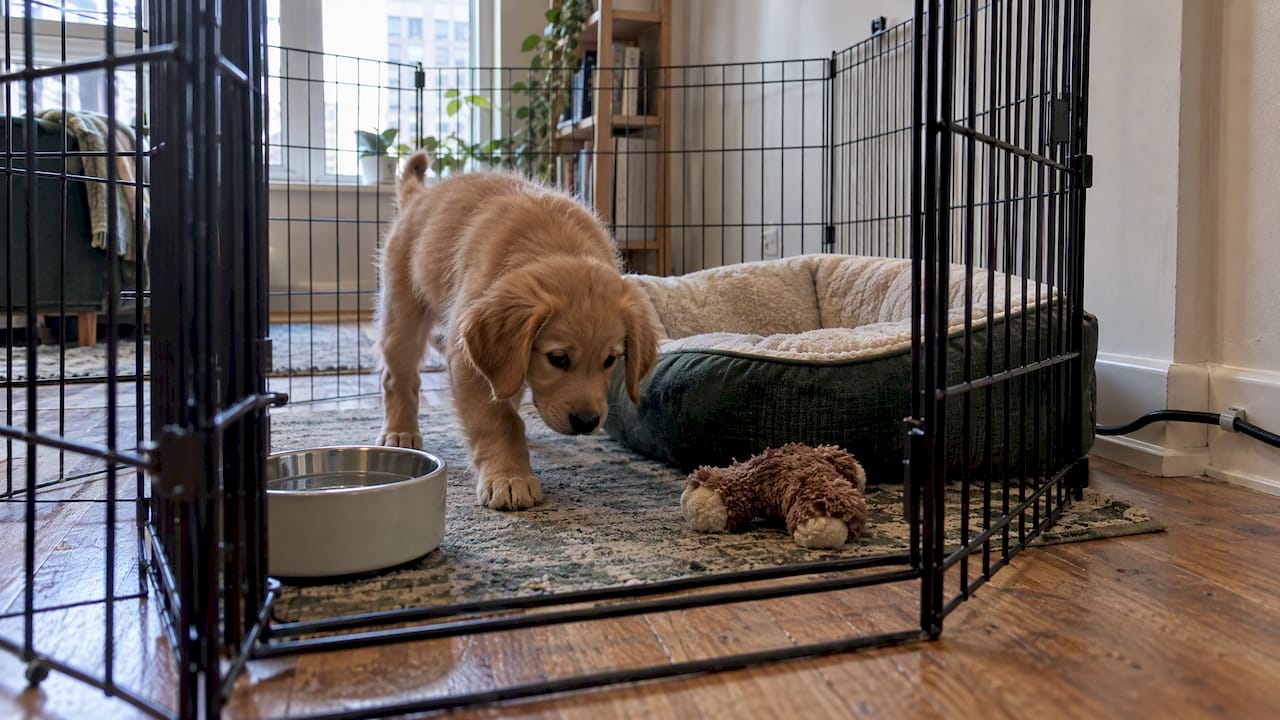
Start a routine immediately. Feed at consistent times, take your puppy out after meals, naps, and play, and praise every correct bathroom trip. Consistency is what makes house-training work in an apartment.
Introduce the building gradually. Let your puppy meet neighbors one at a time, walk common areas on a leash, and practice calm greetings. Neighbors who see a polite puppy are far less likely to complain.
Build short alone-time sessions. Leave for a few minutes, then return before your puppy panics, and lengthen the gap slowly. This prevents the howling and destruction that trigger nuisance complaints.
If you share your home with other pets, introduce them in neutral space with short, supervised meetings. Keep the early days boring and predictable, because a calm start is the best foundation for the bond your emotional support needs.
What care and maintenance do ESA puppies need in rental housing?
Renting adds responsibilities on top of normal puppy care. Landlords rarely care how much you love your dog, but they care about cleanliness, noise, and damage.
Keep vaccinations and vet visits current, and store the records in the folder you would share with a landlord. Check your local government’s official guidance for any animal licensing requirements.
Manage waste promptly, both indoors and outdoors. Clean accidents with an enzyme cleaner so odors do not linger and become a lease issue.
Protect the unit. Use washable bedding, trim nails, and provide plenty of chew toys. Fees and responsibility for damage can depend on the housing circumstances and applicable rules. Check HUD’s assistance animal materials or consult a qualified housing adviser.
Exercise and mental stimulation reduce bad behavior more than any correction does. A tired puppy is a quiet puppy, so plan walks, play, and short training sessions every day.
Finally, stay on top of grooming and flea prevention. A clean, healthy animal keeps your housing file free of complaints and keeps your puppy comfortable.
What is the timeline from ESA letter to housing recognition?
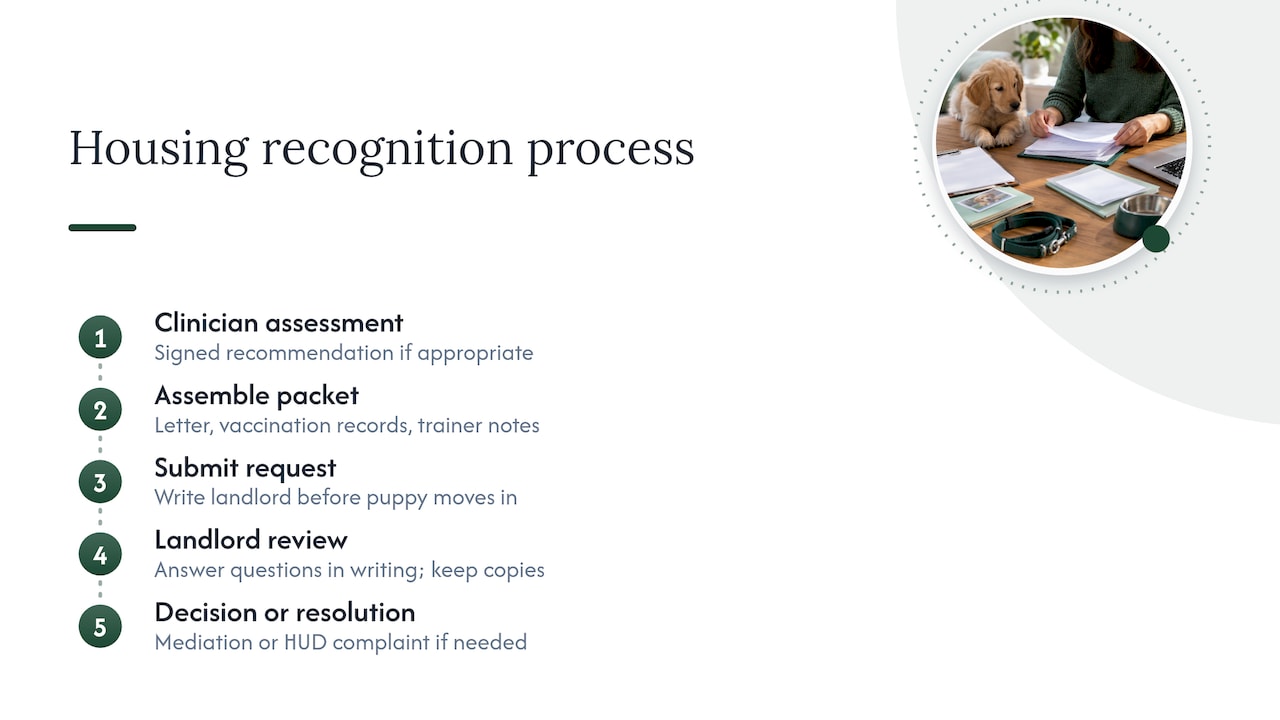
The process moves in stages, and your own preparation sets most of the pace. Timelines vary by clinician, landlord, and location, so treat these stages as a sequence rather than a schedule.
First, you have an assessment with a licensed mental health professional who determines whether an animal relates to your disability-related needs. If appropriate, the clinician issues a signed, current recommendation. Our guide to getting an ESA letter in 2026 covers this step in detail.
Second, you assemble your packet: the letter, vaccination records, and any trainer notes.
Third, you submit a written request to your landlord, ideally before the puppy moves in. A request made after the fact can look like an afterthought.
Fourth, the landlord reviews the request and may ask reasonable verification questions. You respond in writing and keep copies.
Fifth, the landlord approves, or you work through the interactive process and, if needed, mediation or a HUD complaint.
Once approved, your job is to keep the paperwork current and your puppy well-behaved. Recognition is not a one-time event, because behavior problems can reopen the question later.
An author’s note: training first, paperwork second
I keep coming back to one idea when readers ask about puppies. The legal protection is real, but it is thin, and a puppy’s behavior is what decides whether you get to keep it. A calm, trained dog makes a landlord’s job easy. An unruly one hands them a reason.
So my priorities run in this order: train early, document honestly, skip registries, and treat housing as the one domain where the law truly has your back. We focus on cutting through scams and pointing you to licensed clinicians, because that is what holds up when someone challenges your request.
— Erik
How can we help you prepare your housing request?
If you are ready to move from reading to doing, we built our resources to make your request simple and credible. Start with our step-by-step ESA letter guide for a checklist, then use our ESA letter sample to see how a real letter reads. They are educational resources, and they show you what a landlord may reasonably request and how to submit a proper written accommodation request. Open the guide, gather your documents, and send your request with confidence.
This article is general information, not a substitute for advice from a qualified lawyer. Consult a qualified legal professional about your own circumstances before acting on anything here.
FAQ
Does having an ESA go on your record?
An ESA recommendation does not create a public record the way a criminal or credit entry would. Your clinician keeps your health information confidential, and landlords cannot demand your diagnosis or treatment records. They may only verify that the letter is current and the clinician is licensed.
What is the difference between a therapy dog and an emotional support dog?
An emotional support dog provides comfort through its presence to one person, and that person’s clinician supports the need. A therapy dog visits settings such as hospitals or schools to comfort others. Neither is a service animal, because the ADA requires task training for service animals.
Can a puppy be an ESA in a no-pet apartment?
Yes, a puppy can be an ESA in a no-pet apartment if the housing is covered by the Fair Housing Act and a licensed clinician supports the need. Landlords can still deny a request for a documented direct threat or repeated property damage, so training matters.
Can I bring my ESA puppy into stores and restaurants?
Not as a right. The ADA defines service animals as dogs individually trained to do work or perform tasks for a person with a disability, so ESAs do not have guaranteed public-access rights. Businesses may allow an ESA at their discretion. Ask permission first and be ready to leave if the answer is no.
Sources
Recommended
- ESA Housing Rights in 2026: What HUD’s Change Means
- U.S. ESA Airline Rules 2026: DOT Forms, $95–$150 Pet Fees, and PSD Path
- Renters: How HUD’s 2026 ESA Guidance Changes Your Housing Rights
- Get HUD to Accept Multiple ESAs: Clinician Letters Tenants Can Use