
An ESA letter is the only one of the three that matters. A letter from a licensed health care professional who knows your condition can support a housing request for an emotional support animal. “Registration” and “certification” are products sold by websites. No law requires them, and they do not create rights. If you are deciding where to spend your money and trust, the rest of this guide explains why, what a real letter contains, and how to avoid paying for paperwork that a landlord can ignore.
TL;DR
- An ESA letter is a document from a licensed clinician stating that you have a disability-related need for an animal. It is the documentation housing providers look for.
- ESA registration and certification are commercial add-ons. No federal registry exists, and California’s civil rights agency says an ESA does not need to be registered or certified.
- Under the Fair Housing Act, an assistance animal is not a pet, so a housing provider generally cannot charge pet fees or deposits for it.
- State rules differ. Some states require the clinician to be licensed in-state and to have a minimum relationship with you before writing the letter.
- An ESA is not a service animal and does not get public access rights such as entering stores or restaurants.
Table of Contents
- The three terms, side by side
- Why registration and certification do not create rights
- What an ESA letter is and what it does
- Does the clinician’s state matter?
- What the letter protects, and where it stops
- ESA versus service animal
- How to tell a legitimate letter source from a scam
- A practical path for renters and students
- Our perspective
- Where to start
- FAQ
- Sources
The three terms, side by side
Search results use these words as if they were interchangeable. They are not. Here is what each one is in practice.
| Term | What it is | Who issues it | Legal weight |
|---|---|---|---|
| ESA letter | A signed statement about your disability-related need for an animal | A licensed health care professional who knows you | The documentation housing providers may ask for when your need is not obvious |
| ESA registration | An entry in a private online database | A company that sells it | None. No official registry exists |
| ESA certification | A printed or digital certificate, sometimes with an ID card or vest | A company that sells it | None on its own |
The pattern is simple. The letter comes from a clinician and rests on your health. The registration and certificate come from a seller and rest on a payment. The first can support a legal request. The second two are merchandise.
Why registration and certification do not create rights
The federal rules that protect emotional support animals in housing come from the Fair Housing Act (FHA). HUD’s guidance, FHEO Notice 2020-01, explains how housing providers should assess a request to keep an assistance animal. It treats these animals as something other than pets. It describes a process built on a disability-related need and a reasonable accommodation request. It does not describe a registry, because there is no registry to describe.
The same notice addresses the sales side directly. It says that documentation from an internet-based business selling certifications or registrations to anyone who pays is not, by itself, enough to show a disability-related need. A landlord who reads that guidance has good reason to treat a purchased certificate with suspicion.
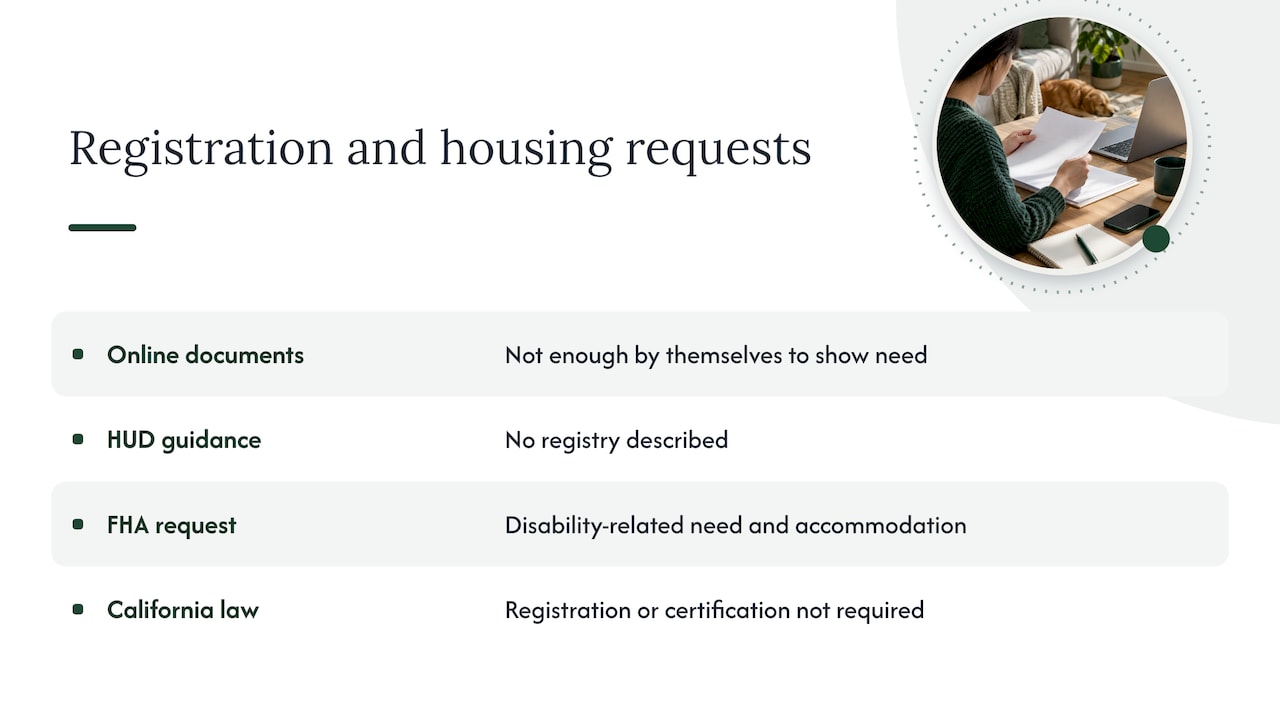
State agencies say the same thing. California’s Civil Rights Department states in its fair housing FAQ that California law does not require an animal to be registered or certified to serve as an ESA, and that such services are unnecessary to establish the need for one.
What about the ID card and the vest?
Cards, vests and tags are a separate product. They may be convenient if you want your animal to look identifiable, but they prove nothing. A vest does not turn a pet into an ESA, and no federal law requires an ESA to wear one. If a seller promises that a card gives you “legal protection,” treat that as a warning sign.
What an ESA letter is and what it does
An ESA letter is the written form of a clinical judgment. A licensed professional who has evaluated you states that you have a condition that qualifies as a disability and that the animal helps with symptoms or limitations connected to it. HUD’s notice says that when a disability or the need for an animal is not obvious, a housing provider may ask for reliable information, and a letter from a health care professional is a common way to give it.
Clinicians are expected to do real work before signing. A peer-reviewed article in Psychiatric Services recommends that the clinician assess whether a patient has a chronic mental impairment caused by a psychiatric condition, and whether an ESA will help ease that impairment. That is a medical question, not a form-filling exercise.
What a credible letter usually contains
HUD does not publish a mandatory template, so layouts vary. A trustworthy letter generally includes:
- The clinician’s name, license type, license number and the state of licensure
- The date, and contact details for the practice
- A statement that you have a disability as defined by fair housing law, without a detailed diagnosis (you do not have to disclose your diagnosis)
- A statement that the animal provides support that relieves one or more symptoms or effects of that disability
- A signature
Notice what is missing: a registration number, a database ID, or a “certified ESA” seal. Those items signal a vendor, not a clinician.
Who can write it
The notice refers to health care professionals who know the person’s disability-related need. In practice that means a licensed therapist, psychologist, psychiatrist, counselor, social worker or physician who has evaluated you. If you already see a therapist, that person is usually the best starting point because they know your history. If you do not have a clinician, a licensed provider who offers a genuine evaluation, including by telehealth where your state permits it, is a reasonable route. Be careful with any service that promises approval before it has spoken with you.
Does the clinician’s state matter?
Yes, and this is where many people get caught. Federal law sets the baseline, but states add their own conditions for letters. According to the Psychiatric Services article, California requires the practitioner to hold an in-state license, to have an established relationship with you for at least 30 days, and to conduct an individual clinical evaluation. The same article notes that Florida requires at least one in-person appointment.
That has practical consequences:
- Check your own state first. A letter that satisfies a service in one state may not meet your state’s rules.
- Expect a waiting period in some states. A promise of a letter “in minutes” is incompatible with a 30-day relationship requirement where one applies.
- Ask where the clinician is licensed. The license should be valid where you live.
These laws keep evolving, so check your state’s current rules on an official government or licensing board page before you pay for anything.
What the letter protects, and where it stops
Housing
HUD’s notice says that under the FHA, assistance animals are not pets. Housing providers must consider reasonable accommodation requests for them, and they may not charge pet fees or deposits for an approved assistance animal. The FHA covers many types of public and privately owned housing. According to ADA.gov, the ADA applies to certain housing settings, while the FHA covers many housing types, including some that the ADA also covers.
The protection has limits. California’s agency explains that a housing provider generally must allow a disability-related ESA accommodation unless it would cause an undue financial or administrative burden, fundamentally alter the business, or the animal poses a direct threat or would cause substantial property damage. You also remain responsible for damage your animal causes, and landlords can enforce normal rules about noise and behavior.
Public places and stores
Here the ESA letter does not help. According to ADA.gov, a service animal is trained to perform tasks related to a person’s disability and generally has public access rights under the ADA, but an animal whose presence provides comfort alone is not a service animal. A restaurant or store can lawfully turn away an ESA that is not also a trained service animal, whatever certificate you carry.
Why some landlords push back
Landlord groups have complained about abuse of the system. The National Apartment Association’s fact sheet on emotional support animals says the proliferation of online ESA letters led the industry to urge HUD to curb potential abuse of accommodation requests. Knowing this helps you prepare. A letter that comes from a clinician who evaluated you, and that clearly states the need, is far harder to challenge than a certificate printed after a checkout page.
ESA versus service animal
People often mix these up, and a mistake here can cause trouble at a store, an airport or a lease signing. A service dog is individually trained to do specific work, such as interrupting a panic response or alerting to a medical event. An ESA provides comfort through its presence and does not need task training. If you want to read more about how trained dogs help people with psychiatric and developmental conditions, this overview of service dogs for anxiety, autism and PTSD shows what that task work looks like.
The practical rule: an ESA letter supports housing requests. A service animal’s status rests on its training and the ADA’s definition. Do not describe your ESA as a service animal to get into a business, because that misrepresents your legal position and makes life harder for handlers with working dogs.
How to tell a legitimate letter source from a scam
The business model behind registration products is selling certainty to nervous people. Watch for these signs:
- Registration is the main product. If the front page sells registry entries, ID cards and vests, the letter is an afterthought.
- Instant approval. A real evaluation involves a conversation about your symptoms. Guaranteed approval, with no assessment, is not clinical.
- No named clinician or license. You should be able to verify the professional on a state licensing board website.
- Claims of “federal registration” or a “national database.” Neither exists.
- A letter issued by someone licensed in another state when your state requires in-state licensure.
- Pressure to buy extras. Certificates, tags and “lifetime registration” add cost without adding rights.
If you have already paid for a registration, you have not lost your chance. Your rights depend on your need and on clinician documentation, not on that purchase. You can still obtain a proper letter from a licensed clinician.
A practical path for renters and students
- Confirm you have a need. Think about how your symptoms affect daily life, and how the animal helps. Be honest and specific.
- Talk to a licensed clinician. Your current therapist or doctor is ideal. If you do not have one, find a licensed provider who performs a genuine evaluation and who is licensed in your state.
- Request the letter and review it. Check the license details, date and wording before you submit it.
- Send a written accommodation request to your landlord or housing office. Attach the letter, name the animal, and keep a copy. Students should contact their campus disability or housing office, which often has its own form.
- Keep records. Save dates, replies and any fee demands. If a landlord charges pet rent for an approved assistance animal, cite HUD’s notice and, if needed, contact a fair housing organization or HUD.
- Plan for renewal. Landlords may ask for current documentation at renewal or for a new animal. Ask your clinician how they handle updates.
Our perspective
We built Supportpet because the first thing most people meet when they search for ESA information is a checkout page. They learn that they need to “register” their animal, pay, and feel protected, until a landlord says no. The paperwork that matters was never the thing being sold.
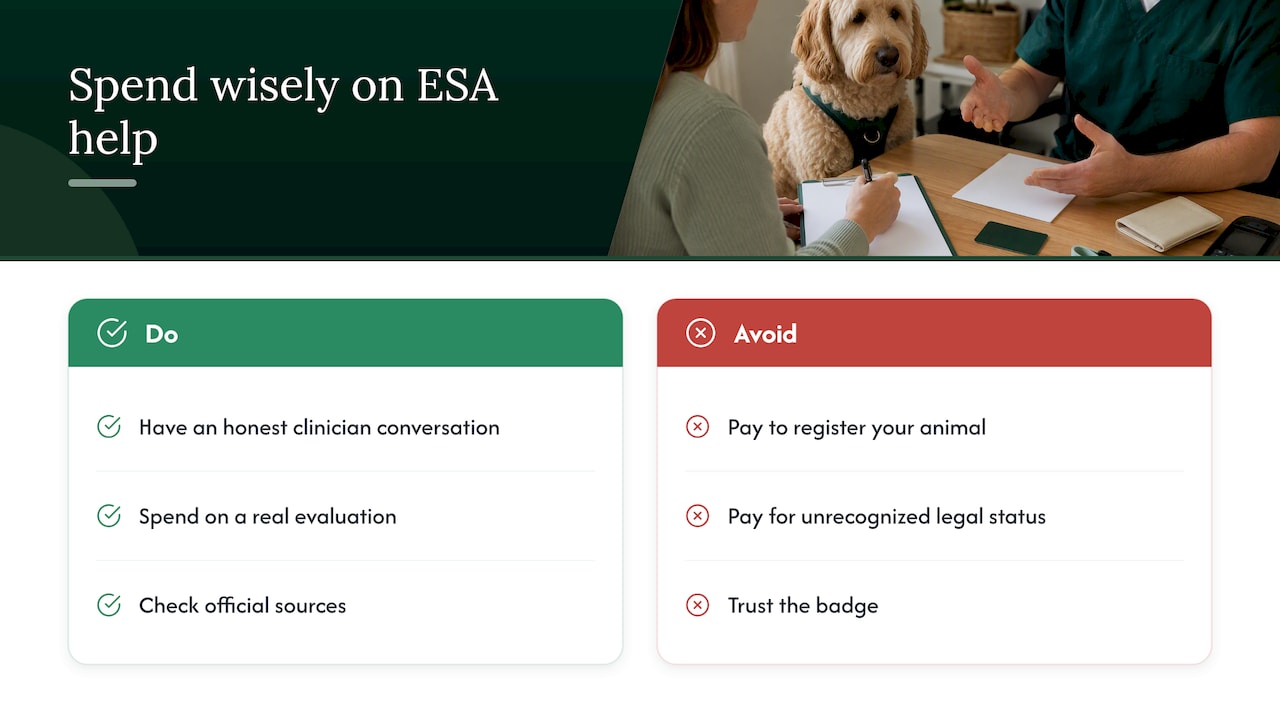
Our view is plain. Your animal does not need to be registered, and the best protection is an honest conversation with a clinician who understands your condition. We do not sell certificates, ID cards or letters, and we do not think anyone should pay for a status that the law does not recognize. Our job is to explain the rules in ordinary language, help you spot a scam before you pay, and point you to official sources so you can check what we say.
We also think a letter should be treated with respect. It is a medical document that says you have a disability-related need. That makes it valuable and means it should come from care, not from a form. If you take only one idea from this page, take this one: spend your time and money on a real evaluation, and ignore the badge.
— Erik
Where to start
If you are still working out whether an ESA fits your situation, or what to say to a landlord, our free guides walk through letters, housing rights and state differences step by step, with no registration fee and nothing to buy.
Browse the plain-language guides at Supportpet and use them to check any provider before you commit.
FAQ
Do I have to register my emotional support animal?
No. Federal housing guidance does not describe any registry, and California’s civil rights agency states that an ESA does not need to be registered or certified. Registration websites are private businesses. What a housing provider may ask for is reliable documentation of your disability-related need, usually a clinician’s letter.
Is ESA certification the same as an ESA letter?
No. A certification is a document sold by a company, often with an ID card, and it does not prove a need on its own. A letter comes from a licensed health care professional who has evaluated you and speaks to your disability-related need for the animal.
Can my landlord charge a pet fee for my ESA?
Under HUD’s guidance, assistance animals are not pets, and housing providers may not charge pet fees or deposits for them. You can still be held responsible for actual damage the animal causes, and your landlord can raise legitimate concerns if the animal poses a direct threat.
Does it matter what state my ESA letter comes from?
Often, yes. California, for example, requires the clinician to be licensed in-state, to have an established relationship with you for at least 30 days, and to perform an individual evaluation. Florida requires at least one in-person appointment. Check your own state’s rules before choosing a clinician.
Can I take my ESA into stores and restaurants?
Not as of right. ADA public access applies to service animals trained to perform disability-related tasks. An animal that provides comfort by its presence alone is not a service animal under the ADA, so a business may decline it.
Sources
- Emotional Support Animals and Fair Housing Law FAQ, California Civil Rights Department
- Assessing a Person’s Request to Have an Animal as a Reasonable Accommodation, HUD FHEO-2020-01
- Considerations for the Writing of Certification Letters, Psychiatric Services
- Service Animals, ADA.gov
- Emotional Support Animals fact sheet, National Apartment Association
- How Service Dogs Help Children With Anxiety, Autism, And PTSD