
Yes, many online ESA-letter services are scams, and a valid ESA letter comes only from a licensed clinician who has a genuine clinical relationship with you. The fastest protection is verifying that clinician’s license before you pay anything. For primary guidance on what counts as acceptable documentation, HUD and Ada are the sources to trust.
TL;DR:
- The Fair Housing Act governs housing requests, while the ADA covers service animals in public settings; an ESA letter grants no restaurant or airline access.
- A valid letter should identify the clinician and license, include an evaluation date, and explain how the animal meets a need tied to your disability.
- Before paying, check the signer’s license on the relevant state board site, confirm a real evaluation occurred, and review recurring charges and privacy terms.
- If a letter is rejected, tell your landlord promptly, seek legitimate documentation, and dispute unauthorized recurring charges through your payment provider.
Table of Contents
- Red flags: common ESA scams to avoid
- What a legitimate ESA letter should include
- Legal reality: ADA vs Fair Housing Act and HUD guidance
- Risks of buying fake or cheap ESA documentation
- How to verify an ESA provider and clinician
- Legitimate steps to get a valid ESA letter
- If you already paid a scam site: remediation and reporting steps
- Recent trends and new scam tactics in ESA scams
- How to distinguish between ESA and service dog scams
- Why clinician verification matters more than any registry
- Free tools to verify your ESA letter before you submit it
- FAQ
- Sources
Red flags: common ESA scams to avoid
Scam sites tend to repeat the same tricks because they work on people who are stressed about housing deadlines or desperate for a quick fix. Learning the pattern takes less time than it took you to read this sentence.
The most common ESA scams share a few traits: speed over substance, bundled products that have no legal weight, and pressure tactics borrowed straight from checkout-page marketing.
- Instant approval or “guaranteed” letters issued after a short quiz with no live interview or clinician contact.
- Registries, ID cards, vests, or “official” certificates sold as if they confer legal status your ESA letter already provides on its own.
- Pricing that looks like a bargain upfront but hides recurring subscription charges or aggressive upsells at checkout.
- Anonymous or unverifiable signers, including clinicians who never speak with you directly or who hold a license in a state with no connection to you or your care.
- Fake government seals, unverifiable testimonials, and countdown timers meant to rush you into paying before you can think it through.
Local investigative reporting has documented real cases of this pattern. One FOX6 investigation found a psychologist under review for signing ESA letters for people she had never properly evaluated, after customers filled out brief online questionnaires. If a provider’s process looks like that, walk away.
What a legitimate ESA letter should include
A real ESA letter reads like a clinical document, not a marketing certificate. Before you accept any letter as valid, check it against these elements.
- Letterhead showing the clinician’s name, license type, license number, and the state that issued the license.
- A date of evaluation and a clear statement that the clinician has clinical knowledge of you as a patient, not just a form you submitted.
- A statement that you have a disability-related need for an assistance animal and a description of how the animal helps, without disclosing your exact diagnosis.
- No reliance on a registry number or ID card as a substitute for the letter itself. A registry or card alone carries no legal weight; the letter and the clinical relationship behind it are what matter.
If you want to compare a document you received against a format that includes all of these elements, our breakdown of clinical items that make an ESA doctor’s note hold up walks through each one in more detail.
Legal reality: ADA vs Fair Housing Act and HUD guidance
Two separate laws govern assistance animals, and confusing them is where many scam sites profit. The ADA covers service animals trained to perform specific tasks for a disability, and emotional support animals are not service animals under that law. That means an ESA letter gives you no federal public access rights to restaurants, stores, or airplanes, no matter what a website promises.
Housing works differently. The Fair Housing Act and HUD guidance govern reasonable accommodation requests for assistance animals in housing, and this is where a properly documented ESA letter actually matters. HUD has been explicit that internet certificates and registries alone are not reliable documentation of a disability-related need, and in one 2019 action HUD asked the FTC to investigate websites selling this kind of paperwork, warning that some sites misleadingly imply federal affiliation.
Practical consequences for renters:
- A landlord may reasonably ask for documentation from a licensed clinician if your disability or need is not obvious.
- HUD recommends an interactive process when a submitted letter looks unclear or questionable, rather than an automatic denial.
- Housing providers cannot charge pet deposits or processing fees for assistance animals once a valid accommodation request is approved.
- Confirming training myths matters too. Our page on why no federal law requires ESA training clears up a common point of confusion for renters and students.
Risks of buying fake or cheap ESA documentation
A cheap letter can end up costing far more than a legitimate one. Landlords routinely reject mill-produced letters, which can trigger retroactive pet fees or put your lease at risk if the animal was already in the unit.
Beyond housing, there are financial and privacy costs to consider:
- Hidden subscription charges that are difficult to cancel or refund once you realize the letter was never valid.
- Exposure of sensitive mental health information to vendors with no clear data-handling or privacy standards, and the possibility that data gets resold.
- Some states penalize false claims or clinicians who issue letters without a genuine clinical relationship, which can leave both the buyer and the signer in legal jeopardy.
- A rejected letter often means starting the entire process over, this time against a tighter deadline.
If you have already received a letter you suspect is fraudulent, our guide on steps to take when you encounter fake ESA letters walks through what tenants and landlords should do next.
How to verify an ESA provider and clinician
Verification takes a few minutes and saves you from the cost of a rejected letter later. Treat this as a checklist before you pay anyone.
- Look up the clinician’s license number on the relevant state licensing board website and confirm the name, license type, and status match what’s on the letter.
- Ask directly whether the clinician has an ongoing clinical relationship with you, how long that relationship has lasted, and whether a real-time interview took place.
- Request details on what the letter template will actually include, along with a privacy policy explaining how your health information is stored and used.
- Review the billing terms closely for refund policies and any clause that could trigger a recurring charge you didn’t expect.
Pro Tip: If the state license lookup returns nothing, or the name on the license doesn’t match the signer, treat the letter as invalid and stop the transaction.
A legitimate telehealth evaluation can absolutely satisfy HUD’s documentation standard. The difference between that and a letter mill isn’t the use of video calls, it’s the depth of the clinical relationship and whether the clinician keeps real records of your care.
Legitimate steps to get a valid ESA letter
Getting a real ESA letter follows a predictable sequence, and skipping steps is usually what leads people toward mills.
- Start with your existing mental health provider if you have one, or locate a licensed telehealth clinician who documents an actual clinical relationship rather than a one-time form.
- Complete a full assessment that covers your history and how an animal specifically helps your symptoms, then request a dated letter on letterhead.
- Keep copies of everything and submit a formal reasonable accommodation request to your housing provider, tracking every submission and response.
- If you use telehealth, confirm the provider maintains ongoing records and expects some form of follow-up care, not just a single transaction.
For a step-by-step walkthrough built around this process, see our guide on getting a verifiable, state-compliant ESA letter.
If you already paid a scam site: remediation and reporting steps
If you suspect you’ve been scammed, act quickly while records are fresh.
- Document the transaction and any communication, then contact your payment provider to dispute unauthorized or recurring charges.
- File a complaint through the FTC complaint portal process and, where relevant, with HUD or your state’s licensing board if a clinician signed without a genuine evaluation.
- Notify your landlord early if a letter gets rejected, and replace it with legitimate clinical documentation rather than letting the dispute drag out; tenant advocacy groups or legal aid can help if you face eviction threats.
- Secure your accounts, change passwords tied to the scam site, and request deletion of any health data you submitted.
Recent trends and new scam tactics in ESA scams
Scam tactics have shifted as more states tighten rules around who can issue an ESA letter. Several states now require a minimum treatment period or an established relationship before a clinician can sign off, which has pushed some scam operators toward shorter, high-pressure “express” services that try to close a sale before a buyer can research those requirements.
QR code scams have also become more common, often appearing on flyers, social media ads, or counterfeit registry cards that link to payment pages disguised as official government portals. Another emerging pattern involves bundling an ESA letter with unrelated products such as travel documentation or “certification” badges that have no legal function, banking on buyers not knowing the difference between a real letter and decorative paperwork.
Investigative reporting continues to expose these patterns at the local level. The case involving an Elm Grove psychologist under review for signing letters without proper evaluation illustrates how even licensed professionals can end up tied to mill-style operations when oversight is thin. The common thread across every new tactic is the same old gap: a real clinical relationship takes time and documentation, and anything promising to skip both is selling you a liability, not a letter.
How to distinguish between ESA and service dog scams
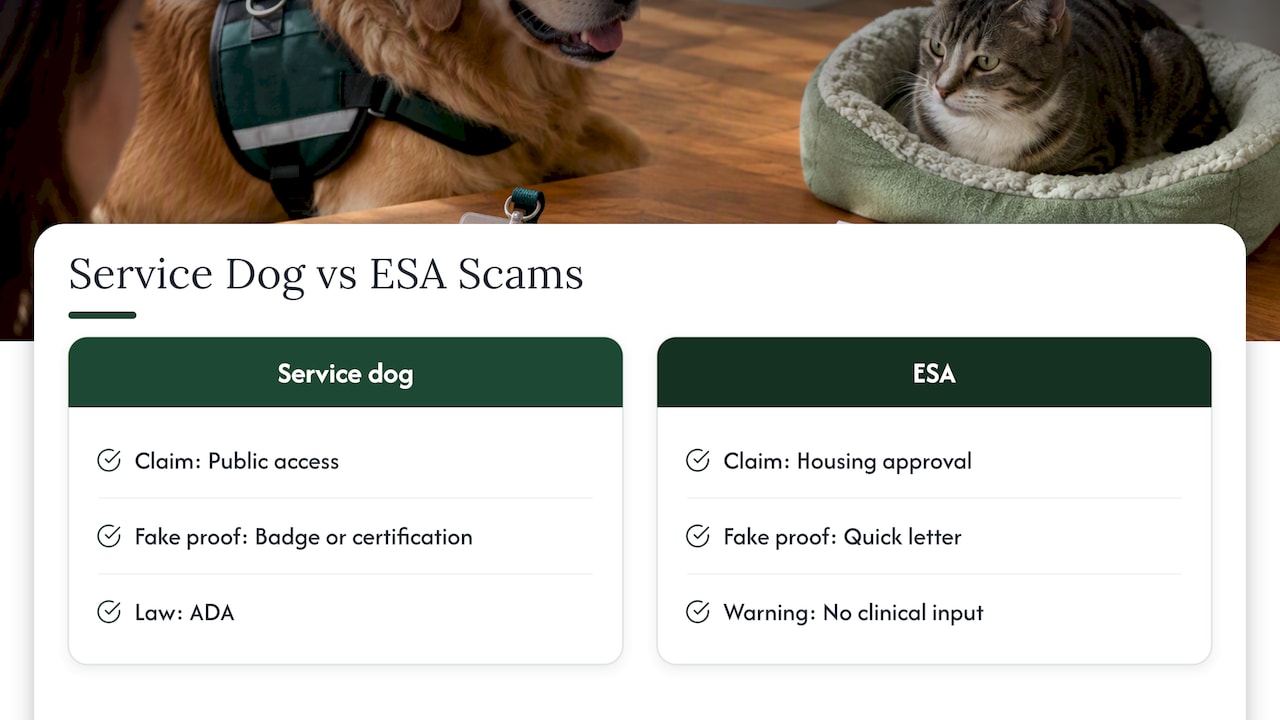
ESA scams and service dog scams exploit different legal gaps, so the warning signs look slightly different. Service dog scams usually involve selling vests, patches, or “certification” that falsely implies the dog has public access rights under the ADA, even though the ADA explicitly states that businesses cannot require registration or certification as proof of a service animal. If a site is selling you a badge to get into a restaurant or airplane cabin, that’s a service dog scam, not a housing document.
ESA scams, by contrast, center on housing documentation under the Fair Housing Act and typically involve a letter, not task training, since ESAs provide comfort rather than performing trained tasks. The tell is the claim being made: a service dog scam promises access to public spaces, while an ESA scam promises housing approval through a quick letter with no real clinical input. Knowing which law actually applies to your situation, public access under the ADA or housing accommodation under the Fair Housing Act, is often enough to spot which kind of scam you’re looking at before you pay anything.
Why clinician verification matters more than any registry
We built SupportPet.org around one belief: a real clinical relationship is the only thing that makes an ESA letter worth the paper it’s printed on. No registry, ID card, or certificate changes that. We’d rather you use our free checklists and sample letters than pay for paperwork a landlord can reject.
— Erik
Free tools to verify your ESA letter before you submit it
Verification tools and letter templates are kept free to help reduce rejected submissions without paid upsells. Whether you’re starting from scratch or checking a letter you already have, these resources are built around the same HUD-aligned standards covered above.
- A step-by-step verification checklist for confirming a clinician’s license and letter format before you submit anything.
- Sample ESA letter templates built to pass HUD documentation checks.
- Guidance for submitting a formal reasonable accommodation request to a housing provider, including what to keep on file.
If your situation involves more than one animal, our page on getting HUD to accept multiple ESAs covers what additional documentation to expect. Start at our ESA letter resources page, or go directly to our housing accommodation guidance if a submission deadline is already close.
This article is general information, not a substitute for advice from a qualified doctor. Consult a qualified healthcare professional about your own circumstances before acting on anything here.
FAQ
Is the ESA website legit?
It depends entirely on whether the clinician behind the letter has a genuine clinical relationship with you and a verifiable license, not on how official the website looks. Check the clinician’s license number against your state’s licensing board, and treat instant approvals or bundled registry sales as warning signs.
How can I protect myself from scams?
Verify the clinician’s license before paying, confirm a real evaluation or interview takes place, and avoid any provider selling registries, ID cards, or certificates as if they carry legal weight. HUD guidance confirms that internet certificates alone are not acceptable documentation for a housing accommodation request.
What is a legitimate ESA letter?
A legitimate ESA letter comes on letterhead from a licensed clinician and includes their license number, the date of evaluation, a statement that they have clinical knowledge of you, and an explanation of how the animal helps with your disability-related need. It does not rely on a registry number or ID card as proof.
How do I know if a provider has a real clinical relationship with me?
Ask directly how long you’ve been working with the clinician, whether a synchronous interview or evaluation occurred, and what follow-up care looks like. A provider that can’t answer these questions, or that issued a letter minutes after a short quiz, likely lacks the clinical relationship HUD guidance requires.
Sources
- Ada
- Assessing a person’s request to have an animal as a reasonable accommodation under the Fair Housing Act (HUD archive)
- Bogus emotional support animal letters; Elm Grove psychologist under investigation (FOX6)