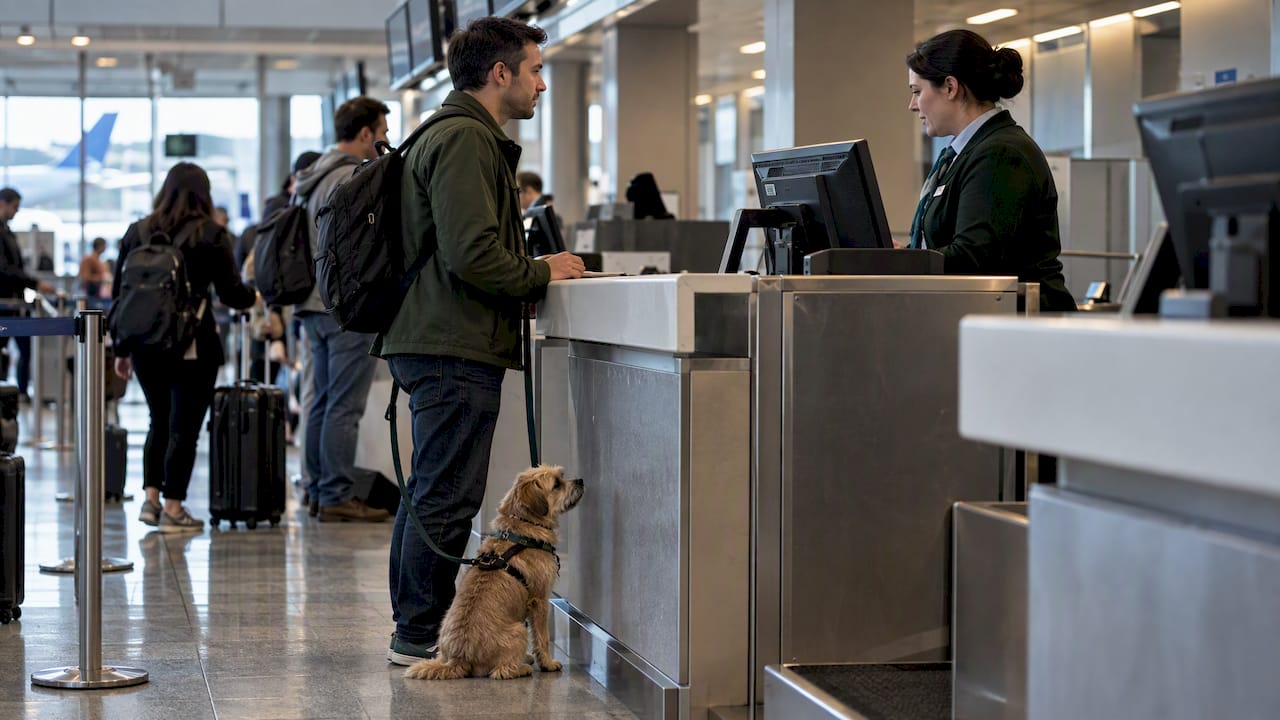
When you travel with an emotional support animal in the U.S., the rules are simpler and stricter than most people expect. Federal air travel law no longer treats an ESA as a service animal, so an airline can treat your animal as an ordinary pet. That usually means a pet fee, an approved carrier under the seat, and the airline’s own paperwork. An ESA letter still matters for your housing. It does not buy you a free seat for your animal.
This guide covers what changed, what to do on a domestic flight, how trained service dogs differ, what to know before crossing a border, and where to turn if an agent gets it wrong.
TL;DR
- Since the U.S. Department of Transportation finalized its rule in December 2020, airlines are not required to carry ESAs as service animals and may charge pet fees.
- Plan on booking your animal as a pet: check the carrier size, pay the fee, and reserve early, because cabin pet spots are limited per flight.
- Only a dog individually trained to do work or perform tasks qualifies as a service animal for U.S. flights, and an ESA letter does not change that.
- International trips depend on the destination’s entry rules, not on ESA status. Start with the official agricultural authority at least several weeks ahead.
- Your ESA letter still protects your housing, so keep it for your lease, not for the airport.
Table of Contents
- What changed, and why your letter no longer gets you on the plane
- How to fly with your ESA as a pet
- What a trained service dog gets that an ESA does not
- Does an ESA letter still matter when you travel?
- Traveling abroad with your animal
- Our perspective: plan for the rules that exist, not the ones you wish applied
- If the airline gets it wrong
- Where our guides can help next
- FAQ
- Sources
What changed, and why your letter no longer gets you on the plane
For years, passengers with a letter from a clinician could bring an ESA into the cabin free of charge. That ended when the Department of Transportation revised its Air Carrier Access Act (ACAA) regulation. The DOT announced the final rule on December 2, 2020, and it redefined who counts as a service animal.
Under the current rule, a service animal is a dog, regardless of breed or type, that is individually trained to do work or perform tasks for a qualified person with a disability. An emotional support animal does not meet that definition. So airlines may:
- Treat your ESA as a standard pet.
- Charge the pet fee that applies to any in-cabin animal.
- Require an airline-approved carrier that fits under the seat in front of you.
Note that this is a rule about airlines, not about whether your condition is real or your ESA is legitimate. Your animal still provides comfort, and the law for housing still protects it. Air travel is simply governed by a different statute with a narrower definition.
The ADA’s technical assistance center makes the same point from the other direction: a letter saying you need emotional support does not turn a pet into a service animal. Training is what separates the two categories, not paperwork. We cover that line in detail in our guide to ESA vs. service dog differences.
How to fly with your ESA as a pet
If your animal is a dog or cat small enough for a carrier, flying is very doable. It just runs through the airline’s pet policy. Here is the order we suggest.
- Read the airline’s pet policy before you buy a ticket. Policies differ on carrier dimensions, weight limits, which species are allowed, and which routes accept pets at all. Some international routes and some aircraft types do not accept pets in the cabin.
- Reserve the pet spot at booking. Airlines cap the number of pets per flight, so a late call can leave you with no spot even after you have paid for your own seat.
- Measure your carrier. It must fit under the seat in front of you, and your animal needs room to stand and turn. Soft-sided carriers are often easier to fit.
- Pay the pet fee. It is charged per direction, so a round trip costs twice. Fees vary by airline and route, and you should read the number on the airline’s own page rather than trusting a third-party list.
- Gather health paperwork. Many airlines ask for proof of vaccinations, and some ask for a recent health certificate. Ask what they require for your route.
- Plan the airport. Find the animal relief areas on your terminal map, and leave time for security screening, where you will usually carry your animal through the metal detector while the empty carrier goes through the scanner.
A good rule: reservation first, ticket second, paperwork third. An animal without a booked spot can be refused at the gate.
Large dogs and ESAs that do not fit in a carrier
This is where the rule change hurts most. If your dog is too big for an under-seat carrier, most airlines will not take it in the cabin as a pet. Your options are limited:
- Ask the airline whether it carries pets in the hold as checked baggage or cargo on your route, and read its heat and temperature restrictions carefully.
- Drive or take a train if the distance allows. Check the rail operator’s pet rules first, since they differ from airline rules.
- Ask your clinician whether your dog could be individually trained to perform tasks. A trained service dog follows different rules, covered below. Training is real work and takes time, so this is a long-term decision, not a quick fix.
Do not buy a vest, ID card, or online “registration.” No federal registry exists, and these products do not change how airlines treat your animal. Airlines can ask for DOT forms from service dog handlers, and a fake certificate can create problems at the gate instead of solving them.
What a trained service dog gets that an ESA does not
It helps to see the gap side by side.
| Emotional support animal | Service dog (psychiatric or other) | |
|---|---|---|
| Definition for U.S. flights | Not a service animal under the ACAA | A dog individually trained to do work or perform tasks |
| Cabin access | At the airline’s discretion, as a pet | Required, if the dog is well-behaved and properly controlled |
| Fee | Pet fee may apply | No charge for the service animal |
| Carrier | Typically required, under the seat | Harness, leash, or tether |
| Species | Whatever the airline’s pet policy accepts | Dogs only |
| DOT forms | Not applicable | Airlines may require them |
The DOT lets airlines ask service dog handlers to submit forms attesting to the animal’s health, behavior, and training. For flights of 8 hours or more, the form also covers the dog’s ability to relieve itself sanitarily. If you booked more than 48 hours before departure, airlines may ask for the forms up to 48 hours ahead. Otherwise they may ask at the gate on the day of travel. A passenger may be limited to two service animals.
Training is also what makes a dog calm enough for this process. If your dog already struggles with travel stress, a trainer’s view on pre-departure anxiety in dogs can show you what is a coping issue and what is a trainable task. Whatever you decide, do not call a dog a service animal when it is an ESA. That misstatement can cost you the trip, and honest bookings avoid it.
Does an ESA letter still matter when you travel?
A little, in specific places, and never as a pass for free cabin travel.
- At home: Your letter remains the core document for housing. Under the Fair Housing Act, a landlord must consider a reasonable accommodation request for an assistance animal, even in a building with a no-pets rule. Read our ESA housing rights guide for what HUD’s recent changes mean.
- When you rent a place on the trip: Short-term rentals and hotels are not the same as a lease. The ADA’s definition covers dogs trained to do tasks, so an ESA has no public-access right there. Many hotels and rental hosts allow pets for a fee, so ask before you book.
- At the airline: Some airlines may ask about your ESA in their pet booking process, and a letter can sometimes support a request for extra flexibility. Treat that as a courtesy, not a right.
If you are still working out what a valid letter looks like, our walk-through of how to get an ESA letter explains why a licensed clinician’s recommendation is what counts. State rules differ, so see ESA letter laws by state too.
Traveling abroad with your animal
Once you leave the U.S., the question is no longer “is my animal an ESA?” It is “what does this country need before it lets any pet in?” Each destination sets its own entry rules, and the CDC’s travel guidance says travelers must meet the entry requirements of the destination country as well as the carrier’s guidelines.
Some entry rules are unforgiving
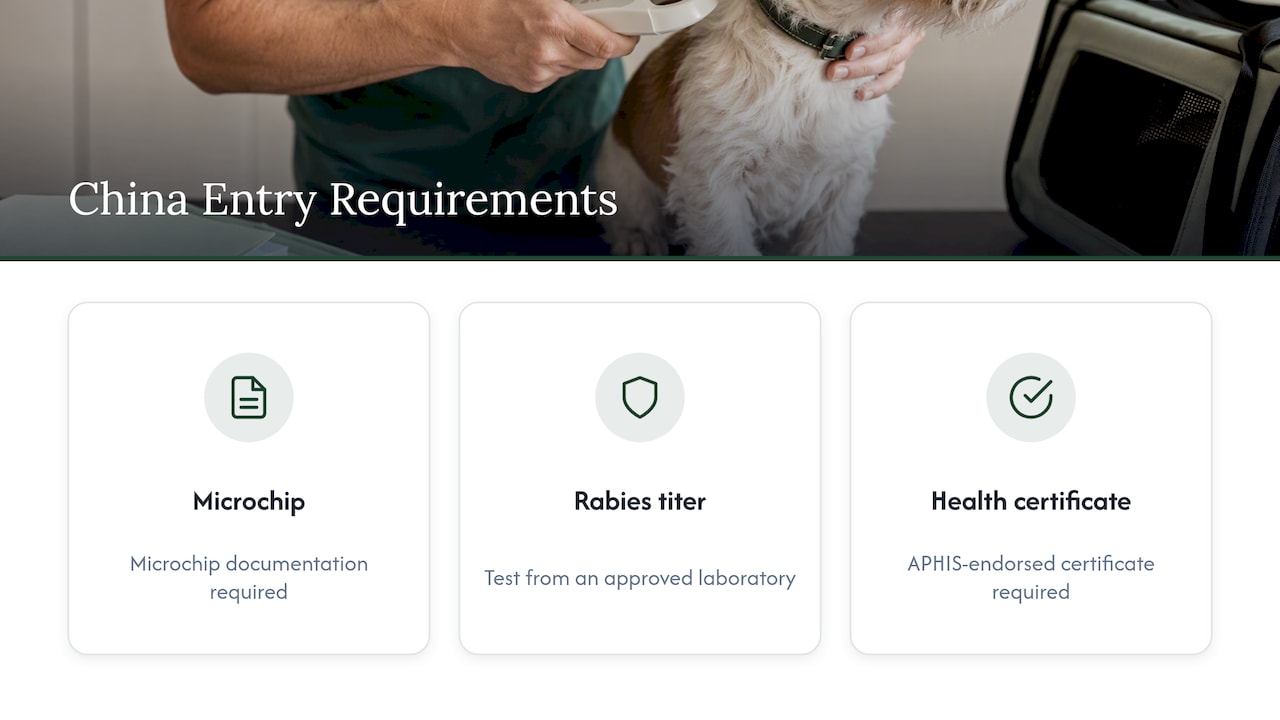
China is a clear example. The USDA’s Animal and Plant Health Inspection Service says its U.S.-to-China pet travel page holds the latest requirements, which can change without notice. They include microchip documentation, a rabies titer test from an approved laboratory, and an APHIS-endorsed health certificate. Missing a step can lead to quarantine or worse for the animal on arrival. Check the destination’s consulate or agricultural authority well ahead of departure, not the week before.
Europe: the pet passport and what it does not cover
Within the European Union, pets such as dogs, cats, and ferrets move with a passport issued by an authorized veterinarian. The European Commission’s FAQ explains that the animal must be identified by a microchip and vaccinated against rabies. It also notes that the passport is generally for pets whose owners live in the EU, and that up to five animals can travel per owner. Some countries add rules such as tapeworm treatment for Finland, Ireland, Malta, or Sweden.
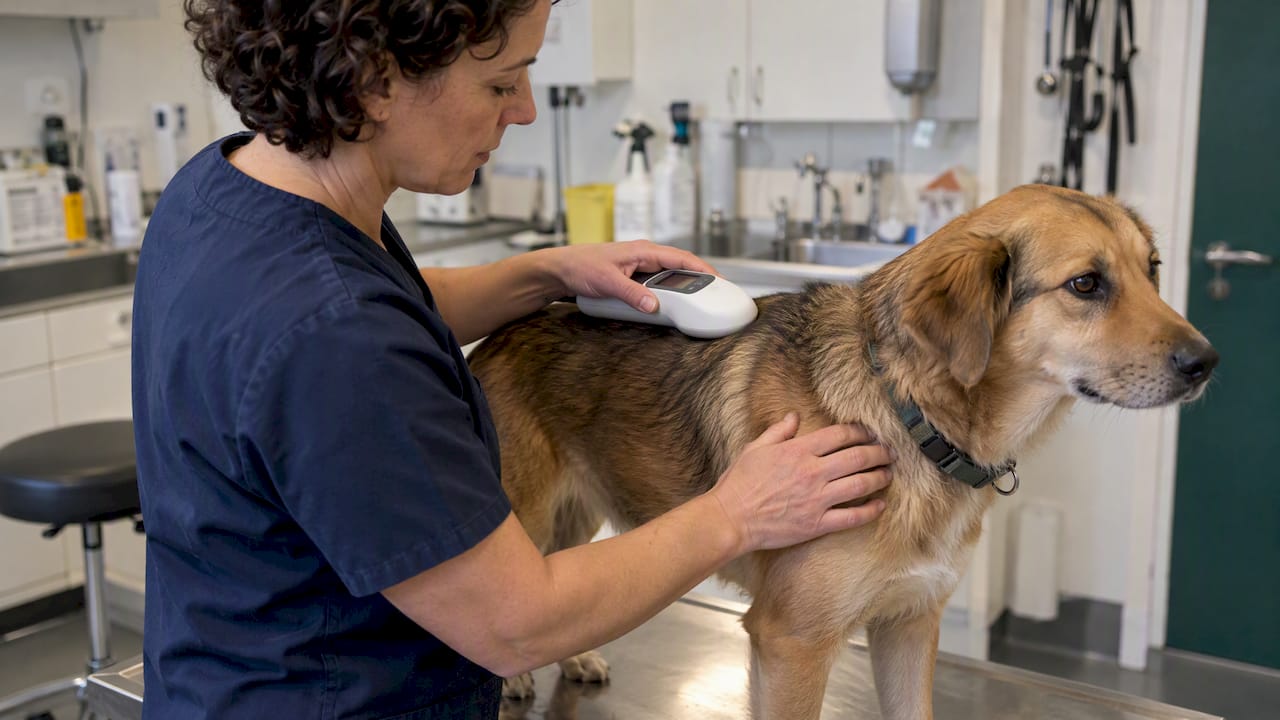
If you live in the U.S., you will not hold an EU pet passport. You will need the entry documents for the country you are landing in, which usually include an official health certificate from a USDA-accredited veterinarian. Your vet and the destination’s official site are the reliable places to confirm this. A travel kit helps once you are there, and this comparison of pet first aid kits for travel is a handy reference when packing.
An international timeline that works
- 3 to 4 months out: Confirm entry rules, microchip type, and whether any lab test or waiting period applies.
- 6 to 8 weeks out: Book the airline pet spot and schedule the vet visit for the health certificate.
- Final 2 weeks: Get the government endorsement if required, and check the airline’s carrier rules again.
- Departure week: Pack copies of every document, vaccination records, a leash, waste bags, and a collapsible bowl.
Timelines vary a great deal by country, so treat these as a planning frame, not a rule. Some countries need months because of waiting periods.
Our perspective: plan for the rules that exist, not the ones you wish applied
We publish this site because people with anxiety, depression, or PTSD often hear conflicting advice about their animals. Online sellers promise cabin access with a certificate and a vest. We think that does real harm. The traveler who believes the promise arrives at the gate, gets turned away, and has to rebook or leave the animal behind. That is a bad day for someone who relies on the animal for stability.
Our view is plain. An ESA is protected where the law protects it: in housing. In the air, the law now draws a line at training, and the honest path is to book your animal as a pet or to talk with your clinician about whether a trained service dog fits your needs. Neither path needs a registry, and no one should pay for one.
If your trip is stressful, plan around the animal’s comfort and yours. Book direct flights, pick off-peak times, and pre-load the airport relief areas on your phone. Take the same care you would take with any anxious passenger, human or not. Our full guide to flying with an emotional support animal goes airline by airline on what to expect.
— Erik
If the airline gets it wrong
Gate agents are not always trained on the current rules. If you are a service dog handler or a passenger with a disability, the DOT says airlines may not discriminate and must give a written response to a formal disability-related complaint within 30 days. Breed-based bans on service dogs are not allowed either.
When an agent disputes something, ask politely for a Complaints Resolution Official, called a CRO. Airlines must make a CRO available at no cost, in person at the airport or by phone during operating hours. Asking for one by name often resolves misunderstandings fast. Write down the agent’s name, the time, and what was said, and keep your booking records.
If you are flying with an ESA as a pet, a dispute is a pet-policy matter. Ask what the written policy says and where, then decide whether to pay, rebook, or reroute.
Where our guides can help next
If your next step is getting valid documentation for housing, start with our honest steps to get an ESA letter, then compare it against the ESA letter sample to check that your letter has the elements a landlord looks for. We do not sell certificates, registrations, or ID cards, and we explain how to spot the sites that do. Our rights guide is free to read.
FAQ
Do airlines accept ESA letters?
U.S. airlines are no longer required to accept them. They may treat your ESA as a pet and apply their pet rules and fees. Some may ask about documentation, but a letter does not give you free cabin travel or an exemption from carrier rules.
Are emotional support animals protected by federal law?
Yes, but mainly in housing. The Fair Housing Act can require reasonable accommodation for an assistance animal in a home. For air travel, ESAs lost their protection under the ACAA when the DOT’s 2020 rule took effect. Public-access rules under the ADA apply to trained service dogs.
Can I take my ESA on a flight outside the U.S.?
Yes, as a pet, if the airline and the destination country allow it. Entry rules depend on the country and may require a microchip, rabies vaccination, a titer test, or an endorsed health certificate. Check the destination’s official agricultural authority, and the CDC’s traveler guidance, well before you book.
What is the difference between a service dog and an emotional support dog?
Training. A service dog is individually trained to do work or perform tasks for a person with a disability. An emotional support dog provides comfort by being present and needs no task training. For flights, that difference decides whether the dog flies free or as a pet.
Sources
- Service Animals, U.S. Department of Transportation
- U.S. DOT announces final rule on traveling by air with service animals
- Service Animals and Emotional Support Animals, ADA National Network
- Traveling with Pets and Service Animals, CDC Yellow Book 2026
- Pet Travel From the United States to China, APHIS
- Dogs, cats and ferrets FAQs, European Commission