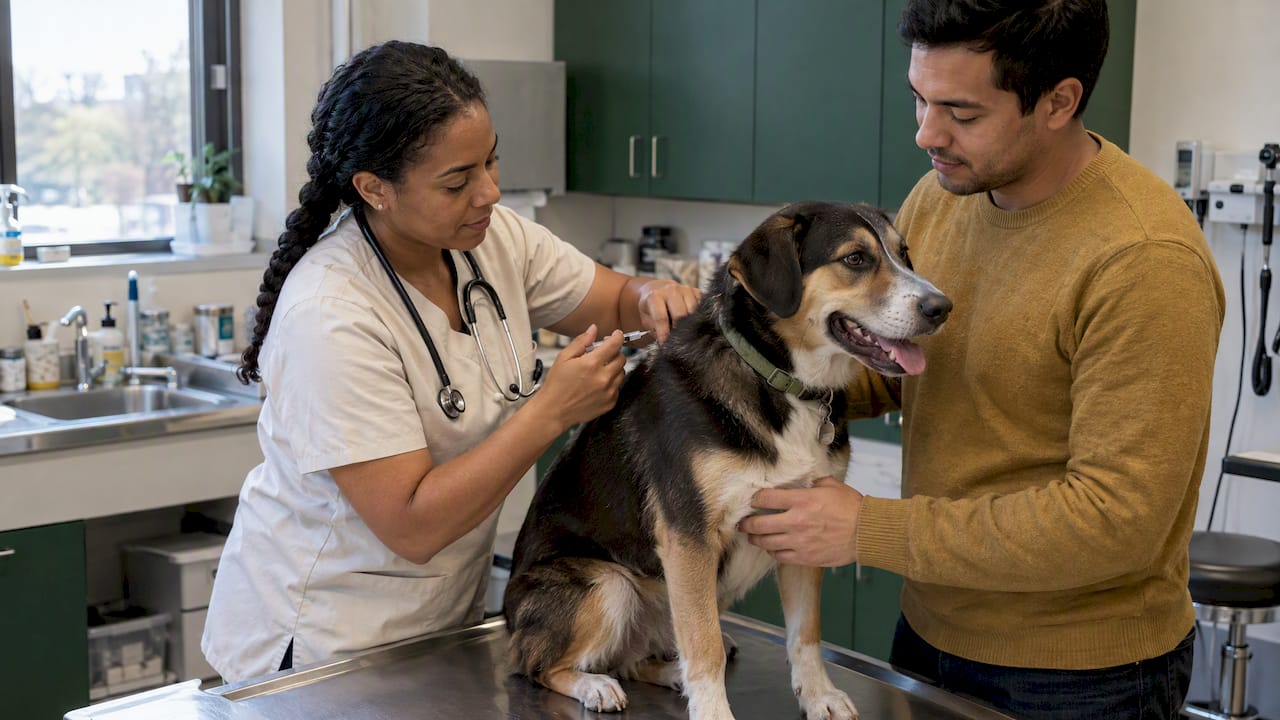
No federal law gives emotional support animals their own vaccine list, but that does not mean your ESA is exempt. Vaccination rules for ESAs come from your city, county and state, from your landlord’s lawful policies, and from veterinary standards. If a rule applies to every dog or cat where you live, it applies to yours, and an ESA letter does not change that. This guide explains who sets the rules, what proof you may be asked for, and how things change when you travel.
TL;DR
- There is no national ESA vaccine schedule. Local and state animal-health laws (rabies is the usual one for dogs) apply to your ESA the same way they apply to any pet.
- A housing provider may ask for proof that your animal is vaccinated as required by law, but it cannot demand a registration, a certificate or your specific diagnosis.
- The American Veterinary Medical Association advises that ESAs follow preventive care, including vaccination, health screening and parasite control.
- Air travel no longer treats ESAs as service animals, and international trips add veterinary health certificates and destination-country rules.
Table of Contents
- Do emotional support animals have to be vaccinated?
- Who sets the rules?
- Which vaccines are typically involved?
- What proof can a landlord or school ask for?
- What if your animal cannot be vaccinated?
- How travel changes the picture
- Common mistakes to avoid
- Our perspective
- Get the full picture on ESA rules
- FAQ
- Sources
Do emotional support animals have to be vaccinated?
In practice, yes. The key point is that an ESA is legally an animal that provides disability-related support, not an animal with a special health status. The AVMA says an ESA may be any species, has no training requirement and has no licensing or certification requirement. It also advises owners to keep ESAs in line with preventive-medicine standards: vaccination, infectious-disease and health screening, and parasite control.
Read those two facts together. Because no ESA registry or certification exists, there is no ESA-specific shot record to hold. What exists is the ordinary vaccine record your veterinarian keeps for any dog, cat or other pet. That record is your proof.
So the honest answer to “do ESA animals have to be vaccinated?” is this: the law that requires it is usually not an ESA law at all. It is the rabies ordinance, licensing rule or public-health regulation that already covers animals in your area. Your ESA status gives you housing protections, but it does not lift those requirements.
Who sets the rules?
Three layers decide what your ESA needs, and they stack.
State and local law
States and many counties and cities set vaccination rules for animals living within their borders. For dogs, rabies vaccination is the most common requirement, and many places tie it to a license or tag. Cats, ferrets and other species are handled differently from place to place, so the rule in one county can differ from the next one over.
Arizona’s official service-animal FAQ is a useful illustration. It says local governments may impose animal-control and public-health requirements, including vaccination rules. That answer is about service animals, which have stronger legal status than ESAs. If disability status does not override local public-health rules for a service animal, an ESA will not override them either.
What to do: call your city or county animal control office, or check its website, and ask what is required for a dog, cat or whatever species you have. Ask whether a license is needed and how often rabies boosters are due.
Your housing provider
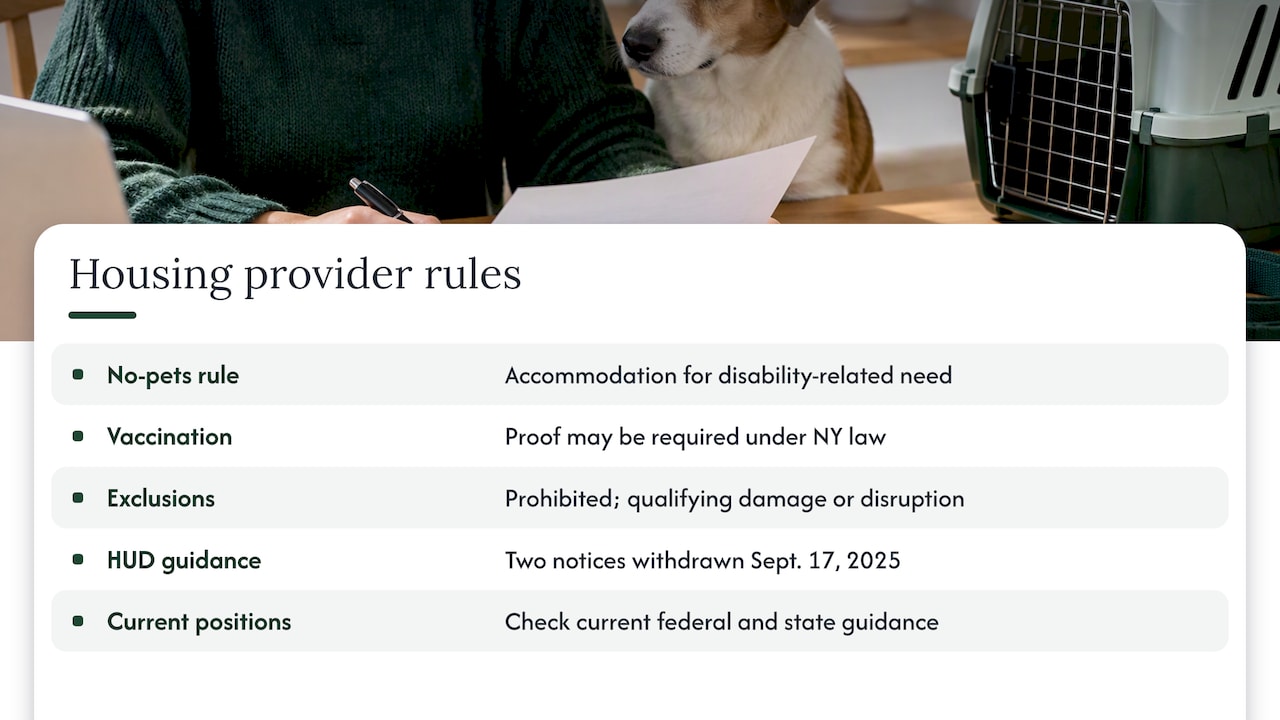
Under the Fair Housing Act, a landlord generally has to consider an ESA as a reasonable accommodation to a no-pets policy when you have a disability-related need. That is the protection most ESA owners rely on. But the accommodation covers the no-pets rule, not every other lawful rule.
New York City’s Commission on Human Rights spells this out. Its guidance says a housing provider may require information confirming that a dog has been vaccinated as required by New York State law. The same guidance says animals prohibited under the city’s Public Health Code, or animals that cause qualifying damage or disruption, may be excluded. New York is one example of how a city applies the rule, but the logic carries to other places: a landlord can ask you to follow the law that covers every animal.
Federal guidance in this area has also shifted. HUD withdrew two earlier guidance notices on service and assistance animals in housing on September 17, 2025. The Fair Housing Act itself still applies, but housing providers and tenants should check the current federal and state positions rather than rely on older summaries.
Your veterinarian
Even where no law demands a specific vaccine, your vet is the person who decides what your animal should have, based on species, age, lifestyle and local disease risk. The AVMA’s preventive-care advice is the professional standard. An ESA living in a dorm, an apartment building or a shared home meets more animals and people than one in a detached house, which is a good reason to keep shots current.
Which vaccines are typically involved?
The vaccines that matter depend on the animal, and your vet should set the schedule. Here is how the question usually breaks down.
| Animal | What is commonly legally required | What your vet may add |
|---|---|---|
| Dog | Rabies, with a license or tag in many places | Core combination vaccines and others based on lifestyle |
| Cat | Rabies in some states and localities | Core feline vaccines and parasite prevention |
| Other species (rabbit, ferret, bird, small mammal) | Varies by state and locality | Species-specific preventive care |
Treat the middle column as a prompt to check, not a final answer. Rules differ by place, and your local animal control office or health department has the current requirement. Your veterinarian can then tell you whether anything further is advisable.
What proof can a landlord or school ask for?
This is where owners get confused, and where scams cause trouble. There are two separate questions: proof about your health need, and proof about your animal’s health.
Proof about your animal
A vaccination record from your veterinarian is ordinary, reasonable documentation. NYC guidance confirms a housing provider may ask for confirmation that a dog is vaccinated as state law requires. Keep a copy of the following:
- Your vet’s current vaccination certificate, showing dates and the next due dates.
- The animal’s license or tag number, where your area requires one.
- A recent exam record, if your vet will provide one.
These are the things a landlord can reasonably tie to a legal requirement. They are different from an “ESA certificate” or “registration”, which you do not need.
Proof about your need
Vaccine paperwork is not the same as your ESA letter. When a disability or the need for the animal is not apparent, a housing provider may ask for confirmation from a treatment provider. The NYC guidance also notes the provider may not require disclosure of the specific underlying disability and may not reject a request because the documentation is not on a particular form or not dated within a set period.
California’s Civil Rights Department adds that an ESA does not need to be registered or certified to qualify for a housing reasonable accommodation. Its guidance also says reliable supporting documentation can come from a reliable third party who is able to know your disability or disability-related need.
In short: your letter answers “why do you need this animal?”, and your vet record answers “does the animal meet the legal health requirements?” Keep them separate, and do not hand over more than is asked.
What if your animal cannot be vaccinated?
Some animals have medical reasons that make a vaccine unsafe, such as a serious illness or a prior reaction. Many jurisdictions have an exemption process for rabies vaccination, usually through a veterinarian’s written statement. The details vary, so do not assume one exists or guess at the process. Ask your vet first, then ask your local animal control or health department what documentation they accept. If a landlord is involved, tell them early and offer the paperwork your vet provides.
If a vaccine is simply overdue, the fix is easy: book the appointment, get the updated certificate and send it over. Most disputes about vaccines end when the record is current.
How travel changes the picture
Travel is where ESA owners most often get caught out, because the housing protections do not follow you onto a plane or across a border.
Flying within the U.S.
The AVMA notes that ESAs are no longer recognized as service animals under the Air Carrier Access Act and DOT regulations, so airlines may apply their pet rules. That means the airline’s pet policy, fees, carrier requirements and any health-document rules can apply to your ESA. Check the airline’s page for your specific route well before you book, because policies differ between carriers.
Traveling abroad
International trips are more demanding. USDA APHIS says the destination country sets the pet-travel requirements, and most countries ask for a health certificate completed, signed and dated by a veterinarian who examines the animal and performs or verifies the required tests, vaccinations or treatments.
The U.S. Department of State adds that many countries have strict pet-entry rules or bans, that foreign authorities may require formal documents such as a pet passport, and that airlines and shipping lines add their own requirements on top of government rules.
A practical order of operations:
- Look up your destination’s pet-import rules on the APHIS pet travel pages.
- Book a veterinary visit early, since some vaccines and tests have timing windows.
- Ask your airline or carrier what it needs in addition.
- Keep originals and copies of every certificate with you, not in checked luggage.
Common mistakes to avoid
- Buying a registration to prove vaccination. Online registries and ID cards do not replace a vet’s record, and they are not required for housing protection. The AVMA states there is no licensing or certification requirement for ESAs.
- Assuming the ESA letter covers everything. The letter supports your accommodation request. It does not waive local animal laws.
- Waiting until a landlord asks. Having your records ready makes the request smoother.
- Letting a license lapse. Where your area requires a license or tag, a missed renewal can undermine an otherwise valid request.
- Treating all species the same. A rabbit, a cat and a dog can face different local rules.
- Using old guidance. Federal housing guidance changed in 2025, so check what currently applies in your state.
Our perspective
We get the same question in many forms: “If I have an ESA letter, can my landlord still ask about shots?” The short answer we give is yes, within limits, and that is not a loophole or a trick. The housing law protects people from being turned away because of a disability-related need for an animal. It was never meant to put animals outside public-health rules that protect neighbors and the animal itself.
We built this site because so many people lose money and confidence to sellers of registrations, certificates and ID cards. Those products have no legal weight for housing, and they often come with a promise that your animal is “exempt” from rules. That promise is false, and a landlord who sees a certificate where a vet record belongs is likelier to push back, not less.
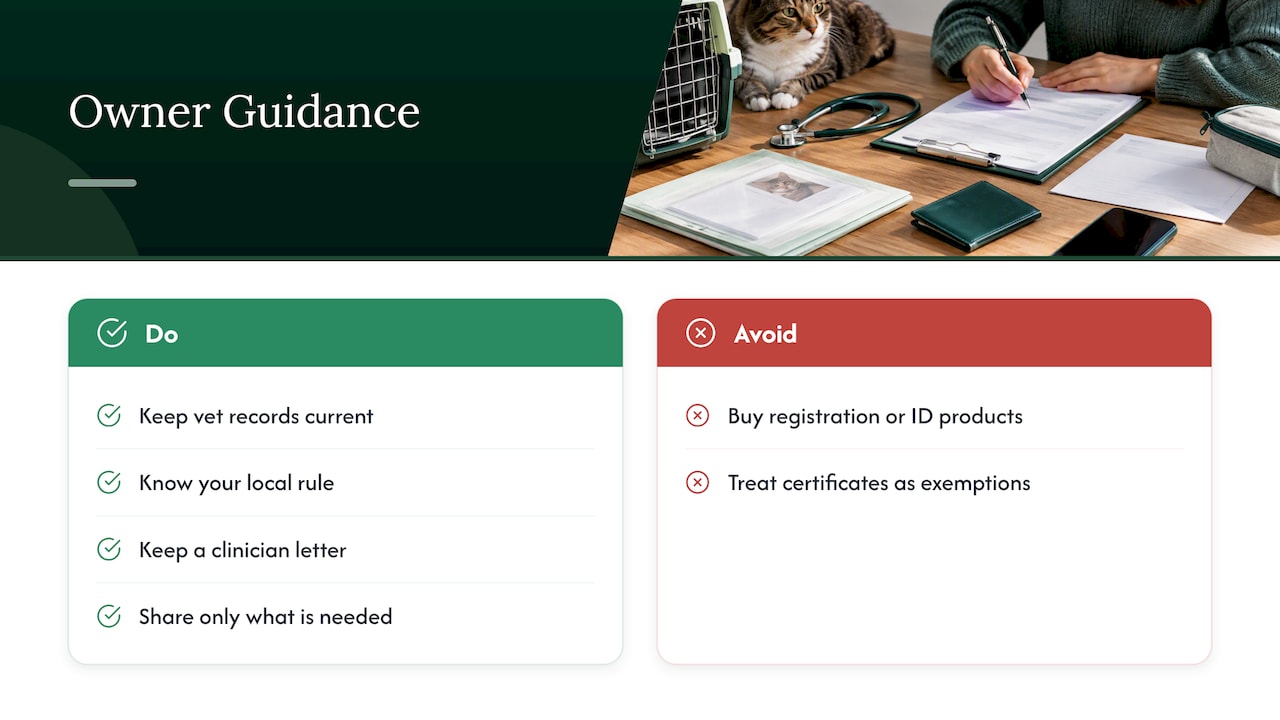
Our advice is plain. Keep your vet records current. Know your local rule. Keep your letter from a licensed clinician who actually knows you. Share what is needed, and no more. Doing these three things keeps your request about what matters: your need for the support your animal gives you.
Staying consistent with your animal’s care is also part of the bond. Reading about how pets support mental health is a good reminder that a healthy, well-cared-for animal is the one that helps you most.
— Erik
Get the full picture on ESA rules
Vaccination is one piece of a bigger set of rules: how to qualify, how a valid letter works, what housing protections cover, and how to spot a scam. Our guides cover each of these in plain language, and everything on the site is free to read. We do not sell certificates, registrations or ID cards. Start at Supportpet and follow the topic you need.
If you are preparing a housing request, a good first step is to put your vet record and your clinician’s letter in one folder, so you can send exactly what is requested and nothing extra.
FAQ
Do ESA animals have to be vaccinated?
In most places, yes, because the vaccination laws that apply to pets apply to ESAs too. There is no separate ESA vaccine requirement, but local rules such as rabies vaccination still cover your animal. The AVMA also advises that ESAs follow preventive care, including vaccination.
Can a landlord ask for proof of my ESA’s vaccinations?
A landlord can generally ask for confirmation that your animal meets the vaccination requirements that apply under the law. New York City’s guidance, for example, allows a provider to ask for confirmation that a dog is vaccinated as state law requires. A landlord cannot ask for your specific diagnosis or insist on a registration or certificate.
Do I need an ESA registration or certificate to show vaccination?
No. A vaccination record from your veterinarian is the proof. California’s Civil Rights Department states that an ESA does not need to be registered or certified to qualify for a housing accommodation.
Are the vaccine rules different when I travel with my ESA?
Yes. Airlines may treat an ESA as a pet, so their pet rules can apply. For international travel, the destination country sets the requirements, and most ask for a health certificate signed by a veterinarian, so check the official pet travel pages early.
What if my ESA is not a dog?
The vaccine rules depend on species and on where you live. A cat, rabbit or other animal may face different local rules than a dog. Ask your veterinarian and your local animal control office what applies to your animal.
Sources
- Service, emotional support, and therapy animals, American Veterinary Medical Association
- Emotional Support Animals in Housing FAQ, NYC Commission on Human Rights
- FAQ Around Service Animals, Arizona Developmental Disabilities Planning Council
- Emotional Support Animals and Fair Housing Law FAQ, California Civil Rights Department
- Frequently Asked Questions About Traveling With Your Pet, USDA APHIS
- Pets, U.S. Department of State
- Assessing a Person’s Request to Have an Animal as a Reasonable Accommodation, Animal Legal and Historical Center
- Pets and Mental Health