
No. No U.S. federal law requires an emotional support animal (ESA) to wear a vest, patch, ID tag or special harness. A vest does not prove your animal is an ESA, it does not give you public access rights, and it will not get you into a rental or onto a plane. What matters is your disability-related need, the documentation behind it and the setting you are in.
This guide walks through housing, restaurants and stores, workplaces and airlines, then covers when a vest is still a reasonable personal choice and which products to avoid.
TL;DR
- No federal law requires an ESA to wear a vest, and a vest has no legal weight on its own.
- In housing, what counts is your disability-related need and a reliable letter from a licensed clinician, not gear.
- Stores, restaurants and most public places can exclude ESAs even when they wear an official-looking patch.
- Airlines generally treat ESAs as pets now, so a vest will not change your ticket or your fee.
- Registries, certificates and ID cards sold online carry no legal authority. Skip them.
Table of Contents
- Why people think an ESA needs a vest
- Housing: where an ESA has real protection
- Restaurants, stores and workplaces: a vest does not open doors
- Flying: do not buy a vest for the airport
- Registries, certificates and ID cards
- When a vest is still a fair choice
- Our perspective
- Where to go from here
- FAQ
- Sources
Why people think an ESA needs a vest
Most of what people see in public is service dogs in vests, so the vest looks like proof of status. Online shops reinforce that. Search for “ESA vest” and the top results are mostly mesh vests and patches for sale, which makes the gear look like part of the process.
It is not part of the process. The vest is a communication aid, nothing more. The U.S. Department of Justice’s ADA service animal guidance says service animals are not required to wear a vest or other identifying gear, and that is the stricter category. If a dog trained to do disability-related work needs no vest, an ESA, which has fewer legal protections, certainly does not need one to qualify.
The confusion also feeds on mixed-up terms. “Service animal,” “emotional support animal,” “assistance animal” and “therapy animal” mean different things under different laws. Our ESA vs. service dog breakdown goes through them in detail. Here is the short version:
| Category | Defined by | Trained for tasks? | Vest required? |
|---|---|---|---|
| Service animal (dog) | ADA | Yes, work or tasks tied to a disability | No |
| Emotional support animal | Housing law (assistance animal) | No task training needed | No |
| Therapy animal | Facility or organization policy | Temperament-tested, not a legal category | No federal rule |
Housing: where an ESA has real protection
Housing is the one area where most ESA owners have strong rights, and a vest plays no role in it.
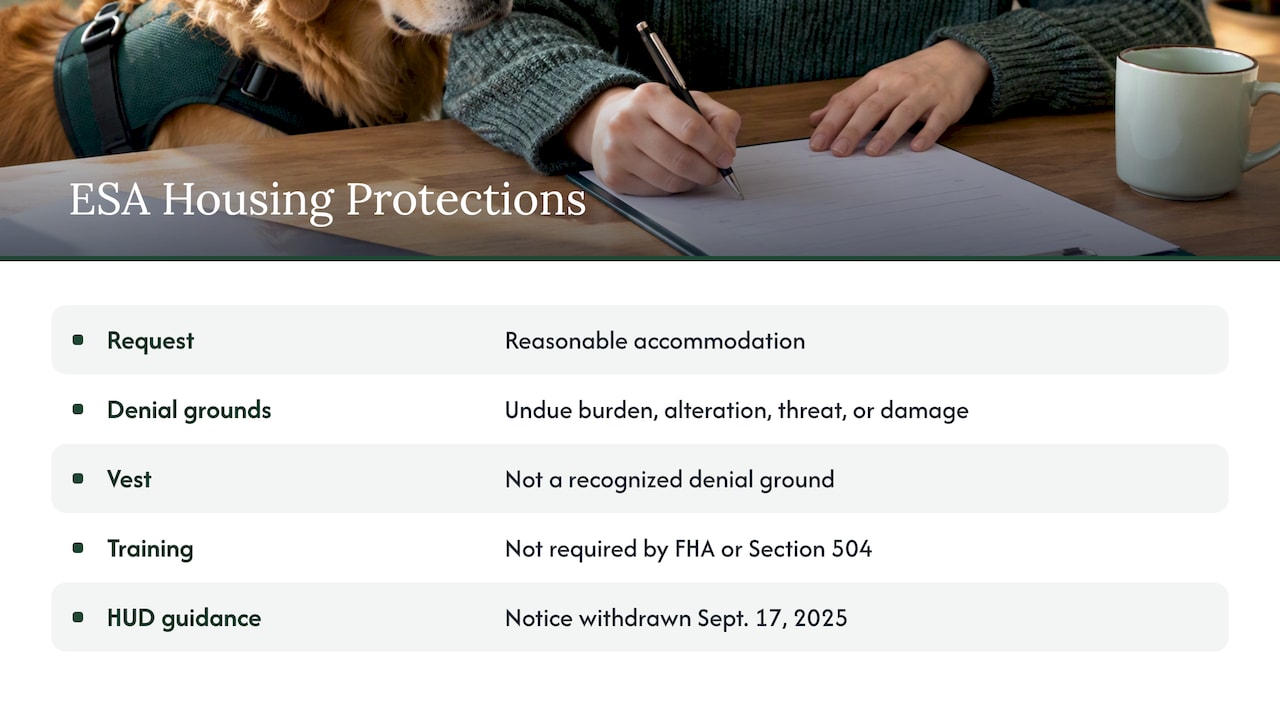
HUD uses the term “assistance animal.” According to HUD’s assistance animals page, that includes an animal that provides emotional support that alleviates one or more identified effects of a person’s disability. You ask your housing provider for a reasonable accommodation, and the provider evaluates the request. HUD says a provider may deny it only on recognized grounds, such as undue burden, fundamental alteration, a direct threat to others or significant property damage. Whether the animal wears labeled gear is not on that list.
The HUD notice on service and assistance animals also explains that neither the Fair Housing Act nor Section 504 requires the animal to be individually trained or certified. One caution: the animal law resource at Michigan State University reports that HUD formally withdrew that notice and a 2020 companion notice on September 17, 2025. The law itself did not change, but housing providers now have less detailed federal guidance to lean on, so expect more variation in how requests are handled. Our page on ESA housing rights and what HUD’s change means tracks the practical effects.
What to hand your landlord instead of a vest
A vest tells a landlord nothing. A letter from a licensed clinician who knows you does. In practice, the request usually includes:
- A written accommodation request naming the animal.
- A letter from a licensed health care professional confirming a disability and a disability-related need for the animal.
- Basic information about the animal, such as species and, if relevant, vaccination status.
The American Academy of Family Physicians says in its guidance on ESA documentation that there is no formal certifying body for ESAs and that ESA status should rest on clinical documentation, not merchandise. If you do not have a letter yet, read how to get an ESA letter the honest way and look at what a real ESA letter looks like. State rules on who may write one differ, which we cover in ESA letter laws by state.
If housing is your main worry, finding a place that will work with you is a separate challenge from the paperwork. These resources for finding supportive housing can help you widen your search.
Students in dorms
The same logic applies to qualifying campus housing. Colleges usually run accommodation requests through a disability services office, and they ask for documentation and a request form. A vest will not substitute for either. Start early, because many schools set deadlines well before move-in, and check your school’s own process.
Restaurants, stores and workplaces: a vest does not open doors
This is where the vest does the most damage, because it creates an expectation the law does not back.
Public accommodations such as restaurants, shops and hotels follow ADA rules, and under the ADA a service animal is a dog trained to do work or perform tasks directly related to a disability. Comfort from presence alone does not qualify. That is the line between a psychiatric service dog and an ESA: a dog trained to, say, interrupt a harmful behavior or alert to a panic attack can be a service animal, while a dog that calms you by being near is an ESA.
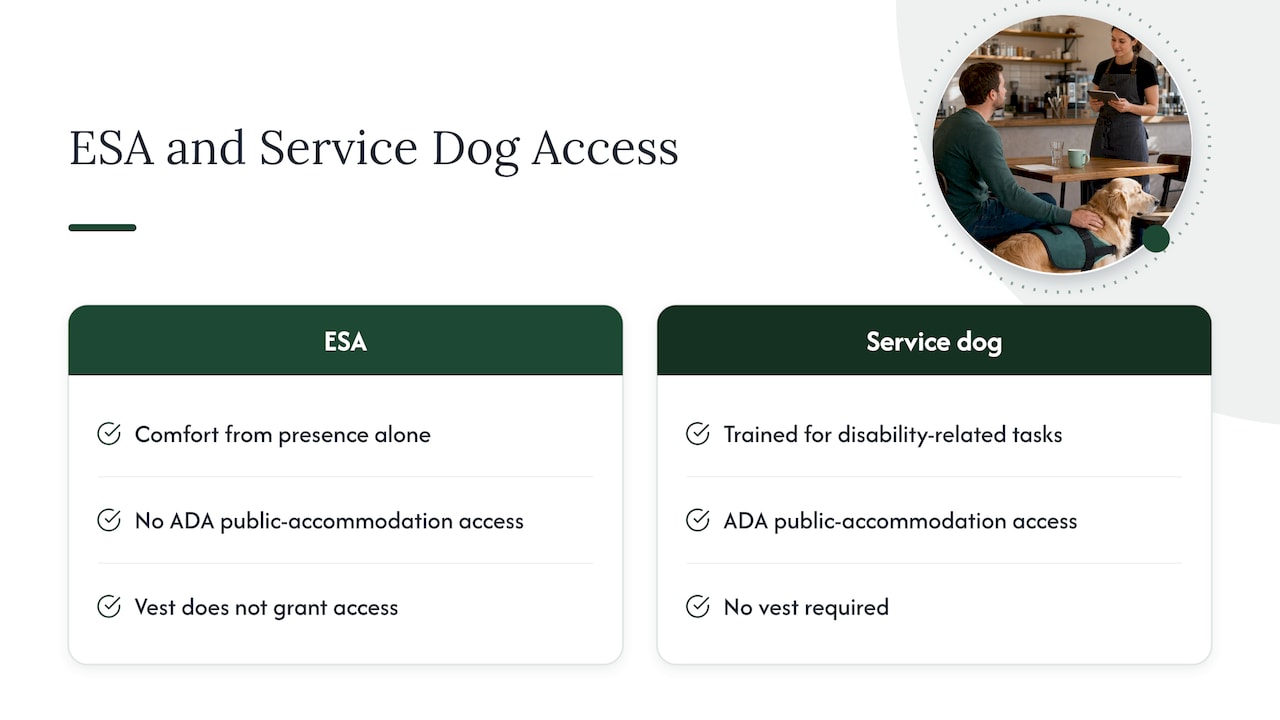
When the status of a dog is not obvious, staff may ask only two questions, according to the ADA FAQ: whether the dog is required because of a disability, and what work or task it has been trained to perform. They may not ask for certification or demand a vest. So an ESA owner who relies on a vest is in an awkward spot: the vest invites the questions, and an honest answer to them ends with the ESA being asked to leave.
Some states and cities have broader rules than the ADA, and many have penalties for falsely claiming a pet is a service animal. Check your own state’s law before you assume anything. Putting a service dog vest on an ESA to get past a door can expose you to those penalties and it makes life harder for people who rely on trained service dogs. We would not do it.
Workplaces are separate again. Employers fall under employment disability law, not the housing rules, and there is no automatic right to bring an ESA to work. Employees usually have to ask for an accommodation and show a need. Again, a vest is irrelevant to that conversation.
Flying: do not buy a vest for the airport
Airline rules changed substantially in recent years. The U.S. Department of Transportation separates emotional support animals from service dogs, and the DOT’s air travel brochure lays out the service animal framework. Airlines are no longer required to accommodate ESAs as service animals, so most carriers treat them as ordinary pets in the cabin, with carrier-size limits and pet fees. We list pet fees in the $95 to $150 range in our airline rules guide, but they vary by carrier, so check before you book.
For a genuine service dog, an airline can ask for the DOT Service Animal Air Transportation Form. Per that form, the handler attests that the animal is required to accompany the passenger with a disability. A vest is not a substitute for it.
Before a trip, verify the following with your airline and not with a gear seller:
- Whether your animal’s species and size are accepted in the cabin
- The pet fee and the carrier dimensions
- Notice deadlines and forms
- Entry rules at your destination, especially abroad
For the full picture, see flying with an emotional support animal.
Registries, certificates and ID cards
Vests are usually sold alongside “official registration,” certificates and ID cards. None of them is a legal requirement.
The American Bar Association’s piece on differentiating service animals, ESAs and pets notes that the ADA creates no registration process for service animals and that registries purporting to license them have no legal significance. The AAFP makes a similar point about ESAs: no formal certifying body exists. A landlord who is shown a registry printout has been shown nothing. A landlord who is shown a letter from a licensed clinician has been shown the real thing.
A quick test for any product or service: does it promise legal status in exchange for a payment and no clinical evaluation? If yes, walk away.
When a vest is still a fair choice
There is no law against putting a vest on an ESA. Some owners find it useful, as long as expectations stay realistic. Reasonable uses:
- Reducing interruptions. A patch that says “do not pet” or “in training” can discourage strangers from approaching.
- Visibility in a permitted setting. If your landlord or a pet-friendly venue already allows your animal, a vest can help neighbors understand why your dog is calm around people.
- Comfort for the animal. Some dogs settle better in a lightweight harness.
What to avoid:
- Wording that says “service dog” on an animal that is not one.
- Any vest sold with the claim that it gives public access.
- Treating the vest as the document. It never is.
If you buy one, choose a plain, honest label such as “emotional support animal,” and carry your clinician’s letter separately for housing situations.
Our perspective
We built this site because the ESA market is full of shortcuts that cost people money and sometimes their housing. Vests are a harmless-looking example, but they sit on top of a bigger problem: sellers imply that gear, registries and ID cards create rights. They do not. The rights come from disability law, and the evidence is a real relationship with a licensed clinician.
We do not sell certificates, registrations or vests. Our aim is to explain the rules in plain language so you can tell a legitimate path from a scam. If someone asks us whether an ESA needs a vest, we answer the way we would answer a friend: put your energy into the letter, the request to your housing provider and the animal’s good behavior. Those three things decide almost every real-world outcome. The vest is optional, and it can even set you up for conflict in places where an ESA is not covered.
Owning an ESA also brings responsibilities. The AAFP authors point out that animals can raise allergy, injury, infectious disease and welfare issues, so an accommodation does not remove your duty to keep your animal healthy, clean and under control. Housing providers can deny a request when an animal poses a direct threat or causes significant damage, and good manners are the best protection you have.
— Erik
Where to go from here
If you are still working out whether an ESA is right for you, our guide to ESAs and ESA letters explains how qualifying works, what a legitimate letter contains and how to avoid sellers who offer a certificate in minutes. It is free to read, and we do not sell letters. If you have a cat, how a cat becomes an ESA covers the same steps for cats.
FAQ
Do emotional support animals need a vest?
No. Federal law does not require an ESA to wear a vest, patch or ID tag. In housing, what matters is your need and a letter from a licensed clinician, so the animal’s gear is beside the point.
Can I put a service dog vest on my ESA?
We advise against it. A vest does not make an animal a service dog, and some states penalize falsely representing a pet as a service animal. It can also lead staff to ask the two ADA questions, and an honest answer will show the animal is an ESA.
Will a vest get my ESA into restaurants or stores?
No. Under the ADA, businesses open to the public can exclude comfort-only animals, and they may not demand a vest or certification from a real service dog. Some state or local laws are broader, so check where you live.
Does my landlord need to see a vest or registration?
No. A landlord can evaluate a request for your disability, your disability-related need and issues such as direct threat or property damage. A registry or vest proves none of these. A letter from a licensed clinician is the document that supports your request.
Does the answer change outside the United States?
Yes. This article describes U.S. federal law. Other countries have their own disability, tenancy, education and transport rules, and even U.S. states can add protections or penalties. Check the law where you live or travel.
Sources
- Service Animals | ADA.gov
- Frequently Asked Questions about Service Animals and the ADA | ADA.gov
- Assistance Animals | HUD.gov
- FHEO Notice FHEO-2013-01 | HUD.gov
- FAQs on Service and Assistance Animals in Housing | Animal Legal & Historical Center
- Emotional Support Animals: Considerations for Documentation | AFP
- Air Travel with Service Animals | U.S. Department of Transportation
- Service Animal Air Transportation Form | U.S. Department of Transportation
- Differentiating Among Service Animals, Emotional Support Animals, and Pets | American Bar Association