
An emotional support animal (ESA) lives with one person who has a disability-related need, and it can be covered by federal housing law. A therapy dog is a trained, evaluated dog that visits other people, usually with its owner, in places like hospitals, schools and libraries, and it has no federally protected right to go anywhere. The two are often confused because both give comfort. They differ in who the animal serves, what training it needs, who vouches for it and which laws apply.
This guide walks through each difference, shows where each animal can go, and helps you decide which role fits your situation.
TL;DR
- An ESA supports its own handler at home. A therapy dog supports many people it visits, together with its owner.
- ESAs need no specific training, but they do need a written recommendation from a qualified health professional. Therapy dogs need training and evaluation, but no medical letter.
- The Fair Housing Act can protect an ESA in rental housing. Therapy dogs get no such protection, and neither gets service-animal public access.
- Registries, certificates and ID cards sold online do not create legal status for either one.
Table of Contents
- The short version: two animals, two jobs
- ESA vs therapy dog side by side
- Who each animal supports
- Training and temperament
- Paperwork: a letter versus an evaluation
- Legal protections and where each can go
- How to decide which role fits you
- What disqualifies a dog from being an ESA?
- Our perspective
- Start with the right document
- FAQ
- Sources
The short version: two animals, two jobs
The American Veterinary Medical Association (AVMA) describes therapy dogs as animals that promote improvement in human physical, social, emotional or cognitive function, often through animal-assisted activities or therapy. It describes ESAs as animals that provide therapeutic emotional support to individuals with disabilities. Notice the difference in audience. A therapy dog works for other people. An ESA is there for one person.
That single idea explains most of the rest:
- A therapy dog goes out to meet people. The visit is a job, and the dog goes home afterward.
- An ESA stays with its person. The comfort is daily and personal, and the animal is part of the household.
- A therapy dog needs a calm, sociable temperament with strangers. An ESA only needs to be manageable in the home and not a danger to others.
ESA vs therapy dog side by side
| Emotional support animal | Therapy dog | |
|---|---|---|
| Who it helps | One person with a disability-related need | Many people in facilities it visits |
| Species | Can be a dog, cat or another common domestic animal | Dog (sometimes other animals, depending on the program) |
| Training | No specific training required | Typically trained and evaluated for behavior and health |
| Paperwork | Written recommendation from a qualified health professional | Evaluation and registration through a therapy animal organization |
| Main legal protection | Fair Housing Act in housing | None at the federal level |
| Public access | No | Only by invitation of the facility |
| Counts as a service animal | No | No |
The AVMA notes that neither type is recognized as a service animal, and that therapy dogs typically undergo training plus behavioral and veterinary evaluation, while ESAs have no specific training requirement. You can read both points on its page about service, emotional support and therapy animals.
Who each animal supports
Therapy dogs: comfort for groups
A therapy dog and its handler usually volunteer together. They might visit a children’s hospital, sit with students during finals week, or spend an afternoon in a nursing home. The people who benefit are the ones the team visits. The handler stays with the dog the whole time, and the visit happens because the facility agreed to it.

That last point matters. According to the AVMA, access to facilities where pets are prohibited is at management’s discretion for therapy dogs. A therapy dog can’t walk into a store or a restaurant on the strength of its therapy work. It can enter a hospital ward because the hospital invited the team.
ESAs: a companion for one person
An ESA gives comfort to the person who lives with it. People who get an ESA recommendation often deal with anxiety, depression, PTSD or another condition that a clinician has assessed. The animal doesn’t perform a task. Its presence helps. If you want the clinical side of how that works in practice, our guide on what clinicians and landlords accept to qualify for an ESA goes through it.
According to the AVMA, ESAs may accompany their handlers at home when reasonably accommodated. That phrase is the core of an ESA’s legal footing: it is about housing, not about general public life.
Training and temperament
This is where the two diverge most visibly.
Therapy dogs are expected to be reliable in unpredictable places. They meet strangers, tolerate hugs, ignore dropped food, stay calm around wheelchairs, beeping equipment and loud children. Programs generally test for this, and many also want proof of vaccinations and a veterinary check. The AVMA says therapy dogs typically go through training and behavioral and veterinary evaluation.
ESAs have no federal training requirement. The law asks about the person’s need and the animal’s conduct, not a diploma. Still, a few practical limits apply. Under the Fair Housing Act, a housing provider may deny an animal that poses a direct threat, according to the Indiana Civil Rights Commission fact sheet on emotional support animals. A dog that bites, lunges or damages the unit puts its own protection at risk. Good manners are not optional in practice, even if no test exists. We cover this in our checklist on ESA training requirements for renters and students.
The distinction from service animals is also worth keeping clear. The ADA National Network explains that service animals are individually trained to perform specific tasks tied to a person’s disability, while therapy dogs and ESAs are not task-trained to assist a person with a disability. If you are weighing ESA against service dog instead, see our page on ESA vs. service dog differences.
Paperwork: a letter versus an evaluation
The documentation each needs is completely different, and mixing them up is how people get scammed.
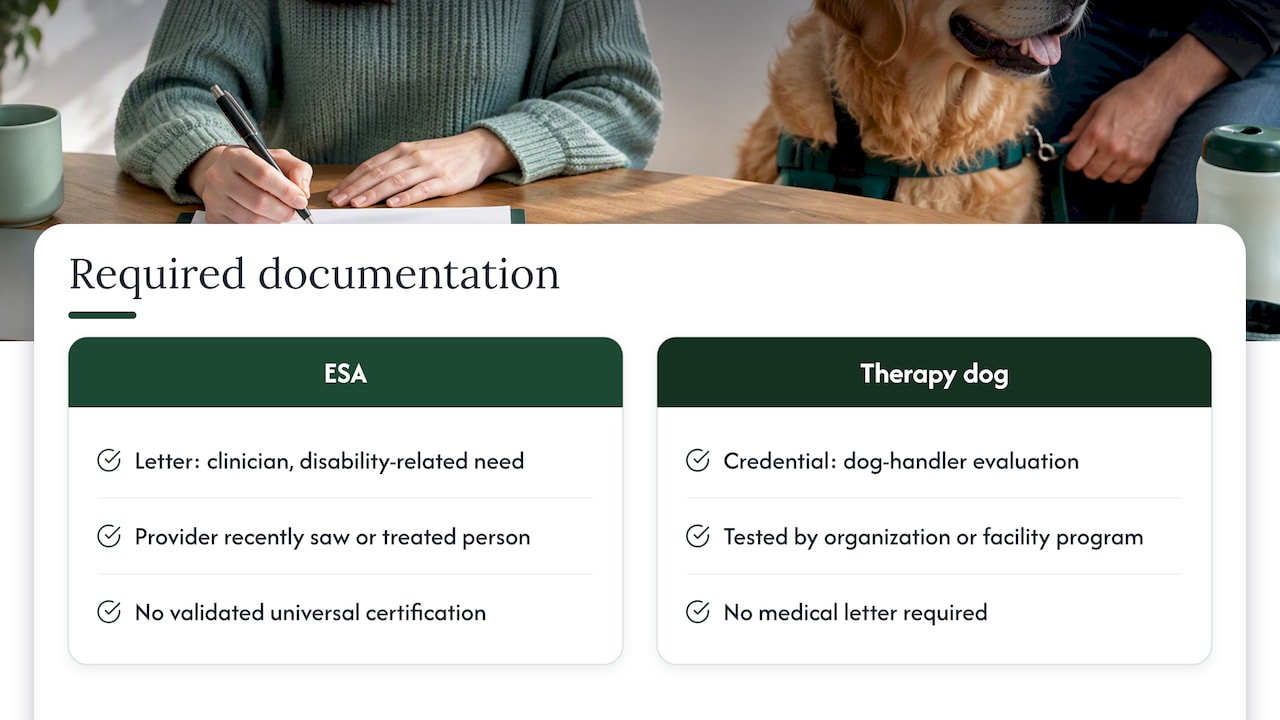
For an ESA, the AVMA says use must be supported in writing by a qualified physician or mental health professional based on a disability-related need. The Indiana fact sheet adds that verification should generally come from a medical provider who has recently seen or treated the person. A one-click quiz is not a clinician relationship. Our pages on how to get an ESA letter and what a real letter looks like show the elements a landlord expects, and the clinical items that make a doctor’s note hold up explain why each one matters.
For a therapy dog, no medical letter is involved, because the dog isn’t there for your disability. Instead, a therapy animal organization or facility program tests the dog and the handler together, and that evaluation is the credential.
Registries do not change this. The 2021 AAHA guidelines state that no validated, universally recognized certification process exists for ESAs and that counterfeit certifications are easy to obtain. A vest, an ID card or a number in a database proves nothing to a landlord. If a site sells you an “official ESA registration,” treat that as a warning sign.
Legal protections and where each can go
Housing
The Fair Housing Act is the main law behind ESAs. The Indiana fact sheet explains that it requires housing providers to allow ESAs necessary for residents with disabilities to use and enjoy their housing. That can include apartments with no-pet policies, in many cases without pet fees, though specifics depend on the situation. For where the rules stand now, read our piece on ESA housing rights and what HUD’s change means. States also add their own rules about who can write a letter, which our ESA letter laws by state page breaks down.
Therapy dogs get nothing comparable. Your own therapy dog, if you also keep it as a pet, is a pet in the eyes of the lease unless you separately qualify for an ESA accommodation. Being a registered therapy team does not unlock a no-pet building.
Public places and travel
Neither animal has service-animal access. The AVMA says therapy animals have no federally protected access right, and that ESAs are protected at home, not in stores, restaurants or other public spaces. Our guide for renters, your ESA guarantees housing rights, not public access, spells this out.
A therapy dog’s entry to a place depends on an invitation. A hospital volunteer program, a university stress-relief event or a school reading program all invite teams on purpose. Without that invitation, the dog is just a dog.
Because rules differ by country, note that this article describes the United States. Elsewhere, the picture changes. In Great Britain, for example, recognised assistance dogs can travel in aircraft cabins on some routes, while dogs that only provide emotional support are not usually considered recognised assistance dogs. In South Australia, it is against the law to refuse accommodation to an applicant planning to keep a therapeutic animal unless the refusal is reasonable. Check the law where you live.
How to decide which role fits you
Use these questions in order.
- Do you need the animal’s help for yourself, every day, including at home? That points to an ESA, if a clinician agrees it is part of your care.
- Do you want to share your dog’s calm nature with other people? That points to therapy work. Your own mental health condition is not required for this.
- Do you need the animal to do a specific task, such as interrupting a panic episode or alerting you to a medical event? That is service-animal territory, a different category with different rules.
- Is your main problem a no-pet lease or a dorm rule? Only an ESA accommodation addresses that.
- Does your dog enjoy strangers, noise and handling? If not, therapy work would stress the dog, and an ESA arrangement at home is the better fit.
The two are not mutually exclusive. Someone can hold an ESA recommendation for their dog and also volunteer with it as a therapy team, as long as the dog enjoys it and passes the program’s evaluation. The legal protections come only from the ESA side, though.
Examples
- A college student with panic attacks wants her cat in her dorm. She needs an ESA accommodation request supported by her clinician. A therapy certification would not help her here.
- A retiree with a gentle golden retriever wants to visit a memory-care unit. He needs a therapy animal evaluation and a facility invitation. He doesn’t need a doctor’s letter for that.
- A renter with PTSD whose dog helps her sleep and settle after nightmares may qualify for an ESA letter. If the dog is trained to wake her from a nightmare on command, a service-dog conversation is the next step.
An animal is one support among several. Many people pair an ESA with therapy, medication or skills work. If your difficulty is mostly about managing intense reactions, emotional regulation coaching is one kind of support worth knowing about alongside a companion animal.
What disqualifies a dog from being an ESA?
There is no federal checklist, so no list of banned breeds or traits exists in the law. In practice, an animal can lose protection if it is a direct threat to others, as the Indiana fact sheet notes. Aggression, repeated property damage and uncontrolled behavior are what get requests denied. The other common failure is paperwork: a certificate from a registry in place of a letter from a clinician who knows you.
A veterinarian cannot write the letter. The AVMA’s position is that veterinarians are not responsible for designating or assigning assistance animals and should focus on the animal’s health and welfare. A letter should come from a physician or mental health professional.
Our perspective
We built this site because the vocabulary around support animals is a mess, and most of the mess is profitable for someone else. Online vendors blur “therapy,” “emotional support” and “service” together because a confused buyer will pay for a vest and a certificate that mean nothing. We don’t sell documents or registrations, and we think that is the only honest place to explain this from.
Here is what we tell friends. If a landlord is the problem, you need an ESA accommodation request backed by a real clinician. If you want to visit hospitals with your dog, you need a therapy program. If you need a trained task, you are looking at a service animal. Buying the wrong credential for the wrong goal costs money and, worse, can make a landlord distrust a legitimate request.
Also, be kind to the animal. A dog that loves people can thrive in therapy work. A dog that is anxious in crowds should not be pushed into it just because the title sounds good. And an ESA’s value is the bond at home, which needs no certificate to be real.
— Erik
Start with the right document
If your goal is housing protection, the document that matters is a letter from a licensed clinician who has assessed you, not a registry listing. Our guide walks through the honest steps to get an ESA letter, what to look for, and which warning signs mean you should walk away.
You can also browse our full rights guide for housing, travel and common questions in one place.
FAQ
Is a therapy dog the same as an emotional support animal?
No. A therapy dog is trained and evaluated to visit groups of people, usually with its owner, in facilities that invite it. An ESA lives with one person and supports that person’s disability-related need, with a written recommendation from a qualified professional. Neither is a service animal.
Can a therapy dog live in a no-pet apartment?
Not because it is a therapy dog. Therapy work carries no federal housing protection, so the dog is treated as a pet under the lease. To request an exception, you would need to qualify for an ESA accommodation with documentation from a clinician.
Does an ESA need training or a certificate?
Federal law sets no training requirement for ESAs, and no recognized certification exists. What a housing provider may ask for is reliable documentation of your need from a health professional, and the animal must not pose a direct threat or cause serious damage. Good behavior still protects your accommodation.
Can my ESA go with me into stores and restaurants?
Generally no. ESAs are protected in housing, not in general public access, which belongs to service animals. A business may choose to allow pets, but it is not required to admit an ESA.
Can an ESA also be a therapy dog?
Yes, if the dog has the right temperament and passes a therapy program’s evaluation. The two roles are separate, so you would need both the clinician’s recommendation for the ESA role and the program’s approval for therapy visits.
Sources
- AVMA: Service, emotional support, and therapy animals
- ADA National Network: Service Animal or Emotional Support Animal
- Indiana Civil Rights Commission: Assistance Animals, Emotional Support Animals (2024)
- 2021 AAHA Working Assistance and Therapy Dog Guidelines
- GOV.UK: Bringing your pet dog, cat or ferret to Great Britain
- Equal Opportunity South Australia: Grounds for discrimination
- Emotional regulation coaching overview