
As of May 22, 2026, HUD limits federal enforcement of Fair Housing Act ESA accommodations to animals trained to perform disability-related tasks. Untrained emotional support animals are no longer presumptively protected under HUD’s complaint process. The FHA statute itself was not amended: private lawsuits and many state and local laws still recognize emotional support animals, and Supportpet’s resources can help renters document a request properly.
TL;DR:
- Housing providers can now only approve emotional support animals that have been trained to perform specific disability-related tasks, limiting the protection of untrained ESAs.
- HUD’s enforcement will require proof of task training, borrowing the ADA’s standard, and will no longer consider comfort or companionship alone as sufficient.
- Requests for ESA accommodations should include a clinician’s letter linking the animal to a specific functional need, avoiding vague or generic statements.
- Landlords can now enforce pet fees and deposits more confidently unless a documented, necessary reason justifies a fee waiver.
- State and local laws may still offer broader ESA protections, so tenants should verify their specific jurisdiction’s rules before assuming their ESA’s rights are diminished.
Table of Contents
- What the May 22, 2026 HUD guidance says and does
- FHA vs. ADA: two different laws, now one enforcement test
- How to request an ESA accommodation now
- Fees, deposits, and eviction risk under the new guidance
- State and local ESA protections may go further than federal enforcement
- A checklist for renters right now
- Where this guidance comes from and how Supportpet fits in
- A publisher’s note on what this actually means for people
- Get clinician-backed ESA documentation through Supportpet
- Sources
What the May 22, 2026 HUD guidance says and does
HUD’s enforcement memorandum rescinded the agency’s long-standing 2020 notice on service and assistance animals. That earlier guidance had told housing providers to treat emotional support animals like assistance animals, rather than pets, and generally advised against charging fees for them. The new memo throws that framework out.
Going forward, HUD’s Office of Fair Housing and Equal Opportunity (FHEO) will only find “reasonable cause” in an animal accommodation complaint when the animal has been individually trained to perform a task tied to the person’s disability. An animal that provides comfort through its presence, without task training, no longer clears that bar at the federal enforcement level.
A few things matter here:
- This is a shift in enforcement policy, not a rewrite of the Fair Housing Act itself.
- HUD has placed pending ESA-related complaints on hold while it applies the new standard.
- Housing providers evaluating a request now, and renters submitting one, should expect HUD’s investigators to ask whether the animal performs a trained task, not just whether it offers comfort.
- The memo draws directly on the ADA’s training test, which is a meaningful borrowing from a different law into FHA enforcement.
For tenants who already have an ESA letter and stable housing, nothing changes overnight. The risk shows up at the point of a new request, a lease renewal, or a dispute over fees.
FHA vs. ADA: two different laws, now one enforcement test
The Fair Housing Act requires housing providers to make a “reasonable accommodation” when a person with a disability needs a change to a rule, policy, or practice to have equal use of housing. That obligation comes from the FHA itself and from decades of HUD regulations interpreting it. It has never required the animal to be trained. Need and disability nexus were the test.
The Americans with Disabilities Act governs a narrower category: service animals in public places like stores, restaurants, and transit. Under ADA regulations, a service animal must be individually trained to perform a specific task connected to a person’s disability. Comfort, companionship, and emotional support explicitly do not count as “work or tasks” under ADA.
Here’s the friction point:
- FHA (housing): historically covered both trained service animals and untrained emotional support animals under “assistance animal” accommodation requests.
- ADA (public spaces): only covers task-trained service animals; ESAs get no protection there.
- HUD’s 2026 shift: imports the ADA’s training test into FHA enforcement, even though the FHA’s own text never required it.
That single change collapses two previously distinct legal standards into one enforcement heuristic. In buildings that also receive federal funding, Section 504 of the Rehabilitation Act can layer on additional obligations, so the analysis doesn’t always end with HUD’s memo alone.
How to request an ESA accommodation now
Landlords may ask for documentation connecting your disability to your need for the animal, but they generally cannot demand your full medical file or a specific diagnosis. A one-page letter purchased from a website with no clinical relationship behind it carries little weight under the new enforcement posture, and it likely carried little weight before, too.
- Get a letter from your treating clinician. It should state that you have a disability under the FHA and that the animal helps alleviate a specific symptom or functional limitation.
- Submit your request in writing. Email or a dated letter creates a record; a hallway conversation does not.
- Keep copies of everything, including the landlord’s response and any follow-up questions.
- Respond to reasonable follow-up requests in writing, and ask whether the property has a standard reasonable accommodation form.
- If a service animal (not an ESA) is involved, understand the landlord’s questions are more limited under ADA-influenced practice: they generally can only ask if the animal is required because of a disability and what task it performs.
Pro Tip: Ask your clinician to write specifically about how the animal reduces a symptom, like interrupting a panic episode or easing a documented sleep disorder, instead of writing that the animal provides general comfort. Specific, functional language holds up better than a vague “for emotional support” line.
Fees, deposits, and eviction risk under the new guidance
The old HUD posture discouraged pet fees for ESAs entirely. That blanket presumption is gone. Housing providers now have more room to argue that an untrained ESA is subject to standard pet fees and deposits, unless the tenant can show the fee waiver itself is a necessary and reasonable part of the accommodation.

That case-by-case necessity and reasonableness test isn’t new. Courts applying the FHA have long required plaintiffs seeking fee waivers to prove the waiver was actually necessary, not just preferred, and that standard now carries more practical weight in the absence of HUD’s earlier default position favoring tenants.
A few practical realities follow from this:
- Landlords can enforce general pet policies more confidently than they could under the 2020 guidance.
- A documented, functional necessity, especially paired with any task training, still strengthens a fee waiver argument.
- Complaints already filed with HUD before May 2026 are sitting on hold, not dismissed. Nobody yet knows how long that hold lasts.
- Private lawsuits under the FHA remain available regardless of HUD’s enforcement stance, and they run on their own timelines, separate from HUD’s complaint process.
If you’re anywhere near a dispute over fees or an accommodation denial, start collecting records now. Necessity is easier to prove with a paper trail than with a memory of what was said.
State and local ESA protections may go further than federal enforcement
HUD’s memo only controls how HUD enforces the federal FHA. It has no power to rewrite state fair housing statutes, and several states haven’t followed HUD’s lead.
Massachusetts is the clearest example. State guidance on assistance animals in housing still treats emotional support animals as protected assistance animals under state law, with its own documentation and process rules, independent of what HUD does at the federal level.
Before assuming your ESA lost its protection, check the following:
- Your state’s fair housing agency or attorney general’s office, which often publishes plain-language guidance.
- Your city or county’s human rights commission, if one exists.
- A local legal aid organization that handles housing cases, which can tell you fast whether your jurisdiction diverges from HUD’s new posture.
A checklist for renters right now
The single biggest thing you control is your paper trail. Everything else, including how a landlord or HUD’s investigators respond, follows from how well documented your request is.
- Get a letter from a treating clinician (not a one-time telehealth form-filler) that ties the animal to a specific, functional limitation.
- Submit a written reasonable accommodation request and save copies of every message that follows.
- Try to resolve fee or documentation disputes directly with your landlord first, and get any agreed concessions in writing.
- If your request is denied, look into your state or local fair housing agency’s complaint process, or talk to a tenant-rights organization like DWELR about what landlord documentation demands are actually reasonable.
- If a private lawsuit is on the table, preserve dated communications, photos, and letters now. Deadlines for filing FHA claims are not indefinite.
Pro Tip: Don’t wait for a dispute to start your file. Save your clinician’s letter, your written request, and the landlord’s reply the same week you send them. Reconstructing a timeline months later, after a denial or an eviction notice, is far harder than keeping folders as you go.
Where this guidance comes from and how Supportpet fits in
Supportpet provides plain-language guidance on ESA rights, clinician-documentation standards, and warnings about the ESA-letter scams that have proliferated online for years.
The core sources behind this shift are HUD’s own May 2026 enforcement memorandum, the earlier 2020 FHEO notice it replaced, ADA regulatory text from the Department of Justice, and state guidance such as Massachusetts’s assistance-animal page, each addressing a different layer of the same legal question.
Legal commentary from firms tracking the change, including analysis from Duane Morris’s animal law blog, has flagged open questions about breed and weight restrictions and how pending litigation will play out.
A publisher’s note on what this actually means for people
Policy shifts like this land hardest on people who did nothing wrong, just relied on guidance that existed for over a decade. Document everything, check your state’s rules before assuming the worst, and be skeptical of any ESA-letter service that promises approval without a real clinical relationship. Supportpet’s guides walk through both.
— Erik
Get clinician-backed ESA documentation through Supportpet
Supportpet is the plain-language alternative to guessing your way through a reasonable accommodation request or paying for a sketchy internet letter mill. Where other options leave you piecing together legal memos and outdated blog posts, Supportpet’s guide walks you through what a treating clinician’s letter needs to say, how to submit a request that HUD’s new standard won’t trip up, and which “instant ESA letter” sites to avoid entirely.
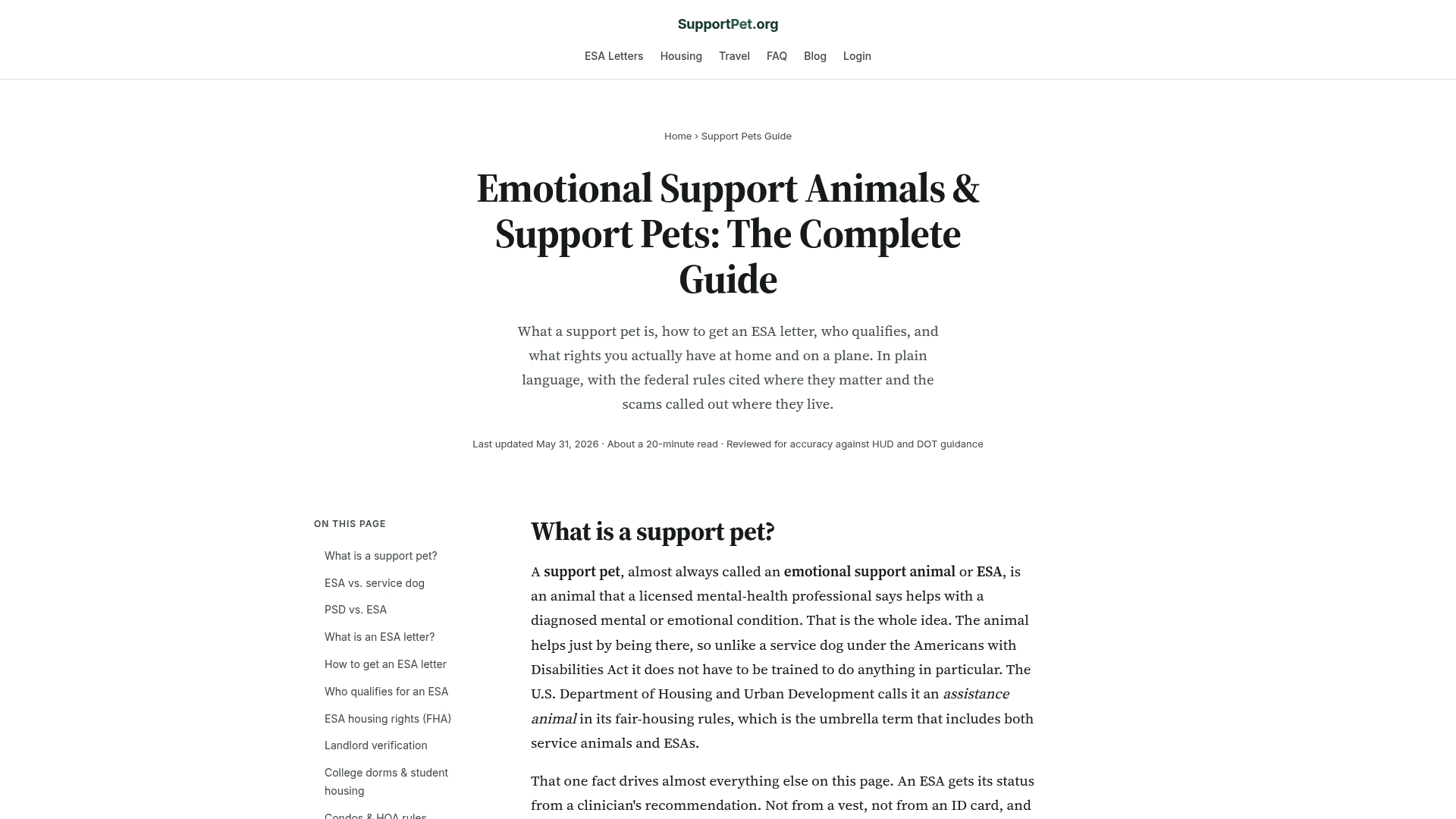
None of this replaces a lawyer, and Supportpet isn’t one. But if you’re trying to figure out what documentation actually holds up before you submit a request, start with Supportpet’s ESA rights guide and get your paperwork in order before you need it.
This article is general information, not a substitute for advice from a qualified lawyer. Consult a qualified legal professional about your own circumstances before acting on anything here.
Sources
- Enforcement Guidance – Assessing Requests for the Use of an Animal as a Reasonable Accommodation Under the Fair Housing Act (HUD, May 22, 2026)
- ADA service animal resources (U.S. Department of Justice / ADA)
- Mass
- The End of an Era: HUD’s 2026 Guidance Upends Emotional Support Animal Accommodations in Housing (Duane Morris blog)