Grounding and mindfulness both bring you into the present moment, but they do different jobs. Grounding is for stabilizing yourself when emotions feel too big, such as during panic, flashbacks or dissociation. Mindfulness is for noticing your thoughts and feelings with openness once you are steady enough to observe them. Meditation is a third thing: a formal, timed way of practicing mindfulness.
If you have ever tried to “just be mindful” in the middle of a spike of anxiety and felt worse, this distinction is for you. Below you will find a plain comparison, a way to pick the right tool in the moment, exercises for each, and the points where a licensed professional should be involved.
TL;DR
- Mindfulness means observing thoughts, feelings and sensations without judgment. Grounding means using your senses, body or mind to steady yourself when you feel overwhelmed.
- A useful rule of thumb: if you are within your window of tolerance, mindfulness fits. If you are outside it, start with grounding.
- Meditation is usually a structured, timed exercise. Mindfulness is a skill you can use during any daily activity.
- Neither replaces professional care. See a licensed clinician for persistent anxiety, trauma symptoms or depression.
- Many people find a calm routine, and for some a companion animal, helps them practice these skills consistently.
Table of Contents
- The short answer: two tools for two states
- What mindfulness is
- What grounding is
- Grounding vs. mindfulness side by side
- Where meditation fits
- How to choose in the moment
- Grounding exercises to try
- A simple mindfulness practice for calmer days
- Safety and when to get professional help
- Perspective: why a steady routine matters
- If a companion animal is part of your coping plan
- FAQ
- Sources
The short answer: two tools for two states
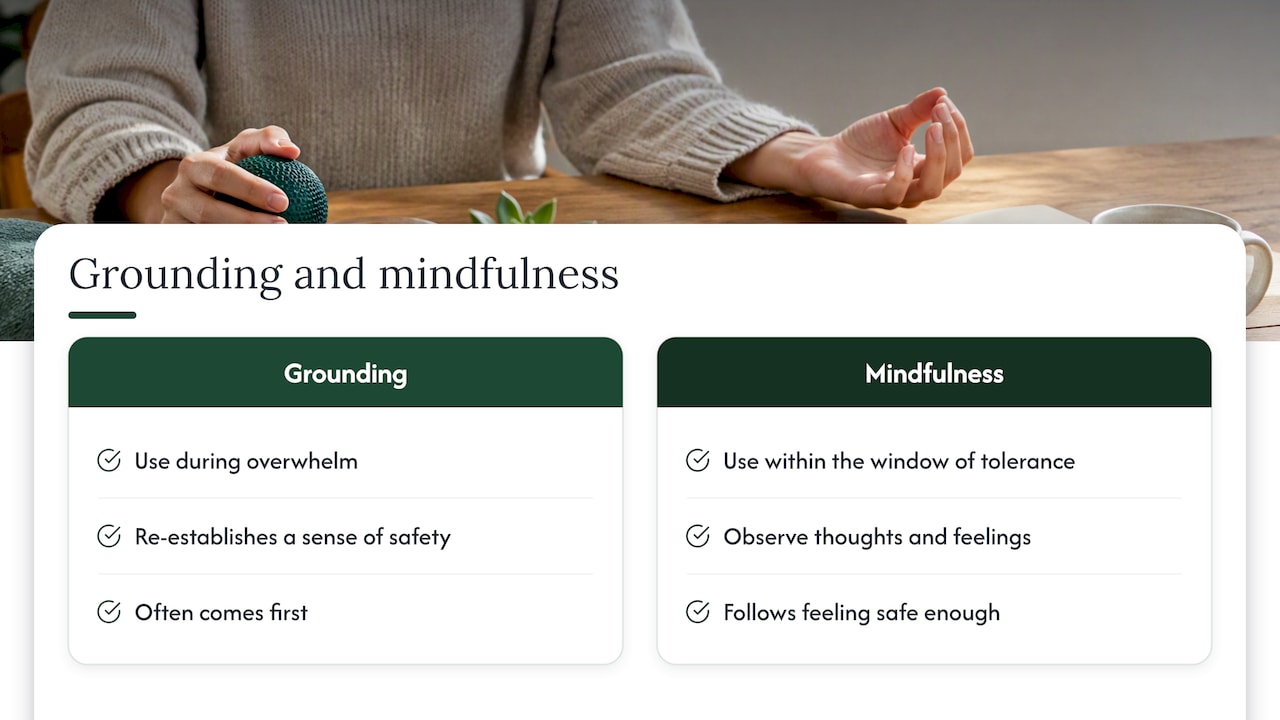
Think of a dial that runs from numb or shut down, through a comfortable middle, to flooded or panicked. Therapists often call the comfortable middle the window of tolerance. One therapy practice’s explanation describes mindfulness as observing thoughts and feelings with equanimity while you are within that window, and grounding as the way to regulate overwhelming emotions and re-establish a sense of safety when you are outside it.
Another psychology practice puts it as three related but separate skills: mindfulness for awareness, grounding for immediate stabilization during overwhelm, and emotional regulation for coping with big emotions more broadly.
So the two are not rivals. Grounding often comes first, and mindfulness comes after you feel safe enough to look at what is going on inside.
What mindfulness is
The American Psychological Association describes two main components of mindfulness: attention to present experiences and acceptance of them without judgment. You notice a thought, a feeling, a tightness in your chest or the sound of traffic, and you let it be what it is rather than arguing with it.
The University of Utah Health describes mindfulness as observing internal and external experience in the present without judgment. It is a skill, not an event. You can wash dishes mindfully, walk mindfully or eat mindfully.
What mindfulness is good at:
- Loosening the grip of repetitive negative thinking. Psychiatrist Dr. Julian C. Lagoy says in Forbes Health that it is particularly useful against consistent negative thoughts because it helps you be less self-judgmental.
- Building awareness of stress signals early, before they snowball.
- Serving as a complementary approach. The National Institutes of Health lists stress, anxiety, PTSD, depression, pain, sleep problems and substance use recovery among the areas where meditation and mindfulness may be used.
What grounding is
Grounding is an umbrella term. The Cleveland Clinic uses it for psychological techniques that refocus your attention on the present and reduce anxiety or intrusive thoughts, and says they can be sensory, physical or mental exercises.
A health authority in Canada describes grounding as a coping strategy and a form of mindfulness that helps the brain refocus on the present when someone is overwhelmed by flashbacks or dissociation. That wording shows why people confuse the two: grounding borrows from mindfulness, but its goal is narrower. It aims to get you out of the storm, not to study the weather.
A quick note on terminology. The Cleveland Clinic separates grounding from earthing. Earthing means physical contact with the Earth, such as walking barefoot on grass. Grounding in the psychological sense may involve breathing, stretching, sensory objects, mantras or distraction, and does not need to involve the Earth at all. This article is about the psychological kind. The same Clinic page notes that claims for earthing, such as better sleep or less inflammation, rest on limited and preliminary research and do not show that it prevents or cures disease.
Grounding vs. mindfulness side by side
| Grounding | Mindfulness | |
|---|---|---|
| Main goal | Stabilize and feel safe | Observe with acceptance |
| Best used when | You feel flooded, panicky, numb or dissociated | You feel steady enough to notice what you feel |
| Typical method | Senses, body, simple mental tasks | Open attention to thoughts, feelings, sensations, surroundings |
| Time it takes | Seconds to a few minutes | Moments in daily life, or longer in formal practice |
| Stance toward feelings | Move attention away from the distress, or anchor yourself beside it | Stay with the experience and let it pass without judging |
| Trauma work | Often the first step | May need to wait until stabilization is in place |
That last row matters. One trauma-focused therapy practice notes that introducing mindfulness skills can sometimes be contraindicated in trauma therapy, where the first priority is stabilization through grounding. If you have a trauma history, work out the pacing with a licensed therapist rather than pushing through on your own.
Where meditation fits
People who search for grounding vs. meditation are usually asking the same question as grounding vs. mindfulness, with one extra layer. Meditation and mindfulness are not identical either.
- Mindfulness is a skill of present-moment awareness without judgment that can be applied to daily activities. Meditation is typically a formal, time-structured practice that requires intentional focus, according to Forbes Health.
- The NIH describes meditation as a range of mind-body practices that may focus attention on breathing, sound, imagery or a mantra.
- A medical school explainer says mindfulness is a component of meditation, and even lists five-senses grounding as one way to practice mindfulness.
- The University of Utah notes that meditation deliberately channels awareness, often toward the breath, to train attention and release unhelpful thoughts.
Put together, here is how grounding differs from meditation. Meditation is a scheduled practice you do to train your attention over time, usually while you are reasonably calm. Grounding is an on-the-spot technique you use whenever distress spikes, with no need for a quiet room or a set session. Some grounding exercises look like meditation (a slow breathing count, for example), but the purpose differs: one trains, the other rescues.
The most widely used structured programs, MBSR and MBCT, are built around eight weekly sessions and a one-day retreat, which shows how formal meditation-based training can be compared with a 60-second grounding exercise.
How to choose in the moment
The same practice that helps on a calm morning can backfire during a bad moment. A simple check works well.
- Scan your body. Notice your breathing, jaw, chest and hands. The therapy practice cited above suggests connecting with how you feel in your body and asking where you are in your window of tolerance.
- Rate it. If your distress is manageable, you can be curious about it. That is mindfulness territory. If your heart is racing, your thoughts are looping, you feel detached from your surroundings or a memory feels like it is happening now, choose grounding.
- Start small. Pick one exercise from the next section and do it for a minute or two.
- Reassess. When your body has settled, you can switch to a gentler, mindful stance: what was that about, what am I feeling now?
If you are practicing during an intense emotional moment, Forbes Health points out that mindfulness is often more accessible and safer than starting a formal meditation, because it does not require you to stop what you are doing. Many people find a short grounding step followed by informal mindfulness is the gentlest sequence.
If racing thoughts and emotional flooding are a regular problem, particularly with ADHD, this walkthrough of steps for emotional flooding shows how stabilizing moves can be built into a busy day.
Grounding exercises to try
The Canadian health authority resource lists sensory techniques such as listening to loud music, biting a lemon or holding ice, and cognitive ones such as mental math or memory games. Here is how those fit into a short menu you can keep in your head.
Sensory
- Hold an ice cube or run cold water over your hands and describe the sensation in detail.
- Bite into something sour or strongly flavored and notice every part of the taste.
- Play a loud, familiar song and follow one instrument.
- Name five things you see, four you can touch, three you hear, two you smell and one you taste. This is the five-senses exercise the medical school explainer mentions.
Physical
- Press your feet into the floor and feel the pressure through your heels.
- Stretch your arms overhead, then let them drop.
- Hold a small object with texture, like a smooth stone or a keychain, and trace its edges.
Mental
- Count backward from 100 by sevens.
- Name every animal you can think of, in alphabetical order.
- Repeat a short phrase such as “I am here, and this will pass.”
The Cleveland Clinic adds a practical safety point: stay aware of physical safety, such as avoiding injury from walking barefoot or shocks from faulty grounding devices, if you try earthing-style approaches.
A simple mindfulness practice for calmer days
The NIH lists muscle tensing and releasing, slow rhythmic breathing and visualization among practical exercises. Here is a three-minute version you can try when you feel steady.
- Sit comfortably and let your eyes close or soften.
- Breathe slowly and rhythmically. Notice the air at your nostrils or the rise of your belly.
- When a thought pulls you away, name it quietly (“planning,” “worrying”) and return to the breath. The point is acceptance of whatever shows up, not emptying your mind.
- Tense your shoulders for five seconds, then release. Notice the contrast.
- Open your eyes and look around the room for one full breath.
By the end, you have used a little meditation, a little mindfulness and a touch of grounding. That overlap is normal.
Safety and when to get professional help
Mindfulness and meditation are generally gentle, but not risk-free. A 2020 review of 83 studies found that roughly 8 percent of participants reported negative experiences from meditation practices, a rate similar to psychological therapies, according to the NCCIH. The same agency advises asking about the training and experience of any meditation instructor.
Two more boundaries to respect:
- The NIH says not to use meditation or mindfulness as a replacement for conventional care or a reason to delay seeing a health provider about a medical problem.
- A review of mind-body interventions found the data insufficient to recommend them as primary treatments for anxiety disorders, though they may be part of a larger treatment plan. For a wider look at what that larger plan can include, see this overview of anxiety treatment without medication.
See a licensed mental health professional, such as a psychologist, licensed counselor or psychiatrist, if panic attacks are frequent, flashbacks keep returning, you feel detached from reality often, grounding stops working, or low mood lasts for weeks. If you are in crisis in the United States, call or text 988 to reach the Suicide and Crisis Lifeline.
Perspective: why a steady routine matters
Most of the people who write to us are not looking for a lecture on psychology. They are renters, students and pet owners who feel anxious or low and want something that works on an ordinary Tuesday. What we see again and again is that the best coping skills are the ones you actually repeat, and routine is what makes that happen.
That is where our focus on emotional support animals comes from. An ESA is not a therapy and does not require task training, but a pet that needs feeding, walking and attention gives many people a daily anchor: something warm to touch, a reason to get outside, a living thing to notice. Those are the same sensory and present-moment cues that grounding and mindfulness ask you to find.
We believe the right order is stabilize first, then reflect, and keep a licensed clinician in the loop. The same clinician is the person who can decide whether an emotional support animal is appropriate for you and, if so, write a legitimate letter. We built Supportpet to explain that process in plain language, free of the registries and certificates that cost money and carry no legal weight.
Erik
If a companion animal is part of your coping plan
If you already share your home with a pet that calms you, or you are wondering whether an animal could be part of a treatment plan, it helps to understand the rules before you act. Our guide on how to get an ESA letter walks through the honest steps, and our comparison of ESAs and service dogs explains why an ESA provides comfort rather than task-trained assistance. For renters, our housing rights guide covers what the Fair Housing Act means for you.
Everything on Supportpet is free to read, and we do not sell certificates, registrations or ID cards.
FAQ
Is grounding the same as mindfulness?
No, though they overlap. Grounding is a stabilizing technique for moments when you feel overwhelmed, and it can be considered a form of mindfulness because it uses present-moment attention. Mindfulness is broader: observing thoughts, feelings and surroundings with acceptance, ideally while you are within your window of tolerance.
Is meditation the same as mindfulness?
Not quite. Meditation is typically a formal exercise done at a set time, often focused on the breath, a sound or a mantra. Mindfulness is a skill of nonjudgmental awareness that you can use in everyday activities, and it is a component of many meditation practices.
What grounding exercises help with anxiety?
Sensory methods such as holding ice, biting something sour or naming what you can see, hear and touch work for many people. Mental tasks like counting backward by sevens also redirect attention to the present. If anxiety is frequent or severe, add support from a licensed professional.
Should I use grounding or mindfulness during a panic attack?
Grounding is usually the better first step, because the goal is to feel safe and stabilized. Once your body calms, a brief mindful check-in can help you understand what happened. Repeated panic attacks deserve an evaluation by a doctor or mental health clinician.
Can grounding or mindfulness replace therapy?
No. They are skills that can support treatment, not substitutes for it. The NIH advises against using mindfulness or meditation to replace conventional care or to postpone seeing a provider about a medical problem.
Sources
- Grounding vs. Mindfulness: How to Understand the Differences
- What is the difference between mindfulness, grounding and emotional regulation
- American Psychological Association: Mindfulness meditation
- University of Utah Health: What is Mindful Meditation?
- Forbes Health: Mindfulness vs. Meditation
- NIH: Mindfulness and Meditation
- Cleveland Clinic: What Is Earthing and Is It Beneficial?
- Eastern Regional Health Authority: Grounding Strategies
- PCOM: What is Mindfulness and Why is Mindfulness Important?
- Mindfulness-based interventions: an overall review
- NCCIH: Meditation and Mindfulness: Effectiveness and Safety
- Mind-Body Interventions for Anxiety Disorders: A Review
- Stop emotional flooding in 3 moves