
Whether your denial is lawful depends on narrow, fact-specific exceptions, not a landlord’s general preference to avoid animals. HUD’s May 22, 2026 memo narrowed federal enforcement, but it did not repeal your protections under the Fair Housing Act or your state’s civil rights law. Right now, get the denial in writing, save every email and text with a date stamp, and ask your treating clinician for a proper letter before you do anything else.
TL;DR:
- Federal enforcement now prioritizes trained animals performing specific tasks, but private courts and agencies still uphold ESA protections without that training requirement.
- Denials based solely on blanket pet bans, breed restrictions, or no-pet policies are generally unlawful if they lack specific, documented safety or burden evidence.
- A well-drafted clinician letter linking your disability to the animal’s functional help is the most effective documentation to prevent or challenge a denial.
- After a denial, gathering detailed written explanations, updating your documentation, and contacting local fair housing agencies improve your chances of success.
- Filing with state or city agencies often offers faster, more effective remedies than HUD complaints, especially given the enforcement shift starting in May 2026.
Table of Contents
- Is a Housing Denial ESA Case Actually Lawful? The Federal Framework
- When Can a Landlord Legally Deny an ESA Request?
- What Documentation Actually Protects You From a Denial?
- What Should You Do Right After a Written Denial?
- HUD Complaint, State Agency, or Lawsuit: Which Enforcement Path Fits Your Case?
- Public Housing, Colleges, and HOAs: Where the Rules Diverge
- Why Did HUD Change Course, and What Do Legal Experts Say?
- Why Do Landlords Keep Denying ESA Requests Anyway?
- ESA vs. Service Animal: Why the Housing Protections Aren’t the Same
- Coping With the Fallout: Mental Health Effects of a Denial
- What Recent Cases Reveal About How Courts Handle ESA Denials
- Finding ESA-Friendly Housing If Your Current Fight Isn’t Winning
- Where to Get Help: Advocacy Groups and Agencies for ESA Housing Disputes
- What Tenants Should Prioritize After a Denial
- Get a Defensible ESA Letter Before Your Next Housing Application
- Sources
Is a Housing Denial ESA Case Actually Lawful? The Federal Framework
The Fair Housing Act (FHA) hasn’t changed. What changed is how the Department of Housing and Urban Development enforces it. On May 22, 2026, HUD rescinded its prior guidance on emotional support animals and announced a new enforcement standard: it will generally find “reasonable cause” against a housing provider only when the animal has been individually trained to perform disability-related work or tasks. That’s the legal definition of a service animal, not an ESA.
In practice, this means HUD’s own investigators will usually decline to pursue a complaint if your ESA hasn’t gone through formal task training. HUD attached case materials referencing Henderson v. Five Properties to the memo as an example of the kind of dispute it now wants agencies to weigh differently, treating training status as a central factor in whether a complaint moves forward.
Here’s the part landlords and property managers often get wrong, and tenants often misunderstand too: HUD choosing not to investigate is not the same as your ESA losing legal protection. The FHA still gives you a private right of action. You can still sue in federal court, and courts are not required to adopt HUD’s enforcement posture as the legal standard. As DREDF explains, the memo is a policy and staffing decision about which complaints HUD prioritizes. It is not a change to the statute itself.
A few things follow from that distinction:
- HUD may close or decline your complaint, but that outcome carries no legal weight in a private lawsuit.
- State and local human rights agencies operate under their own statutes and are not bound by HUD’s memo at all.
- Courts have historically reached conclusions that diverge from HUD guidance documents, since those memos are enforcement instructions, not binding law.
- Your landlord’s obligation to engage in an interactive process around your accommodation request remains intact under the FHA regardless of HUD’s staffing choices.
So if you’ve been denied, the real question isn’t “did HUD change the rules.” It’s “did my landlord violate the FHA or my state’s law,” which is a separate and still very much alive question.
When Can a Landlord Legally Deny an ESA Request?
Landlords do have lawful grounds to deny an ESA accommodation. They’re narrower than most property managers act like they are, and they require actual evidence, not a hunch. Four categories cover almost every legitimate denial.
- Undue financial or administrative burden, or fundamental alteration of operations. A landlord has to show the accommodation would impose a real, quantifiable cost or disrupt how the property functions, not just that it would rather not deal with pets. Minnesota’s guidance is explicit that this determination has to rest on objective evidence, not assumptions about a breed or species.
- Direct threat to other residents or the property, based on this specific animal’s actual conduct. A history of aggression, a documented bite, or verified property destruction by that particular animal can justify a denial. A landlord’s general fear of dogs, or a no-pit-bull policy applied automatically, does not qualify. The threat has to be tied to individual behavior, evaluated on the facts in front of them.
- Insufficient reliable documentation of a disability-related need. If you never provided a letter connecting a diagnosed condition to a specific functional need the animal addresses, a landlord can lawfully ask for more before approving. This is the most common denial reason, and it’s often fixable rather than final.
- Ongoing lease violations unrelated to the accommodation itself. Chronic late rent, unauthorized occupants, or repeated noise complaints don’t disappear because you have an ESA. A landlord can still deny or terminate tenancy for reasons that have nothing to do with the animal.
Notice what’s missing from that list: pet fees, breed restrictions, size limits, and blanket no-pet policies. None of those override a valid ESA accommodation request. If your denial letter cites a no-pets clause and nothing else, that’s a strong sign the denial doesn’t hold up.
What Documentation Actually Protects You From a Denial?
The single biggest factor separating a defensible ESA request from a vulnerable one is where the letter came from. A letter from a clinician who has an actual treatment relationship with you carries far more weight than a document purchased from a website that issues certificates after a five-minute questionnaire. Mass.gov’s guidance is direct about this: housing providers are advised to give more credibility to letters from treating providers than to mass-produced online letters, and HUD’s own 2026 memo flagged the online certificate industry as part of what drove its policy shift.
That distinction matters because HUD cited caseload growth tied to exactly this kind of documentation as one reason it narrowed enforcement, according to DREDF’s analysis of the memo. A landlord who suspects your letter came from a template mill isn’t being unreasonable to ask questions. A landlord who denies a letter from your actual therapist of two years is on much shakier ground.
A defensible letter should include a few specific elements:
- A statement that the clinician has an established relationship with you as a patient, not a one-time consultation.
- Language connecting your diagnosed condition to a specific functional limitation, and explaining how the animal helps address it.
- The clinician’s license type, credentials, and contact information.
- A current, dated signature. Letters that are years old or undated give landlords a legitimate reason to ask for updated documentation.
What landlords may request is limited. They can ask for documentation confirming a disability-related need and the relationship between the disability and the animal. What they may not demand is your specific diagnosis, your full medical records, or details about your treatment beyond what’s necessary to establish the need. If a landlord’s request goes further than that, you’re allowed to push back and ask them to specify what the FHA actually entitles them to see.
Pro Tip: If you obtained your ESA before you had a formal letter, tell your clinician that timeline honestly. A letter that explains why the animal came first and the diagnosis or treatment plan followed is more credible than one that looks like it was written to backfill a decision you’d already made.
What Should You Do Right After a Written Denial?
The days right after a denial decide how strong your case is later. Move through these steps in order, and don’t skip the paperwork even if it feels redundant.
- Request a detailed written explanation for the denial, including the specific legal basis the landlord is relying on and any timeline for appeal or resubmission. A denial that just says “no pets allowed” is different, legally, from one that cites a documented safety incident.
- Supplement your documentation immediately if the stated reason was inadequate evidence. Send an updated clinician letter, a copy of any prior approval history, and a clear written request that references the specific FHA accommodation standard. Mass.gov’s guidance notes tenants should generally be given the chance to provide additional information before a final denial, so don’t assume the first “no” is the last word.
- Build a dated evidence file now, before memories fade. Save the original request, every reply, texts, emails, and notes from phone calls with a date and who you spoke to. If the landlord referenced behavior incidents, request their written account of what happened and when.
- Contact a fair housing advocacy group or legal aid office before signing anything that waives your rights or agrees to remove the animal. Many operate free of charge and can tell you within days whether your case has merit.
- If repairs or behavior remediation come up, document what you offered to fix or pay for, and keep receipts. This becomes relevant if a landlord claims property damage as the basis for denial.
Timing isn’t just a formality here. Fair housing complaints carry filing deadlines, typically within one year of the discriminatory act under federal law, and state deadlines vary. Missing that window can close off remedies that would otherwise be available to you, regardless of how strong your underlying case is.
HUD Complaint, State Agency, or Lawsuit: Which Enforcement Path Fits Your Case?
You have three real paths after a denial, and HUD’s 2026 shift makes the choice between them more consequential than it used to be.
Filing with HUD is free and doesn’t require a lawyer, but the 2026 memo means an untrained-ESA complaint is now more likely to get closed without a finding, particularly if your documentation is thin. HUD hasn’t eliminated this path. It’s just deprioritized a large category of cases within it.
- HUD can still refer complaints to state agencies for investigation under local law, even when it declines to pursue federal action directly.
- A HUD complaint creates an official record of your denial, which can matter later even if HUD itself doesn’t act.
State and city human rights agencies are often the faster, stronger option right now, and they’re free. Agencies in New York City, California, Minnesota, and Massachusetts all maintain their own standards independent of HUD’s enforcement posture, and several explicitly require individualized assessments that go beyond what HUD’s memo now emphasizes. Contacting these offices is generally a faster first move than jumping straight to litigation.
Private lawsuits remain fully available under the FHA. HUD declining to pursue your complaint doesn’t close this door, since courts apply the statute independently and aren’t bound by HUD’s internal memos, a point DREDF’s legal analysis makes clear. The tradeoff is cost and time. A lawsuit takes months at minimum and usually requires an attorney, though fair housing cases can sometimes be handled on contingency or with fee shifting if you win.
The realistic strategy for most tenants: file with your state or city agency first, keep building your documentation file regardless of outcome, and treat a private suit as the option you hold in reserve if the agency route stalls.
Public Housing, Colleges, and HOAs: Where the Rules Diverge
Not every housing situation runs on the same rulebook, and assuming otherwise causes a lot of unnecessary denials to stick.
Federally assisted housing, including HUD-subsidized units and properties receiving federal funds, often falls under Section 504 of the Rehabilitation Act in addition to the FHA. Section 504 has its own procedural requirements and, in some respects, applies more stringent obligations on housing providers than the FHA alone. If you live in subsidized housing, ask specifically whether Section 504 protections apply to your denial, since the analysis can differ from a private landlord dispute.
Student housing typically runs through a college’s disability services office rather than a standard landlord accommodation process. Appeals in this setting often go through an internal academic grievance procedure before, or instead of, a fair housing complaint. If a university housing office denies your ESA, ask for its specific appeal process in writing. Many schools have separate, faster internal review than what a HUD or state complaint would offer.
HOAs and condo boards are generally bound by the FHA the same way rental landlords are, but enforcement often runs through the board’s own governing documents first. Check your state’s specific guidance before assuming the process mirrors a rental dispute:
- New York City’s Commission on Human Rights fact sheet spells out what documentation and fees are and aren’t permitted.
- Minnesota’s Department of Human Rights lists the specific denial bases regulators will actually accept.
- Massachusetts’s guidance details the interactive process landlords are expected to follow before a final denial.
Look up your own state’s civil rights or human rights agency by name. Nearly every state has a page similar to these three, and it’s usually the fastest way to find local contacts.
Why Did HUD Change Course, and What Do Legal Experts Say?
HUD’s memo didn’t come out of nowhere. The agency pointed to a sharp rise in ESA-related complaints tied to the growth of online certificate services, according to DREDF’s breakdown of the policy shift, and framed the change as a response to a caseload it viewed as increasingly clogged with weak or manufactured documentation.
Legal commentary on the shift has been notably consistent on one point: this is a staffing and prioritization decision, not new law, and landlords who treat it as blanket permission to deny ESAs are taking on real risk.
Housing providers should continue conducting individualized assessments of accommodation requests rather than issuing blanket denials, because HUD’s enforcement change doesn’t bind courts and private litigation risk under the Fair Housing Act remains fully intact.
That’s the core of the practitioner guidance summarized in a legal analysis published by JD Supra. The reasoning cuts both directions. Landlords who deny every ESA request reflexively, betting HUD won’t come after them, are exposed to state agency action and private suits that don’t care what HUD’s memo says. Tenants who assume HUD’s shift means their rights disappeared are giving up leverage they still legally hold.
The practical upshot for anyone reading this after a denial: your state’s law and your ability to sue privately didn’t move an inch in May 2026. What moved was which agency picks up the phone first, and how quickly. That’s a meaningful change, but it’s not the end of the road it might feel like.
Why Do Landlords Keep Denying ESA Requests Anyway?
Legal protections exist, and denials still happen constantly, for reasons that mostly boil down to cost avoidance, liability fear, and simple unfamiliarity with the law.
Property managers overseeing dozens of units often apply a blanket no-pet or breed-restriction policy because it’s administratively simpler than evaluating each request individually, even though that approach is exactly what the FHA prohibits. Insurance concerns play a real role too. Some property insurance policies list breed exclusions or liability language that makes landlords nervous about any animal on the premises, regardless of its legal status as an ESA.
Documentation skepticism is another major driver, and it’s not always unreasonable. The flood of instant online ESA certificates has made some landlords distrustful of any letter, including legitimate ones, which is part of why HUD cited that same industry as a factor in its 2026 policy shift.
There’s also a financial incentive some property managers won’t say out loud: charging pet deposits and monthly pet rent generates revenue that a legally protected ESA accommodation doesn’t allow them to collect. A denial, even an unlawful one, sometimes reflects that lost revenue more than any genuine safety or burden concern.
None of these reasons make a denial lawful on their own. But recognizing which motivation is actually driving your specific denial helps you figure out where to push back, whether that’s clarifying your documentation, pointing to the specific FHA standard, or escalating to a state agency that won’t accept a policy-based excuse.
ESA vs. Service Animal: Why the Housing Protections Aren’t the Same
Confusing these two categories is probably the single biggest reason ESA denials happen and stick. Service animals are trained to perform specific tasks tied to a disability, like guiding someone who is blind or interrupting a seizure. That training requirement is written into the Americans with Disabilities Act and carries into how HUD’s 2026 memo evaluates housing complaints.
Emotional support animals provide comfort through their presence rather than through trained tasks. No training or certification is legally required for an ESA to qualify for a reasonable accommodation under the Fair Housing Act, and that’s exactly the distinction HUD’s memo leans on. Because HUD’s new enforcement standard prioritizes complaints involving trained animals, an ESA request without training documentation is now more likely to get deprioritized at the federal level, even though the FHA’s own legal standard for ESAs never required training in the first place.
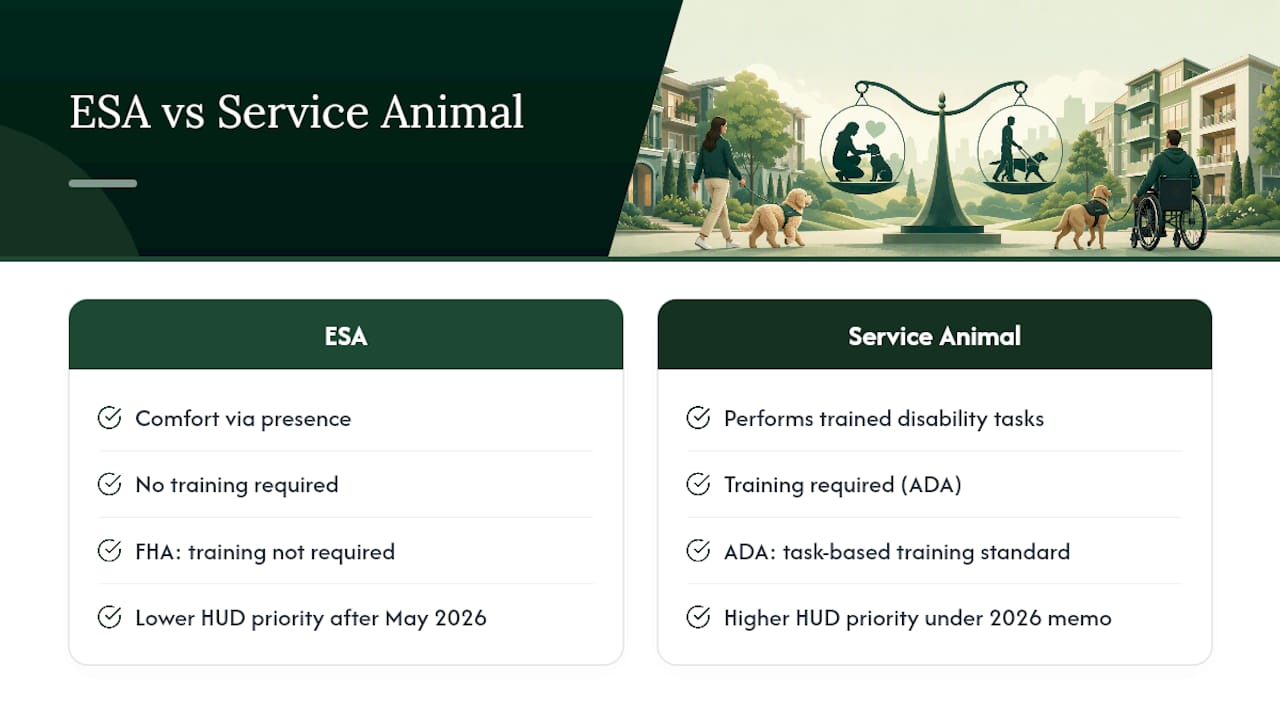
This creates a strange gap for tenants: the law protecting your ESA hasn’t weakened, but the federal agency that used to help enforce it has shifted its attention toward animals that meet a different, higher standard. That’s exactly why documentation quality and state-level options matter more now than they did before May 2026. A trained service animal denial is still likely to get HUD’s attention. An ESA denial increasingly depends on your clinician’s letter and your state agency’s willingness to act.
Coping With the Fallout: Mental Health Effects of a Denial
Losing a housing option, or facing the threat of losing your current home, because of an ESA denial isn’t just a legal setback. For many people, it directly undermines the exact thing the ESA was prescribed to help manage. The stress of a housing search, combined with the fear of separation from an animal that provides real symptom relief, can spike anxiety and depression symptoms at precisely the moment you need stability most.
A few concrete strategies help during this stretch. Keep your treating clinician in the loop about the denial itself, not just the original accommodation request. A housing crisis is a legitimate topic for a therapy session, and your clinician documenting that stress in real time can also strengthen your case if litigation becomes necessary later.
Lean on your support network for the practical logistics, not just emotional backup. Ask a friend or family member to help you organize your documentation file or make phone calls to advocacy groups. Offloading the administrative burden, even partially, reduces the compounding stress of fighting a denial while also managing daily life.
Set a decision timeline for yourself. Give the appeal and complaint process a defined window, a few weeks to a couple of months, and have a backup housing plan in progress simultaneously. Fighting a denial is worth doing, but pinning all your hope on one outcome with no fallback tends to make the waiting period far harder than it needs to be.
What Recent Cases Reveal About How Courts Handle ESA Denials
Henderson v. Five Properties, the case HUD attached to its May 2026 memo, is worth understanding because of how HUD is using it, not necessarily because of a sweeping new rule it created. HUD cited the case as an example supporting its shift toward prioritizing trained-animal complaints, which tells you more about HUD’s internal reasoning than about how every court will rule going forward.
That gap matters. Courts evaluating FHA claims independently of HUD’s enforcement guidance have continued to recognize ESA accommodations as valid even without formal training, since the statute itself never imposed a training requirement. HUD’s memo reflects an enforcement choice, not a judicial reinterpretation of the FHA, a distinction legal commentary has repeatedly stressed since the memo’s release.
What this means practically: if your case ends up in front of a judge rather than a HUD investigator, the training question that now dominates HUD’s internal triage may carry far less weight. Your documentation quality, the landlord’s stated reason, and whether they engaged in a genuine interactive process are likely to matter more than whether HUD would have opened an investigation. That’s a meaningful reason not to treat a HUD decline as the final verdict on your legal standing.
Finding ESA-Friendly Housing If Your Current Fight Isn’t Winning
Sometimes the smartest move isn’t fighting a denial to the end. It’s redirecting that energy toward finding housing that won’t force the fight in the first place.

Start by asking directly, before you apply, how a property handles ESA accommodation requests. A landlord who answers clearly and references a written policy is a better sign than one who seems unfamiliar with the concept or immediately mentions extra fees, since legitimate ESA accommodations shouldn’t carry pet deposits or pet rent at all.
Look specifically at smaller, independently owned rental properties as well as larger complexes. Individual landlords sometimes have more flexibility to evaluate a request personally, without a corporate no-pet policy standing in the way, though this cuts both directions since they may also be less familiar with FHA requirements.
Check whether your state or city publishes a list of housing anti-discrimination resources; several human rights agencies maintain complaint histories or educational materials that indirectly reveal which property management companies have faced repeated ESA disputes.
Have your documentation ready before you start touring units, not after you’ve already fallen in love with an apartment. A dated treating-clinician letter in hand from day one changes the entire tone of the conversation with a prospective landlord, shifting it from “convince me” to “here’s what the law requires.”
Finally, don’t rule out reapplying to a property that denied you once if your documentation has meaningfully improved since then. Denials based on inadequate evidence are often fixable, and a stronger letter can change the outcome the second time around.
Where to Get Help: Advocacy Groups and Agencies for ESA Housing Disputes
You don’t have to navigate a denial alone, and several organizations exist specifically to help tenants in this situation, often for free.
Start with your state or city’s human rights or civil rights agency. These aren’t generic hotlines. They’re the same offices whose guidance underpins much of this article, including Massachusetts’s Commission Against Discrimination, Minnesota’s Department of Human Rights, and New York City’s Commission on Human Rights. Most states maintain a comparable office, and a quick search for your state’s name plus “human rights agency” or “fair housing” should surface it.
Legal aid organizations in most regions handle housing discrimination cases at no cost for tenants who meet income eligibility requirements. Many operate a dedicated fair housing hotline separate from their general intake line, which usually gets you a faster initial response.
Disability rights organizations, including groups like DREDF, publish plain-language breakdowns of exactly the kind of policy shift covered in this article and can point you toward region-specific advocacy contacts.
Finally, your treating clinician’s office may know of local tenant advocacy groups from prior patients who’ve faced similar disputes. That referral is often more targeted than a general internet search, since it comes from someone familiar with your specific documentation needs.
What Tenants Should Prioritize After a Denial
The mistake I see tenants make most often isn’t ignorance of their rights. It’s sequencing. People fight the denial emotionally before they’ve built the paperwork trail that actually wins the fight, and by the time they’re ready to escalate, weeks have passed with no dated record of what happened.
Prioritize the treating-clinician letter over everything else. A boilerplate online certificate might feel faster, but it’s the exact category of documentation HUD cited as driving its own 2026 policy narrowing, which means it’s now weaker evidence than it was a year ago, not stronger.
Talk to a local fair housing group before you sign anything a landlord hands you after a denial, especially anything framed as a compromise. I’ve seen the pattern too often: a tenant agrees to remove the animal “temporarily” under pressure, and that agreement becomes very hard to walk back later.
And if you already had an approved ESA accommodation, know that a landlord can’t just revoke it because a new property manager took over or because HUD’s posture shifted. Revocation requires the same fact-specific process as an original denial. Don’t let anyone tell you otherwise just because they said it with confidence.
— Erik
Get a Defensible ESA Letter Before Your Next Housing Application
The gap between a denial that sticks and one that doesn’t almost always comes down to what’s in your letter. This site offers plain-language guidance and recommendations about clinician-based documentation that HUD’s 2026 memo pointed to as a stronger standard, in contrast to mass-produced online certificates that receive skepticism from the agency.
A letter built around an actual clinical relationship, one that names your functional limitation and explains specifically how your animal helps, holds up better with landlords, state agencies, and courts alike. That’s true whether you’re facing your first accommodation request or fighting a denial that already happened. The rights guide on the site explains what a defensible letter needs to include and how to obtain one from a clinician familiar with your case. If you’re heading into a new housing application or pushing back on a denial right now, start there before you send another document to a landlord.
This article is general information, not a substitute for advice from a qualified lawyer. Consult a qualified legal professional about your own circumstances before acting on anything here.
Sources
- HUD — Enforcement guidance and materials (May 22, 2026)
- Mass
- Emotional support animals — NYC Commission on Human Rights (housing fact sheet)
- Service and emotional support animals in housing — Minnesota Department of Human Rights
- HUD’s policy reversal on emotional support animals — DREDF