
HUD’s May 22, 2026 memorandum limits federal enforcement of animal-related housing accommodations to individually trained assistance animals, no longer treating untrained emotional support animals as presumptively protected. The Fair Housing Act itself hasn’t changed, and tenants can still sue privately or lean on state and local protections. If you’re relying on an ESA letter, your legal rights just shifted, but they haven’t disappeared.
TL;DR:
- Only assistance animals that have been individually trained to perform specific tasks related to a person’s disability will be considered reasonable accommodations under HUD’s new enforcement standards.
- An ESA letter alone is now less persuasive; it should be paired with documented evidence of task training and a clinician’s explanation of how the animal assists with the disability.
- Private FHA lawsuits remain viable within the two-year deadline, and state or local protections continue regardless of HUD’s enforcement changes.
- Housing providers must now evaluate requests on a case-by-case basis, documenting specific reasons for approval or denial, especially regarding trained animals.
- Tenants should proactively build a comprehensive file, including trainer records and detailed clinician letters, before facing potential disputes or denials.
Table of Contents
- What Changed in HUD’s May 22, 2026 Enforcement Guidance
- What Didn’t Change: The Law and Your Private Rights
- How HUD Will Evaluate Accommodation Requests Now
- Practical Next Steps If You Rely on an ESA
- What Landlords and Housing Providers Should Do Now
- State and Local Law Still Fills a Lot of Gaps
- SupportPet’s Guidance: Building Documentation That Holds Up
- What This Guidance Shift Actually Means for You
- Get SupportPet’s ESA Rights Guide Before You File a Request
- Sources
What Changed in HUD’s May 22, 2026 Enforcement Guidance
The May 22, 2026 memorandum rescinds HUD’s 2020 assistance animal notice, the guidance that told housing providers to treat both trained service animals and untrained ESAs as presumptively reasonable accommodations. That framework is gone. HUD’s Office of Fair Housing and Equal Opportunity, known as FHEO, will now find “reasonable cause” to pursue a discrimination complaint only when the animal in question has been individually trained to perform a task related to a person’s disability.
HUD’s stated rationale points to executive direction, a growing caseload of disputed ESA claims, and court decisions that questioned how much deference the old subregulatory notices actually deserved. Litigation like Henderson v. Five Properties is part of that backdrop, with courts increasingly willing to second guess HUD’s own interpretive guidance rather than defer to it automatically.
The practical fallout hits hardest on the administrative side:
- Open ESA complaints already filed with FHEO are being placed on hold.
- Each paused case will get individual review under the new training standard rather than automatic advancement.
- Cases involving animals with documented task training move forward; cases resting solely on a comfort or companionship rationale face a steeper climb.
Earlier HUD notices from 2013 and 2020 had broadly discouraged pet fees and breed or weight restrictions for any assistance animal, trained or not. The 2026 memo pulls back from that blanket approach, though it doesn’t resolve every downstream question about fees or restrictions on its own.
What Didn’t Change: The Law and Your Private Rights
HUD’s memo is an enforcement policy, not a statute. The Fair Housing Act itself hasn’t been amended by Congress, and its text still prohibits discrimination based on disability in housing. Three things remain true regardless of how HUD chooses to allocate its own investigative resources:
- Private lawsuits are still available. Tenants denied a reasonable accommodation can sue in federal or state court under the FHA, and legal analysis confirms this route stays open even as HUD’s enforcement posture shifts. The general filing window for FHA claims runs two years from the discriminatory act, so acting promptly matters.
- Section 504 obligations for federally funded housing haven’t moved. If your building receives federal funds, HUD’s enforcement memo doesn’t rewrite those separate disability-access requirements.
- State and local law can still require ESA accommodations. HUD’s choice about where to spend its own enforcement energy has no bearing on what a state legislature or city council has independently written into law.
Courts aren’t bound by HUD’s internal enforcement priorities. A judge weighing a private FHA claim can still rule that denying an ESA accommodation was discriminatory, even in a case HUD itself would decline to pursue. The Justice Department’s fair housing resources lay out that statutory framework, and it hasn’t budged.
How HUD Will Evaluate Accommodation Requests Now
HUD is borrowing the training component of the ADA’s service animal definition. Under that standard, the animal must be individually trained to perform specific work or tasks directly related to a person’s disability, things like alerting to an oncoming panic attack, retrieving medication, or interrupting a self-harming behavior. Generalized comfort or calming presence, without task training, no longer meets HUD’s bar for federal enforcement.
One nuance matters here: the FHA framework, unlike the ADA, still allows for species beyond dogs when the animal is genuinely trained to perform a disability-related task, according to legal analysis from Holland & Knight. The operative question is training, not species.
What counts as evidence now?
- Trainer certificates or documented training records showing specific tasks learned
- Contact information for a trainer who can verify the work performed
- Behavioral documentation showing the animal reliably performs the task
- A clinician’s letter describing the disability-related need, which still matters but now works alongside training proof rather than standing alone
Housing providers can request documentation connecting the disability to the need for the animal. They cannot demand your full medical file or a specific diagnosis.
Pro Tip: Ask your clinician to describe functional limitations and the accommodation’s purpose in plain terms rather than clinical jargon. A letter that explains what the animal does for you, not just that you have a diagnosis, holds up better under this new training-focused review.
Practical Next Steps If You Rely on an ESA
Where you stand now depends heavily on whether your animal has any formal training behind it.
- If you already have an ESA letter, keep it, but don’t treat it as sufficient on its own anymore. Pair it with any documentation showing specific things your animal does, calming techniques it performs, alerts it gives, tasks it has learned, even informally. The more task-specific detail you can add, the stronger your position if a dispute arises.
- If your animal has real training, gather proof. Contact the trainer for written confirmation, log specific behaviors, and request an accommodation letter from your clinician that ties those trained behaviors to your disability.
- If your animal is untrained, be realistic about federal enforcement odds. Options include pursuing formal task training, exploring other supports, or preparing for a private lawsuit rather than a HUD complaint if a provider denies your request.
- Decide your filing path deliberately. A HUD complaint now faces a narrower review standard and possible delay given the backlog of paused cases. A private lawsuit under the FHA remains available within the two-year filing window, and a local fair housing agency or attorney can help you weigh which route fits your situation and budget.
Disability rights advocates have flagged that this shift effectively moves the burden onto individuals, who now have to pursue private litigation or lean on state protections rather than counting on a federal agency to act. That’s a real cost in time and legal fees, and it’s worth building your documentation file before a dispute starts rather than scrambling after a denial letter arrives.
What Landlords and Housing Providers Should Do Now
Housing providers face their own compliance puzzle: HUD’s enforcement retreat doesn’t remove FHA liability risk from private suits. A defensible process matters more than ever.
- Rewrite pet and accommodation policies to explicitly distinguish individually trained assistance animals from untrained ESAs, rather than lumping every “support animal” request together.
- Review each accommodation request individually. Blanket denials or blanket approvals both create legal exposure.
- Document the specific basis for every decision using the FHA’s actual tests: whether the accommodation poses an undue financial or administrative burden, whether the animal poses a direct threat, and whether granting it would fundamentally alter the nature of the housing operation.
- Keep records of every request, the documentation provided, and the reasoning behind the final decision. Those records are exactly what a court will want to see if a denied tenant files suit.
- Loop in legal counsel before finalizing a new policy, particularly for buildings receiving federal funding where Section 504 obligations sit alongside FHA requirements.
State and Local Law Still Fills a Lot of Gaps
HUD’s enforcement choice governs federal action, nothing more. States and cities that have written their own ESA protections into law aren’t affected by what HUD decides to prioritize.
- Several states have independent fair housing statutes or human rights codes that address assistance animals separately from federal HUD guidance, and those rules stay in force regardless of HUD’s enforcement posture.
- Publicly funded housing covered by Section 504 often operates under a distinct compliance framework that doesn’t move just because HUD’s FHA enforcement standard shifted.
- Legal commentary notes the on-the-ground effect will be uneven. Tenants in states with strong independent ESA protections may see little practical change, while tenants in states without such laws now depend more heavily on private FHA litigation.
Check your state’s fair housing statute directly, and contact a local fair housing agency or legal aid office before assuming HUD’s new posture is the final word on your situation. Many of these agencies offer free consultations and can tell you within a single phone call whether your state closes the gap HUD just opened.
SupportPet’s Guidance: Building Documentation That Holds Up
Whatever the enforcement standard looks like in a given year, the fundamentals of a credible ESA letter haven’t changed. A legitimate letter comes from a licensed clinician who has an actual therapeutic relationship with you, addresses your functional limitation in plain language, and states that an emotional support animal is part of your treatment plan.
Watch for the warning signs of a scam:
- Any “certificate,” “registration,” or online database that claims to make your ESA official. No such national registry exists, and HUD has never required one.
- Instant-approval letters from a website that never had you speak with a licensed clinician.
- Any service promising your landlord “must” accept the animal with no room for individualized review.
This rights guide walks through sample letter language, documentation templates, and how to fold trainer evidence into a request when your animal has any task training behind it.
Pro Tip: Give your housing provider enough detail to justify the accommodation without volunteering your full diagnosis. “I have a documented disability requiring emotional support” plus a functional description usually satisfies the request without oversharing your medical history.
What This Guidance Shift Actually Means for You
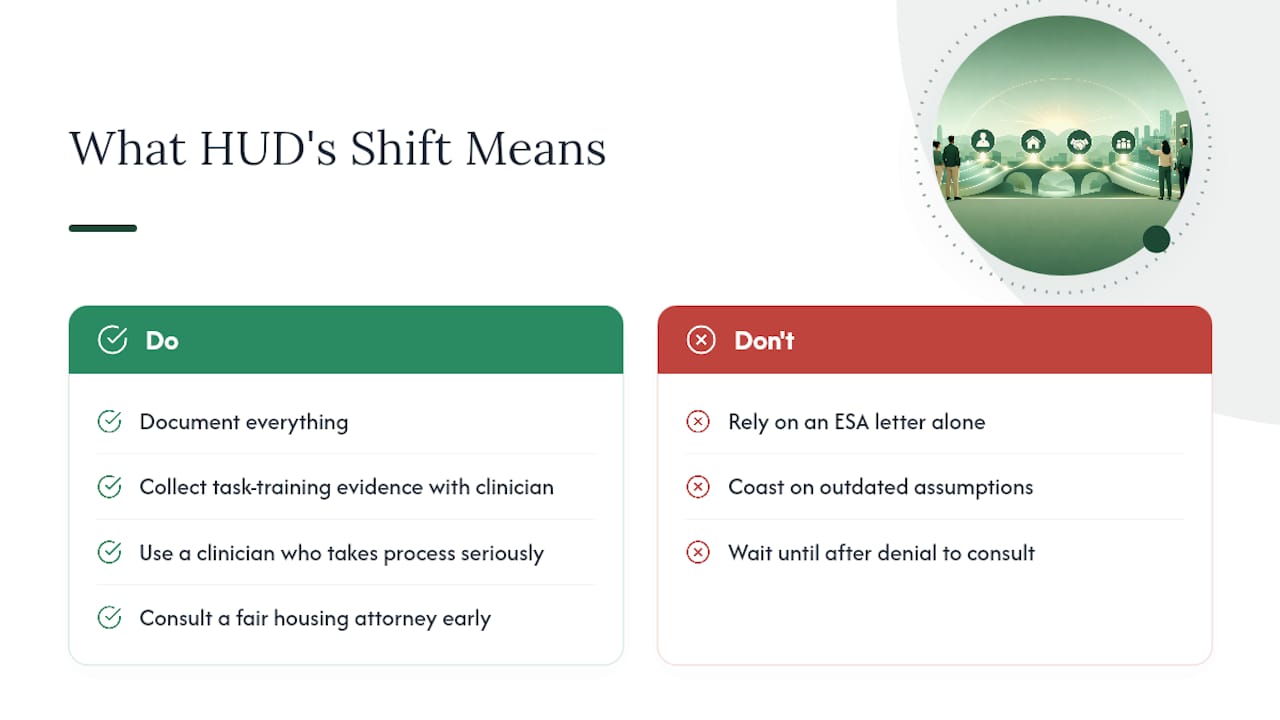
HUD narrowed its own enforcement lane. It didn’t rewrite the Fair Housing Act, and it didn’t strip away your ability to sue a landlord who denies a legitimate accommodation. What it did do is raise the practical bar: an ESA letter alone now carries less weight with federal enforcers than it did a year ago, and pairing it with any task-training evidence you can gather puts you in a far stronger position.
My honest read: don’t panic, but don’t coast on outdated assumptions either. Document everything, work with a clinician who takes the process seriously, and talk to a fair housing attorney early if a denial looks likely rather than after it happens.
— Erik
Get SupportPet’s ESA Rights Guide Before You File a Request
Most tenants find out HUD’s rules changed only after a landlord already pushed back, which is the worst time to start assembling documentation. The Emotional Support Animals & ESA Letters: Your Rights Guide walks you through building a request that holds up under the new training-focused review, before you need it.
The guide includes documentation checklists, sample clinician letter language, and a rundown of the online scams to avoid, the fake registries and instant-certificate sites that have never carried legal weight with HUD or a court. You’ll also find guidance on pairing an ESA letter with training evidence if your animal has any, which matters more under this year’s enforcement standard than it did before. Visit Supportpet to download the guide and start building your file today.
Sources
- Enforcement Guidance – Assessing Requests for the Use of an Animal as a Reasonable Accommodation Under the Fair Housing Act (May 22, 2026) — HUD
- HUD rescinds emotional support animal guidance — Holland & Knight
This article is general information, not a substitute for advice from a qualified lawyer. Consult a qualified legal professional about your own circumstances before acting on anything here.