
Generally, a no-pets rule must be waived as a reasonable accommodation under the Fair Housing Act when you have a disability-related need for an emotional support animal, though HUD’s 2026 enforcement shift and state rules affect how smoothly that plays out. The immediate step is to put your request in writing and attach clinician documentation before you move in or before a dispute starts.
TL;DR:
- HUD’s 2026 memo prioritizes individually trained assistance animals, so renters with unresolved ESA complaints can turn to state agencies, including in California and Maryland.
- A clinician letter should name the licensed treating provider, describe a functional limitation, explain how the animal alleviates related symptoms, and be dated and signed.
- A blanket ban alone is insufficient; landlords may deny requests for a documented threat, undue burden, or fundamental change to housing operations after individual review.
- Send a complete request by email and registered mail, keep dated copies, and follow up in writing after 10 to 14 days without a response.
- Avoid instant certificates or animal registries; housing documentation should come from a licensed clinician who evaluated you, since no national registry has legal weight.
Table of Contents
- How federal law treats no-pets rules for ESAs
- Exactly how to request an ESA accommodation
- What landlords can and cannot require or charge
- State and local variation after HUD’s 2026 enforcement change
- Practical tips to strengthen your request and avoid scams
- Typical timeline and best practices for landlord response
- How to handle disputes or denials of an ESA accommodation request
- Examples of successful requests and legal protections
- Documentation differences between ESAs and pets
- Why documentation quality matters more than ever
- Templates and guides to help you request an accommodation
- FAQ
- Sources
How federal law treats no-pets rules for ESAs
The Fair Housing Act treats an emotional support animal differently from an ordinary pet. When a landlord enforces a blanket no-pets policy, HUD’s guidance on assistance animals explains that a reasonable accommodation can require waiving that policy so a tenant with a disability-related need can keep the animal. The animal itself is not reclassified as a pet for housing purposes, even though it lives in the unit the same way a pet would.
A 2026 memorandum changed how aggressively HUD pursues these cases, not what the statute says. According to DREDF’s analysis of HUD’s policy reversal, the agency now prioritizes enforcement for animals individually trained to perform disability-related tasks, which means federal investigators give less attention to complaints involving untrained emotional support animals. The Fair Housing Act itself was not amended, so the underlying right to request an accommodation still exists.
Landlords retain a few lawful defenses, and they matter in practice:
- A landlord can deny a request after an individualized assessment shows the specific animal poses a direct threat to others that cannot be reduced through reasonable steps.
- A landlord can deny a request that would impose an undue financial or administrative burden or fundamentally alter the housing operation.
- A landlord cannot rely on a blanket “no pets” clause alone to refuse an assistance animal without that individualized review.
Exactly how to request an ESA accommodation
A clear, well-documented request moves faster and holds up better if a landlord pushes back. Follow these steps in order:
- Write the request plainly. State that you have a disability, that you are requesting a reasonable accommodation to keep an assistance animal, and that you are not disclosing more medical detail than necessary.
- Attach a clinician letter. The letter should identify the treating provider, describe a functional limitation in general terms, state that the animal alleviates symptoms connected to that limitation, and recommend the animal as part of your treatment. Our sample ESA letter walks through each of these elements.
- Date and sign everything. The letter needs a date and the clinician’s signature; a request letter without supporting documentation is far easier for a landlord to question.
- Deliver it through a traceable channel. Send the request by email and by registered mail, and keep copies of both along with any delivery receipts.
- Set a follow-up reminder. Give the landlord roughly 10 to 14 days to respond before you follow up in writing.
- Escalate calmly if there’s no response. A polite reminder that references your original request date, and a note that you may contact a fair housing agency if the matter stays unresolved, often prompts a reply.
Pro Tip: Keep every piece of correspondence in one folder, dated in order, so you can show a clear timeline if the request ever becomes a dispute.
Our step-by-step guide to getting an ESA letter covers how to find a licensed clinician if you do not already have one.
What landlords can and cannot require or charge
Landlords sometimes apply pet-related rules to assistance animals by default, but several of those rules do not hold up for ESAs with proper documentation.
- Pet deposits and routine pet fees are often discouraged for assistance animals under HUD and Department of Justice guidance, though outcomes depend on the specific facts and local enforcement climate.
- Blanket breed, size, or species bans are usually unlawful as applied to assistance animals; a landlord can only act on documented behavior, not a category-wide rule.
- A landlord may ask for documentation that shows a disability-related need for the animal, limited to what is necessary to support the request.
- A landlord cannot demand your full medical records, a specific diagnosis beyond what is needed, or access to your broader treatment history.
- A landlord can still deny or limit an accommodation after an individualized review finds a documented direct threat that cannot be mitigated.
State and local variation after HUD’s 2026 enforcement change
HUD’s May 2026 memorandum did not rewrite the Fair Housing Act, but it changed where federal enforcement attention goes. DREDF’s coverage of the memo explains that HUD now prioritizes cases involving individually trained assistance animals, which means HUD may decline to pursue complaints tied to untrained emotional support animals.
That shift makes state and local agencies more important for renters.
- California’s Civil Rights Department FAQ confirms that when a tenant has a documented disability-related need for an ESA, California law generally requires a reasonable accommodation despite a no-pets policy, independent of HUD’s federal posture.
- Maryland’s Commission on Civil Rights issued its own guidance following HUD’s enforcement change, clarifying that state-level protections for ESAs remain in effect even where federal follow-through has slowed.
- If a federal complaint stalls, a state civil-rights agency, a private fair-housing attorney, or small-claims court can still be a path forward.
Our ESA housing rights page breaks down what the 2026 change means state by state.
Practical tips to strengthen your request and avoid scams
A strong request rests on a real clinical relationship, not a fast online form. A credible letter comes from a licensed clinician who has actually evaluated you, states your functional limitation in plain terms, and recommends the animal as part of ongoing care.
- Avoid any service that issues an “ESA certificate” or ID card within minutes with no clinical evaluation; these do not satisfy housing-provider documentation standards.
- Be wary of sellers offering national “registration” for assistance animals, since no such registry carries legal weight under the Fair Housing Act.
- Verify a letter’s legitimacy by confirming the clinician’s license and that you had an actual treatment conversation, not a one-time questionnaire.
- Offer the landlord reasonable mitigations voluntarily: current vaccination records, a waste-management plan, or a note about the animal’s behavior history.
Pro Tip: If you need a licensed provider to start a treatment relationship, resources like Alvarado Therapy’s mental health directory can help you find one before you request a letter.
Typical timeline and best practices for landlord response
Most housing guidance points to a prompt review once a tenant submits a complete, valid request, often discussed as roughly ten days from receipt, followed by what fair housing practitioners call an interactive dialogue between tenant and landlord rather than a flat yes-or-no answer. That conversation is where a landlord might ask limited follow-up questions or propose minor conditions, such as proof of current vaccinations.
A landlord who needs more time to evaluate a request should communicate that in writing rather than letting the request sit unanswered. Silence is one of the more common triggers for disputes, since a tenant with no response has no way to know whether the request is being considered, lost, or quietly denied.
On your side, the best practice is patience paired with a paper trail. Send your documentation once, in full, rather than trickling in pieces that force the landlord to keep reopening the file. If the landlord asks a clarifying question, answer it directly and keep a copy of your answer.
Watch for a specific pattern: some landlords wait until lease renewal to reclassify a long-approved emotional support animal as a “pet” and attach a new fee. If that happens, your original approval letter and the dated history of your request are the strongest evidence that the animal was never a pet under the lease.
How to handle disputes or denials of an ESA accommodation request
A denial is not the end of the process. Start by asking the landlord, in writing, for the specific reason for the denial, since the Fair Housing Act requires an individualized basis rather than a blanket policy citation.
If the stated reason is a direct-threat claim, gather evidence that rebuts an overbroad assumption: veterinary records, a documented behavior history, and any mitigation you are willing to offer, such as supervised access in shared spaces. HUD’s assistance animal guidance frames direct-threat denials as requiring real evidence tied to the specific animal, not a general assumption about a species or size.
If the landlord simply ignores the request or restates the no-pets policy without addressing your documentation, your next move depends on where you live. A state civil-rights agency, such as California’s Civil Rights Department or Maryland’s Commission on Civil Rights, can open an investigation even in the current federal enforcement environment. Our list of state-level ESA law checks walks through how to find your state’s equivalent agency and file a complaint.
Private fair-housing counsel is another route, particularly when a lease renewal is approaching and you need a faster resolution than an agency complaint typically allows. Keep every piece of correspondence dated and organized throughout the dispute, since that record is what an agency or attorney will ask for first.
Examples of successful requests and legal protections
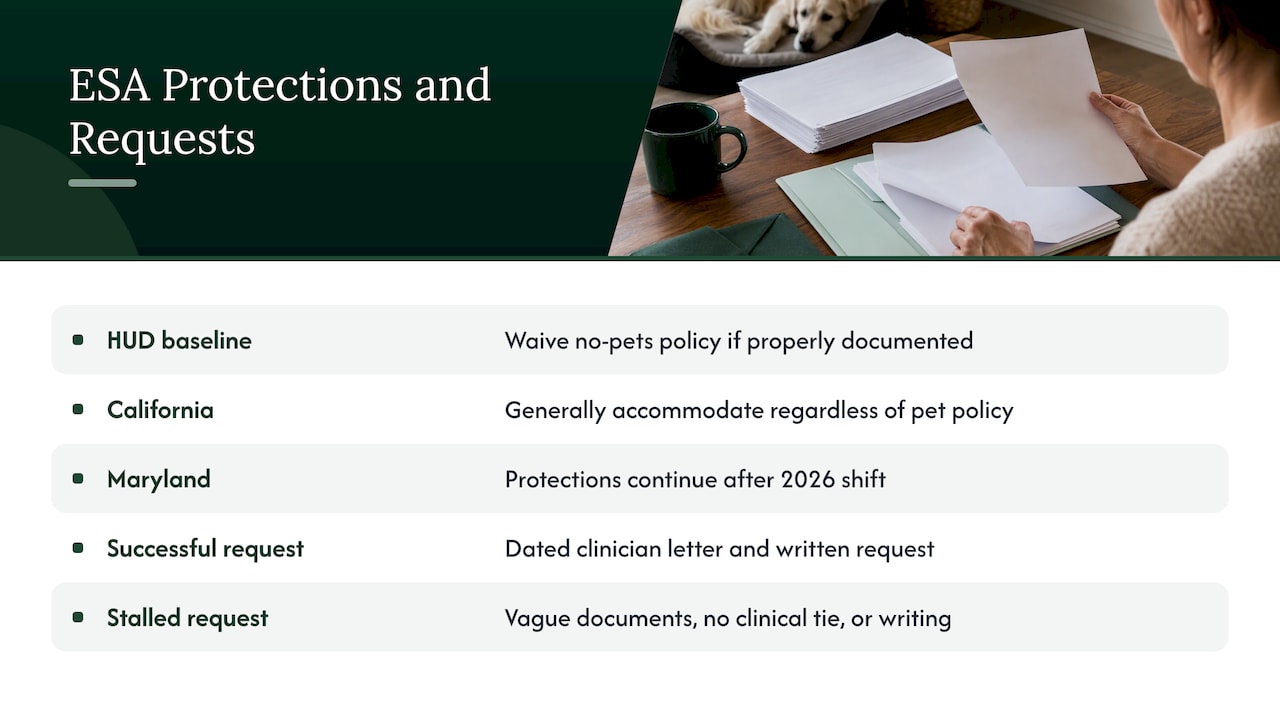
Fair housing enforcement has repeatedly centered on the same pattern: a tenant with a documented disability-related need for an assistance animal challenges a landlord’s blanket no-pets policy, and the policy gives way to an individualized accommodation. HUD’s guidance on assistance animals describes this as the baseline expectation under the Fair Housing Act, framing a waived no-pets policy as the standard outcome once a request is properly documented.
State guidance reflects the same pattern at the local level. California’s Civil Rights Department FAQ describes disability-related ESA requests as generally requiring accommodation regardless of a property’s pet policy, and Maryland’s Commission on Civil Rights issued guidance reinforcing that state protections continue to apply to ESA requests even after HUD’s 2026 enforcement shift.
The common thread across these examples is documentation quality. Requests that succeed tend to pair a specific, dated clinician letter with a direct, written accommodation request, rather than relying on a generic online certificate. Requests that stall or fail more often involve vague documentation, no clinical relationship behind the letter, or a tenant who never put the request in writing at all. The paperwork is not a formality, it is the evidence that turns a policy exception into a legal right.
Documentation differences between ESAs and pets
A pet has no legal standing against a no-pets policy. An emotional support animal does, but only when the paperwork behind it demonstrates an actual disability-related need rather than a preference for having an animal in the home.
The core difference is the clinician relationship. A pet owner needs nothing beyond proof of ownership and, often, vaccination records. An ESA request needs a letter from a licensed, treating clinician who can speak to a functional limitation and explain why the animal is part of your care, exactly the structure outlined in our ESA letter sample.
A second difference is scope. A landlord can ask broad questions about a pet, including breed and size, because no legal protection limits that inquiry. For an ESA, the landlord’s questions are supposed to stay narrow: whether you have a disability-related need and whether the animal is necessary for that need, not your full diagnosis or treatment history.
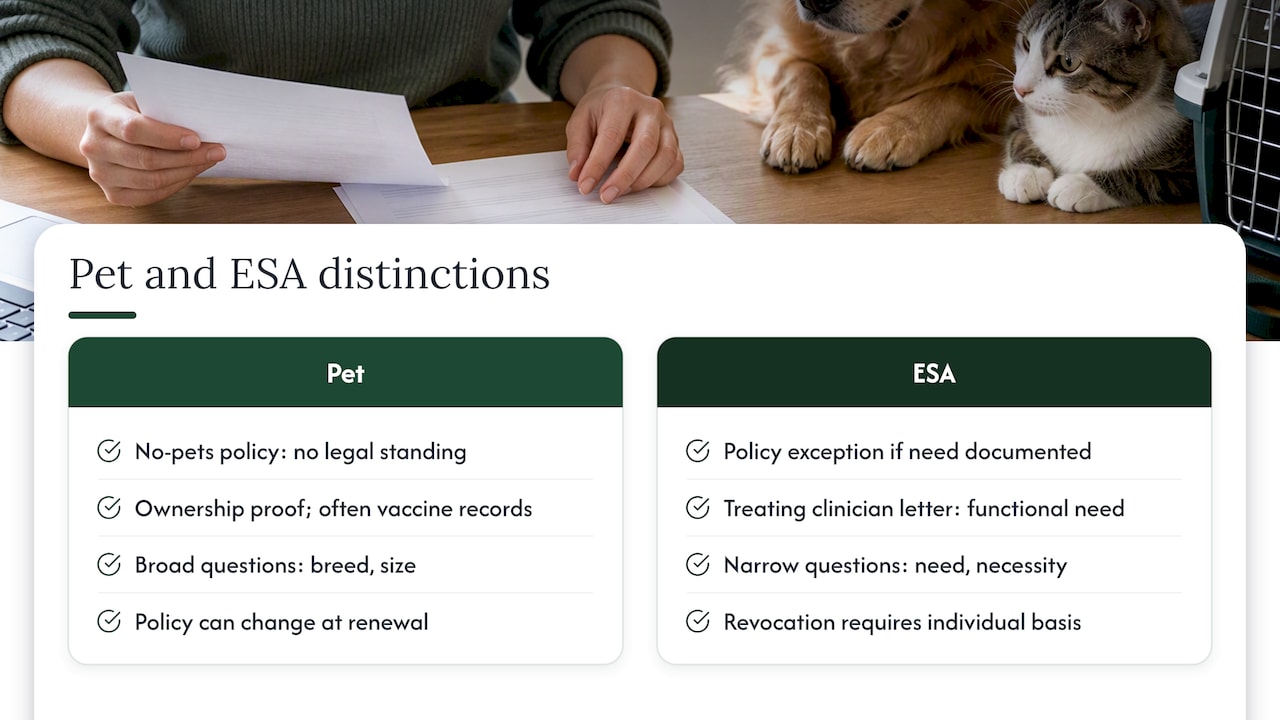
A third difference is durability. A pet policy can change at the landlord’s discretion at any renewal. An ESA accommodation, once properly documented and granted, is harder to revoke later without the same individualized justification that would have been required to deny it in the first place. That is why keeping your original letter and request on file matters well beyond move-in day.
Why documentation quality matters more than ever
The gap between a real ESA accommodation and a rejected request rarely comes down to the law itself. It comes down to paperwork quality, and that gap has widened since HUD narrowed its own enforcement focus in 2026. A tenant with a dated letter from an actual treating clinician is in a different position than a tenant holding a same-day online certificate, even though both animals might serve the same emotional function at home.
My honest read is that the current environment rewards preparation over urgency. Renters who treat the accommodation request as a one-time hurdle to clear before move-in tend to struggle when a dispute surfaces later, because they never built the paper trail that a renewed landlord challenge would require. Renters who keep their clinician relationship active and their documentation current hold a much stronger position, regardless of which way federal enforcement swings next.
— Erik
Templates and guides to help you request an accommodation
We put together plain-language resources specifically for renters navigating a no-pets policy with an emotional support animal, built around what a real clinician letter and a real request actually need to contain, not generic advice.
Our ESA letter sample shows what a complete, properly dated letter looks like element by element, and our guide to getting an ESA letter walks through finding a licensed clinician and avoiding the instant-certificate services that do not hold up under a landlord’s scrutiny. These are educational templates and informational resources, not legal advice, and we encourage you to check your state’s specific guidance alongside them.
Start with our emotional support animals and ESA letters guide to see the full picture of your rights before you submit a request.
This article is general information, not a substitute for advice from a qualified doctor. Consult a qualified healthcare professional about your own circumstances before acting on anything here.
FAQ
Can you get around a no-pets policy with an ESA?
Yes, when you have a documented disability-related need, a landlord generally must waive a no-pets policy as a reasonable accommodation under the Fair Housing Act. The waiver depends on submitting a proper written request with clinician documentation, not simply asking verbally.
Can an ESA live in a non-pet-friendly apartment?
Yes, a properly documented emotional support animal can live in a unit with a no-pets policy because the animal is treated as an accommodation rather than a pet under fair housing law. The tenant still needs to submit a written request and supporting clinician letter before move-in or as soon as the need arises.
Will ESA laws change in 2026?
The Fair Housing Act itself has not changed, but HUD’s 2026 enforcement memo shifted federal priorities toward individually trained assistance animals, which reduces how often HUD pursues complaints involving untrained ESAs. State agencies in places like California and Maryland have since issued their own guidance confirming that state-level ESA protections remain active.
Is it illegal to refuse an emotional support animal request?
A landlord cannot simply refuse a well-documented ESA request based on a blanket no-pets policy alone, since the Fair Housing Act requires an individualized assessment first. A lawful denial generally requires a specific finding, such as a documented direct threat that cannot be reasonably mitigated.
What should a clinician’s ESA letter include?
A credible letter identifies the treating clinician, describes a functional limitation in general terms, states that the animal alleviates symptoms tied to that limitation, and carries a date and signature. Our sample ESA letter breaks down each required element in detail.
Sources
- Hud
- An Enforcement Agency That Won’t Enforce: HUD’s Policy Reversal On Emotional Support Animals - DREDF
- Emotional Support Animals and Fair Housing Law FAQ — California Civil Rights Department
- MCCR issues emotional support animal guidance following change in federal fair housing enforcement — Maryland Commission on Civil Rights