
A valid ESA letter from a licensed clinician can support a housing accommodation request under the Fair Housing Act, but the ground has shifted. HUD’s May 22, 2026 guidance tells federal investigators to prioritize complaints about trained service animals over untrained emotional support animals, so the safest move now is a letter from your treating clinician paired with a careful, well-documented request to your landlord.
TL;DR:
- Landlords now prioritize well-documented, clinician-issued ESA letters that include provider credentials, a signed date, and a clear connection between the animal’s presence and therapeutic benefit.
- A valid ESA letter must confirm a substantial impairment, demonstrate a professional relationship, and explicitly link the animal to symptom relief, avoiding boilerplate or online certificates.
- Housing requests should be submitted with certified mail, proof of delivery, or timestamped email, maintaining complete documentation to support the accommodation claim.
- Landlords can require verification of the clinician’s license and contact details but cannot demand additional assessments, notarized forms, or diagnoses without risking legal challenges.
- Most common landlord accommodations include waivers of pet fees or policies, but assistance animals may still face restrictions if they pose documented safety risks or cause damage.
Table of Contents
- What Counts as an ESA vs. a Service Animal
- What a Valid ESA Letter Must Include
- How Do You Get a Legitimate ESA Letter?
- How Should You Submit the Accommodation Request?
- What If Your Landlord Denies the Request?
- What Qualifies an Animal as an ESA?
- How Does the Landlord’s Screening Process Typically Work?
- What Accommodations Might a Landlord Actually Offer?
- What Happens if Your ESA Causes Damage or Poses a Risk?
- A Note on Avoiding Letter Mills and Trusting Your Own Clinician
- Where to Find Templates and Clinician Guidance
- Sources
What Counts as an ESA vs. a Service Animal
An emotional support animal provides comfort through its presence. It has no task training and no certification requirement, which is exactly why housing law treats it differently than a service animal trained to perform a specific job, like alerting to a medical event or guiding someone around obstacles.
That distinction matters because two separate legal frameworks apply. The Fair Housing Act covers “assistance animals,” a category that includes both ESAs and service animals, and it requires landlords to consider reasonable accommodation requests for either type. The Americans with Disabilities Act, by contrast, governs public spaces like restaurants and stores, and it only recognizes trained service animals there.
Where this plays out in practice:
- Housing (FHA): ESAs and service animals both qualify for reasonable accommodation, including waived pet fees and pet-free policy exceptions.
- Air travel (Air Carrier Access Act): Airlines are no longer required to accommodate ESAs; only trained service dogs get guaranteed cabin access under current federal rules.
- Restaurants, retail, workplaces (ADA): Only trained service animals get automatic access. An ESA has no legal right to enter a grocery store or an office building.
What a Valid ESA Letter Must Include
Housing providers and courts look for specific, verifiable details in a clinician letter. A letter missing these elements is easy for a landlord to challenge, and increasingly easy for them to reject outright.
A defensible ESA letter includes:
- Provider credentials. Full name, license type (LCSW, psychologist, psychiatrist, nurse practitioner, etc.), license number, state of licensure, and direct contact information, all on professional letterhead.
- A signed and dated statement. No stamped signatures from a form-mill website, no blank date fields.
- Confirmation of a professional relationship. The letter should state that the provider has evaluated the patient directly, not just reviewed an online questionnaire.
- Disability confirmation. A statement that the patient has an impairment substantially limiting a major life activity. The specific diagnosis does not need to appear.
- A nexus statement. Language connecting the animal’s presence to a therapeutic benefit for that specific impairment.
Watch for red flags: instant online “certificates,” registry numbers (there is no official ESA registry in the United States), one-question intake forms, and any letter that lacks a real phone number or license ID for the signer. Trinity Washington University’s advisory on ESA scams is blunt about this. Letter mills produce boilerplate that frequently fails to meet the standards HUD’s own guidance lays out, and some states now treat those products as legally unreliable.
Pro Tip: Ask your clinician to note the date of your last visit inside the letter itself, and confirm ahead of time that they’re willing to answer a brief, written follow-up question if your landlord asks for clarification. That single detail often settles disputes before they start.
How Do You Get a Legitimate ESA Letter?
Start with the person who already knows your history. A therapist, psychiatrist, or primary care provider you’ve seen more than once is in a far stronger position to write a defensible letter than a stranger on a five-minute video call.
- Begin with your treating clinician. If you don’t have one, establish care through an in-network provider, a community mental health center, or a reputable telehealth service, but verify the clinician’s license before you pay for anything.
- Talk through the specific benefit. During your visit, describe how the animal helps with concrete symptoms and daily function, not just “it makes me feel better.” Panic attacks that ease with the dog nearby, sleep that improves with the cat present, that’s the kind of functional detail a letter needs.
- Confirm the letter’s contents before you leave. Check for every element listed above and ask for a signed copy on letterhead. Turnaround varies by provider, and some clinicians charge a documentation fee separate from the visit itself.
- If your clinician declines, ask for a referral. A refusal usually means they don’t think the accommodation is clinically appropriate, or they simply don’t write these letters. Either way, avoid the temptation to buy an instant letter from an online mill instead. Legitimate telehealth evaluations can produce valid letters when they reflect a real clinical relationship. The difference between that and a scam is depth of contact and documentation, not the mode of the appointment.
Some states impose additional rules, including minimum relationship duration before a provider can issue an ESA letter. Check your state’s specific requirements if you’re working with a new clinician.
How Should You Submit the Accommodation Request?
Send a short written request, not just the letter itself. Reference the Fair Housing Act, attach the clinician letter, and state plainly what you’re asking forwhether that’s a waiver of a no-pets clause, a waiver of a pet fee, or both.
- Certified mail with return receipt gives you a dated, provable delivery record.
- Tenant portal upload works too, as long as you screenshot the confirmation screen immediately after submitting.
- Timestamped email to your landlord or property manager is acceptable, but keep every reply and forward a copy to your own personal account.
Keep copies of everything, the letter, your cover request, and any confirmation of delivery. Documentation like this becomes your evidence trail if the request is challenged later.
Landlords can legitimately ask for clarifying information when a disability isn’t obvious, but they cannot demand your full medical file or a specific diagnosis, and they cannot require a notarized letter or their own proprietary form. If a property manager pushes for more than the letter provides, a short written response confirming the letter meets HUD’s documentation standards is usually enough.
Pro Tip: Never volunteer your diagnosis in writing, even if a landlord asks directly. Point them back to the letter’s disability confirmation language instead, that’s the level of detail the law actually requires.
What If Your Landlord Denies the Request?
HUD’s enforcement guidance issued on May 22, 2026 changed the practical calculus here. The department now directs its investigators to prioritize complaints involving animals trained for disability-related tasks, which means HUD is less likely to pursue enforcement action on a pure ESA dispute than it was previously.
That doesn’t mean you’re out of options.
- Contact state or local fair housing agencies. Many states enforce their own housing discrimination laws independent of HUD’s federal enforcement priorities.
- Consider a private lawsuit. The Fair Housing Act includes a private right of action, and a properly documented clinician letter remains meaningful evidence in that kind of case even after HUD’s enforcement shift.
- Reach out to disability rights organizations for guidance or referrals to attorneys who handle housing discrimination on a contingency or pro bono basis.
- Document every landlord response, including any alternative they offer, like a payment plan for a fee instead of a full waiver. Courts sometimes weigh a reasonable offered alternative when deciding whether a full waiver was truly necessary.
If informal resolution fails and the stakes are high, an attorney consultation is worth the hour. Small-claims filings and civil housing complaints both move faster when your paper trail is complete: dated submission, clinician contact information, a documented functional limitation, and every written exchange with the landlord.
What Qualifies an Animal as an ESA?
There’s no federal breed list, size cap, or species restriction written into the Fair Housing Act. What actually determines ESA status is the relationship between the animal and the person’s documented impairment, not the animal itself.
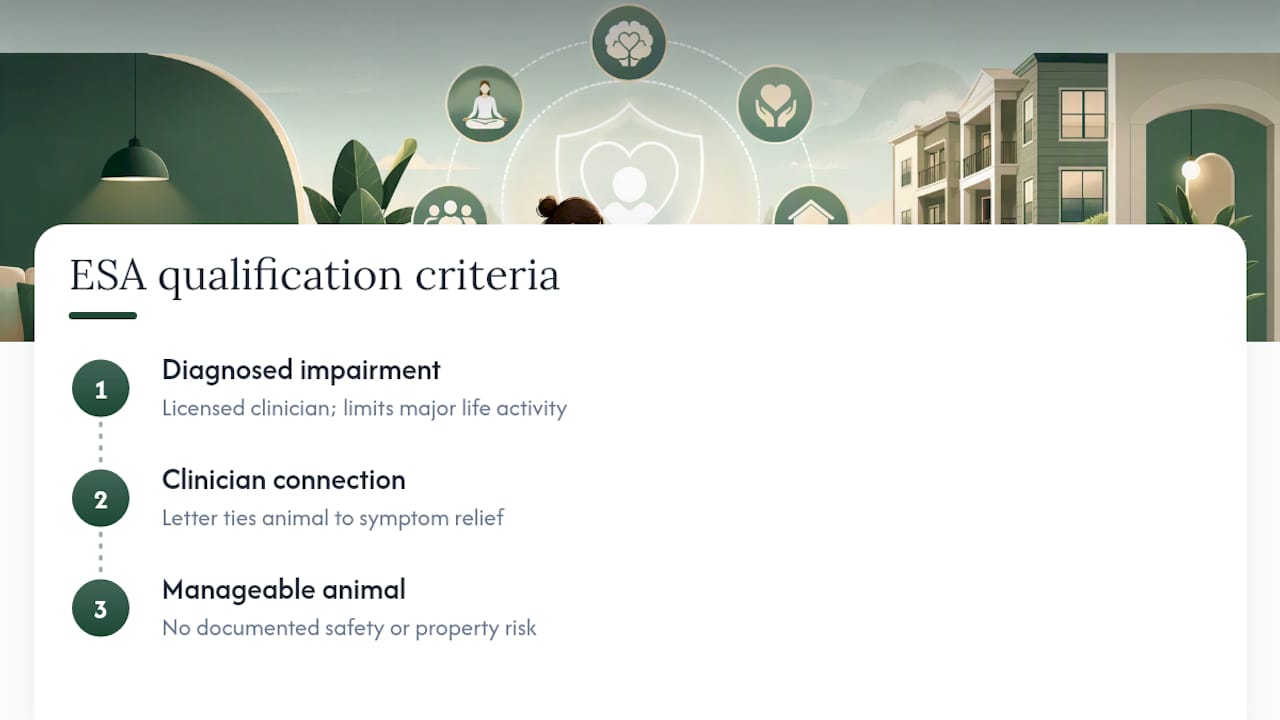
Three things matter functionally. First, the person requesting the accommodation needs a diagnosed condition that substantially limits a major life activity, confirmed by a licensed clinician. Second, the clinician needs to connect the animal’s presence to relief from specific symptoms, easing anxiety, interrupting a panic response, providing grounding during dissociation. Third, the animal needs to be manageable in a housing setting: it can’t pose a documented safety risk to other residents or the property itself.
Dogs and cats make up the overwhelming majority of ESAs simply because they’re the easiest to house safely, but rabbits, birds, and other domesticated animals can qualify under the same standard when a clinician’s letter supports it. Exotic or unusually large animals face more landlord pushback and more scrutiny, since a housing provider can reasonably question whether an animal fits safely in a rental unit regardless of its emotional value to the tenant.
What doesn’t qualify: an animal chosen after the fact simply to avoid a pet fee, or one with no clinician tying it to a specific functional need. That’s precisely the gap HUD’s enforcement guidance was written to address, separating documented therapeutic need from convenience labeling.
How Does the Landlord’s Screening Process Typically Work?
Most property managers use some form of documentation review once they receive your accommodation request, even without a formal “pet screening” system in place. The process usually starts with a written intake, where the landlord logs the request, the attached letter, and the date received.
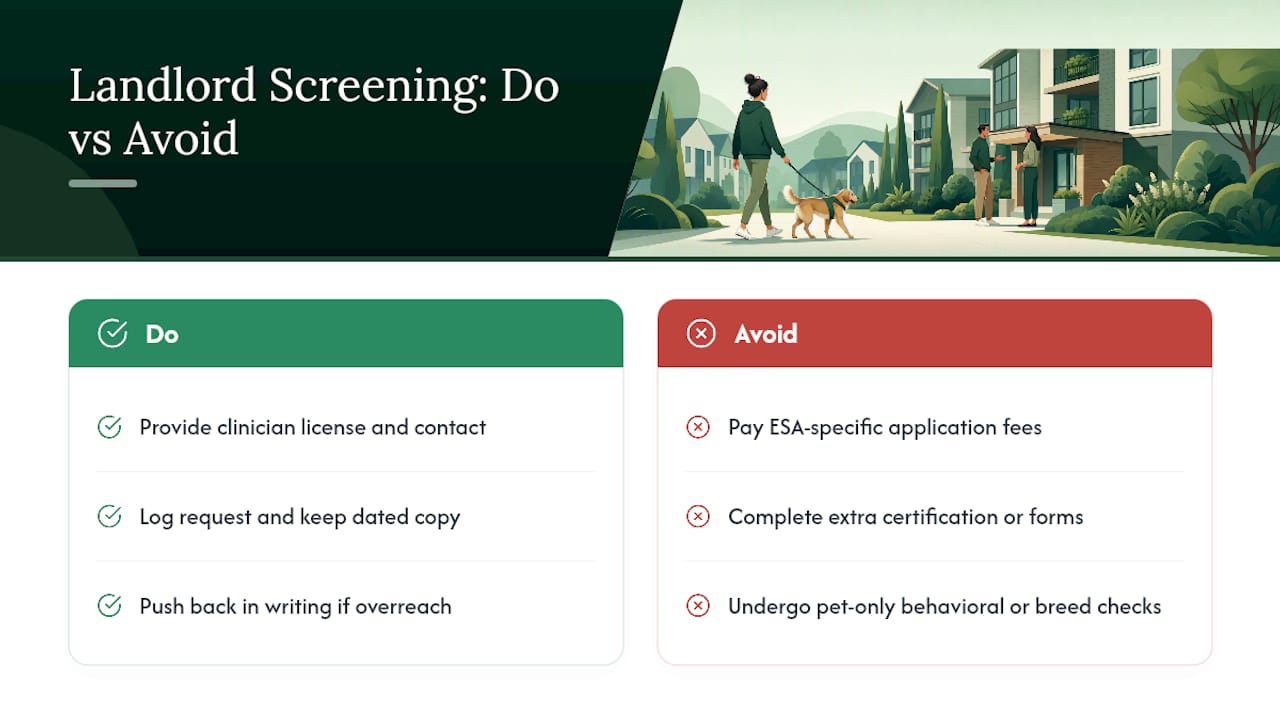
From there, a landlord will typically verify that the letter includes a real license number and functioning contact information, sometimes by calling the clinician’s office directly. This is legal, and it’s exactly why a defensible letter needs accurate provider details. A landlord cannot demand additional forms beyond this verification step, and they cannot require you to complete a separate certification or pay an ESA-specific application fee, since assistance animals are legally distinct from pets under HUD guidance.
Some larger property management companies route accommodation requests through third-party verification services that check a letter’s format and the provider’s license status against public licensing boards. This is different from a general pet-screening fee charged for ordinary pets, and it should not come with a cost to you if the animal is properly documented as an assistance animal rather than a pet.
Where landlords sometimes overreach: requiring the ESA to complete the same behavioral assessment or breed restriction review applied to regular pets, or demanding proof of vaccination beyond what any responsible pet owner would provide. Neither is standard under HUD’s own guidance, and both are worth pushing back on in writing if they surface.
What Accommodations Might a Landlord Actually Offer?
The most common accommodation is a straightforward pet-policy waiver: the property allows the ESA to live in the unit despite an otherwise strict no-pets rule, with no pet deposit or monthly pet rent charged, since assistance animals aren’t legally pets.
Some landlords offer partial accommodations instead of full waivers. A unit reassignment to a ground-floor apartment, for instance, if the original unit has stairs that complicate handling a mobility-limited animal. Others propose a modified deposit structure, technically not allowed for a genuine assistance animal under HUD’s guidance, but sometimes offered as a compromise when a landlord is uncertain about documentation.
Weight or breed exceptions come up often in multi-unit buildings with existing size caps. A well-documented ESA request generally overrides a building’s general breed or weight restriction, since that restriction applies to pets, not assistance animals. If a landlord insists on enforcing it anyway, that’s worth escalating rather than accepting quietly.
Timeline accommodations matter too. A landlord who needs a week or two to review documentation before finalizing the lease amendment is acting reasonably, as long as they’re not using delay as a de facto denial. Get any interim verbal approval in writing, even a short confirmation email, so you have something to point to if the final answer changes.
What Happens if Your ESA Causes Damage or Poses a Risk?
An ESA loses its protected status the moment it becomes a genuine safety threat that can’t be reduced or eliminated through reasonable modification. This is one of the few areas where a landlord’s denial holds up regardless of how strong your clinician letter is.
Direct threat determinations have to be based on the specific animal’s actual conduct, not assumptions about its breed or species. A landlord can’t deny a pit bull ESA request purely on breed reputation, but they can act if that specific dog has bitten someone or displayed aggressive behavior documented by a neighbor complaint or an incident report.
Property damage works differently from safety risk. A landlord generally can still hold a tenant financially responsible for damage caused by an ESA, the same way they would for damage caused by a roommate or a child. Reasonable accommodation covers the right to have the animal in the unit; it doesn’t cover the cost of a chewed door frame or a stained carpet. Keep records of your own if you dispute a damage claim, photos at move-in, any professional cleaning receipts, anything that establishes the unit’s baseline condition.
If a landlord raises a direct-threat argument, ask for the specific incident or behavior they’re citing in writing. A vague claim like “other tenants are uncomfortable” doesn’t meet the legal standard; a documented bite or a pattern of aggressive behavior does.
A Note on Avoiding Letter Mills and Trusting Your Own Clinician
The single biggest mistake people make in this process is shopping for the fastest letter instead of the most defensible one. A letter that took fifteen minutes and a credit card number to produce is the first thing a skeptical landlord’s attorney will challenge, and it’s the first thing that falls apart under any real scrutiny.
Start with the clinician who already knows you, ask direct questions about the letter’s contents before you leave the appointment, and keep every piece of correspondence with your landlord factual and brief. Document everything. That habit, more than any single legal argument, is what actually protects you when a request gets contested.
— Erik
Where to Find Templates and Clinician Guidance
Getting the letter right the first time saves weeks of back and forth with a property manager. Supportpet breaks down each required letter element in plain language, walks through how to verify a clinician’s license before you pay for an evaluation, and offers submission templates you can adapt for certified mail, portal uploads, or email requests.
The resources focus on one thing: helping you build a request a landlord can’t easily dismiss. That means steering clear of registry numbers and instant-certificate sites entirely, since those products carry no legal weight and often work against you in a dispute. If you’re weighing a therapeutic animal’s role in your daily routine, pet therapy research for calming techniques offers useful context on how animal companionship supports emotional regulation more broadly.
Visit Supportpet for the full letter checklist and submission templates before you contact a clinician or send anything to your landlord. Getting the documentation right from the start is the difference between a smooth approval and a drawn out dispute.