
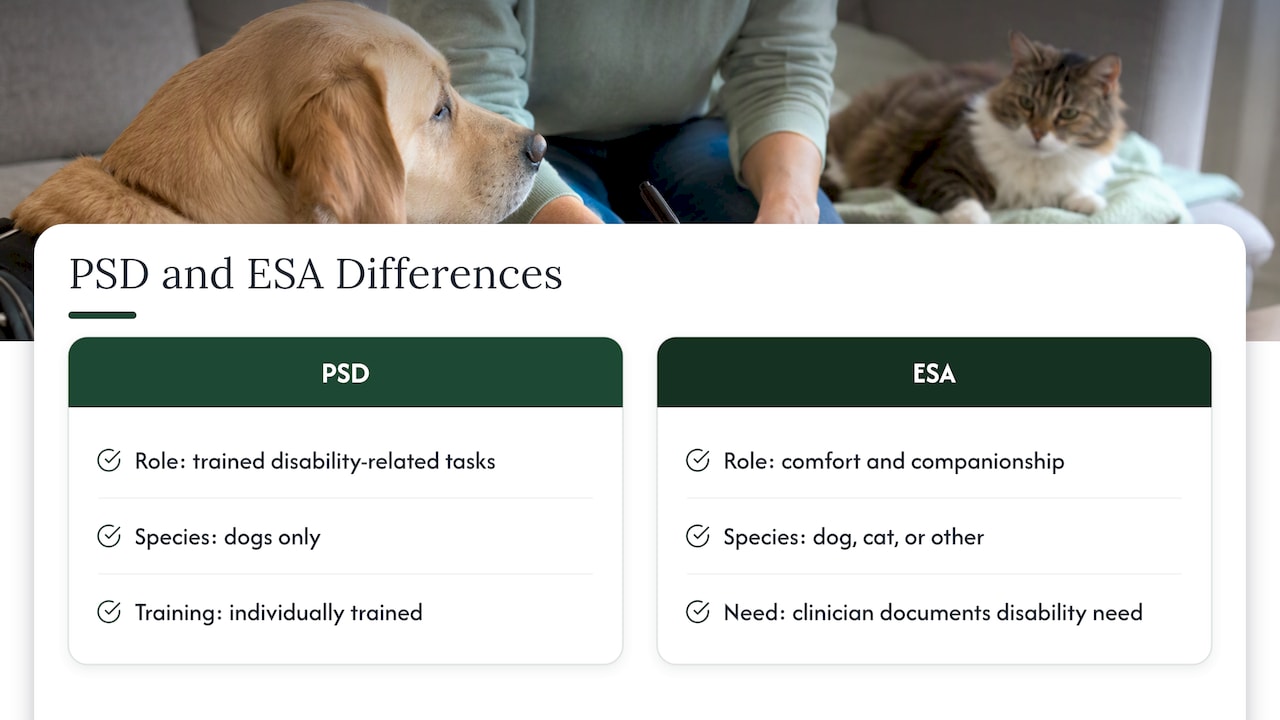
A psychiatric service dog (PSD) is a dog individually trained to perform specific tasks that ease a psychiatric disability. An emotional support animal (ESA) helps through its presence and needs no task training. That one difference decides almost everything else: where you can bring the animal, what a landlord must do, and whether an airline has to let it on the plane.
This guide compares the two side by side, explains what changed for ESAs in housing in 2026, and helps you work out which path matches your situation. It is general education, not legal or medical advice.
TL;DR
- A PSD is a dog trained to do work or tasks for a psychiatric disability. An ESA is a comfort animal with no task-training requirement.
- Only PSDs carry public access rights under the ADA, and only trained service dogs must be accepted by airlines.
- ESA housing protection has become shakier: in May 2026 HUD stopped pursuing complaints from tenants with untrained ESAs, so state law and your landlord’s response matter more than before.
- No registry, certificate, vest or ID card makes an animal an ESA or a service dog. Sites that sell them are selling you nothing the law recognizes.
- Choose based on function: if the dog does a job for your disability, look at a PSD. If it mainly comforts you, an ESA letter from a licensed clinician is the route.
Table of Contents
- The core difference: status versus function
- What a psychiatric service dog actually does
- ESA vs. PSD at a glance
- Housing: what changed in 2026
- Public places: where only a PSD has rights
- Flying with a PSD or an ESA
- How to decide: five questions
- Conditions and the right fit
- Our perspective
- Where to start
- FAQ
- Sources
The core difference: status versus function
Most confusion comes from treating the animal as a status (“my dog is an ESA”) instead of a function (“my dog does this for my disability”). The APA’s resource document on emotional support animals stresses that ESAs are different from service animals and other disability-related assistance animals, and that ESAs are defined and protected by a patchwork of federal, state and local laws.
A service animal earns that label by what it does. Under the ADA, a service animal is a dog individually trained to do work or perform tasks for a person with a disability. Comfort, calm presence and companionship do not count as tasks. A well-behaved dog living with someone who has PTSD is still a pet in a restaurant unless it has been trained to do something that reduces the effects of that disability.
An ESA, by contrast, is defined by the relationship and the clinical need. A licensed clinician who knows you documents that you have a disability-related need for the animal. The animal can be a dog, a cat or another species, and it needs no special training beyond being manageable in your home.
What a psychiatric service dog actually does
The ADA lists examples of psychiatric tasks: reminding a person to take medication, performing room checks for PTSD, or interrupting impulsive behaviors. Other commonly described tasks include deep pressure therapy during an anxiety episode and guiding someone out of an overwhelming setting.
The test is whether the task is directly tied to your disability. A dog that wakes you from a nightmare and turns on a light is performing a task. A dog that makes you feel better when you pet it is providing comfort, which is valuable but a different legal category.
For a deeper look at tasks and training, see our guide to psychiatric service dogs, their tasks, training and your rights.
Training and certification
The ADA does not require professional training programs, and it does not require certification. The Department of Justice says business staff may not demand documentation or proof of training. You can work with a trainer or train the dog yourself, but the dog must reliably perform its tasks and behave in public. A dog that is out of control, or not housebroken, can be asked to leave.
Because nothing official exists, online “registries” and ID cards carry no federal weight. The same goes for ESA “certificates.” If a website offers to certify your pet for a fee, walk away.
ESA vs. PSD at a glance
| Emotional support animal (ESA) | Psychiatric service dog (PSD) | |
|---|---|---|
| Species | Dogs, cats and other animals | Dogs only (the ADA makes a narrow exception for miniature horses) |
| Task training | Not required | Required: individually trained tasks tied to your disability |
| Public access (stores, restaurants) | No ADA right | Yes, wherever the public is allowed |
| Housing | Federal enforcement sharply reduced in 2026; state law and landlord policy matter | Strongest footing, since a trained assistance animal meets HUD’s current standard |
| Air travel | Treated as a pet | Accepted as a service animal with DOT paperwork |
| Documentation | Letter from a licensed clinician | None required by the ADA in public; DOT form for flights |
| Vest or ID required | No | No |
Housing: what changed in 2026
For years, both ESAs and PSDs were treated as assistance animals, not pets, under the Fair Housing Act. HUD’s assistance animals page explains that housing providers must make reasonable accommodations, such as waiving no-pet rules or pet fees, for tenants with a disability-related need, whether or not the animal was formally trained.
That practical picture shifted. According to DREDF’s analysis, on May 22, 2026 HUD issued a memo canceling its earlier ESA guidance (FHEO-2013-01 and FHEO-2020-01) and telling staff to stop pursuing complaints from tenants whose animals have not been individually trained to do disability-related work or tasks. The same analysis notes that the Fair Housing Act itself has not changed and no court has ruled that ESAs are excluded.
In plain terms:
- If you have a PSD, you fit the standard HUD now applies. Your dog is trained to perform tasks tied to your disability, so your request stands on the firmest ground.
- If you have an ESA, the federal enforcement agency is less likely to take your side in a dispute. You may still have rights under the statute, state law or local rules, and many landlords will still grant accommodations, but you can no longer count on HUD to back you up.
We track this in detail on our page about ESA housing rights and what HUD’s change means. Check your state’s rules too: our ESA letter laws by state page shows who can write a letter and where.
If you are also navigating rent costs and benefits, for example as a caregiver of someone with autism, this housing assistance roadmap for caregivers covers funding and support options that sit alongside any animal accommodation.
Dorms and student housing
College housing generally runs through the school’s disability services office. Ask early, before move-in, and expect them to ask for documentation from your clinician. Policies vary by school, so get the process in writing.
Public places: where only a PSD has rights
The ADA covers businesses open to the public, from grocery stores to hotels. Staff who are unsure whether a dog is a service animal may ask only two questions: is the dog required because of a disability, and what work or task has it been trained to perform? They cannot ask for papers, a demonstration or details of your diagnosis.
An ESA has no such right. A store can say no, and a restaurant can too. Our explainer on what an ESA does and does not guarantee walks through the limits renters run into most.
A PSD can still be removed if it is out of control and you do not correct it, or if it is not housebroken.
Flying with a PSD or an ESA
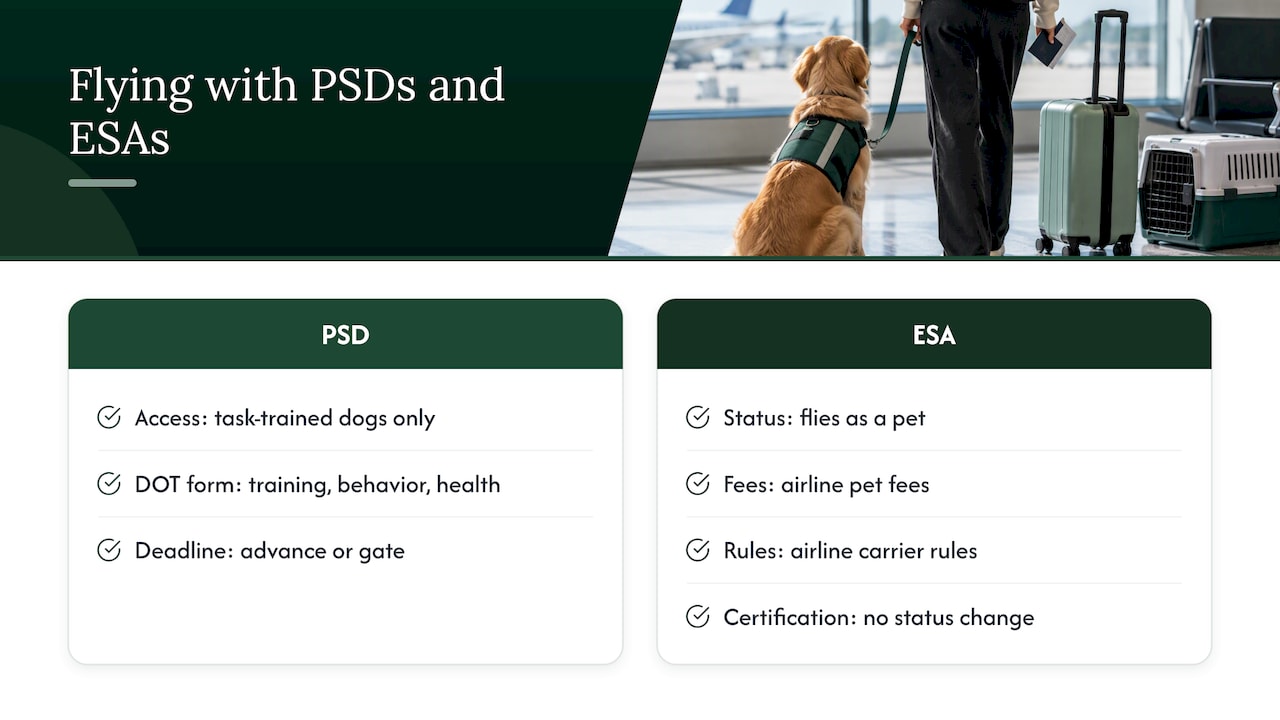
Since January 2021, the U.S. Department of Transportation no longer treats ESAs as service animals. Airlines must accommodate only dogs that are individually trained to do work or perform tasks for a person with a disability, a standard set out on the DOT service animals page.
For a PSD, expect to complete the DOT Service Animal Air Transportation Form, which attests to the dog’s training, behavior and health. Airlines may require it in advance or at the gate, so check your carrier’s deadline well before you travel. An ESA flies as a pet and is subject to the airline’s pet fees and carrier rules, and buying an online “certification” will not change that.
For current airline specifics, see flying with an emotional support animal and our breakdown of U.S. ESA airline rules, DOT forms and the PSD path.
How to decide: five questions
- Does the animal do a specific job for my disability? If it interrupts panic, reminds you of medication or checks rooms, it may qualify as a PSD. If its value is comfort, think ESA.
- Is it a dog? Only dogs count as service animals under the ADA. A cat or rabbit can be an ESA, not a PSD.
- Can the dog behave reliably in public? PSD work means calm behavior in stores, transit and waiting rooms. Not every dog has the temperament, and that is no failing.
- Where do I need the animal? If the answer is mainly your apartment, an ESA letter has been the traditional route, though 2026 changes make state law worth checking. If you need it at work errands, medical offices and on planes, you need a PSD.
- Do I have a clinician who knows me? Both paths are stronger with documented treatment. The APA notes clinicians are expected to evaluate for a clinically recognized impairment before supporting an animal, and many are wary of automated services that skip that step.
Can an ESA become a PSD?
Sometimes. If your dog already has a good temperament, you can train it to perform tasks tied to your disability, either alone or with a trainer. It becomes a PSD when it reliably performs those tasks, not when a form or a vest says so. A dog that only comforts you does not convert by paperwork.
Conditions and the right fit
Some examples of how this plays out, kept general because every case is individual:
- Anxiety or depression with housing needs: A cat or dog that steadies your day at home fits the ESA model. Read how to qualify in How to Get an ESA Letter: The Honest Steps.
- PTSD with hypervigilance or nightmares: Tasks such as room checks or waking you from a nightmare are the kind of work a PSD does. Our article on whether PTSD can qualify you for an emotional support animal covers both routes.
- Panic attacks in public: A dog trained for deep pressure or to guide you out of crowded places points toward a PSD. Treatment from a licensed provider remains the foundation, and a clinician who offers trauma-focused care, such as trauma and PTSD treatment in California for residents there, can help you document what you need.
Our perspective
We built Supportpet because the ESA world is full of paid shortcuts: certificates, registries, ID cards and rush letters. None of them is recognized by federal law, and all of them make readers feel safer than they are. The honest picture is less glamorous. An ESA is a clinical recommendation, and a service dog is a trained working animal.
The 2026 HUD shift makes that honesty matter more. Readers who relied on an ESA letter as a near-guaranteed housing shield now need to read their state law, talk to their clinician and plan for a landlord who may say no. We do not sell letters or documents. We explain what the rules say, flag what is a scam, and point you toward licensed clinicians, not websites that stamp a form.
One point we repeat: do not buy a vest hoping it will do the work of training. Staff are only allowed two questions, so a vest changes nothing legally, and a misbehaving dog in a vest harms every handler who relies on access.
— Erik
Where to start
If you think an ESA fits you best, our guide to emotional support animals and ESA letters explains the process, the legal protections and the red flags in plain language. You can preview what a legitimate letter contains with our ESA letter sample, and compare the two categories further in ESA vs. service dog: key differences.
FAQ
What qualifies you for a psychiatric service dog?
You need a psychiatric or other mental disability, and a dog individually trained to perform tasks that help with it. The ADA does not require a letter, certification or registration for public access. A clinician who knows you can still help document your condition, which matters for housing and airline forms.
Can I fly with my psychiatric service dog?
Yes. Airlines must accept trained service dogs, and they can require the DOT Service Animal Air Transportation Form attesting to training, health and behavior. Submit it by the airline’s deadline, since some ask for it up to 48 hours ahead. A dog that is aggressive or poses a safety threat can still be refused.
Do ESAs have public access rights?
No. The ADA recognizes only individually trained service dogs, and comfort alone is not a task. A business may allow your ESA, but it is not required to.
Does an ESA letter still protect me in housing?
It is less certain than it was. HUD stopped pursuing complaints from tenants with untrained ESAs in May 2026, though the Fair Housing Act itself is unchanged. State law, your lease and your landlord’s willingness to accommodate now carry more weight, so talk to your clinician and check local rules.
What dog breed is best for a PSD?
The law does not limit PSDs by breed, and airlines cannot refuse a dog solely because of its breed. Temperament, health, trainability and the ability to stay calm in public matter far more. Choose the dog that can reliably do your tasks, ideally with advice from a trainer.
Sources
- Frequently Asked Questions about Service Animals and the ADA, ADA.gov
- Service Animals, ADA.gov
- Assistance Animals, HUD
- HUD’s Policy Reversal on Emotional Support Animals, DREDF
- Resource Document on Emotional Support Animals, American Psychiatric Association
- Service Animals, U.S. Department of Transportation
- DOT Final Rule on Traveling by Air with Service Animals
- DOT Service Animal Air Transportation Form