
Yes, you can ask a public housing agency or subsidized landlord to allow an emotional support animal, and in most cases they must say yes. Federal rules treat an ESA as a reasonable accommodation for a disability, which means a “no pets” policy, a pet fee or a size limit generally cannot be applied to your animal. You still have to show a disability-related need, and the agency can refuse only in narrow situations. This guide walks through who is covered, what to send, what the agency may and may not charge, and what to do if the answer is no.
TL;DR
- Public and federally assisted housing is covered by the Fair Housing Act and Section 504, so providers must consider an ESA request as a reasonable accommodation.
- If your disability or need is not obvious, the provider may ask for reliable information, usually a letter from a licensed professional who knows you. An online certificate or registry ID on its own does not do this job.
- Providers may not charge a pet fee or deposit for an assistance animal, but can bill you for actual damage if that is their usual practice.
- A denial should come with an explanation. You can respond with more information or file a disability discrimination complaint.
- ESAs are protected in housing, not in stores, restaurants or other public places. That is where service animals differ.
Table of Contents
- Which laws protect an ESA in public housing
- Why “no pets” rules do not apply to your ESA
- Who qualifies
- What documentation a housing provider can ask for
- How to make the request, step by step
- Fees, deposits and damage
- When a provider can say no
- More than one animal, dorms and shared housing
- ESA or service animal: what changes in public housing
- Our perspective
- Where to start
- FAQ
- Sources
Which laws protect an ESA in public housing
Three federal frameworks matter for a tenant in public or subsidized housing.
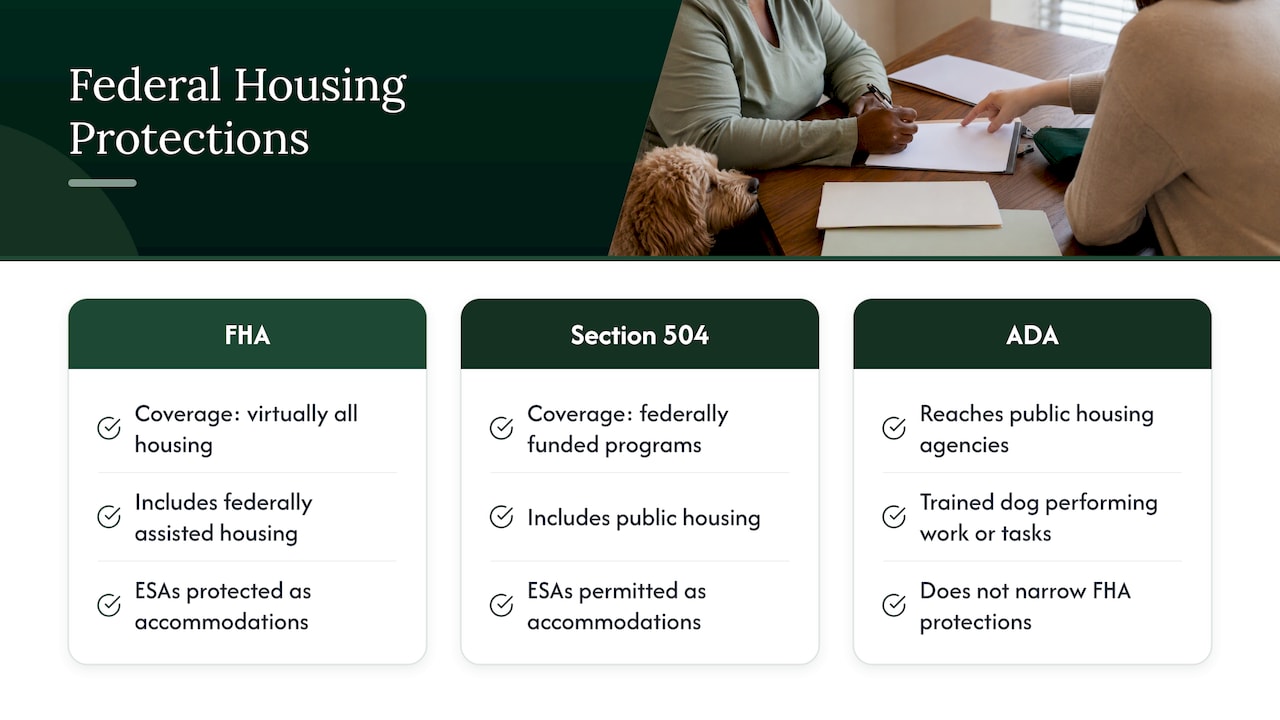
The Fair Housing Act (FHA) requires housing providers to make reasonable accommodations so that a person with a disability has an equal opportunity to use and enjoy a home. HUD’s guidance says it covers virtually all housing, including federally assisted housing. That includes public housing authorities, project-based programs and private landlords who rent to voucher holders.
Section 504 of the Rehabilitation Act applies to programs that receive federal financial assistance, which is exactly what public housing is. HUD’s notice explains that, under the FHA and Section 504, providers must permit assistance animals, including ESAs, as a reasonable accommodation when needed, unless an exception such as undue burden, fundamental alteration, direct threat or substantial property damage applies.
The Americans with Disabilities Act (ADA) also reaches public housing agencies as government entities, but its definition of a service animal is narrow: a dog trained to do work or perform tasks. HUD clarifies that when ADA and FHA rules overlap, such as in a public housing leasing office, the provider must follow both, and that the ADA’s narrow definition does not limit the broader assistance animal protections under the FHA. In short, your ESA does not need to be a dog or have any training to be protected at home.
If you want the bigger picture on how these rules have shifted, our page on ESA housing rights and what HUD’s change means covers the recent developments.
Why “no pets” rules do not apply to your ESA
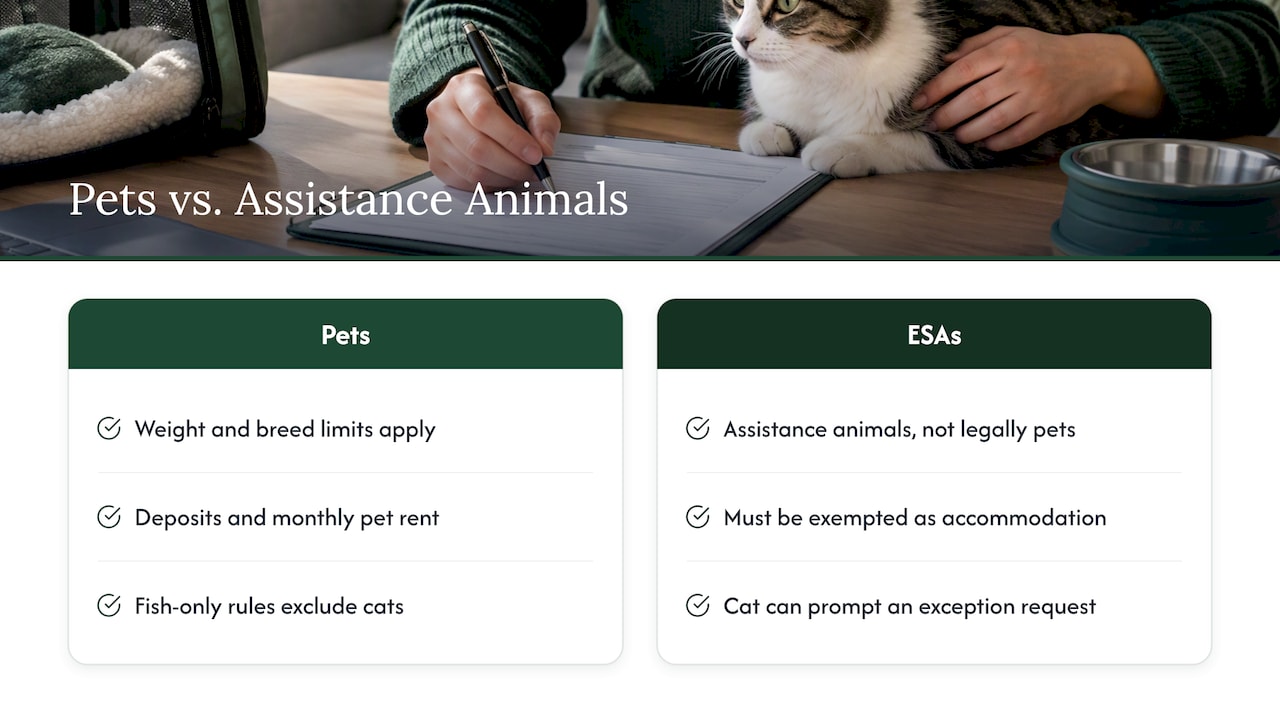
Most public housing leases come with a pet policy: weight limits, breed lists, deposits, monthly pet rent. Those rules exist for pets. An ESA is not legally a pet. It is an assistance animal, which is why a pet policy cannot simply be applied to it.
Federal regulations make this explicit for housing built for older adults and people with disabilities. The pet ownership rules in 24 CFR Part 5 do not apply to assistance animals, which must be exempted as a reasonable accommodation. If you live in one of those projects, the housing provider cannot point to its general pet rules as a reason to refuse you.
This matters in practice. A tenant with a 60-pound dog in a building with a 25-pound limit, or a tenant with a cat in a building that allows only fish, can still ask for an exception. The question the provider must answer is not “do our pet rules allow this animal?” but “does this person have a disability-related need, and would the accommodation be unreasonable?”
Who qualifies
You may qualify if you have a disability and the animal helps with a disability-related need. Under the FHA, a disability is a physical or mental impairment that substantially limits one or more major life activities. Anxiety, depression, PTSD and other mental health conditions can meet that definition when they limit things like sleeping, concentrating, interacting with others or caring for yourself. A diagnosis alone is not the test. The connection between your limitations and what the animal does for you is.
The animal does not need special training. Massachusetts’ civil rights guidance notes that an animal does not need training to be considered an ESA, and that ESA accommodations fall under the Fair Housing Act in housing, while service-animal rights under the ADA apply in public settings.
What documentation a housing provider can ask for
If your disability is obvious or already known to the provider, they should not ask for more. If it is not, HUD says the provider may request reliable information supporting the disability and the animal’s disability-related assistance or emotional support.
In practice that is usually a letter from a licensed health care or mental health professional who knows you. Massachusetts spells out what a good letter contains. It should identify the professional, indicate an ongoing treatment relationship, address whether the condition substantially limits a major life activity, and connect the animal to your symptoms or limitations.
What the letter should and should not be
A solid letter:
- comes from a licensed professional, such as a therapist, psychologist, psychiatrist, physician or licensed clinical social worker, who has actually assessed you;
- states that you have a disability within the meaning of fair housing law, without needing to reveal your full diagnosis or medical history;
- explains how the animal relates to your disability-related needs;
- is signed, dated and includes the professional’s license information.
What does not hold up is a registry listing, a vest, an ID card or a certificate bought for a fee with no real assessment. California’s civil rights agency states that there is no legal requirement to register or certify an ESA, and that online certificates alone generally do not reliably establish a disability or the need for an accommodation. The same guidance recognizes that documentation from an online service can count when it rests on an individualized assessment by a licensed health care professional. The assessment is what carries the weight, not the website.
Providers also cannot be rigid about format. Under HUD’s 2020 guidance, they must assess your specific situation and cannot reject a request over arbitrary documentation requirements as long as the information is reliable. A letter on a clinic’s letterhead is fine; a provider’s own mandatory form is not the only acceptable route.
Letter rules, including who is allowed to write one, differ somewhat by state. We keep a breakdown in our guide to ESA letter laws by state.
How to make the request, step by step
- Get your documentation first. Talk to a licensed professional you see (or can see) for treatment. Ask for a letter that covers the points above.
- Find the right office. In public housing, that is usually the housing authority’s management or reasonable accommodation coordinator. HUD encourages agencies to build reasonable accommodation procedures into their Admissions and Continued Occupancy Policies (ACOP), so check your agency’s ACOP or ask for its accommodation procedure.
- Put it in writing. A verbal request is valid, but Massachusetts recommends a written request with supporting documentation so there is a record. Keep a copy and note the date you submitted it.
- Keep the request simple. Say you have a disability, you are asking to keep an assistance animal as a reasonable accommodation, and your letter is attached. Describe the animal (type, and name if you like). You do not need to write a legal argument.
- Follow up. If you hear nothing, send a polite written reminder. Delay can itself be treated as a denial in some cases, so keep your timeline.
A short sample request
I have a disability and am requesting a reasonable accommodation under the Fair Housing Act and Section 504 to live with my emotional support animal, a [type] named [name]. A letter from my licensed [provider type] is enclosed. Please let me know if you need anything else to process this request.
That is enough. Keep it free of medical detail beyond what your professional’s letter already covers.
Fees, deposits and damage
This is where tenants most often get surprised. HUD’s guidance says housing providers may not charge a fee or deposit for an assistance animal, but may charge the tenant for damage the animal causes if that is their usual practice for damage caused by tenants.
Some local rules say the same in even plainer terms. New York City’s Commission on Human Rights explains that providers cannot charge ESA fees, deposits or additional insurance, but may require payment for actual damage or excessive wear.
So if your housing authority tells you that your ESA comes with a monthly pet rent or a one-time pet deposit, push back in writing and cite the accommodation. You remain responsible for your animal’s behavior and for keeping it under control, cleaned up after and cared for, as with any lease obligation.
When a provider can say no
A provider is not required to approve every request. Under HUD’s framework, the exceptions are undue financial or administrative burden, fundamental alteration of the program, a direct threat to others’ health or safety, or substantial property damage that cannot be reduced by other reasonable means. Massachusetts similarly notes a provider may deny a request if it would impose a fundamental alteration or an undue financial or administrative burden.
These are judged one animal at a time. A provider cannot refuse because of breed or size alone, or because other tenants dislike animals. They would need evidence about your specific animal’s conduct or a real operational problem. NYC’s fact sheet adds that providers may exclude animals prohibited by the Public Health Code or whose damage or disruption creates an undue hardship, which is a reminder that local law can add its own limits.
If you are denied
Ask for the reason in writing. Massachusetts says the provider should explain why, and that you may file a disability discrimination complaint with an enforcement agency. Often a denial is based on something fixable: a letter missing a key element, or a request sent to the wrong person. Send the missing information and ask for a new decision. If the provider will not budge, you can file a complaint with HUD’s Office of Fair Housing and Equal Opportunity or your state or local fair housing agency. A local legal aid office or fair housing organization can often help tenants for free.
More than one animal, dorms and shared housing
Two ESAs. You may request more than one. Massachusetts guidance says the support letter should explain the separate need for each animal, and a provider may ask for documentation that establishes a separate disability-related need for each one. If one animal covers your needs, asking for two is harder to justify.
Student housing. Dorms are housing, so the FHA generally applies. The same Massachusetts guidance notes that a dorm designed specifically for students with allergies could be an exception if an animal would fundamentally alter its operations. Otherwise, submit your request to the university’s disability or accessibility office early, well before move-in, since many schools run their own review process.
Moving between units. If you transfer within a housing authority or move to a new property, the accommodation does not automatically follow you. Send your letter again to the new provider.
ESA or service animal: what changes in public housing
A service dog is trained to perform tasks related to a disability, and it can accompany you into stores, restaurants and other public places. An ESA provides support through its presence and has housing protection, but no general right of access to businesses. At home, though, both are treated as assistance animals under fair housing rules, so the practical request process is similar. If you are unsure which category fits your situation, see our comparison of ESA vs. service dog differences.
Our perspective
Most of the messages we hear from renters are not about the law. They are about fear: fear of losing a lease, fear of being treated as a fraud, fear of paying for a document that turns out to be worthless.
Our view is simple. The protection is real, and it belongs to people with a genuine disability-related need. It does not come from a certificate, a registry number or a vest. It comes from a licensed professional who knows you and can say, in their own words, why the animal matters to your health. Anything that skips that step puts your housing at risk.
That is why we publish free, plain-language guidance and do not sell registrations or ID cards. A tenant in public housing has less room for error than most, because the housing is hard to replace. Read your housing authority’s policy, ask for the accommodation in writing, keep copies, and treat a first denial as the start of a conversation rather than the end.
Erik
Where to start
If you are preparing a request, our guides are built for exactly this moment. Begin with the ESA letter laws by state to see what applies where you live, then read the ESA housing rights guide to understand what your provider can and cannot ask. Everything is free to read.
You can also browse the full set of explainers on the Supportpet homepage, from letters to travel questions, without any sign-up.
FAQ
Do apartments look into ESA letters?
Providers may review a letter to confirm it is reliable when your disability is not obvious. They may check that it comes from a licensed professional who knows you and that it ties the animal to your needs. They should not demand your full medical records or a diagnosis.
Can a public housing authority charge a pet deposit for my ESA?
No. HUD’s guidance says housing providers may not charge a fee or deposit for an assistance animal. They may charge you for damage your animal causes if they would do so for other tenants’ damage.
Can I have two emotional support animals in subsidized housing?
You can ask. The provider may require documentation showing a separate disability-related need for each animal, so ask your licensed professional to address each one in the letter.
Does an ESA letter let me bring my animal into stores or restaurants?
No. ESA protections apply to housing under the Fair Housing Act. Public access rights under the ADA cover trained service animals, so businesses are generally not required to admit an ESA.
What if my request is denied?
Ask for the reason in writing, then fix any gap, such as missing letter details, and resubmit. If the provider still refuses without a valid exception, you can file a disability discrimination complaint with HUD or your state or local fair housing agency.
Sources
- HUD FHEO Notice FHEO-2013-01, service animals and assistance animals
- HUD notice on assessing a person’s request to have an animal as a reasonable accommodation (2020)
- 24 CFR Part 5 Subpart C, pet ownership rules (eCFR)
- HUD Public Housing Occupancy Guidebook, Nondiscrimination requirements
- Mass.gov, Assistance animals in housing
- Mass.gov, Disability rights for users of assistance animals
- California Civil Rights Department, Emotional Support Animals and Fair Housing Law FAQ
- NYC Commission on Human Rights, Emotional Support Animals in housing FAQ