
Yes. A housing provider must consider a request to keep an emotional support animal when the animal is necessary because of a disability, under the standards HUD enforces through the Fair Housing Act. That right has limits, and a provider can ask for documentation when the need is not obvious. Start by putting your request in writing and gathering reliable documentation from a clinician who knows you.
TL;DR:
- Landlords can request documentation only if the disability or need for an emotional support animal is not visibly obvious, requiring a letter from a licensed clinician.
- A reasonable accommodation may involve waiving no-pet policies, pet fees, or breed restrictions without granting public access rights like trained service animals.
- Verified clinician letters must describe the disability, the animal’s role in alleviating symptoms, and confirm an ongoing professional relationship, avoiding full medical records or diagnoses.
- Denials based on direct threat, undue burden, or fundamental alteration require specific evidence related to the animal or case, not stereotypes or preferences.
- Filing a HUD complaint entails keeping thorough records of all communications, fees, and responses, with remedies including policy changes, damages, or future accommodations.
Table of Contents
- What counts as a reasonable accommodation for an ESA under housing law
- What documentation housing providers may request
- Step-by-step: how to request a reasonable accommodation for an ESA
- When a housing provider may lawfully deny or limit an ESA accommodation
- How to enforce your rights: complaints, evidence, and remedies
- Avoiding scams and getting reliable ESA documentation
- Common tenant mistakes and three practical reminders
- Supportpet resources: templates, sample letters, and next steps
- Sources
- FAQ
What counts as a reasonable accommodation for an ESA under housing law
HUD defines an assistance animal broadly enough to include emotional support animals that provide therapeutic benefit to a person with a disability, and it says plainly that these animals are not pets for purposes of the Fair Housing Act. That distinction matters because it strips away the pet rules, breed restrictions, and pet fees that many leases apply, replacing them with a disability rights framework.
A reasonable accommodation under this framework typically means a housing provider waives a no-pets policy or a weight or breed limit so a tenant can keep their ESA. It does not mean the animal gets special access rights outside the home the way a trained service animal does under the Americans with Disabilities Act. Service animals are dogs trained for specific tasks and are governed by ADA rules covering public spaces; ESAs are governed by the FHA and HUD guidance, which apply specifically to housing.
- HUD treats assistance animals as a disability accommodation, not a pet.
- The FHA can require waiving no-pet policies, fees, and size or breed limits.
- ADA service animal rules cover public access; FHA and HUD guidance cover housing.
What documentation housing providers may request
A landlord can only ask for documentation when your disability or your need for the animal is not obvious. If you use a wheelchair and ask for a service animal, no paperwork is needed. If your condition is not visible, such as anxiety or PTSD, the provider can request reasonable documentation connecting the disability to the need for the animal.
HUD’s 2020 guidance, FHEO Notice 2020-01, says a letter from a licensed health professional who has an actual relationship with the patient is generally sufficient. What the letter should avoid is oversharing: a diagnosis name and a clear statement of disability-related need is enough. A landlord cannot lawfully demand full medical records, therapy notes, or a specific diagnosis.
- Documentation is appropriate only when the disability or the disability-animal connection isn’t obvious.
- A letter from a licensed clinician who knows the patient’s history is generally sufficient.
- Housing providers may not require access to full medical records or a named diagnosis.
Pro Tip: Ask your clinician to state that you have a disability, that the animal alleviates a symptom of that disability, and that they have an ongoing relationship with you, without naming your diagnosis.
Step-by-step: how to request a reasonable accommodation for an ESA
A written request is far easier to defend later than a verbal one, and it starts the clock on the housing provider’s obligation to respond.
- Submit your request in writing, stating that you have a disability and need the animal to use and enjoy your home.
- Name the specific accommodation you want, such as a waiver of a no-pets clause or a pet fee.
- Attach or offer to provide clinician documentation if your provider hasn’t already treated a similar request as obvious.
- Give the housing provider a reasonable window to review and respond, and follow up in writing if you don’t hear back.
- Keep a copy of every letter, email, and text you send or receive about the request.
- Limit what you disclose to the disability-related need, not your full medical history.
The Supportpet guide to ESA rights includes a template you can adapt for this exact letter, which keeps disclosures narrow while covering what HUD says a request needs.
When a housing provider may lawfully deny or limit an ESA accommodation
Denials are legal only under a few narrow circumstances, and providers carry the burden of proving one applies. HUD’s guidance lists direct threat, undue burden, and fundamental alteration as the recognized exceptions.
A direct threat means the specific animal has a documented history of aggression or property destruction, not a general assumption about its breed or size. Undue burden is assessed case by case: a small building with thin walls and a large, loud animal might raise a real financial or administrative burden, but a landlord simply preferring not to deal with an animal isn’t enough.
- Direct threat requires evidence tied to the specific animal, not stereotypes about its type.
- Undue burden and fundamental alteration are evaluated on the individual facts, not assumed.
- Fee waivers and deposit demands are among the most frequently disputed points, and HUD enforcement guidance explains that whether a pet deposit is unlawful depends on the circumstances of each case involving an assistance animal.
How to enforce your rights: complaints, evidence, and remedies
If a request is denied without a lawful basis, or if a landlord retaliates after you ask, you can file a complaint with HUD’s Office of Fair Housing and Equal Opportunity. Some cases escalate to the Department of Justice, which has pursued housing providers directly. A DOJ complaint against a housing authority shows the kind of enforcement action the government brings when providers refuse reasonable accommodations or impose unlawful pet policies.
Before filing, gather everything that documents the timeline of your request and the provider’s response.
- Save copies of your written request, the clinician letter, and every reply from the housing provider.
- Note dates of conversations, including anyone present, in case you need a witness account.
- Keep records of any fees demanded or lease terms changed because of your ESA.
Remedies in these cases have included policy changes, monetary damages, and injunctive relief requiring a provider to accommodate future requests. Timelines vary widely depending on whether the case settles or proceeds through litigation, so treat a complaint as a process measured in months, not days.
Avoiding scams and getting reliable ESA documentation
A generic online certificate or registration card is not what HUD guidance describes as sufficient documentation, and many landlords now recognize these products and reject them outright. What holds up is a letter from a licensed clinician, such as a therapist, psychologist, or physician, who has assessed you individually and can speak to your specific disability-related need.
Before you rely on any letter, verify the clinician holds an active license in your state and confirm they conducted a real evaluation rather than a brief online questionnaire.
- Skip any service that issues a letter without a genuine clinical assessment.
- Confirm the clinician’s license is active and appropriate to your condition.
- Ask that the letter describe your need in plain terms without unnecessary diagnostic detail.
Pro Tip: A letter that reads like a form template, with no personal detail about your treatment history, is the kind landlords most often challenge.
Common tenant mistakes and three practical reminders
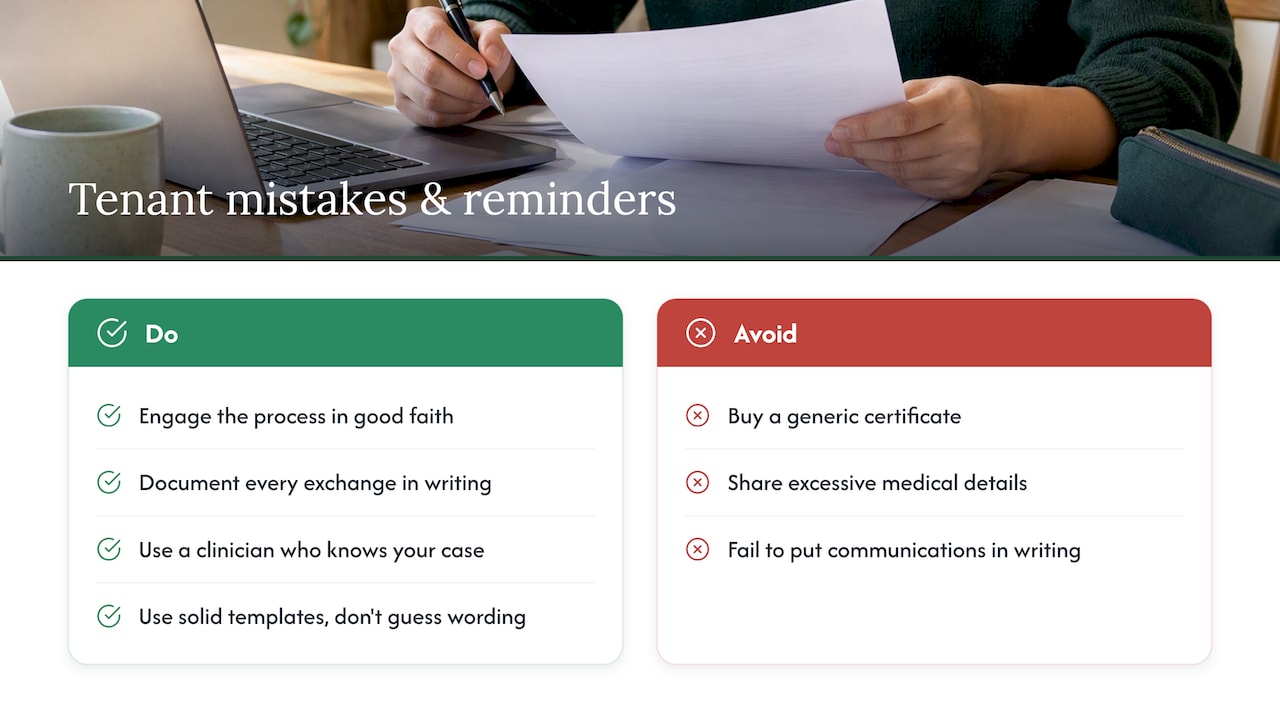
The tenants who run into trouble usually made one of three errors: they bought a generic certificate instead of getting an individualized letter, shared far more medical detail than necessary, or never wrote anything down and had no record when a dispute started.
Engage the process in good faith and document every exchange in writing. Use a clinician who actually knows your case, not a one-time online form, and lean on solid templates rather than guessing at the wording.
— Erik
Supportpet resources: templates, sample letters, and next steps
Getting this right the first time saves you weeks of back and forth with a landlord. The guide walks through the clinician checklist, a sample accommodation request letter, and plain-language explanations of what HUD documentation rules actually require, so you’re not piecing it together from scattered forum posts.
If you’re also negotiating shared housing terms, the roommate compatibility checklist can help you put pet and ESA expectations in writing before a dispute starts. Visit the Supportpet ESA rights guide for the full template library and next steps on preparing your request.
This article is general information, not a substitute for advice from a qualified lawyer. Consult a qualified legal professional about your own circumstances before acting on anything here.
Sources
- Hud
- Complaint – United States v. Town of East Hampton Housing Authority (example DOJ enforcement filing)
FAQ
What is a reasonable accommodation for an ESA?
A reasonable accommodation for an ESA is a change to housing rules, such as waiving a no-pets policy or a pet fee, that allows a person with a disability to keep an emotional support animal. HUD requires this when the animal is necessary because of the person’s disability and no lawful exception applies.
What are the 5 common means of reasonable accommodation?
There’s no single official list of five methods; accommodations are decided case by case based on what the tenant needs and what the housing provider can reasonably provide. Common examples include waiving no-pet clauses, waiving pet fees or deposits, and adjusting size or breed restrictions for the specific animal.
What are the new rules for emotional support animals in 2026?
There is no new federal rule specific to this year; HUD’s governing guidance remains its assistance animals framework and the 2020 documentation notice, FHEO Notice 2020-01. Some state and local agencies have issued their own clarifications, so it’s worth checking your state’s civil rights office for anything specific to your area.
Do landlords actually verify ESA letters?
Landlords cannot demand medical records, but they can and increasingly do question letters that look like generic templates from online certificate mills. A letter from a licensed clinician who has an actual relationship with the patient, as described in HUD’s guidance, is far less likely to be challenged.