
If your roommate objects to your emotional support animal (ESA), or you are the one living with someone else’s, the short answer is this: the law mostly speaks to your landlord or school, not to your roommate. Your roommate cannot evict you or personally “reject” an approved animal. But your landlord can still reopen the question, a college can move someone, and a hostile home is a bad place for you and the animal. The best outcomes come from a written agreement, a clear paper trail and an early, calm conversation.
This guide covers both sides of the dispute, how colleges and landlords usually settle these cases, and what changed in federal policy in 2026.
TL;DR
- Fair Housing protections run between you and your housing provider. A roommate has no power to evict you, and no legal duty to “accept” an ESA the way a landlord might.
- Federal policy shifted in 2026, so check your state law and your housing provider’s written policy before you count on any protection.
- Allergies, fear, noise and shared spaces cause most disputes. A written roommate agreement settles most of them.
- Colleges often resolve stalemates by moving a student, and priority dates or seniority often decide who stays.
- Suing a roommate for “emotional distress” over an ESA rarely works. Mediation or a move is usually faster and cheaper.
Table of Contents
- Who actually decides: your roommate, your landlord or your school
- What changed in 2026, and why it matters for roommates
- The most common ESA roommate disputes
- If you own the ESA: how to protect your housing and your relationship
- If your roommate has the ESA: what you can reasonably ask for
- Roommate agreements: what colleges require and you can borrow
- How colleges settle ESA roommate stalemates
- When talking stops working: mediation before court
- Perspective: why we push for agreements over arguments
- Need the paperwork side sorted first?
- Finding a better housing fit
- FAQ
- Sources
Who actually decides: your roommate, your landlord or your school
Most fights start from a wrong assumption: that a roommate gets a vote. Legally, they usually do not.
The HUD guidance on assistance animals describes a reasonable accommodation as something a housing provider grants a person with a disability. Under that framework, a provider generally cannot charge extra fees or deposits for an approved assistance animal. It can deny a request only in narrow cases, such as undue burden or a direct threat that no other accommodation can remove. Those duties belong to the landlord, not to the person sharing your kitchen.
Three parties matter in practice:
| Who | What they control | What they cannot do |
|---|---|---|
| Landlord or property manager | Approves or denies the accommodation request; sets house rules | Charge pet fees for an approved animal (under the HUD framework above) |
| College housing office | Approves ESAs, assigns or moves rooms, enforces agreements | Ignore a roommate’s documented medical issue, such as a serious allergy |
| Roommate | Negotiates, files complaints with the landlord or school, may ask for mediation | Evict you, or legally veto an approved animal on their own |
One more point from a legal Q&A: a lawyer on Avvo explains that ESA rules apply to landlords rather than roommates, and that forcing an animal into a home with a strongly opposed roommate is often counterproductive. A dog can suffer too if it lives with someone who resents it.
What changed in 2026, and why it matters for roommates
The ground has moved. In June 2026, a law firm summary reported that HUD rescinded its 2020 guidance on emotional support animals. It also reported a new enforcement standard that focuses on animals individually trained to assist with a disability, and said state and local laws are not affected by the federal change.
What that means for you:
- Your landlord may now be less willing to grant ESA requests without extra proof, and a roommate who complains may find a more receptive ear.
- State and local fair housing laws may still protect you. Check yours. Our guide to state ESA law checks walks through how.
- Documentation matters more. See our explainer on what HUD’s 2026 change means for ESA housing rights, and our walkthrough on how to prove your ESA housing rights after HUD’s memo.
If you are mid-dispute and your housing depends on the animal, talk to a local fair housing organization or a tenant attorney. The law is shifting, and a general article cannot tell you how your landlord or your state will treat your case.
The most common ESA roommate disputes
A guide to college ESA roommate conflicts lists the usual triggers: allergies, fears, personal preferences and other comfort concerns in shared spaces. In practice, they sort into five groups.
Allergies and asthma
This is the strongest objection a roommate can raise, because it is a health issue. If you are the roommate with allergies, get a note from your doctor. At a school, it goes to the disability or accessibility office. In a rental, it goes to the landlord. A documented medical need on one side and a documented ESA on the other puts the decision where it belongs: with the institution that must weigh both.
Fear of animals
A genuine phobia is real, but it is harder to document than an allergy. It still counts as a concern to raise with the housing provider, and it can shape solutions such as keeping the animal in a bedroom or choosing a different room pairing.
Noise, smell and mess
Barking, litter boxes, shedding and cage odors are the daily irritants. They are also the easiest to fix with specific rules: who cleans, when, and where the animal stays.
Access to shared spaces
Many owners are surprised here. The University of Wisconsin–Madison compliance office states that an ESA is not a pet but a reasonable accommodation so a resident can use and enjoy an assigned room or apartment. Unlike a service dog, an ESA does not carry general access rights, and a housing provider may restrict it from common areas outside the owner’s private space. Western Washington University similarly describes ESAs as limited to their owner’s residence. Rules vary by school and landlord, so read yours.
Care and neglect
If an animal is left alone for long stretches, or a roommate ends up feeding or walking it, resentment builds fast. This is the dispute where a written agreement helps most.
If you own the ESA: how to protect your housing and your relationship
Legal protection is the floor, not the plan. Here is a sequence that works.
- Tell your roommate early, in person. Do it before the animal arrives, not after. Ask directly about allergies, fears and past experiences with animals.
- Get your paperwork in order first. You need a valid letter from a licensed clinician who knows you. Our guides to getting an ESA letter the honest way and what a real letter looks like show what a legitimate one contains. Skip any site that sells instant certificates or registry IDs.
- Send your accommodation request in writing. Our copy-ready landlord notification letter can help you word it. Keep copies of everything.
- Offer a written animal care plan. Cover noise, cleaning, feeding, designated areas and what happens when you travel.
- Be ready to compromise on common areas. Keeping the animal out of the living room costs you little and can save the whole arrangement.
- Confirm everything in writing. A text recap of what you agreed is better than a memory.
If your roommate’s objection is a documented medical one, treat it as seriously as you want yours treated. Pushing back with “I have a letter” tends to turn a solvable problem into a formal complaint.
If your roommate has the ESA: what you can reasonably ask for
You are not powerless, but your leverage is practical rather than legal. Roommates cannot evict each other, and eviction is a landlord-tenant process, as Michigan Legal Help explains in its roommate guide. That page also notes that roommates on the same lease are usually jointly and severally liable, meaning each is fully responsible for the rent and any damage. That cuts both ways: if the animal causes damage, the lease may hold you responsible too, so document problems early.
Reasonable requests include:
- A written agreement on cleaning, noise and where the animal stays.
- A medical note if you have an allergy, sent to the landlord or school.
- Limits on shared spaces, such as a no-animal kitchen.
- A review date, say 30 days in, to see how things are going.
Skip the ultimatums. Threatening the owner, or the animal, escalates conflict and can create legal trouble for you.
Roommate agreements: what colleges require and you can borrow
Many schools require a signed agreement before an ESA moves in. The Converse University ESA roommate and suitemate agreement is one public example. It covers things like the animal being housebroken and a minimum age for dogs and cats, and it restricts leaving the animal alone overnight. Failing to keep up the agreement or document care can bring conduct violations or removal of the animal, so owners should take it seriously.
Ottawa University’s ESA application policy shows the usual sequence: review the policy and rules first, then submit a request form with a medical provider’s form. Your school’s version will differ, but the logic is the same.
Even off campus, you can borrow the structure. A solid agreement has these parts:
- Animal basics: species, breed, size, vaccination status.
- Care: who feeds, walks, cleans and pays for supplies.
- Spaces: where the animal may and may not go.
- Noise and odor: what counts as a problem and how fast it gets fixed.
- Absences: who handles the animal if the owner is away.
- Review and exit: when you check in, and what happens if it is not working.
If your landlord uses an addendum, our piece on ESA housing addendum fields shows the four fields worth keeping.
How colleges settle ESA roommate stalemates
When talk fails, schools step in. According to one college guide, housing priority dates often decide who stays: the student who applied first or has seniority usually keeps the room, and the other is relocated. That is a commonly described practice, not a universal rule, so ask your housing office how yours works.
A few practical tips for students:
- Go to residence life or the accessibility office early. Do not wait for a blowup.
- Ask whether a single room or a different pairing is available.
- Bring your documentation, and ask what the school needs from a roommate with a medical objection.
- Keep communications polite and in writing.
If you are choosing between an ESA and a service dog, our comparison of ESA vs. service dog differences explains why the access rights are so different.
When talking stops working: mediation before court
A formal fight is slow, costly and stressful. The City of Boulder’s guide to mediation describes it as a process in which a neutral mediator helps people resolve a conflict through open communication and creative problem solving. Mediation is typically voluntary, though a court can order it once a case is filed. The same guide notes that some states protect what is said in mediation by law, such as Colorado under C.R.S. § 13-22-307. Check your own state’s rules.
Many cities, counties and universities offer low-cost or free mediation. Search for your county’s community mediation center or your campus ombuds office.
HUD’s own approach to accommodation relies on an interactive process: open communication, naming specific needs and looking for compromises. The same spirit works between roommates. Start there before anyone mentions lawyers.
Can you sue a roommate over an ESA?
You can try, but it is rarely a good move. Michigan Legal Help treats roommate disputes mainly as matters for lease terms and mediation, and notes that emotional distress is a specific legal concept, not a catch-all for disagreements. A claim over an ESA is a high bar. For most people, finding a different room or using mediation is faster and cheaper.
Perspective: why we push for agreements over arguments
We built Supportpet because people kept learning their rights from sellers of certificates and registries instead of from plain explanations. Roommate disputes show the cost of that confusion. Owners believe a letter makes them untouchable. Roommates believe a complaint can force the animal out. Both are usually wrong.
Here is what we think after reading the rules, the school policies and the cases people describe. The law protects your relationship with your housing provider. It does not protect your relationship with the person you share a fridge with. That relationship is yours to build, and it will decide whether the accommodation actually feels like support.
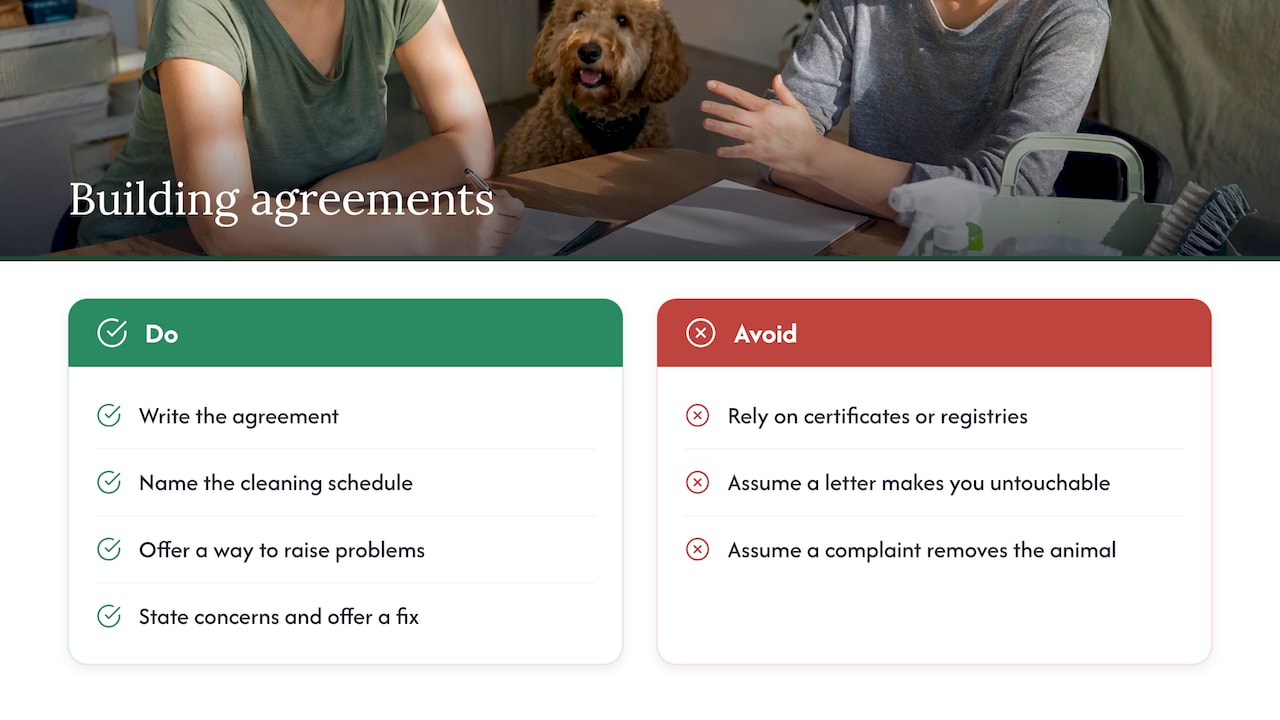
So write the agreement. Name the cleaning schedule. Give your roommate a way to raise problems without a formal complaint. If you are the roommate, state your real concern, whether it is allergies or fear, and offer a fix. An animal meant to ease anxiety should not live in a house where everyone is on edge, and a good-faith compromise usually protects the animal, the owner and the lease.
And because federal policy moved in 2026, keep your documents current and know your state’s law. We keep our guides updated for exactly that reason.
— Erik
Need the paperwork side sorted first?
Before any roommate conversation, make sure your own documentation holds up. Our free guide to ESA letters and your housing rights explains what a valid letter is, how to avoid scams and how federal and state rules fit together. We do not sell certificates or registrations, just plain-language information. If you are weighing a cat for a shared space, start with how a cat becomes an ESA.
Finding a better housing fit
Sometimes the honest answer is that a particular house will never work. If so, widen the search rather than fight a losing battle. Some supportive housing resources can help you look at options built around disability and mental health needs. When you tour new places, ask about assistance animal policies in writing before you sign, and check your state ESA letter laws.
FAQ
Can my roommate legally refuse my ESA?
Usually not by themselves. Reasonable accommodation duties fall on the landlord or school, not roommates. But a roommate can raise documented concerns, such as a medical allergy, with the housing provider, who must weigh them. A roommate who also holds the lease may have more say if the landlord has not yet approved the animal.
Can a roommate kick me out because of my ESA?
No. Eviction is a landlord-tenant process, and one roommate cannot do it to another. They can, however, complain to the landlord or school, and some leases let roommates end shared arrangements in other ways. Read your lease and ask a tenant attorney if you get a threat.
Can my ESA go in the living room and kitchen?
Not necessarily. Housing providers can restrict an ESA from shared spaces that are outside your private quarters, and many schools do. Check your lease, school policy and any roommate agreement, and ask for a written answer.
What if my roommate is allergic to my ESA?
An allergy is a legitimate concern, and the housing provider will want medical documentation. Typical solutions include keeping the animal in your room, using air filters, cleaning routines, or moving one of you. Raise it early and in writing.
Should I sue my roommate over an ESA dispute?
In most cases, no. Lawsuits are slow and expensive, and emotional distress claims over roommate disputes are hard to win. Try a written agreement, then mediation, and consider moving if neither works.
Sources
- HUD: Assistance Animals
- Holland & Knight: HUD Rescinds Emotional Support Animal Guidance (June 5, 2026)
- Avvo: Can a roommate reject an ESA dog if I have a letter?
- College ESA Roommate Conflicts: How to Navigate Successfully Guide
- UW–Madison Office of Compliance: ESAs in University Housing
- Western Washington University: Animals in Residence
- Michigan Legal Help: I Have a Problem with My Roommate
- Converse University: ESA Roommate/Suitemate Agreement
- Ottawa University: ESA Application Policy
- City of Boulder: Guide to Mediation
- HUD and DOJ: Reasonable Accommodations Under the Fair Housing Act