
Short answer: federal fair housing law protects emotional support animals in most housing situations, but state rules and enforcement details vary, so you need to check both the federal baseline and your state’s specific rules. The Fair Housing Act sets the floor everywhere in the country. ESAs do not carry the public access rights that trained service animals have under the ADA. Start with the federal overview below, then jump to the state-specific guidance that applies to you.
TL;DR:
- Most states follow federal rules requiring housing providers to accommodate emotional support animals unless it causes undue burden, threat, or fundamental change.
- State statutes may address DOC fraud, set limits on the number of animals, or specify anti-fraud measures, but federal protections remain the baseline where no law exists.
- Legitimate ESA documentation must come from a licensed professional, focus on functional need, and avoid overly detailed or instant online certificates, which are often scams.
- Denial of an ESA request is only lawful if based on proof of threat, undue hardship, or lack of genuine disability connection after a proper interactive process.
- Enforcement involves federal and state agencies, with some states adding penalties for fake certifications and procedural protections that can influence complaint timeliness and outcomes.
Table of Contents
- Federal baseline: Fair Housing Act, HUD guidance, and key legal principles
- How state laws vary and a practical checklist for reading your state entry
- Typical state patterns with illustrative examples
- Documentation and legitimate ESA letters: what actually counts
- Housing rights, landlord interactions, and enforcement steps
- Differences from service animals, public access, travel, and other rules
- Supportpet resources, clinical guidance, and anti-scam protection
- State-level enforcement agencies and their roles in ESA disputes
- Interaction between state ESA laws and local housing ordinances
- State-specific penalties or fines for non-compliance with ESA laws
- Updates and changes in state ESA laws
- When to get legal or clinical help
- Supportpet: where to find legitimate ESA guidance and tools
- Sources
- FAQ
Federal baseline: Fair Housing Act, HUD guidance, and key legal principles
The Fair Housing Act requires housing providers to grant reasonable accommodations for assistance animals, including emotional support animals, unless the request creates an undue burden, fundamentally alters the housing program, or the animal poses a direct threat to others. This applies in rentals, condos, and co-ops nationwide, regardless of “no pets” policies.
The HUD FHEO guidance spells out what a landlord can and cannot ask for when a tenant requests an accommodation. It also draws a firm line between assistance animals and pets, which matters because pet fees and pet deposits typically should not apply to an ESA.
A few principles anchor the federal framework:
- Housing providers must engage in an interactive process rather than issuing an automatic denial.
- Assistance animals are treated differently from pets under HUD guidance, particularly regarding fees.
- Denials are limited to specific, documented circumstances like direct threat or undue financial and administrative burden.
- The DOJ enforces the Fair Housing Act and has pursued cases against landlords who denied legitimate accommodation requests without justification.
These federal rules apply in every state. What changes from state to state is how aggressively agencies enforce them, whether additional tenant protections exist, and whether a state has passed its own laws targeting ESA letter fraud.
How state laws vary and a practical checklist for reading your state entry
No two states handle emotional support animals identically, even though the federal floor is the same everywhere. Some states passed statutes that specifically address ESA documentation fraud. Others added consumer protections around fees and deposits, and a few impose limits on the number or type of animals a household can claim.
When you look up your own state’s rules, check for these four things:
- Statute citation. Look for the actual bill or code section, not a summary blog post repeating an older version.
- Agency guidance. Identify which state agency (often a housing or civil rights commission) handles ESA-related complaints.
- Complaint portal. Confirm whether your state offers an online or paper complaint process separate from the federal HUD system.
- Effective date. Note when the law took effect or was last amended, since anti-fraud provisions and fee rules get updated periodically.
A state page that lacks a specific ESA statute does not mean you have no protection. It usually means the state defers entirely to federal Fair Housing Act rules, which still apply.
Typical state patterns with illustrative examples
Most states fall into one of a few recognizable clusters once you start comparing their approaches to emotional support animals.
- States that closely mirror HUD and FHA language. These states have no separate ESA statute and simply point residents toward federal guidance and the standard reasonable accommodation process.
- States with added tenant protections. Some states layer on rules about fee waivers, faster response timelines for landlords, or explicit anti-retaliation language for tenants who file a request.
- States with anti-letter-mill laws. A growing number of states have passed statutes penalizing companies that sell ESA certificates or registrations without any real clinical evaluation, aiming squarely at the documentation scams that confuse the market.
- States that add limits. A smaller group of states caps the number of animals per accommodation request or require the animal to meet basic health and vaccination standards before a landlord must comply.
State laws vary considerably in structure and emphasis. Research comparing top state-level resources shows these clusters recur across the country: some states add anti-fraud statutes, some add tenant protections, and many rely entirely on federal law with no supplemental state rule at all.
If your state’s page says “no state-specific ESA law” or “no state recognition,” that is not a gap in your rights. It means the Fair Housing Act, a federal law, is the only framework governing your situation, and it still requires housing providers to consider your accommodation request in good faith. The absence of a state statute is common and does not weaken your federal protection.
Documentation and legitimate ESA letters: what actually counts
A housing provider is allowed to ask for limited, relevant documentation when a disability and the need for an animal are not obvious. Under HUD’s 2020 guidance, that typically means a letter from a licensed health or mental health professional confirming the disability-related need. Landlords cannot lawfully demand specific notarized forms, detailed diagnostic records, or medical charts.
A legitimate letter generally includes:
- Confirmation that the writer is a licensed clinician with a professional relationship to the patient.
- A statement of functional limitation without unnecessary diagnostic detail.
- An explanation of why the animal is necessary as part of the person’s treatment or daily functioning.
- A recommended time frame for the accommodation, since needs can change.
Red flags that signal a letter mill instead of a real clinical evaluation include instant online certificates, no actual conversation with a licensed provider, registry listings sold as if they carry legal weight, and guarantees of approval regardless of your situation. None of those products carry legal standing under the FHA.
Pro Tip: Ask any clinician writing your letter to keep the language focused on function and necessity, not a full diagnostic history. That protects your privacy and gives housing providers exactly what HUD guidance says they’re entitled to see, nothing more.
Housing rights, landlord interactions, and enforcement steps
Requesting a reasonable accommodation starts with a written request to your housing provider. State clearly that you have a disability-related need for an assistance animal and, if asked, provide a letter from a licensed clinician. Keep a copy of everything you send.
Landlords retain narrow grounds to deny a request:
- Undue burden. The accommodation would impose significant financial or administrative strain given the size and resources of the housing provider.
- Direct threat. The specific animal has a documented history of aggression or property damage that cannot be mitigated.
- Fundamental alteration. Granting the request would change the essential nature of the housing operation.
- Insufficient disability-related nexus. The tenant cannot show any connection between the disability and the need for the animal after a good-faith interactive process.
If your request is denied without one of these justifications, you can file a complaint with HUD or your state’s fair housing agency. The DOJ’s enforcement record includes cases against landlords who denied legitimate ESA accommodations, often resulting in monetary damages and policy changes at the property level.
Keep detailed records throughout: dated copies of your written request, your clinician’s letter, every landlord communication, and any incident reports if a dispute arises over the animal’s behavior. If you receive a denial or an eviction notice tied to your ESA, that documentation becomes the foundation of any HUD complaint or legal defense you file.
Differences from service animals, public access, travel, and other rules
Emotional support animals occupy a specific legal lane, and it is narrower than many people expect. Under the ADA, only trained dogs (and in some cases miniature horses) that perform a specific task related to a disability qualify as service animals with public access rights. ESAs, which provide comfort through their presence rather than trained tasks, do not qualify for that same access to restaurants, stores, or other public accommodations.
- Housing protections under the FHA are separate from and broader than ADA public access rules.
- Air travel rules for support animals fall under the Department of Transportation, which has changed its policies in recent years and should be checked directly before flying.
- Employment accommodations for an ESA are evaluated under different disability employment law standards, not the FHA.
- A landlord who understands the difference between a service animal and an ESA will typically ask different questions depending on which one you’re requesting.
Knowing which law governs which setting keeps you from over-claiming rights in public spaces or under-claiming them at home.
Supportpet resources, clinical guidance, and anti-scam protection
Supportpet publishes plain-language explainers on legitimate ESA documentation, built around the same clinician-first standard that HUD guidance describes: a real evaluation, a real professional relationship, and a letter focused on function rather than unnecessary diagnostic detail. The goal is helping renters recognize a scam letter mill before they pay for one.
For clinicians, a defensible letter states the professional relationship, the functional limitation, and the necessity of the animal, without disclosing a full diagnosis. Supportpet’s rights guide tracks how housing guidance evolves and flags when a reader’s situation looks complex enough to warrant a local attorney or state agency instead of a general explainer.
State-level enforcement agencies and their roles in ESA disputes
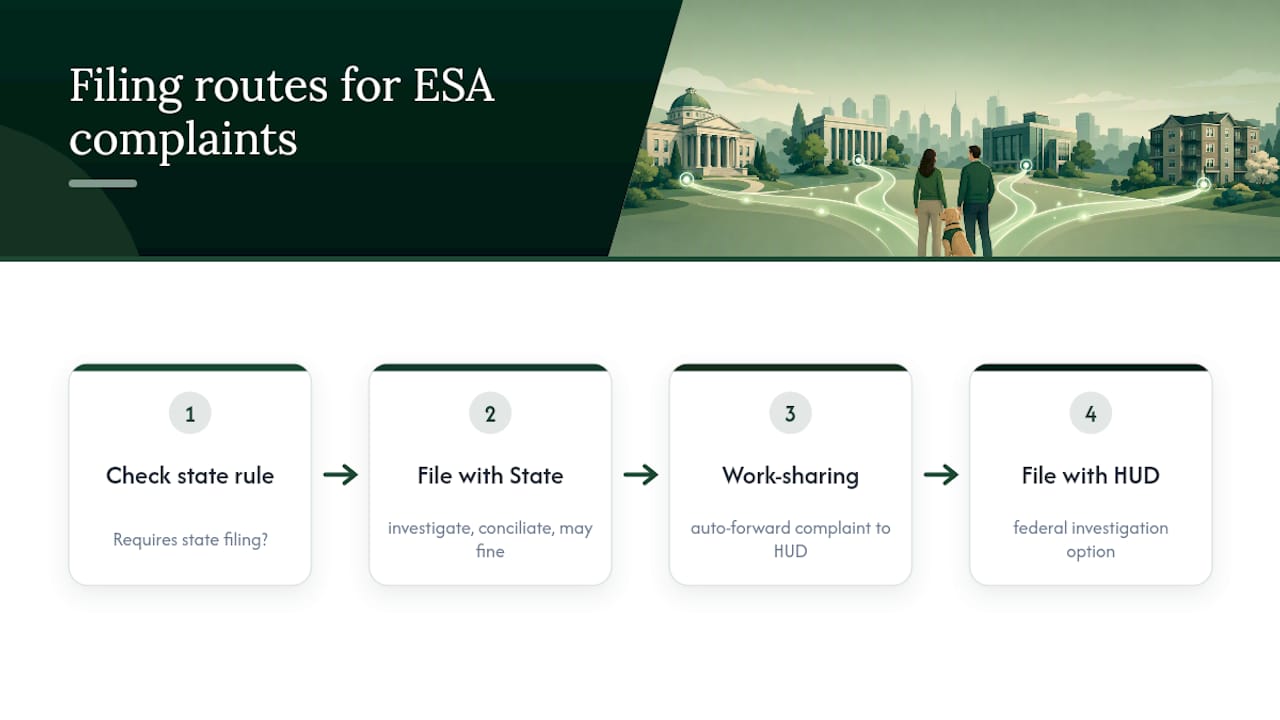
Most states designate a specific agency to handle housing discrimination complaints, often a civil rights commission or a department of fair employment and housing. These agencies typically operate in parallel with HUD rather than replacing it, meaning a tenant can sometimes choose between filing federally or through the state system, depending on which offers a faster timeline or a more favorable venue.
State agencies generally investigate the complaint, attempt conciliation between tenant and landlord, and can refer unresolved cases to formal hearings or litigation. Some states also empower their agencies to issue fines directly against noncompliant landlords, separate from any federal penalty.
The practical difference for a tenant is speed and familiarity. A state agency may already understand local housing stock, common landlord practices, and regional court tendencies in ways a federal investigator handling cases nationwide might not. That said, state agencies vary widely in staffing and backlog, so response times differ significantly from one state to another.
Before filing, check whether your state requires you to file with the state agency first, or whether you can go straight to HUD. Some states have a “work-sharing” agreement with HUD, meaning a complaint filed with either office gets forwarded to the other automatically, which can save you from filing duplicate paperwork.
Interaction between state ESA laws and local housing ordinances
Beyond state statutes, city and county ordinances can add another layer to the picture. Local rent boards, municipal housing codes, and city-level fair housing offices sometimes impose additional notice requirements or timelines that landlords must follow when responding to an accommodation request.
These local rules cannot lawfully reduce the protections guaranteed under the Fair Housing Act. They can, however, add procedural steps, such as requiring landlords to respond to a written accommodation request within a specific number of days, or mandating that certain buildings register their pet and assistance animal policies with a local housing authority.
The practical effect is that two tenants in the same state, one in a large city and one in a rural area, might experience slightly different processes even though the same state and federal laws technically apply to both. City ordinances tend to matter most in dense urban markets with active rent stabilization boards, where local housing offices already handle a high volume of tenant disputes.
If your city has its own housing or human rights department, check whether it accepts ESA-related complaints directly. In many cases, a local office can move faster than a state or federal agency simply because it handles a smaller caseload tied to a defined geographic area.
State-specific penalties or fines for non-compliance with ESA laws
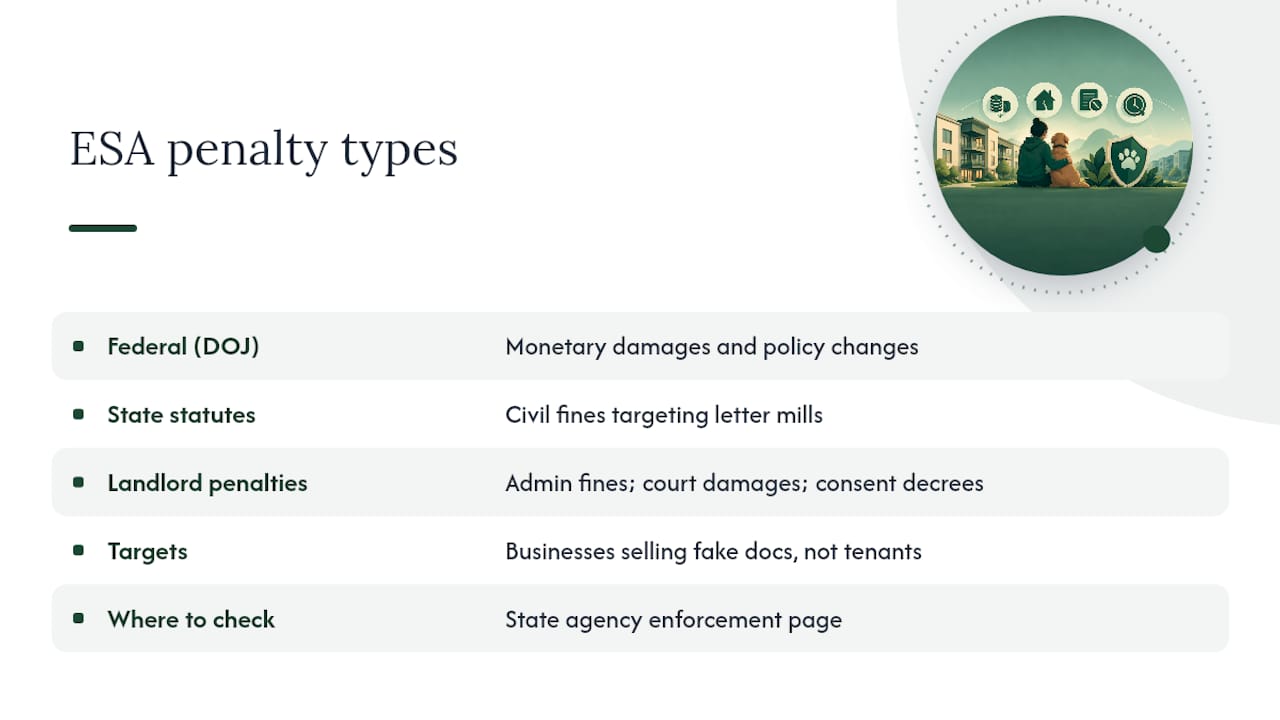
Penalties for landlords who violate ESA accommodation rules vary by jurisdiction and by whether the case is handled at the federal or state level. Under federal enforcement, the DOJ has pursued cases resulting in monetary damages paid to tenants along with required policy changes at the property or company level.
States that have passed their own ESA-related statutes, particularly anti-letter-mill laws targeting fraudulent documentation sellers, often build in separate civil penalties distinct from the housing discrimination remedies available under the FHA. Those penalties typically target the businesses selling fake certification, not the tenants who unknowingly purchased them.
For landlords, noncompliance can mean administrative fines from a state agency, court-ordered damages in a private lawsuit, or a consent decree requiring changes to leasing policies and staff training. The exact structure depends heavily on which state agency handles the complaint and whether the case escalates to litigation.
Because these penalty structures differ so much by state, a tenant dealing with a contested denial should check their specific state agency’s enforcement page rather than assuming a uniform national penalty applies. The federal floor guarantees a remedy path exists everywhere, but the size and shape of that remedy depends on where you live and which venue you use to file.
Updates and changes in state ESA laws
State ESA law has been in motion for several years, largely driven by two competing pressures: rising fraud from online letter mills, and rising demand from renters with legitimate mental health needs. The result has been a steady stream of state-level anti-fraud legislation aimed at the businesses selling instant certificates, not at genuine accommodation requests.
At the same time, some states have moved to clarify or expand tenant protections, adding specific timelines for landlord responses or barring certain fee practices more explicitly than the federal guidance does on its own. Other states have left their frameworks largely unchanged, continuing to rely on the federal Fair Housing Act as the sole governing law.
Enforcement emphasis has also shifted somewhat. Agencies increasingly focus on trained service animals in public access disputes, which makes clear, well-documented ESA housing requests more important than ever for tenants who want a smooth approval process. A letter that meets HUD’s documentation standard, from a licensed clinician, focused on function rather than diagnosis, remains the most reliable protection regardless of which state you live in.
Given how often these rules get revisited, checking the effective date on any state’s statute or agency guidance before relying on it is worth the extra few minutes.
When to get legal or clinical help
This guide explains the federal and state framework, but it is not legal advice, and it cannot resolve a contested denial for you. If a landlord refuses a legitimate accommodation request, or if you’re facing an eviction tied to your ESA, contact HUD, your state fair housing agency, or a housing attorney promptly. Keep every document. Time matters more than most tenants expect once an eviction notice is involved.
— Erik
Supportpet: where to find legitimate ESA guidance and tools
Sorting real ESA documentation from a scam certificate site takes more effort than it should, which is exactly the gap Supportpet fills. The site walks renters through what a legitimate letter looks like, what a licensed clinician needs to include, and how to avoid paying for a registry or ID card that carries no legal weight under the Fair Housing Act.
Its rights guide lays out federal protections alongside practical steps for requesting a housing accommodation, so you’re working from the same standard HUD guidance describes rather than guessing. If you’re starting the process, that guide is the place to begin before you contact a landlord or a clinician.
This article is general information, not a substitute for advice from a qualified lawyer. Consult a qualified legal professional about your own circumstances before acting on anything here.
Sources
- Assistance animals and fair housing: navigating reasonable accommodations (fact sheet)
- Assessing a person’s request to have an animal as a reasonable accommodation under the Fair Housing Act (HUD FHEO guidance)
- ADA service animal guidance
- Fair Housing Act (U.S. Department of Justice)
FAQ
What are the new rules for emotional support animals in 2026?
There is no single new federal rule currently pending. The Fair Housing Act and HUD’s documentation guidance remain the governing framework, while individual states continue to update anti-fraud statutes and tenant protections at different paces, so checking your specific state’s latest guidance is more useful than looking for one nationwide change.
Can someone legally deny an emotional support animal?
Yes, but only in narrow circumstances: undue burden, direct threat, fundamental alteration of the housing program, or no demonstrated disability-related need after a good-faith interactive process. A blanket “no pets” policy alone is not a lawful reason to deny a legitimate request.
Can a landlord deny an ESA in Texas?
A landlord in Texas is bound by the same federal Fair Housing Act standard as landlords everywhere else, so denial is only lawful under the same narrow grounds: undue burden, direct threat, or fundamental alteration. Texas-specific statutes and agency procedures may add detail, so checking the state’s own housing agency guidance is worthwhile for the exact complaint process.
How many ESA animals can you legally have?
The Fair Housing Act does not set a fixed national number, since accommodation requests are evaluated individually based on documented need. Some states or specific housing providers may apply their own reasonable limits, so the number allowed depends on your state’s rules and the housing provider’s documented policy.