
Send your landlord a written reasonable accommodation request, attach a current ESA letter from a licensed clinician, and ask for a written response. Do this before you move in an animal, not after. Keep a copy of everything you send. Under the Fair Housing Act, once you make that request, your landlord has to engage with you rather than issuing a flat no.
TL;DR:
- Landlords cannot demand full medical records or diagnosis details and must respond to ESA requests rather than simply denying them outright.
- A recent, signed, and detailed ESA letter from a licensed clinician is crucial, ideally dated within the last year, to ensure legal weight.
- Submitting requests via email or tenant portal creates a clear, timestamped record and typically results in quicker landlord responses.
- Blanket “no pet” policies or breed restrictions generally violate HUD guidance when applied to verified ESAs, especially after proper documentation.
- If denied without explanation, tenants should request a written reason, avoid answering unnecessary questions, and consider contacting fair housing authorities or HUD if the denial seems unlawful.
Table of Contents
- How to Talk to Your Landlord About an ESA: Checklist and Scripts
- What Landlords Can and Cannot Legally Ask For
- Gathering Your ESA Documentation the Right Way
- Step-by-Step: Submitting Your ESA Request and Following Up
- If Your Landlord Denies or Stalls on Your Request
- Some resources focus on one thing landlords and tenants both need: a documentation trail that actually holds up. That starts with sourcing your letter from a licensed clinician who conducts a real assessment, not a website that issues a certificate after a five-minute quiz.
- Why Communication Beats Confrontation Every Time
- Get a Ready-Made Request Template From a trusted ESA resource
- Sources
- FAQ
How to Talk to Your Landlord About an ESA: Checklist and Scripts
You don’t need a lawyer to write this request. You need a clear paper trail and a few sentences that say exactly what you’re asking for.
Run through this before you hit send:
- Review your lease for pet clauses, pet fees, and any accommodation request procedure already spelled out.
- Get your ESA letter from a licensed clinician, dated recently.
- Pick a written channel: email or your tenant portal, never a text or phone call alone.
- Send the request and attach your documentation.
- Save copies of everything, including delivery confirmations.
Three scripts cover most situations:
- Quick notification: “I’m writing to let you know I have an emotional support animal and will be submitting a formal accommodation request with documentation this week.”
- Full written request: “I’m requesting a reasonable accommodation under the Fair Housing Act to keep my emotional support animal in my unit. Attached is documentation from my licensed provider. Please confirm receipt in writing.”
- In-person follow-up: “I sent an accommodation request on [date] with my ESA letter attached. Can you confirm you received it, and let me know if you need anything else?”
Customize the full email template above with your name, unit number, and the date, then send it directly to your property manager or through your portal’s maintenance/request feature.
What Landlords Can and Cannot Legally Ask For
The Fair Housing Act requires landlords to make reasonable accommodations for tenants with disabilities, and an emotional support animal generally qualifies as one. The Department of Justice is clear that landlords must engage with the request, not just approve or reject it in silence.
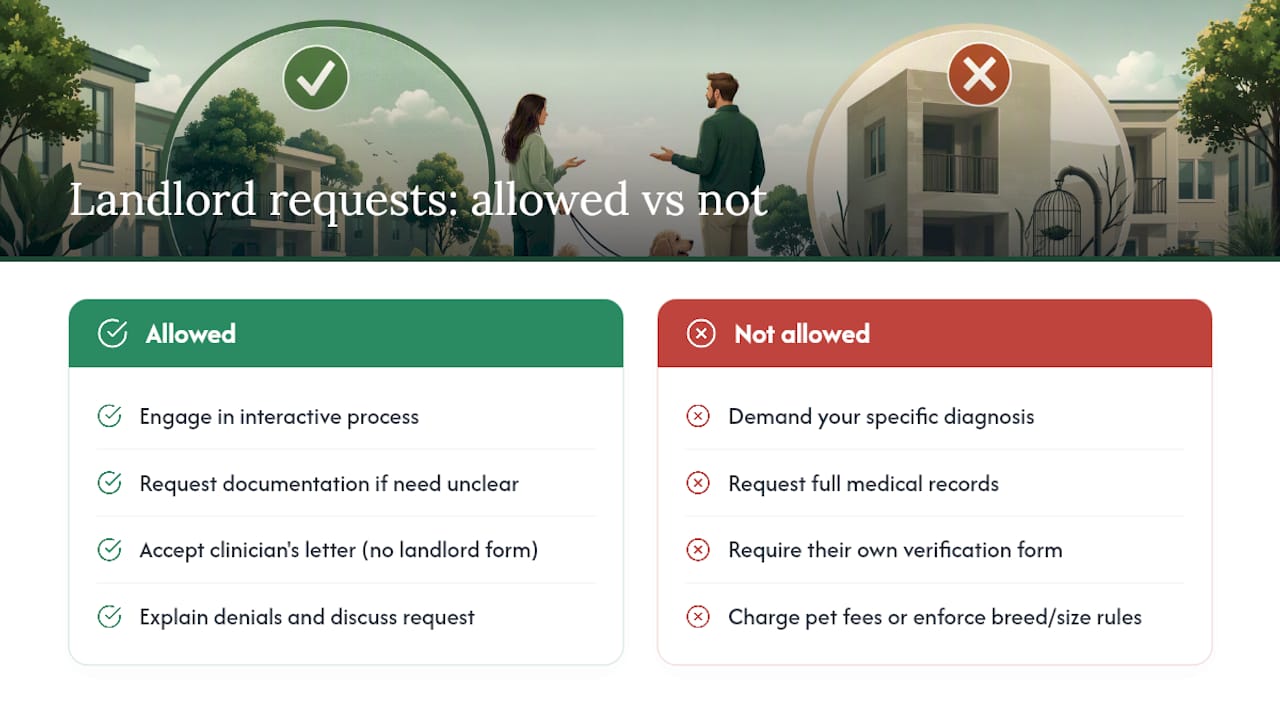
When your disability or need for the animal isn’t obvious, a landlord can ask for documentation. HUD’s assistance-animal guidance confirms this. What they cannot do is demand your specific diagnosis, request your full medical records, or insist you use their own provider verification form instead of your clinician’s letter.
HUD also states landlords cannot charge pet fees or deposits for an ESA, and breed or size restrictions that treat an ESA like an ordinary pet are generally improper under the HUD assistance animals notice.
A landlord who denies your request without explanation, or who refuses to discuss it at all, may be failing the “interactive process” the FHA requires. That silence itself can become evidence in a complaint.
Gathering Your ESA Documentation the Right Way
A solid ESA letter includes a few non-negotiable pieces: your provider’s name and license information, their contact details, a signature, a date, and a statement connecting your disability to your need for the animal. University housing offices, which process thousands of these requests, look for exactly this combination in their ESA accommodation guides.
Many landlords expect a letter dated within the past year. If yours is older, ask your clinician for an updated version rather than turning to a registration website, since those services don’t carry legal weight on their own.
You’re not required to disclose your specific diagnosis to get approval.
- Share only what the letter itself states.
- Decline to answer follow-up questions about symptoms or treatment history.
- Redirect medical questions to your clinician if a landlord pushes further.
Pro Tip: Ask your clinician for two copies of your letter, one for your landlord and one to keep in your own records, in case a copy gets lost in a portal upload.
Step-by-Step: Submitting Your ESA Request and Following Up
Email or a tenant portal beats a phone call every time, because it creates a timestamp and a written trail you can point to later.
- Use a clear subject line like “Reasonable Accommodation Request: Emotional Support Animal.”
- Attach your ESA letter as a PDF, along with any lease addendum your property provides.
- Ask directly for written confirmation of receipt.
- Wait about a week before following up. Many housing guides note landlords are expected to respond within roughly 10 days under HUD guidance.
- If they ask for clarification, answer only what’s necessary. You don’t owe them your diagnosis.
- Save every reply, timestamp, and attachment in a dedicated folder.
| Step | Action | Why it matters |
|---|---|---|
| Choose channel | Email or portal | Creates a timestamped record |
| Attach documents | ESA letter, lease addendum | Meets landlord’s documentation right |
| Set follow-up | 7 to 10 days | Matches typical HUD response expectations |
| Document responses | Save all replies | Builds your case if disputed later |
If your landlord goes quiet past that window, a polite but firm follow-up asking for a written response is fair and often necessary.
If Your Landlord Denies or Stalls on Your Request
Ask for the denial in writing, with the specific reason stated. A landlord who won’t put their reasoning on paper is often signaling they know the denial won’t hold up.
Some red flags suggest the denial may violate the FHA:
- A blanket “no pets” policy applied without considering your accommodation request.
- Refusal to respond or engage with your documentation at all.
- Demands for information beyond what HUD allows, like a full diagnosis.
- Threats of eviction issued before any real discussion took place.
If you see these signs, your first moves should be asking for reconsideration in writing, then contacting your state or local fair housing agency. You can also file a complaint directly with HUD, which offers a free process with a one-year window from the date of the discriminatory act. For complicated cases, a consultation with a tenant rights attorney or legal aid office is worth the hour.
Some resources focus on one thing landlords and tenants both need: a documentation trail that actually holds up. That starts with sourcing your letter from a licensed clinician who conducts a real assessment, not a website that issues a certificate after a five-minute quiz.
Watch for these red flags in any ESA service you consider:
- No individualized evaluation, just a form and a payment page.
- Guarantees of approval regardless of your situation.
- No licensed clinician’s name or contact information provided.
- Pressure to buy a “registration” or ID card as if it carries legal weight.
Checklists can map to what HUD and university housing offices actually request, so you’re not guessing what counts as sufficient documentation.
Why Communication Beats Confrontation Every Time
Most advice on this topic treats the ESA request like a legal battle waiting to happen. It isn’t, not usually. The renters who get approved fastest are the ones who treat the first message as a simple, professional request rather than an opening argument.
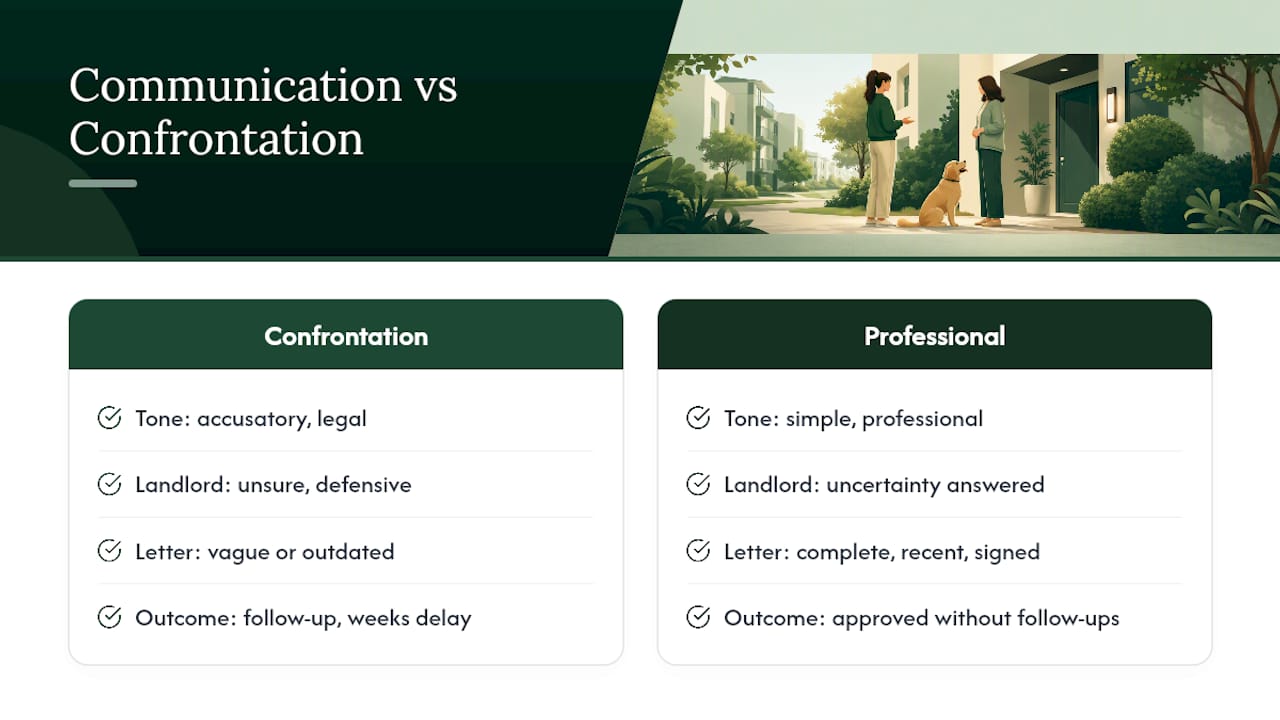
The conventional advice oversells confrontation and undersells paperwork. A landlord who denies a request often isn’t hostile. They’re unsure what they’re legally allowed to ask for, and a clear, complete submission answers that uncertainty before it turns into a dispute.
Prioritize the letter’s quality over the speed of sending it. A vague or outdated ESA letter invites follow-up questions that eat weeks. A complete one, dated recently and signed by a real clinician, often gets approved without a single back-and-forth. Skip the registration sites entirely. They add cost and zero legal protection, and a savvy property manager will recognize one on sight.
— Erik
Get a Ready-Made Request Template From a trusted ESA resource
Writing a strong accommodation request from scratch is doable, but it’s easier with a template built around what landlords and housing offices actually check. Supportpet’s guide walks through how to get a valid ESA letter, spot documentation scams before you pay for them, and put together a request packet that mirrors HUD’s own standards.
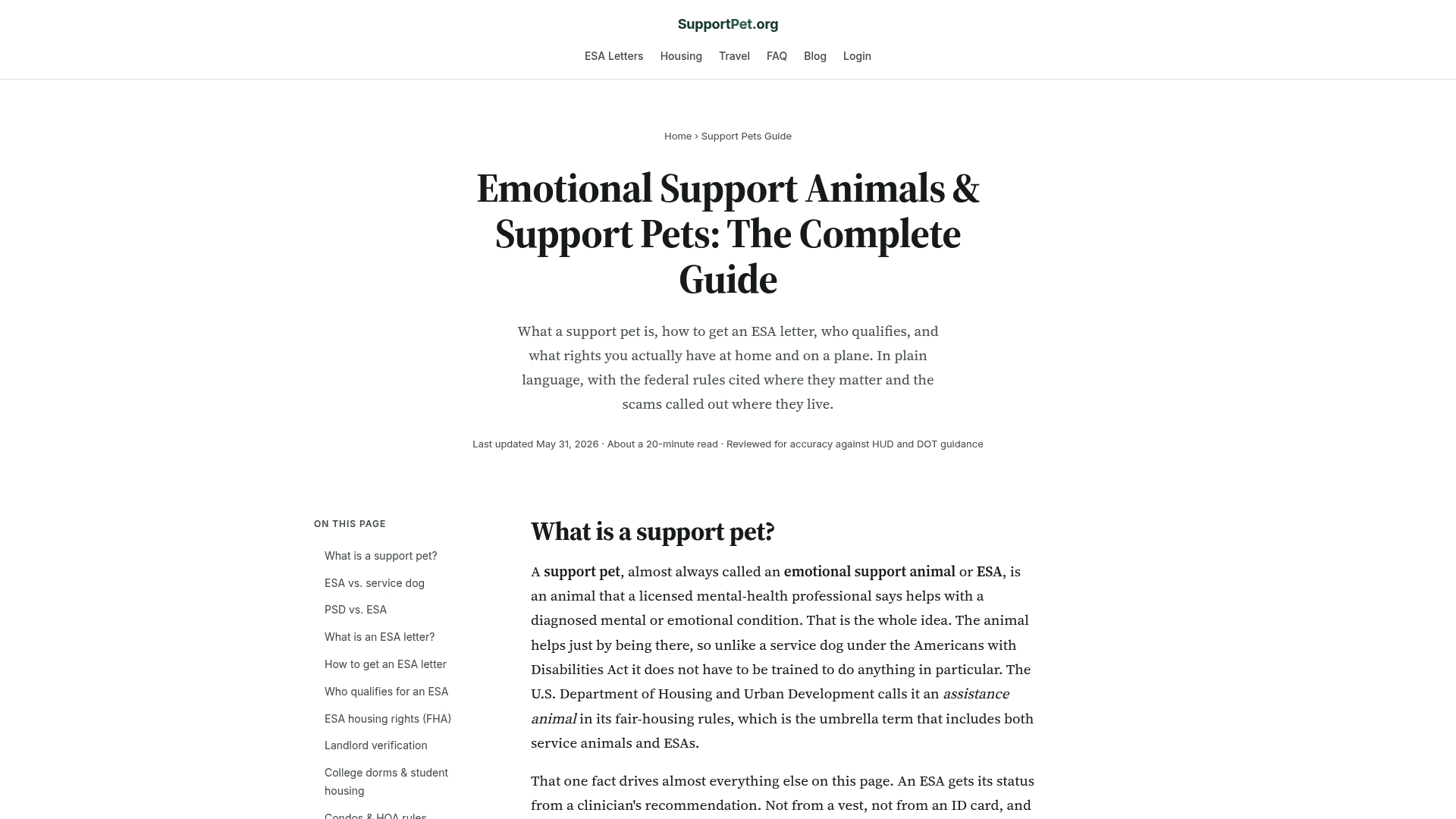
The guide includes sample letters, a request checklist, and notes on what to do if your landlord pushes back. It’s an optional resource, not a requirement. If you’d rather have a template ready before you approach your landlord instead of drafting one under pressure, start with Supportpet’s ESA guide and pull the pieces you need.
This article is general information, not a substitute for advice from a qualified lawyer. Consult a qualified legal professional about your own circumstances before acting on anything here.
Sources
- HUD — Assistance animals
- U.S. Department of Justice — Fair Housing Act
- UCF — Housing accommodation guide (ESA)
FAQ
What Should I Do if My Landlord Denies My ESA Request?
Ask for the denial in writing with a specific reason, then contact your state or local fair housing agency if the reasoning seems to violate the FHA. You can also file a free complaint with HUD within one year of the denial.
Can a Landlord Get Around ESA Housing Rights?
Landlords sometimes try blanket “no pets” policies, breed restrictions, or pet fees to sidestep ESA requests, but HUD guidance treats these as generally improper when applied to a documented ESA.
Can My Landlord Simply Refuse to Allow My ESA?
Not without engaging in the interactive process first. A landlord can request documentation when your need isn’t obvious, but an outright refusal without discussion can violate the Fair Housing Act.
Does Texas Allow Landlords to Deny an ESA?
Federal fair housing law applies in Texas the same as anywhere else, so a Texas landlord must follow the same reasonable accommodation process and can’t deny a properly documented ESA request without a legitimate reason.
How Recent Does My ESA Letter Need to Be?
Many landlords prefer a letter dated within the past 12 months. If yours is older, ask your clinician for an updated version rather than relying on a registration site.