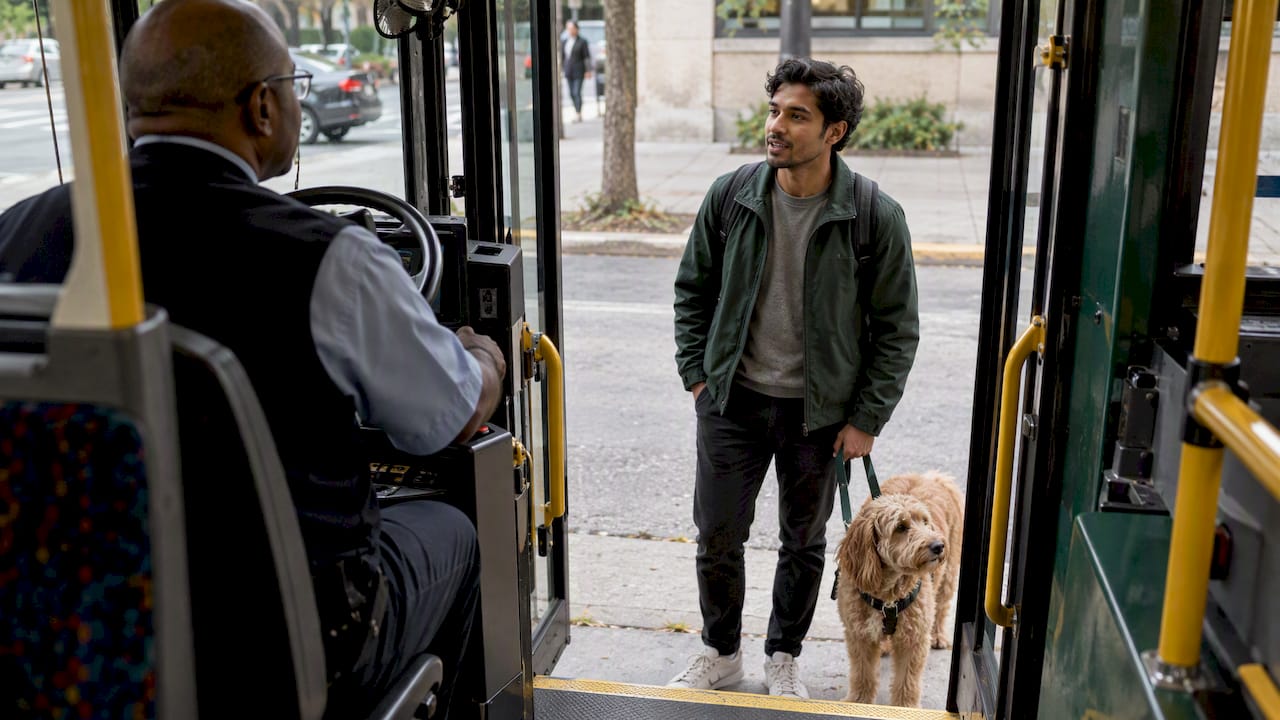
An emotional support animal has no legal right to ride a bus. Federal disability rules for transit cover trained service animals, not ESAs, so whether your animal can board depends on the bus operator’s own pet policy. Some city systems let you bring a pet in a closed carrier. Greyhound and many university shuttles do not. This guide explains the rules, shows how real operators handle ESAs, and gives you a plan so you are never stuck at the curb.
TL;DR
- No federal rule requires a bus or transit agency to admit an ESA. The Federal Transit Administration says only trained service animals must be allowed.
- Greyhound accepts service animals only, so an ESA letter will not get your animal on board.
- Many city systems admit ESAs as ordinary pets, usually in a closed carrier that stays on your lap or at your feet.
- Your ESA letter protects you in housing. It does not work as a bus pass for your animal, and neither does a registration or an ID card.
Table of Contents
- What federal law says about ESAs on buses
- Why housing rights do not follow you onto the bus
- What an ESA letter and registration can and cannot do on a bus
- Greyhound and intercity buses
- How city and regional buses treat ESAs
- School buses and campus transit
- Our perspective
- Plan a bus trip with your ESA
- Get the paperwork that does work
- Other ways to travel with an ESA
- FAQ
- Sources
What federal law says about ESAs on buses
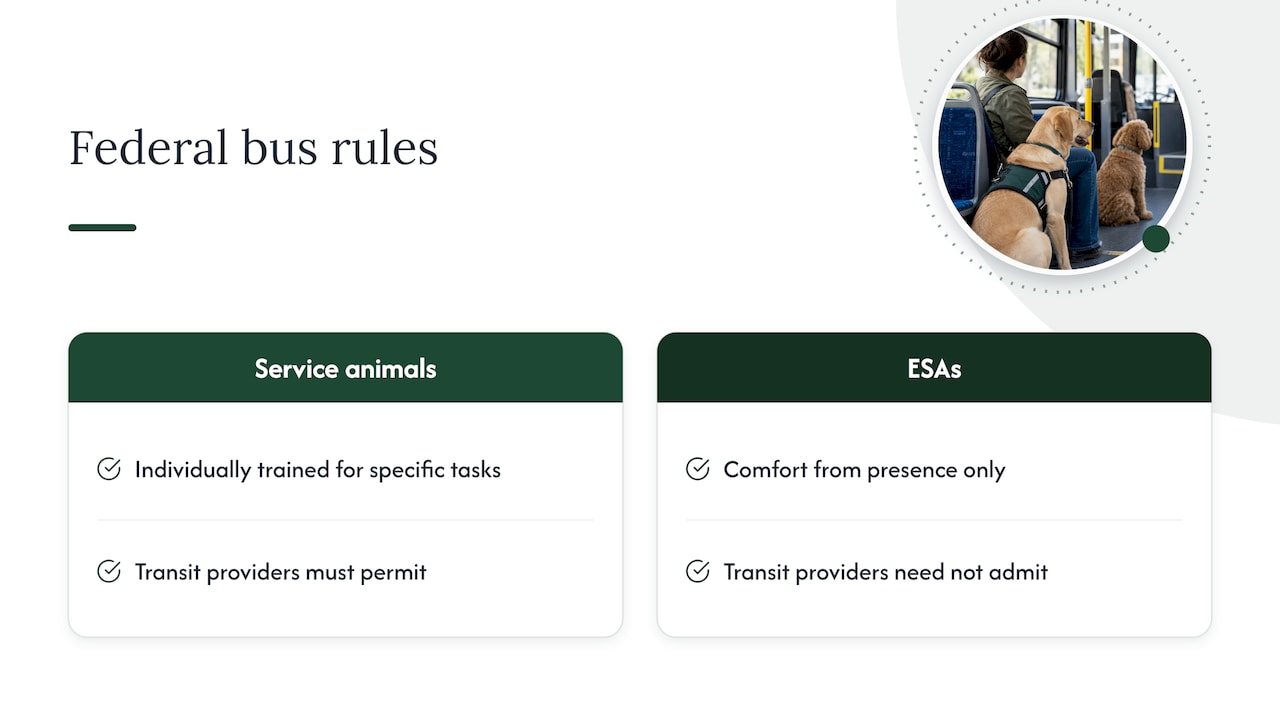
The Americans with Disabilities Act (ADA) is the law that opens buses to animals, and it uses a narrow definition. A service animal is individually trained to do specific work or tasks for a person with a disability. An animal that helps just by being there, which is what an ESA does, falls outside that definition.
The Federal Transit Administration applies this directly to buses. Under the Department of Transportation’s ADA rule, 49 C.F.R. Section 37.167(d), transit providers must permit trained service animals and are not required to allow emotional support animals, according to the FTA. The agency’s frequently asked questions repeat the point: an animal that provides comfort only through its presence does not qualify as a service animal.
That does not mean an ESA is banned. It means the transit agency decides. It may admit your animal as a pet, restrict it, or refuse it, and each choice is lawful.
If you want the full legal picture of where the two categories split, we cover it in our guide to ESAs versus service dogs.
Why housing rights do not follow you onto the bus
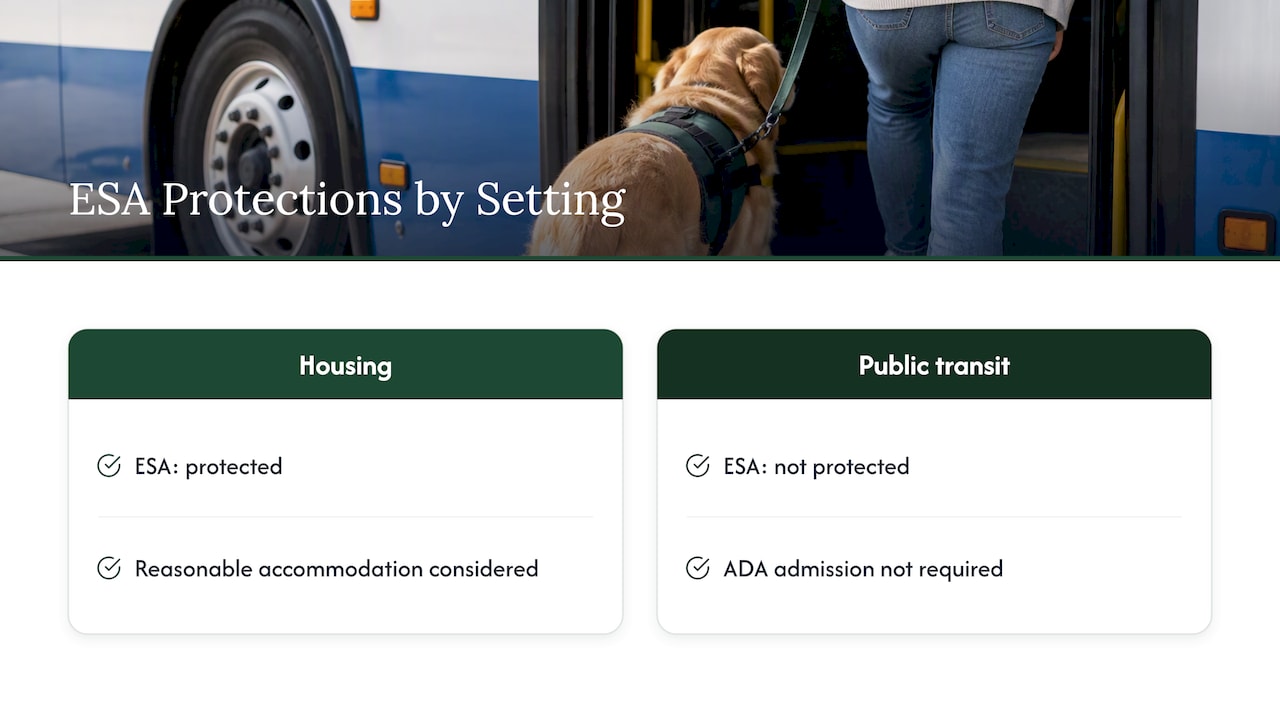
Most people first learn about ESAs through housing. The Fair Housing Act treats an ESA as an assistance animal, and a landlord generally has to consider it as a reasonable accommodation. That protection is specific to your home.
The Department of Justice lays this out in a comparison of protections by setting. Its service animal and assistance animal table lists assistance animals as protected in housing but not on public transportation. California’s Civil Rights Department describes the same split when it explains that housing providers must allow an ESA as a reasonable accommodation, while an ESA is not a service animal because it is not specifically trained to assist.
The American Veterinary Medical Association makes a similar point: documentation may support a housing accommodation, but registration has no legal effect. Our housing rights breakdown explains what your letter does cover at home.
What an ESA letter and registration can and cannot do on a bus
A letter from a licensed clinician documents a disability-related need for the animal. That is useful for a landlord. A bus driver has no duty to honor it for your animal.
Registrations, certificates, vests and ID cards are weaker still. The Department of Justice states that online certification or registration documents do not convey ADA rights and are not recognized as proof that a dog is a service animal. Paying a website for a badge will not change how a driver or agency treats your ESA.
There is a second reason to skip fake paperwork. Presenting an ESA as a service animal can create a confrontation, and it makes life harder for people who rely on trained service animals. If you want to know what a legitimate letter looks like and what it is for, see our ESA letter sample.
Greyhound and intercity buses
For long trips, Greyhound is the name most readers search. Its policy is simple: it admits service animals and not pets or ESAs. A 2026 review of the policy puts it plainly: dogs other than service dogs are not allowed, and animals cannot ride in the cabin or in the luggage bays below.
Two practical consequences follow:
- Telling a driver that your cat or dog is an emotional support animal will not change the outcome. Showing a letter will not either.
- The Department of Justice has looked at how intercity carriers treat the people the rules do protect. It investigated FlixBus and Greyhound over alleged ADA Title III violations, including complaints that they improperly denied service animals. If you do have a trained service animal, those rights are real and enforceable.
Because policies change, check the carrier’s current animal page before you buy a ticket, and contact customer service if your situation is unusual.
How city and regional buses treat ESAs
Local transit is where you will find the most variety. Because the ADA does not decide the question for ESAs, each agency writes its own rule. The American Kennel Club notes that ESAs are generally handled under a system’s ordinary pet rules, which vary by location.
Here is how several operators handle it.
| Type of operator | How it treats an ESA | What to do |
|---|---|---|
| Suburban county bus (WestCAT, California) | Allows ESAs as pets only when secured in a proper pet carrier | Bring a carrier that closes fully |
| Regional bus system (RTS, Monroe County) | Pets and ESAs must be in a closed container, held on your lap or near your feet, without taking a seat or blocking the aisle | Choose a carrier small enough to hold |
| Territorial public works system (Virgin Islands) | Says comfort and emotional support animals are not service animals and may board in six-sided kennels or carriers | Use a kennel that is enclosed on every side |
| University campus shuttle (Texas A&M) | Prohibits animals, including ESAs, with limited exceptions for trained service animals and official mascots | Plan another route, or ask your disability office |
The pattern is clear. Where an agency allows an ESA, it is treated as a pet. That means a carrier, no seat for the animal, and no blocking the aisle. Where it does not, the answer is no, whatever your letter says.
Check these points before you ride
- Carrier rules. Does the agency require a closed or six-sided carrier, and is there a size limit?
- Fares. Some agencies treat a carried pet as luggage with no charge. Others have their own rules, so read the page.
- Species. Many pet policies cover only small dogs and cats. A larger dog may not qualify however calm it is.
- Behavior. Agencies can remove an animal that is disruptive, whatever its category.
School buses and campus transit
School and campus buses add another layer. Public school transportation is governed by a mix of disability education law and district policy, so ask the district’s transportation department and the student’s school team about any animal before the first day. Do not assume that a family’s ESA letter carries over from the home lease.
University shuttles are a common trap for students who have an ESA in their dorm. Housing rules may allow the animal in a residence hall, while the campus shuttle can bar it entirely, as the Texas A&M example above shows. If you live on campus and depend on shuttles, ask the disability services office early. They may know what the transit department allows and can suggest alternatives.
Our perspective
We get this question from people who feel caught out. They did the right thing: they saw a licensed clinician, got a legitimate letter, and have an animal that helps them cope. Then a driver says no, and they feel the system has failed them.
The system did not break. It was never built to cover this. Housing law protects your ability to live with your animal. Transit law protects people with trained service animals. The two do not overlap for ESAs, and no document you can buy changes that.
Our advice is to plan around it. Treat a bus trip with your ESA as a pet trip. Find the operator’s pet rules, get a carrier that meets them, and have a backup if the answer is no. If you are anxious about the journey itself, talk to your clinician about coping steps that do not depend on the animal being beside you for that leg.
We also do not sell certificates, registrations or ID cards, and we will tell you not to buy them. Free, accurate information is the point of this site.
— Erik
Plan a bus trip with your ESA
A few steps take the stress out of it.
- Read the agency’s animal policy. Look for a page titled service animals, pets or rider rules on the operator’s website. Search for “animals” or “pets” if it is not in the menu.
- Confirm in writing if you can. A short email to customer service gives you something to point to if a driver is unsure.
- Buy the right carrier. Where carriers are required, choose one that closes fully, fits on your lap or at your feet, and lets your animal stand and turn around. Practice at home so the animal is calm inside it.
- Choose quiet times. Off-peak buses are easier on you and your animal, and they leave room if you need to move.
- Carry the paperwork that matters. Keep your ESA letter for housing and any vet records the operator asks for. Do not present either as a service animal credential.
- Have a backup. Know a rideshare option, a friend, or an alternative route in case a driver refuses.
If you do use a trained service animal, remember what transit staff may ask. The FTA says a provider may ask whether the animal is a service animal and what tasks it is trained to perform, but may not require special identification or documentation. Caregivers who help a family member with disabilities get around can also read about autism transportation assistance, which covers where support exists beyond the vehicle itself.
Get the paperwork that does work
A bus is one setting where an ESA has no protection, but your home is another. If you rent and need a legitimate letter from a licensed clinician, our step-by-step guide to getting an ESA letter shows how the process works and what to avoid. For rules that differ by state, see ESA letter laws by state.
We do not sell letters or certificates. We explain how a valid one works, so you can spot a scam before you pay for it.
Other ways to travel with an ESA
Buses are one of several modes, and they are not equally strict. If you are planning a longer trip, our guide to flying with an emotional support animal covers what airlines allow today. For an overview of travel in general, see the travel section of our rights guide.
Species matters too. Small cats and small dogs fit carrier rules most easily, which is why our pages on emotional support cats and emotional support dogs are useful when you are picking transport.
A car is the most predictable option, because no operator rules apply. If you do not drive, a friend, family member, or rideshare that accepts pets will often be easier than a bus that may turn you away at the door.
FAQ
Can I take my emotional support animal on a city bus?
It depends on the agency. Federal rules do not require transit systems to admit ESAs, so each one sets its own pet policy. Many allow a pet in a closed carrier, while some, such as certain university shuttles, bar animals altogether. Check the agency’s website before you ride.
Does Greyhound allow emotional support animals?
No. Greyhound admits service animals only, and a letter or registration does not change that. Pets and ESAs are not allowed in the cabin or the luggage compartment. Check the carrier’s animal policy page before booking, since policies can change.
Can an ESA letter get my animal on a bus?
No. An ESA letter documents a need for the animal in housing. Transit agencies have no obligation to honor it, and online registrations or ID cards carry no ADA rights either.
Can I say my ESA is a service animal to ride the bus?
You should not. A service animal is individually trained to perform tasks for a person with a disability, and staff may ask what tasks the animal performs. An animal that provides only comfort does not meet that definition, and misrepresenting it can lead to removal and make access harder for real service teams.
What carrier do I need to bring an ESA on a bus that allows pets?
Most agencies that allow pets want a fully closed carrier that stays on your lap or at your feet. Some specify a six-sided kennel. The animal cannot take a seat or block the aisle, so choose a size you can comfortably hold.
Sources
- FTA: Are transit providers required to allow a passenger to travel with a comfort animal
- FTA: Frequently asked questions on civil rights and the ADA
- FTA: Proof of service animal status
- DOJ: Service animals and assistance animals
- DOJ: Frequently asked questions about service animals and the ADA
- DOJ Civil Rights Division: Flix North America, FlixBus, and Greyhound
- California Civil Rights Department: Emotional support animals and fair housing law FAQ
- AVMA: Assistance animals, rights of access and the problem of fraud
- Dogster: Are dogs allowed on Greyhound buses
- American Kennel Club: Can you take your dog on the subway
- WestCAT: Rider service animals
- RTS Monroe: Riding with an animal
- Virgin Islands Department of Public Works: Service animal policy
- Texas A&M Transportation Services: Transit FAQ
- Autism transportation assistance for caregivers
Recommended
- Flying With an Emotional Support Animal in 2026: What Airlines Allow
- ESA vs. Service Dog: Key Differences in 2026