
Yes, you can sometimes live with an emotional support animal in a college dorm, but only after the school approves it as a housing accommodation. You do not just move in with the animal. You apply through the disability or accommodations office, submit documentation from a licensed provider, and agree to the school’s care and behavior rules. Federal guidance changed in May 2026, so the details below matter more than they used to.
TL;DR
- Colleges approve ESAs case by case, through a disability or housing accommodations office. Bringing an animal in first can get you in trouble.
- Expect to provide a letter or prescription from a licensed provider who treats you, plus vaccination and licensing records for the animal.
- Approved ESAs usually stay in your assigned room, must be house-trained and controlled, and are often barred from dining halls and classrooms.
- A roommate’s allergy can change the outcome, and the student adding the animal may be the one asked to move.
- HUD changed its enforcement stance in May 2026, but disability rights laws still apply. Denials can be appealed, so keep every document.
Table of Contents
- How ESAs fit into campus housing
- Pets, ESAs and service animals: three different things in a dorm
- How to request approval, step by step
- What documentation schools ask for
- Rules your school can set once the ESA is approved
- Vaccines, vet records and cleanliness
- Roommates, allergies and competing needs
- What the 2026 HUD change means for students
- If your request is denied or the school wants more
- Our perspective
- Where to go next
- FAQ
- Sources
How ESAs fit into campus housing
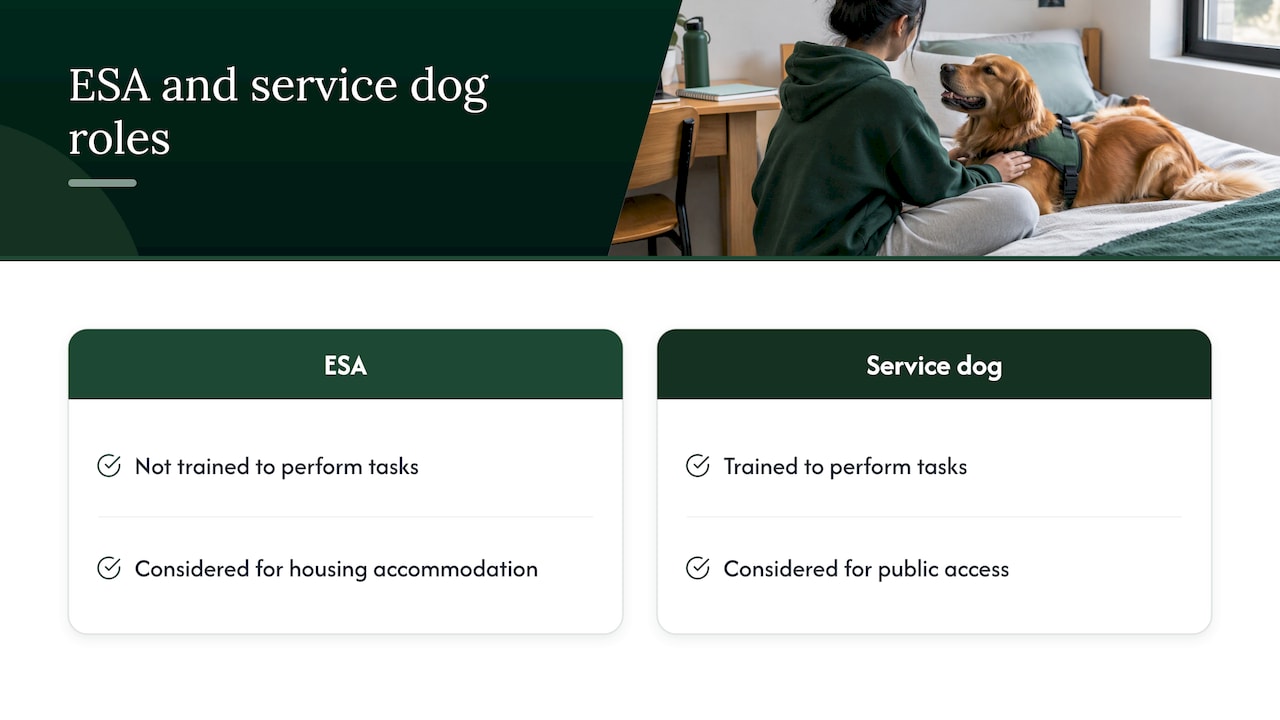
An emotional support animal is a companion animal that eases symptoms of a disability, such as anxiety, depression or PTSD. It is not trained to perform tasks, which is the main difference from a service dog. That difference is why schools treat ESAs as a housing matter and not as a public-access matter: an ESA is considered for where you live, not for where you go on campus.
University-owned housing has generally been treated as covered by the Fair Housing Act, which lets students with disabilities request an ESA in the dorm as a reasonable accommodation. In practice, each school writes its own policy on top of that, so the process at one campus can look quite different from another. The examples below come from real published policies at public universities and colleges. Your own school’s policy is the document that controls your situation.
If you want the legal background first, our guide to ESA housing rights in 2026 explains how housing law treats these animals.
Pets, ESAs and service animals: three different things in a dorm
Most schools sort animals into three groups, and mixing them up is the most common reason requests stall.
| Type | Trained for tasks? | Usual dorm treatment |
|---|---|---|
| Service animal | Yes, individually trained to do work for a person with a disability | Handled under disability law, allowed more broadly on campus |
| Emotional support animal | No, provides comfort through its presence | Allowed in your assigned housing only after approval |
| Ordinary pet | No | Usually not allowed, apart from small fish tanks or similar, depending on the school |
An ESA does not need a vest, an ID card or an online registry listing. Those products carry no legal weight, and no college is required to accept them. What a school wants to see is a legitimate need and a provider relationship, which is covered next.
How to request approval, step by step
The sequence is similar nearly everywhere, even if the forms differ.
- Find the policy. Search your school’s name plus “emotional support animals” or “housing accommodations.” The policy usually sits with the disability services office or residence life.
- Contact the right office before move-in. At Lorain-style community colleges and large universities alike, requests go through a central office. For example, LCCC students request an ESA through the Office of Student Accommodations, and CSUF residents follow Disability Support Services’ accommodation request process.
- Submit provider documentation. This is the heart of the request. See the next section.
- Submit animal records. Expect vaccination and licensing records, and sometimes a photo or description of the animal.
- Wait for written approval. Do not bring the animal until you have it. At Clarkson College, for instance, no ESA may be kept in housing before the student receives approval, and an animal found in a residence hall without approval can lead to conduct action.
- Sign the agreement. Most schools have you acknowledge care, cleanliness and liability rules in writing.
- Tell your roommate or suitemates as the school directs. Many offices notify them for you.
Start early. Some schools set lead times of weeks, and housing assignments can limit your options if you apply late. Check the accommodations office’s page for the current deadlines, because they change each year.
What documentation schools ask for
The documentation rule that trips students up is the quality of the provider relationship. LCCC asks for a current prescription from a licensed provider that verifies a treatment relationship over time, and it does not accept a one-time-session or purchased prescription or verification. Plenty of schools take a similar line.
What that means in practice:
- The provider should be a licensed professional who actually knows you: a therapist, psychologist, psychiatrist, physician or similar.
- The letter should describe how the animal helps with your disability-related symptoms, on the provider’s letterhead with license details.
- It should be current. Many schools want it dated within the past year, so check the policy.
- Instant-letter websites and registry certificates tend to be the documents schools reject.
Providers vary in what they are allowed to write by state. Our overview of ESA letter laws by state shows who can write one where. Note that some states add their own requirements, such as a minimum period of treatment before a letter is issued.
A letter also reads best when it explains the therapeutic role of the animal, which is easier to do if you understand the research on how pets support mental health. Your provider decides what to include. You do not have to disclose your diagnosis in most cases, though a school may ask for enough information to understand the disability-related need.
Rules your school can set once the ESA is approved
Approval is not a blank check. Schools attach conditions, and breaking them can lead to the animal’s removal. These are published examples.
Where the animal may go.
- UW–Madison allows an ESA in common areas of assigned residence buildings, but not in dining halls, classrooms or other university spaces. It must be leashed, crated or caged in those common areas.
- UMass Amherst is stricter: an ESA is allowed only in the student’s assigned residence hall room, not in common spaces or other campus facilities.
How the animal must behave and be kept.
- At UW–Madison, ESAs must be housebroken, controlled outside the assigned room, kept current on vaccinations, and not left unattended for extended periods. Waste goes in outdoor bins.
- UMass Amherst requires house-training, leashes or carriers during transport, crating when the student is away, and current vaccinations. It may remove an animal that poses a safety threat or causes an unmanageable disturbance.
- Western Washington University prohibits leaving an animal unattended in the assigned room overnight. Violations of its community standards may bring conduct action or removal of the animal.
- CSUF holds owners responsible for cleanliness and damages and requires prompt disposal of animal waste.
The common thread: you are fully responsible for the animal, and the school’s tolerance for disruption is low. Plan for the daily routine before you apply. Who walks the dog at 6 a.m. before an 8 a.m. class? Where does the cat go during a long lab day? A crate-trained animal is much easier to place.
Vaccines, vet records and cleanliness
Vaccination proof is among the first things requested, and a missing record is a common cause of delays. Book a vet visit well before the housing deadline and ask for a printed record of rabies and other required shots, and for local licensing where the town requires it. Students heading to campus often also handle their own health paperwork at the same time, so it helps to look at vaccines before college for your own checklist while you gather the animal’s.
For cleanliness in a small shared building, a few habits prevent most complaints:
- Bag and dispose of waste outdoors every time, in the bins the school names.
- Keep litter boxes or cages cleaned on a schedule, and ask your roommate if the smell bothers them.
- Groom the animal regularly to limit shedding and dander in shared bathrooms and hallways.
- Keep food sealed so the room does not attract pests that could trigger a housing inspection.
Roommates, allergies and competing needs
A roommate with a documented allergy or asthma has a disability-related need too, and housing offices have to weigh both. Brevard College’s guidelines show how this plays out: housing staff may contact roommates, consult accessibility staff about conflicting issues such as allergies, and look for an alternative arrangement. Generally, the student who is bringing in the animal may be the one asked to move.
If you share a room, you can reduce the risk:
- Apply early so the office can match you with a compatible roommate or place you in a single or private-bath unit.
- Ask whether the school can make a housing assignment around your needs before you are matched.
- Tell the office about any roommate conflict in writing, not just verbally.
- Be realistic about species. A hairless or low-dander animal, a caged small animal or a fish may fit a shared room more easily than a large dog.
The same office can also help you if you are the roommate with allergies. You can file your own accommodation request.
What the 2026 HUD change means for students
This is the part most students are asking about. On May 22, 2026, HUD issued an enforcement memo. According to a Fisher Phillips analysis, it rescinded earlier guidance on emotional support animals in housing and shifted toward the stricter standard used for trained service animals. A summary of the memo says HUD will find reasonable cause and recommend charges only in animal-related cases involving animals trained to provide disability-related assistance.
That is a major change in how HUD enforces the Fair Housing Act. It is not the end of your rights, though.
- The same analysis notes students still have rights under Section 504 of the Rehabilitation Act, the Americans with Disabilities Act and various state fair housing laws, which remain unchanged.
- Fisher Phillips also says the memo does not permit blanket ESA denials, and disability discrimination stays illegal under federal and state law.
- A Saul Ewing alert advises that universities may feel empowered to reject loosely supported ESA requests, as long as they keep running the interactive process and do not fall back on categorical denials.
In plain terms: expect schools to look harder at documentation, and expect fewer easy approvals when the paperwork is thin. A strong request has a real provider, a clear link between the animal and your symptoms, and complete animal records. Your school may also update its policy, so read the current version each term. Our page on what HUD’s change means for ESA housing rights tracks the details as they develop.
To tell enacted rules from proposals, look for the source. A final policy appears on your school’s official page or in a government memo or statute. A bill that has only been introduced, or an opinion post about what “will” happen, does not change what your housing office can require today.
If your request is denied or the school wants more
A denial is not always final. Start by asking for the reason in writing. The most common reasons are incomplete paperwork, a provider the school does not accept, a late application, or a conflict with another student’s accommodation.
Then:
- Fix what can be fixed. Ask what additional documentation would satisfy the office, and send it with a dated cover note.
- Use the internal appeal. At UC Berkeley, students may appeal in writing to Housing Accommodations within five business days, based on new information or a procedural error. Your school’s window may be shorter or longer, so find it on day one.
- Keep a paper trail. Save emails, forms and the names of staff you spoke with.
- Escalate if needed. Your school’s Title IX/504 or ADA coordinator, your state’s fair housing agency or a disability rights legal aid group can advise you. A lawyer or advocate familiar with your state can tell you which remedies are available now that federal enforcement has shifted.
Stay calm and professional throughout. Housing offices respond better to a clear, documented request than to an angry one.
Our perspective
We built Supportpet because students keep running into the same two problems: sites selling certificates that no school accepts, and confusing campus policies nobody explains.
Our view is simple. A dorm ESA request succeeds on substance: a licensed clinician who knows you, a clear description of how the animal helps, and an animal that is vaccinated, house-trained and ready to live under the school’s rules. A registry card or vest adds nothing.
We also think the 2026 HUD change makes good preparation more important, not less. Read your school’s policy, keep your paperwork honest and complete, and know the other laws that still protect you. Our guides are free and written to help you do exactly that.
Erik
Where to go next
If you are still working out whether an ESA fits your situation, our Rights Guide walks through qualifying, getting a legitimate ESA letter, and the housing protections behind it, without selling certificates or registrations. For the legal side, start with ESA housing rights in 2026, and check ESA letter laws by state before you contact a provider.
Use our free guides to check what your state requires of the clinician and what a school is likely to ask for, so your request is complete the first time.
FAQ
Can I have a dog in a college dorm room?
Sometimes. A dog can live in a dorm if the school approves it as an ESA accommodation or if it is a trained service dog. Size, breed and your roommate situation can affect placement. Approval has to come before the dog arrives on campus.
Does having an ESA go on my record?
Accommodation requests are generally handled by the disability or accommodations office, and schools typically treat that information as confidential and limit who sees it. Housing staff may learn only what they need to place you and the animal. Ask your school’s office how it stores and shares records.
How do I get an ESA for free?
The animal itself is yours to choose: many students use a pet they already own, or adopt through a shelter. The letter must come from a licensed provider who treats you, which you may be able to get through campus counseling, a clinic that bills insurance or a sliding-scale provider. Be wary of anything marketed as an instant registration.
Will ESA laws change in 2026?
They already have shifted in one important way: HUD’s May 2026 enforcement memo narrowed which animal cases it will pursue. Disability rights under Section 504, the ADA and state laws still apply. Check your school’s current policy and your state’s fair housing agency for anything newer.
Sources
- UW–Madison: Emotional Support Animals in University Housing
- LCCC Student Accommodation Handbook
- CSUF Emotional Support Animals in Student Housing Policy
- WWU: Animals in Residence
- UMass Amherst: Emotional Support Animals
- Brevard College: Guidelines for Emotional Support Animals in College Housing
- UC Berkeley: ESAs and Service Animals in Housing
- Clarkson College: Emotional Support Animal Policy
- LegalClarity: Can You Register an Emotional Support Animal?
- Fisher Phillips: HUD Pulls the Plug on Emotional Support Animal Guidance
- Grand River Solutions: HUD Enforcement Memorandum About Emotional Support Animals
- Saul Ewing: HUD Reverses Policy on Emotional Support Animals
Recommended
- ESA Housing Rights in 2026: What HUD’s Change Means
- ESA Letter Laws by State (2026): Who Can Write One, Where
- Does an ESA Letter Expire? What U.S. Renters Need to Know