
To live with an emotional support animal in a no-pet rental, you need two things: a reasonable-accommodation request and reliable documentation from a healthcare professional who knows you. Students in dorms usually need a third piece, the school’s own application. A paid certificate, registry entry, ID card or vest is not part of that packet. This guide covers what to gather, what to leave out, and what happens after you send it.
TL;DR
- The core packet is a short written request plus a letter from a licensed clinician who has personal knowledge of your need. HUD’s assistance animal page treats an assistance animal as something other than a pet.
- You generally don’t have to tell your landlord your diagnosis, and you should not hand over therapy notes or a full medical file.
- Online certificates and registrations don’t establish a disability-related need on their own.
- Colleges run their own process. Start with the disability or accessibility office and get written approval before the animal moves in.
- Federal guidance has shifted recently, and state law varies, so check your state’s rules before you send anything.
Table of Contents
- What ESA housing paperwork actually is
- Step 1: Write the accommodation request
- Step 2: Get documentation that holds up
- Step 3: Add animal records when they are requested
- Paperwork for a private rental vs. student housing
- What happens after you send it
- Paperwork you can skip
- Our perspective
- Where to go next
- FAQ
- Sources
What ESA housing paperwork actually is
There is no single federal ESA form. The paperwork is the evidence for a request under the Fair Housing Act. The law can require a housing provider to waive a no-pet rule, and pet deposits or fees, when the animal is necessary for you to use and enjoy your home equally, according to HUD.
In practice that breaks into three parts:
- The request. You tell the housing provider you have a disability and need an assistance animal.
- The clinician documentation. A licensed professional explains, in functional terms, why the animal helps with your disability.
- The animal’s records. Vaccination, licensing and similar paperwork, only where a provider lawfully asks for it.
The first two establish your right to the accommodation. The third addresses whether this particular animal is suitable for the home. Keeping them separate makes the packet easier to read and harder to dispute.
A note on changing federal guidance
Much of what you’ll read online relies on HUD’s 2020 notice on assistance animals. According to an animal-law summary, HUD formally withdrew that notice and its 2013 predecessor on September 17, 2025. The Fair Housing Act itself did not change. The withdrawn notices were guidance, not the statute, and the pages describing them are still useful for understanding how a reasonable request is evaluated. Our explainer on what HUD’s change means for ESA housing rights tracks the details. If a landlord cites the withdrawal as a reason to refuse, a complete, well-documented packet is still your strongest position. Your state’s fair housing agency may also have its own rules.
Step 1: Write the accommodation request
A request does not need legal language. The Massachusetts Office on Disability says a request can be verbal or written, but recommends putting it in writing and keeping a copy. Do that. A dated email or letter is proof of when you asked and what you asked for.
A usable request covers:
- That you have a disability, without necessarily naming the diagnosis
- The species and type of animal (for example, one adult cat)
- That the animal helps with a disability-related need
- Which rule or fee you are asking to have waived, such as a no-pet policy, a breed or weight limit, or a pet deposit
- That clinician documentation is attached
Keep it short. A few sentences is plenty. If you want wording to adapt, we have a copy-ready letter to notify your landlord.
Send it to the right person
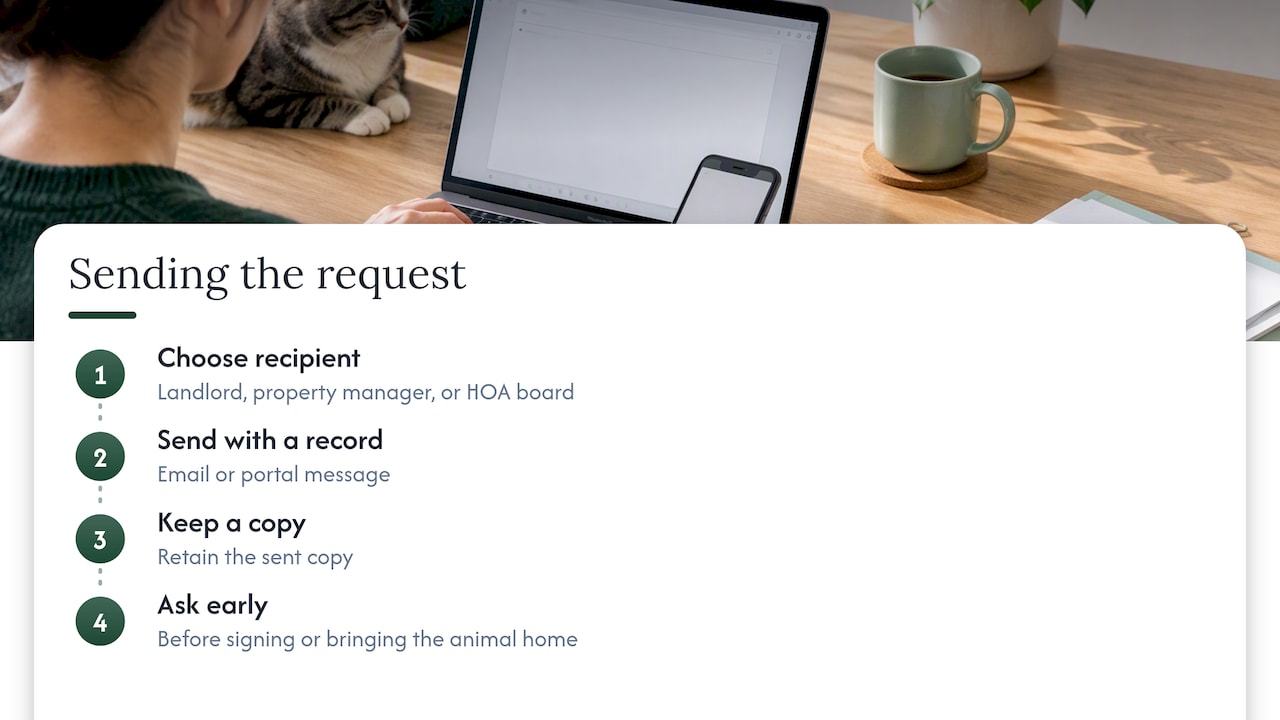
Address it to whoever manages the property: the landlord, property manager, or HOA board. Send it by a method that leaves a record, such as email or a portal message, and keep the sent copy. Don’t wait until move-in day if you can avoid it. Asking before you sign or before you bring the animal home leaves time for questions.
Step 2: Get documentation that holds up
The clinician’s letter is the piece landlords scrutinize most. According to HUD’s 2020 notice, reliable documentation comes from a professional with personal knowledge of the individual. That could be a therapist, psychologist, psychiatrist, physician or other qualified healthcare provider who actually treats you.
What a strong letter says
The letter should confirm that you have a disability and that the animal provides disability-related assistance or alleviates identified effects of the disability. It does not need your diagnosis, symptom history or treatment details. Our ESA letter sample shows how that reads in practice, and there is a second look at templates that pass HUD checks.
A solid letter typically includes:
- The clinician’s name, license type and license number, and the state of licensure
- Contact details and the date
- A statement that the clinician knows you through an actual professional relationship
- The disability-related need, in plain terms
- Their signature
Is a telehealth appointment acceptable?
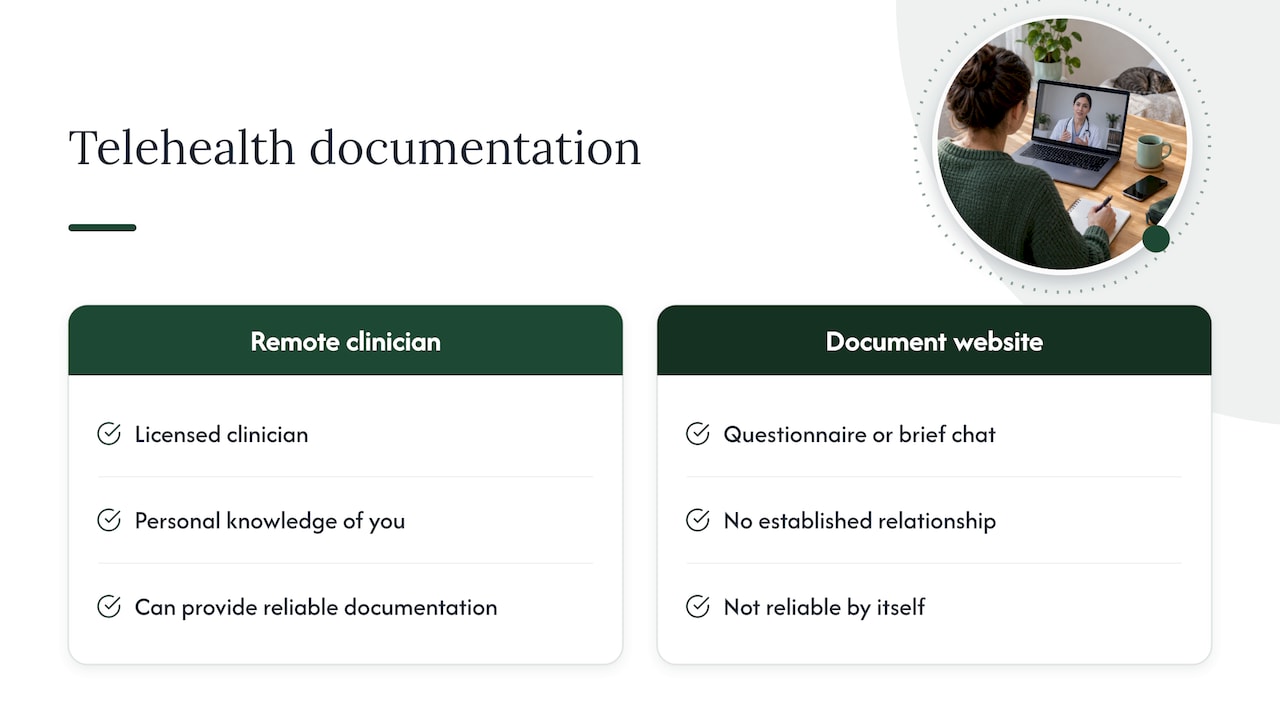
Often, yes. HUD’s guidance distinguishes between licensed clinicians who deliver care remotely and websites that sell a document after a questionnaire or a brief chat with no established relationship. HUD says internet documentation is not reliable by itself, while a remote clinician with personal knowledge of you can provide reliable documentation. The test is continuity, not whether you sat in an office.
If you already see a therapist, ask them first. They know your history, which is exactly what a landlord or school will want to see. If you live abroad and need English-language care, a licensed practice offering online sessions, such as a therapy practice serving English-speaking adults in Madrid, shows what a real ongoing clinical relationship looks like. For U.S. housing, though, make sure the clinician’s licensure and your state’s rules suit the request. Our state-by-state ESA letter laws page covers who can write a letter and where.
What to keep out of the packet
Don’t send psychotherapy notes or your full medical file unless a law specifically requires it. HUD’s guidance supports that limit, and a letter confirming the disability and the need is enough in the usual case. Oversharing gives a landlord nothing it is entitled to and exposes sensitive information.
Step 3: Add animal records when they are requested
This is the part many tenants overlook. Landlords may ask for ordinary documents about the animal itself, and they are on firmer ground there than when they ask about your condition. Common items include:
- Current vaccination record, such as rabies where the law requires it
- Local license or registration with the city or county
- A recent photo, which also helps the landlord identify the animal later
- Contact details for your veterinarian
These records show the animal is healthy and legally kept. They don’t replace the clinician’s letter, and the clinician’s letter doesn’t replace them. If you have a cat, our page on how a cat becomes an ESA walks through the typical questions.
You don’t need to hire a trainer or buy a certificate of any kind. We explain why in our checklist on ESA training requirements. An ESA does not need task training. The Department of Justice draws the line this way: a service animal is generally an individually trained dog that performs work or tasks, while an ESA gets housing protection through fair housing law and not through automatic public access.
Paperwork for a private rental vs. student housing
| Private rental | College or university housing | |
|---|---|---|
| First stop | Landlord or property manager | Disability or accessibility services office |
| Main documents | Written request, clinician letter | School’s ESA application, provider verification |
| Animal records | If lawfully requested | Often required: photo, vaccination, license |
| Approval | Landlord’s decision, with possible follow-up questions | Written approval before the animal comes to campus |
| Template use | A simple letter often works | Use the school’s current form, not a generic template |
Campus paperwork is often heavier. The University of California, Berkeley’s housing instructions require written approval before an animal enters campus housing, and ask for a provider letter, a veterinary vaccination record, an animal photo and any applicable local license. Other schools add intake with disability services or conduct and liability forms. Policies differ, so read your own school’s page. Examples include UNCW’s documentation guidelines, which call for signed documentation from a medical professional or another reliable third party in a position to know about your disability.
Start early. Many offices have deadlines tied to housing assignments, and a missed one can delay approval past move-in.
What happens after you send it
The landlord may ask limited follow-up questions, usually about whether the documentation supports the need. Massachusetts guidance says a provider should issue a decision, and if it denies the request, it should explain why and may need to continue a good-faith dialogue with you.
Reasons a landlord can still say no
A letter is not a guarantee. California’s Civil Rights Department FAQ explains that a provider must evaluate the accommodation and, when needed, use an interactive process. Even so, a provider may object on evidence that the animal poses a direct threat, would cause substantial damage, creates a nuisance, or is a type of animal barred under applicable law. A blanket no-pet policy is not the end of the conversation, but a documented safety problem can be.
If you get a refusal:
- Ask for the reason in writing.
- Check whether it cites something specific about your animal or just the pet policy.
- Offer to answer any reasonable question or supply a missing record.
- Keep every message.
- If it stays stuck, contact your state or local fair housing agency or HUD’s fair housing office.
Paperwork you can skip
Certificates, national registries, ID cards and vests don’t create housing rights. HUD’s notice is clear that an online document alone doesn’t show a disability-related need. The question a landlord can fairly ask is about your need and the documentation behind it, not whether the animal appears in a database. Read more in our guide to whether ESA registration is real, and why a $70 certificate won’t protect your housing rights.
A good rule: if a site promises instant approval, charges per animal for a “registration,” or never asks about your health, treat it as a warning sign.
Our perspective
We built Supportpet because the most common mistake we see is spending money on the wrong document. People buy a certificate, hand it to a landlord, and then find out it carries no weight. The packet that works is much plainer: a short, honest request, a letter from a clinician who knows you, and tidy records for your animal.
We also think renters carry too much anxiety about the process. You are not asking for a favor. You are asking for an accommodation the law can require, and you can do it calmly, in writing, with a copy for yourself. Keep your private health details private, and be organized about everything else. Because we don’t sell letters or registrations, we have no reason to tell you that you need more than you do.
— Erik
Where to go next
If you are still working out the order of steps, our honest steps for getting an ESA letter page lays out the full process from first appointment to landlord request. For the broader picture of rights and letters, start at the Supportpet guide to emotional support animals and ESA letters. It is free to read, and we don’t sell documents.
FAQ
Do I need an ESA certificate or registration for housing?
No. HUD says online certificates or registrations alone don’t establish a disability-related need. What matters is reliable documentation from a clinician who knows you, plus your request.
Does my landlord have to know my diagnosis?
Generally not. The letter should confirm that you have a disability and that the animal helps with it, without unnecessary diagnostic detail. Don’t send therapy notes or full medical records unless a specific law requires it.
Can I send the request verbally?
You can, and some states say a verbal request counts, as Massachusetts does. Still, put it in writing and keep a copy. A written record protects you if there is a later dispute about what was asked and when.
Is the process the same in a dorm?
Not quite. Schools usually require their own application through a disability or accessibility office, along with provider verification and often animal records. Many want written approval before the animal arrives, so use your school’s current form.
Sources
- Assistance Animals, HUD.gov
- Assessing a Person’s Request to Have an Animal as a Reasonable Accommodation, HUD notice (2020)
- FAQs on Emotional Support Animals, Animal Legal & Historical Center
- Assistance animals in housing, Mass.gov
- ESAs and Service Animals, UC Berkeley Housing
- Documentation Guidelines & Forms, UNCW
- Emotional Support Animals and Fair Housing Law FAQ, California Civil Rights Department
- U.S. Department of Justice complaint, Philadelphia condominium case
Recommended
- ESA Letter Sample: What a Real Letter Looks Like (2026)
- ESA Housing Rights in 2026: What HUD’s Change Means
- ESA Letter Laws by State (2026): Who Can Write One, Where
- Get Your ESA Approved: Copy Ready Letter to Notify Your Landlord