The Fair Housing Act gives landlords no fixed number of days to answer an emotional support animal (ESA) request. The standard is “a reasonable amount of time,” and a long silence can be treated as a denial. Indiana’s Civil Rights Commission explains that failing to respond within a reasonable period may count as refusing the request. In practice, about 10 days is the benchmark most housing advocates use. Federal enforcement changed in May 2026, though, so your state’s law now matters more than it used to.
TL;DR
- No federal law sets an ESA response deadline. “Reasonable” is the legal test, and urgency shortens what counts as reasonable.
- About 10 days is the widely cited best practice. It is a guideline, not a codified rule.
- Put your request in writing, state the date you sent it, and ask for a written reply by a specific date.
- Silence can be treated as a denial. Follow up in writing, then contact your state civil rights agency or a fair housing organization.
- HUD’s May 22, 2026 memo changed federal enforcement for untrained ESAs, but many state laws still protect them.
Table of Contents
- What the law says about timing
- Where the “10 days” figure comes from
- Public and subsidized housing can have written deadlines
- How HUD’s May 2026 change affects the wait
- How to make a request that gets a fast answer
- What to do if the landlord stalls
- Fees and extra paperwork during review
- Do the same timing rules apply in dorms?
- Perspective
- Get your request ready
- FAQ
- Sources
What the law says about timing
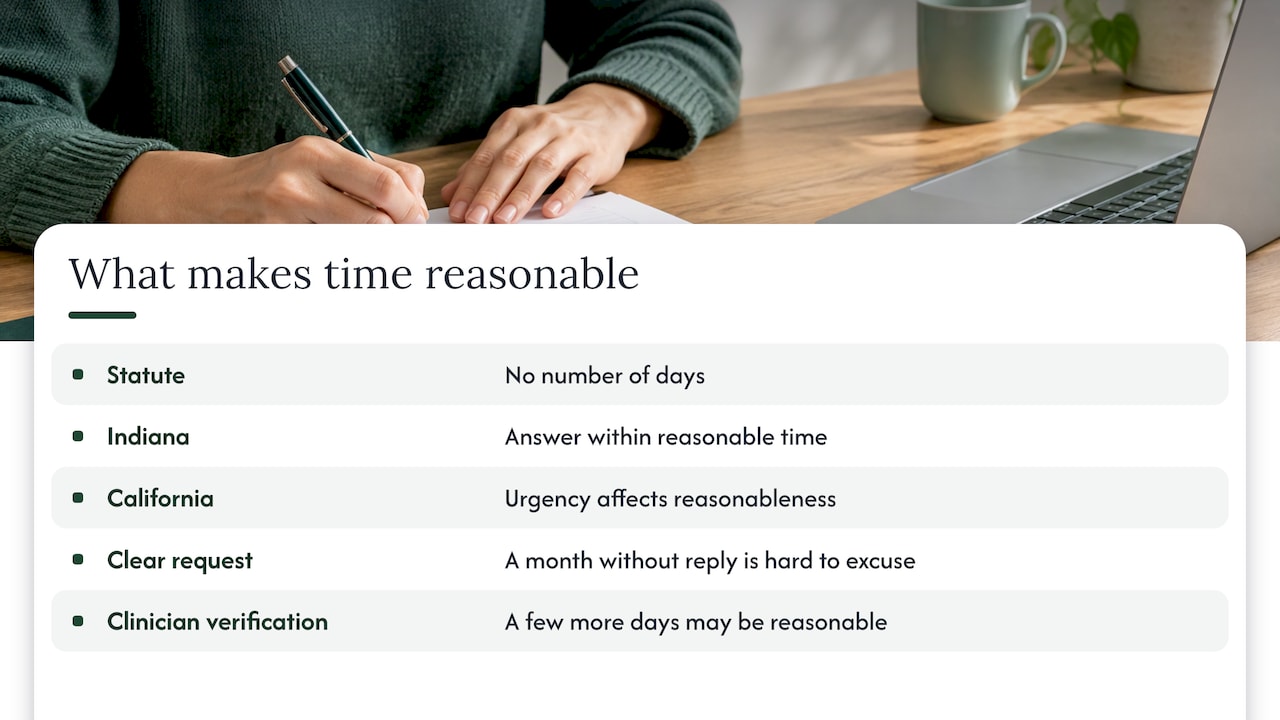
There is no number of days in the statute. The Indiana fact sheet above says the housing provider must answer within a reasonable amount of time. California’s Civil Rights Department adds that how long is reasonable depends on factors such as whether you need the accommodation urgently, and that failing to respond is unlawful housing discrimination in that state.
So the clock is flexible. A landlord who gets a request with a clear letter on a Monday has little excuse for saying nothing a month later. A landlord who needs to verify a letter from a clinician may reasonably take a few more days, as long as they are actually working on it.
State agencies describe the same standard in similar words. Minnesota’s Department of Human Rights tells tenants to ask as soon as possible and tells landlords to respond in a reasonable amount of time. None of these agencies publishes a hard number for private landlords.
Where the “10 days” figure comes from
You will see “10 days” everywhere, so it helps to know what it is. Maryland Inclusive Housing notes that HUD gives no specific timeframe and that responding within 10 days is a best practice. It also notes that a delay can be treated as a denial by HUD.
The figure also shows up in model letters. Disability Rights North Carolina’s sample letter asks for a written response within 10 business days. The organization is clear that providers must respond promptly and that 10 days is a suggestion.
Use it the same way. Writing “please reply by [date 10 days out]” in your request is a fair, professional ask. It does not create a legal deadline, but it gives you a clean date to point to if you need to escalate.
Public and subsidized housing can have written deadlines
Private landlords have no codified clock, but housing authorities often do. Their written policies are worth knowing if you rent in subsidized housing.
| Housing provider | Stated timeline | Source |
|---|---|---|
| Public housing authorities (HUD resident fact sheet) | Usually within 10 business days of receiving the request or documentation | HUD Exchange fact sheet |
| Denver Housing Authority | Written response within 20 business days after all information needed for review is submitted | DHA fact sheet, August 2021 |
| Housing authorities of Guin, Hackleburg, Bear Creek and others (Alabama) | Response within 20 business days; written decision within 30 business days of the request and any needed documents | Reasonable accommodation policy, 2015 |
The spread from 10 to 30 business days shows why “reasonable” is not one number. If you live in subsidized housing, ask the office for its written reasonable accommodation policy. The deadline is likely in it.
How HUD’s May 2026 change affects the wait
On May 22, 2026, HUD issued an enforcement memorandum. According to Maine Human Rights Commission guidance, HUD will no longer find reasonable cause in complaints involving emotional support animals. It will pursue enforcement only where an animal has been trained to perform work or tasks tied to a person’s disability.
What does that mean for response time? Two things.
- A federal complaint about a slow landlord is a weaker lever for an untrained ESA. The reasonable-time standard was always enforced through complaints, and HUD has signaled it will not take up these cases.
- State law now carries more weight. The same Maine guidance points out that the Maine Human Rights Act expressly covers emotional support animals and is not changed by a federal memo. Other states and cities have their own rules, and some count ESAs as protected assistance animals.
We cover the details on our page about ESA housing rights after HUD’s change, and our ESA letter laws by state page helps you see what applies where you live. Check your state agency’s current guidance before you rely on any single rule.
How to make a request that gets a fast answer
Speed starts with you. A complete, clear request is easier to approve and harder to ignore.
- Write it down. Indiana’s agency recommends a written request, such as an email, so you have a record. Keep a copy and note the date and time you sent it.
- Say what you are asking for. Name the animal, state that you are requesting a reasonable accommodation to a no-pets policy because of a disability, and say you will provide supporting documentation.
- Attach verification from a clinician. A landlord may ask for verification of a disability and the need for the animal when it is not obvious. The Indiana fact sheet says verification should generally come from a medical provider who has recently seen or treated you. See our ESA letter sample for what a legitimate letter contains.
- Ask for a reply by a date. Ten days out is a reasonable ask. Use a date, not “soon.”
- Send it to the right person. Use the contact the lease names for maintenance or notices, and copy the property manager if you know one.
The tenant’s side of timing matters too. Massachusetts guidance for state-aided housing notes that a person may make a request at any time, including after bringing the animal into the housing, and that housing authorities should let the animal stay while verification is pending. That guidance covers state-aided public housing in Massachusetts, so it is not a universal rule for private rentals. Still, it is better to ask before the animal moves in.
When your need is urgent
Urgency changes what is reasonable. If you are moving in within days, starting treatment, or going through a crisis where the animal’s support matters to your daily functioning, say so in the request and give your move date. California’s agency lists urgency as a factor in how fast a landlord must act.
A mental health condition does not have to be dramatic to be real, and a quick answer helps recovery. Research on pets and mental health shows why many people feel the need for an animal’s companionship is pressing, not optional. Share only what the landlord needs. You do not have to disclose your diagnosis or medical history.
What to do if the landlord stalls
A missing reply is not a free pass to wait. Move through these steps in order and keep every message.

Day 1 to 10: give them room
Some landlords are checking with an owner, a lawyer or an insurer. A short wait is normal. Do not bring the animal in unannounced if your lease forbids pets and you have no answer yet, unless a local rule says otherwise.
Day 10 to 14: send a written follow-up
Reply to your own first email. Keep the tone calm: say you sent the request on [date], that you have not heard back, and that you ask for a written response by a new date a few days away. Restate that the animal is for a disability-related need.
After that: treat silence as a denial
Because an unreasonable delay can be treated as a denial, you can start escalating. Options include:
- Your state civil rights or human rights agency, which often takes housing complaints for free.
- A local fair housing organization, which can send the landlord a letter or advise you.
- A legal aid office or disability rights group in your state.
- HUD’s fair housing complaint process. Complaints have filing windows, so do not sit on it. Check the current limit on HUD’s site, and keep in mind the May 2026 change to how HUD handles ESA cases.
If the landlord says no
A flat no is not the end of the conversation. Maryland’s Commission on Civil Rights says a blanket rejection without an individualized look will very often violate the law. Even where granting the request would be a real hardship, the provider has to try to find another solution through a good-faith discussion.
California’s agency describes that discussion as an exchange of information that should happen in a timely way and in good faith. Indiana’s guidance adds that if the provider thinks the request is unreasonable, it should discuss alternatives with you. If a reasonable and effective alternative exists, it must generally be granted. Respond to a denial by asking, in writing, what alternative they will accept.
Fees and extra paperwork during review
A landlord may ask for information to verify the need when the disability and need are not obvious. That is normal and is not stalling. What they cannot do is pile on conditions.
Several state agencies say so directly:
- California’s CRD says tenants cannot be charged pet deposits or pet rent for emotional support animals.
- The Maine guidance says use of an assistance animal may not depend on paying a fee or security deposit. You stay liable for actual damage the animal causes.
- A California housing association’s helpline summary adds that a tenant may not be required to carry liability insurance for the animal, but can be asked to pay for damage beyond ordinary wear and tear.
These are state-specific statements. If a landlord demands a pet fee as the price of reviewing your request, write down the demand and check your own state’s rule before you pay.
Do the same timing rules apply in dorms?
Not necessarily. Colleges handle animals through their disability services or housing office, and each school sets its own process and timeline. Our research found no single national response deadline for campus housing. Start early, ideally before the housing assignment period, and ask the school’s disability services office for its written procedure and its expected turnaround. Then use the same habits as with any landlord: submit in writing, attach clinician documentation, and request a reply date.
Perspective
We built Supportpet because the timing question is where renters get stuck. Most people who need an ESA are not fighting a landlord. They are waiting on one, and every quiet day feels like a refusal.
Our view is simple. The best way to shorten the wait is to send a request that is complete the first time: written, dated, backed by a letter from a licensed clinician who has actually evaluated you, and clear about the reply date you are asking for. A landlord can answer that in a day. A vague text message can sit for weeks.
We also think renters deserve the real picture after HUD’s May 2026 change. Federal enforcement for untrained ESAs has narrowed, but that does not erase your state’s rules, and it does not make a clear, polite, documented request any less worth sending. Know your state, keep your records, and do not pay for a registry or certificate that no law requires.
Erik
Get your request ready
If you are about to ask your landlord, start with the paperwork. Our free guide walks through how a legitimate ESA letter works, what a clinician has to do, and how to avoid the registries and ID-card sites that sell documents with no legal weight. We do not sell letters or certificates. We explain how the process works so you can ask with confidence.
Read the Emotional Support Animals and ESA Letters rights guide to get your request ready, then check your state on our housing rights page before you send it.
FAQ
How many days does a landlord have to answer an ESA request?
No federal law gives a number of days. The legal test is a reasonable amount of time, and urgency can shorten it. About 10 days is the best practice most advocates and agencies cite, and some housing authorities set 10 to 30 business days in their own written policies.
Can silence from my landlord count as a denial?
Yes. State agencies such as those in Indiana and California say that failing to respond within a reasonable time can be treated as a denial or as unlawful discrimination. Send a dated written follow-up, then contact your state civil rights agency or a fair housing group.
Should I move my animal in while I wait?
It depends on your lease and state. Some public housing guidance lets the animal stay while verification is pending, but that is not a rule for every private landlord. Ask for a written answer first, and speak with a fair housing organization if you are unsure.
Does the May 2026 HUD memo mean landlords can ignore my request?
No. The memo changes what HUD will enforce for untrained ESAs, but state and local laws still apply, and some expressly cover emotional support animals. A landlord who ignores your request may still be breaking your state’s law, so check with your state agency.
Can a landlord charge a fee while reviewing my request?
In states such as California and Maine, agencies say no pet deposit, pet rent or fee can be required for an assistance animal, though you stay responsible for damage. A landlord can ask for reasonable verification of your need. Check your own state’s rule if a fee comes up.
Sources
- Assistance Animals: Emotional Support Animals, Indiana Civil Rights Commission (September 2024)
- Housing, California Civil Rights Department
- Housing, Minnesota Department of Human Rights
- Reasonable Accommodations, Maryland Inclusive Housing
- Sample Letters: Housing and Assistance Animals, Disability Rights North Carolina
- Resident and Applicant Fact Sheet: Reasonable Accommodations in Public Housing, HUD Exchange
- Reasonable Accommodation Fact Sheet, Denver Housing Authority (August 2021)
- Reasonable Accommodation Policy, Housing Authorities of Guin, Hackleburg, Bear Creek and others (2015)
- MHRC Guidance on HUD Assistance Animal Change, Maine Human Rights Commission (August 2026)
- PHN 2023-01 Guidance for Animals in State-Aided Public Housing, Massachusetts (February 2023)
- Guidance: Disability Accommodations in Housing, Maryland Commission on Civil Rights
- Helpline Highlights: Support animals and a ‘no pets’ rule, California Apartment Association (October 2022)
- How Pets Can Boost Your Mental and Physical Health, The Pursuit Counseling
Recommended
- Does an ESA Letter Expire? What U.S. Renters Need to Know
- Avoid ESA Letter Scams: Which Clinicians Housing Providers Trust for Renters
- ESA Letter Sample: What a Real Letter Looks Like (2026)