
A new landlord does not automatically erase your emotional support animal accommodation, but you should plan on asking again, in writing, and early. The Fair Housing Act (FHA) still requires housing providers to consider disability-related animal requests, even though federal enforcement changed in May 2026. Your lease, your state or city law, and how you document your request now matter more than they used to.
This guide covers what usually carries over when a building is sold or management changes, what to do if a pet policy changes, what a landlord may ask for, and where to turn if you are refused.
TL;DR
- The FHA requirement to consider reasonable accommodations for people with disabilities did not change, but HUD’s May 2026 enforcement guidance now focuses on individually trained animals.
- Many states and cities protect ESAs more broadly than current federal enforcement does, so your location can decide the outcome.
- When ownership changes, send the new landlord a short written accommodation request and a letter from a licensed clinician. Do not assume the old approval was passed along.
- A landlord can ask for reliable documentation of the disability-related need, but not for your diagnosis.
- If you are refused or threatened, keep everything in writing and consider a complaint to HUD or your state fair housing agency.
Table of Contents
- What changed in 2026, and what did not
- Does a new landlord cancel your ESA accommodation?
- How to make the request to a new landlord
- What a new landlord can and cannot ask
- Your state or city may protect you more than HUD does
- If a new landlord refuses or threatens eviction
- A checklist for the first 30 days with a new landlord
- Where to start if you need a letter or the rules for your state
- FAQ
- Sources
What changed in 2026, and what did not
For more than a decade, landlords were told by HUD that emotional support animals were protected under the FHA. On May 22, 2026, HUD’s Office of Fair Housing and Equal Opportunity (FHEO) issued new enforcement guidance stating that it will find reasonable cause over a refused pet-policy waiver only where the animal has been individually trained to do work or perform tasks related to the person’s disability.
That is a shift in what HUD itself will pursue. It is not a new law. The FHA still says that refusing reasonable accommodations needed for a person with a disability to use and enjoy a home is discrimination. HUD’s general assistance animals page continues to explain that a housing provider must allow an accommodation unless it would impose an undue burden, fundamentally alter operations, pose an unmitigated direct threat, or cause significant physical damage.
Two practical points follow:
- Federal enforcement and your legal rights are not the same thing. Commentary from real estate professionals notes that the guidance does not stop private lawsuits under the FHA and does not override state or local laws that protect assistance animals more broadly.
- Landlords are not told to refuse every ESA. One property management adviser cautions that the memo is not a simple green light to deny requests and that landlords should keep reviewing each one case by case.
For a fuller walk-through of the federal change, see our guide to ESA housing rights in 2026.
Does a new landlord cancel your ESA accommodation?
Not by itself. But there is no single federal rule that says an approval transfers to a buyer or new management company, so treat the answer as “it depends on your lease and your state.”
Here is how the common situations tend to play out in practice.
The building is sold and your lease continues
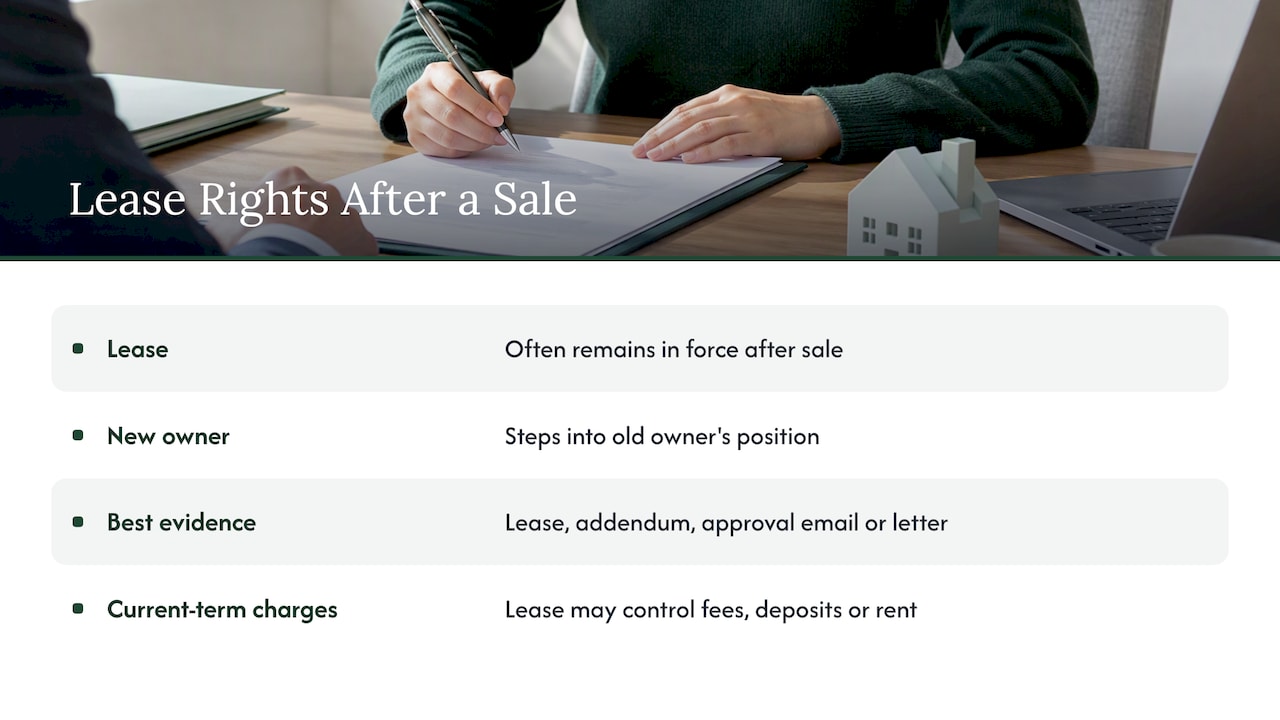
In many places, a tenant’s existing lease stays in force when the property changes hands, and the new owner steps into the old owner’s position. If your lease already says you may keep your animal, or if the previous landlord waived fees in writing, that paper is your best evidence. Keep a copy of the lease, any addendum, and the approval email or letter.
One real estate source notes that an existing lease may control whether you can be charged pet fees, deposits or rent during the current term. That is a reason to read the exact wording of what you signed before anyone asks you to sign something new.
Your lease is month-to-month
Month-to-month tenancies are the most exposed to change, because a landlord can often update terms with proper written notice. State rules on how much notice is required differ, so check your state’s landlord-tenant statute or tenant resource page. A pet-policy change is not supposed to be a way around fair housing duties. If a new “no pets” rule arrives and you rely on an animal for disability-related reasons, respond with an accommodation request rather than ignoring the notice.
Renewal time brings a new pet policy
This is the most common version of the question. A new management company sends a renewal packet with pet rent, a pet addendum, a breed list or a ban. Do not just sign the packet or move out. Reply in writing, say that you are requesting a reasonable accommodation for a disability-related need for an assistance animal, and attach your documentation. Then ask for a written response before the renewal deadline.
Your first lease with a new landlord
If you are moving in, you are starting fresh. You can make the request before signing, at signing or after moving in. Raising it early, in writing, avoids the awkward situation of an animal appearing after the lease was signed with a “no pets” clause.
How to make the request to a new landlord
You do not need magic words. A clear, polite, dated request works.
- Write it down. Email is fine and gives you a timestamp. Address it to the person or company named on your current lease or notice.
- State the request. Say you have a disability and are asking for a reasonable accommodation to keep an assistance animal despite the pet policy, fees or restrictions.
- Explain the need, not the diagnosis. Massachusetts state guidance, for example, says a tenant should explain the disability-related need for the animal and is not required to disclose a medical diagnosis.
- Attach documentation. A landlord may ask for reliable documentation from a qualified third party, such as a healthcare provider familiar with your condition, who can verify the need.
- Ask for a written decision. Give a reasonable date and say you will follow up.
- Keep records. Save every message, notice, photo of posted rules and receipt.
If you are unsure how to describe your symptoms and why the animal helps, it can be useful to read about anger as a mental health condition and similar emotional-regulation topics before your appointment, so you can talk to your clinician in specific terms.
What a good letter contains
The letter should come from a licensed professional who actually knows you and your condition. A certificate, registry listing or ID card bought online is not what a landlord is entitled to rely on, and it can hurt your credibility. Our ESA letter sample shows what a legitimate letter typically includes, and our page on ESA letter laws by state explains who may write one where you live.
What a new landlord can and cannot ask
The line between a reasonable question and an intrusive one is where many disputes start.
| A landlord can usually ask | A landlord should not demand |
|---|---|
| A written request that connects the animal to a disability | Your diagnosis or medical records |
| Reliable documentation from a qualified provider | A paid registry, certificate or ID card |
| That the animal not cause a direct threat or significant damage | Proof of task training, where state or local law protects untrained ESAs |
| Payment for actual damage the animal causes | Extra deposits, pet rent or pet fees, where your law treats the animal as an accommodation |
The last row depends on where you live. New York City’s Commission on Human Rights says housing providers cannot charge additional deposits or pet fees for an ESA, cannot require extra insurance, and must exempt the animal from breed, weight and size limits unless that would cause undue hardship, although they may charge for actual damage. Massachusetts says a person with a disability-related need can request an exemption from animal restrictions, policies or fees that block equal enjoyment of housing.
Under the federal enforcement approach, by contrast, a landlord in a state without its own protections may feel more comfortable asking whether the animal is trained. That is why the local law matters so much.
Your state or city may protect you more than HUD does
The federal change did not wipe out state and local fair housing laws. The Maryland Commission on Civil Rights stated in September 2026 that the federal shift does not remove protections under Maryland law, and that under the state fair housing act a reasonable accommodation may include an emotional support animal even without individual task training.
Law firm commentary also points out that the new guidance leaves open how it interacts with state and local ESA protections, the status of breed and weight restriction challenges, and pending private lawsuits. In plain terms: the picture is still settling.
Before you write to a new landlord, look up three things:
- Your state fair housing agency or civil rights commission, and whether it has issued ESA guidance since May 2026.
- Your city or county human rights office, if one exists.
- Whether your building takes federal assistance. A property adviser notes that in HUD-assisted housing Section 504 may also apply, which can change the analysis.
Students in dorms
University housing is also covered by disability accommodation rules, but schools run their own process. Contact your campus disability or accessibility office first, not the housing desk, and allow plenty of lead time before the term starts. If your housing changes from one provider to another, such as moving from a dorm to private student apartments, treat it as a new request.
If a new landlord refuses or threatens eviction
Stay calm and keep the exchange in writing. Then work through these steps.
- Ask for the reason in writing. A denial should rest on something specific, such as undue burden, a direct threat or damage, not a blanket policy.
- Offer to clarify the documentation. Sometimes a refusal is just about a missing or vague letter. Ask your clinician to address it.
- Cite your local law. Name the state or city statute or agency guidance that protects you.
- File a complaint. HUD says a tenant who believes an assistance-animal accommodation was unlawfully denied can file a complaint with FHEO. Your state or local fair housing agency may be a stronger route given the 2026 change, and a legal aid office or fair housing organization can tell you which.
- Do not ignore eviction paperwork. Respond within the deadline and get legal help. A court deadline does not pause while you wait for an agency.
Retaliation is also a problem for landlords. In a 2020 case, HUD charged a New York landlord after alleging fees, threats and an eviction following an assistance-animal request, noting that the FHA prohibits threatening and coercing people who exercise their fair housing rights. It is an example, not a prediction, but it shows why records matter.
A checklist for the first 30 days with a new landlord
- Find your signed lease and any pet addendum or waiver.
- Note who owns and manages the property now, and where to send notices.
- Send a written accommodation request with your clinician’s letter.
- Keep your animal’s vaccinations and license current, as local law requires.
- Photograph the unit at move-in or renewal so any later damage claim has a baseline.
- Keep a dated log of every conversation.
Our perspective
We built Supportpet because people with anxiety, depression or PTSD kept running into the same two problems: landlords who did not know the rules, and websites selling “registrations” that carry no legal weight. A change of landlord makes both problems worse, because you are suddenly asking a stranger to take your word for something deeply personal.
Our view is simple. The strongest position you can be in is a clear written request, backed by a letter from a licensed clinician who knows you, and a good understanding of your own state’s law. That is true after May 2026 as much as before it. Federal enforcement has narrowed, but the law you live under has several layers, and many of them are still on your side.
We also think you should never pay for a certificate, ID card or registry entry to feel protected. Free, plain-language information about how letters, state rules and housing requests work is what we aim to provide, so you can walk into a conversation with a new landlord prepared.
Erik
Where to start if you need a letter or the rules for your state
If you do not yet have documentation, or you are not sure your current letter would satisfy a new landlord, start with our free guides. They explain how a valid ESA letter works, who can write one in your state, and what to expect from housing providers. Begin on the Supportpet home page for the full overview.
We do not sell certificates or registrations, and we never suggest you need one. For state-specific rules, read our ESA letter laws by state page.
FAQ
Does my ESA approval from the old landlord transfer to the new one?
Not automatically in most situations. If your lease stays in force after a sale, its terms, including any written waiver of pet fees, generally remain your evidence. If you sign a new lease or renewal, make a fresh written request and attach current documentation.
Can a new landlord change the pet policy and make me remove my ESA?
A policy change does not remove your right to ask for an accommodation. Fixed-term leases are usually harder to change mid-term than month-to-month tenancies. Respond to the notice in writing, state that you are requesting a reasonable accommodation, and check your state’s rules on notice and on ESAs.
Can a landlord charge pet rent for an emotional support animal after the 2026 HUD change?
It depends on where you live. Some jurisdictions, such as New York City, say housing providers cannot charge extra deposits or pet fees for an ESA, while federal enforcement now concentrates on trained animals. Check your state or city fair housing agency and your lease before paying anything.
What should I do if my new landlord asks for my diagnosis?
You can decline to share your diagnosis. State guidance, such as that from Massachusetts, says tenants do not have to disclose a medical diagnosis. Offer a letter from your licensed healthcare provider that confirms the disability-related need instead.
Where do I complain if my request is denied?
You can file with HUD’s FHEO, and you should also look at your state or local fair housing agency, since state law may protect ESAs more broadly. A fair housing organization or legal aid office can help you choose the right route and meet filing deadlines.
Sources
- Assistance Animals, HUD.gov
- HUD FHEO enforcement guidance on animals as reasonable accommodations
- Assistance animals in housing, Mass.gov
- Emotional Support Animals in Housing FAQ, NYC Commission on Human Rights
- MCCR emotional support animal guidance, Maryland Commission on Civil Rights
- HUD Issues Enforcement Guidance on Animals as Reasonable Accommodations, National Law Review
- HUD charges New York landlord, HUD Archives
- HUD Reverses ESA Policy, Paragon Realtors
- HUD’s New Memo on Assistance Animals, The Habitat Group
- Could anger be a mental health condition, Couples Fight School
Recommended
- ESA Housing Rights in 2026: What HUD’s Change Means
- Does an ESA Letter Expire? What U.S. Renters Need to Know