
For years the rule was simple: a landlord could not charge a pet deposit, pet fee or pet rent for an emotional support animal (ESA), but could take real damage out of your regular security deposit. Since HUD’s May 2026 memo the federal picture is less certain, but many state laws still say the same thing. Your regular security deposit stays as it is. What changes is whether the extra pet charges can be waived, and that now depends heavily on where you live.
TL;DR
- A normal security deposit that every tenant pays is allowed. A separate pet deposit, pet fee or pet rent for an ESA is what the Fair Housing Act’s accommodation rules were historically read to forbid.
- On May 22, 2026, HUD withdrew its older ESA guidance and narrowed its federal enforcement to individually trained animals, so federal help for a comfort-only ESA is no longer something to count on.
- Several states and D.C. still prohibit extra charges for assistance animals in their own laws, including Florida, Virginia and the District of Columbia.
- Real damage beyond normal wear and tear can still come out of your standard deposit.
- Put your request in writing, keep your documentation, and check your state law before you pay any pet charge.
Table of Contents
- The short answer on pet deposits and ESAs
- What HUD changed in May 2026
- Security deposit vs. pet deposit vs. pet rent
- What the law says in your state
- Can a landlord deduct ESA damage from your regular deposit?
- When a landlord can still say no
- Student housing and special programs
- How to ask for a waiver in writing
- Federal voucher programs
- Where to start with us
- FAQ
- Sources
The short answer on pet deposits and ESAs
Under the long-standing federal approach, an ESA was treated as an assistance animal, not a pet. HUD’s own page still describes an assistance animal as one that provides assistance, performs tasks or gives disability-related emotional support, and is not a pet. Because it is not a pet, pet-specific charges were not supposed to apply.
That logic is why a landlord who asks for a $300 pet deposit or $25 a month in pet rent on top of your lease could face a fair housing complaint. The Department of Justice has acted on exactly this: a 2020 complaint alleged that Missouri housing providers required a pet deposit for a tenant’s assistance animal, and a consent order followed in 2021.
What the landlord can still collect is the ordinary security deposit that applies to every tenant, whether or not you have an animal. That money is held against unpaid rent and damage, not against the presence of your animal.
The complication is 2026. If you have read that “HUD changed the ESA rules,” that is true, and it affects how strongly you can rely on federal enforcement. It does not by itself rewrite the Fair Housing Act or your state’s law. The sections below separate the three layers: federal law, state law and your lease.
What HUD changed in May 2026
On May 22, 2026, HUD’s Office of Fair Housing and Equal Opportunity issued an enforcement memo, effective immediately, that cancelled both its 2013 and 2020 guidance documents on assistance animals. According to a law firm analysis of the memo, those documents had told housing providers to treat ESAs as assistance animals rather than pets, not to charge pet fees and to request only limited documentation.
Two points from that same analysis matter for your deposit:
- The Fair Housing Act itself has not been amended. The memo withdraws guidance and changes how HUD treats complaints, but it does not rewrite the statute or any state law.
- The memo is limited to animal accommodation complaints under the Fair Housing Act.
Another legal review describes the new standard as aligning federal housing enforcement with the ADA, so that only individually trained animals are the focus. A comfort-only ESA, the kind most tenants have, no longer gets the same federal attention. Nolo’s landlord guide, updated June 1, 2026, summarizes it the same way: the FHA requires accommodation only for animals trained to perform disability-related work or tasks, and the rules remain in flux.
What this means in practice:
- A landlord may feel freer to push back on pet charges for an untrained ESA.
- You may have a harder time getting HUD to act on a complaint.
- You still have other routes: state fair housing agencies, state attorneys general and private lawsuits, depending on where you live.
We keep a running explainer of the change on our page about ESA housing rights in 2026.
Security deposit vs. pet deposit vs. pet rent
These three get mixed up constantly, and the difference is the whole question.
| Charge | What it is | Typical ESA treatment where protections apply |
|---|---|---|
| Security deposit | Money every tenant pays, held against unpaid rent and damage | Allowed, in the same amount you would pay without an animal |
| Pet deposit | An extra refundable or non-refundable sum charged because you have an animal | Not allowed for an assistance animal |
| Pet fee | A one-time charge, often non-refundable | Not allowed for an assistance animal |
| Pet rent | A monthly add-on for the animal | Not allowed for an assistance animal |
The practical test is simple. If the charge exists because of the animal, and a tenant without an animal would not pay it, it is a pet charge. If every tenant pays it, it is your standard deposit.
A landlord also cannot generally raise your standard deposit above what other tenants pay just because you have an ESA. Where state law caps total deposits, the cap still applies. California’s rules, for example, are summarized by one tenant guide as capping the combined deposits at two months’ rent for most leases, but check your state’s current statute, since caps differ and have been revised in recent years.
What the law says in your state
Because federal enforcement has narrowed, state statutes now do much of the work. Here are the ones we can point to directly.
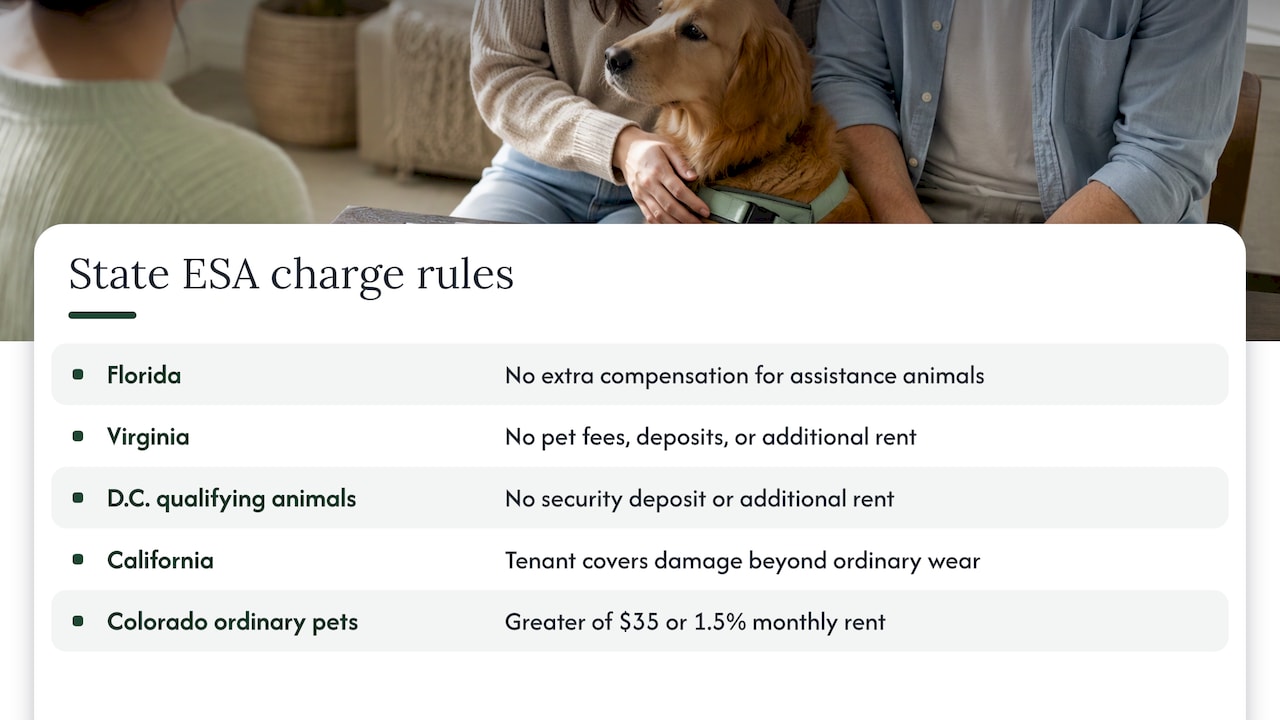
Florida. Florida Statutes section 760.27 says a person with a disability-related need for an assistance animal cannot be required to pay extra compensation for the animal.
Virginia. Virginia’s fair housing code says a person with a disability who keeps an assistance animal in a dwelling cannot be charged a pet fee, deposit or additional rent.
District of Columbia. D.C. Law 25-308, the Pets in Housing Amendment Act of 2024, applies to leases beginning after October 1, 2025. It bars requiring a security deposit or additional rent for service or assistance animals needed as a reasonable accommodation.
California. The state’s civil rights agency says ESA holders may still have to cover repair costs for damage to the premises, excluding ordinary wear and tear. That is a statement about damage, not a license for pet charges.
Colorado and other pet-rent states. Colorado lets landlords charge monthly pet rent for pets, capped at the greater of $35 or 1.5% of monthly rent, according to Nolo’s pet-fee guide. That cap is for ordinary pets. It tells you what a landlord may charge a pet owner, which is exactly what you should not be asked to pay if your state treats your ESA as an assistance animal.
If your state is not listed, do not assume it has no protection. Many states fold ESAs into their own fair housing acts. Our guide to ESA letter laws by state covers who can write a letter and where, and your state fair housing agency can tell you what applies to charges.
Can a landlord deduct ESA damage from your regular deposit?

Yes, and this surprises tenants who assume “no pet fees” means “no responsibility.” An ESA exempts you from pet charges, not from liability for harm. Nolo’s guidance says landlords may deduct repair costs for assistance-animal damage from the security deposit as state and local law allow.
What that looks like:
- Chewed trim, scratched floors, stained carpet beyond normal wear: can be deducted, with documentation.
- Normal wear and tear: cannot be deducted, whether or not an animal lived there.
- Odor or flea treatment after move-out: often disputed. Ask for an itemized statement and receipts.
Here is a worked example. You pay a $1,500 security deposit, the same as every tenant in the building. Your dog scratches a section of hardwood and the landlord’s refinishing invoice for that section is $400. The landlord can usually deduct that documented repair cost, and you get the rest back under your state’s return rules. The landlord cannot also keep a $300 “pet deposit” that was added at move-in because of your dog.
To protect yourself:
- Photograph and video every room on move-in day, and send the files to the landlord by email.
- Complete the move-in condition checklist and keep a copy.
- Repair small damage promptly instead of letting it grow.
- At move-out, request an itemized list of deductions, in writing, and compare each item with your photos.
When a landlord can still say no
A deposit waiver does not mean an unconditional right to any animal. HUD’s page lists the grounds on which a housing provider may deny an accommodation: undue burden, fundamental alteration, a direct threat that cannot be reduced, or substantial physical damage that cannot be reduced. Those tests look at the individual animal’s behavior, not at breed stereotypes.
The Justice Department has also pushed back on blanket limits. A 2026 settlement agreement requires the defendants to drop weight and breed limits for assistance animals and use their accommodation policy instead of conflicting policies. Federal courts have long held the same on the underlying principle: in Fair Housing of the Dakotas v. Goldmark Property Management (2011), the court treated trained and untrained assistance animals alike under the FHA. Remember that this predates the 2026 memo, and the memo changes how HUD enforces, not what a court has already written.
Student housing and special programs
Dorms are rental housing too, but colleges run their own request process. At Towson University, for instance, students seeking disability-related housing accommodations, including an ESA, must register and submit documentation to the disability services office, and requests are reviewed annually. Because the review repeats each year, plan to renew your paperwork before housing deadlines.
Short-term programs can differ. The University of Iowa’s summer housing guidebook says some programs, such as summer internship or conference housing, may exclude ESAs from the residence halls altogether. If you are in a short program, ask the housing office before you bring your animal.
A useful rule: if a school or program charges every resident a housing deposit, you pay that. If it adds an animal-specific fee, ask in writing whether it applies to approved accommodations.
How to ask for a waiver in writing
A short, calm request works better than an argument. Here is a sequence that keeps your record clean.
- Read the lease and the pet addendum. Note the exact names of each charge: pet deposit, pet fee, pet rent, cleaning fee.
- Send a written accommodation request. Say you have a disability-related need for an assistance animal and attach your letter from a licensed clinician who knows you. Our ESA letter sample shows what a legitimate letter contains.
- Ask that pet charges be removed. Name the charges and cite your state’s rule if it has one.
- Keep proof. Email is best. Save every reply.
- If you are refused, contact your state or local fair housing agency, a legal aid office or a tenant rights group. Do this before paying a disputed fee if you can, and if you must pay to keep your housing, say in writing that you pay under protest.
One warning: certificates, registry listings and ID cards do not replace a clinician’s letter and carry no legal weight with a landlord. We explain why in our piece on emotional support animal registration.
Federal voucher programs
If you rent with a Housing Choice Voucher or a Project-Based Voucher, your situation is stricter. HUD’s chart on non-rent fees says public housing agencies and owners are prohibited from charging fees for assistance animals under those programs, as of February 21, 2024. Check with your housing agency whether any 2026 change touches your program before you assume either way.
Our view
We read a lot of tenant questions, and the pattern is consistent: people do not lose a deposit dispute because the law was against them. They lose because they had no paper trail. A pet fee they paid without objecting, a letter they never sent, move-in photos they never took.
We also think the May 2026 headlines scared many renters into paying fees they may not owe. HUD’s memo changed federal enforcement, not the Fair Housing Act’s text, and many state laws speak for themselves. Know which layer you stand on before you pay.
Our approach is to keep the information free and plain, and to point you toward a licensed clinician rather than a document seller. A valid letter, a written request and clear records are what protect your deposit, and none of them require buying a registration.
Erik
Where to start with us
We do not sell letters, certificates or registrations. We publish free, plain-language guides so you can check your rights before you sign or pay. If you want the full picture in one place, start with our ESA and housing rights guide, then read the state-by-state guide above for your own rules.
If you are not sure what applies to you, the Supportpet home page lists our guides on letters, housing, travel and scams.
FAQ
Do I have to pay a pet deposit if I have an ESA letter?
In many places, no. Federal fair housing rules were historically read to bar pet deposits, fees and pet rent for assistance animals, and states such as Florida and Virginia, plus D.C., say so in their own laws. After HUD’s May 2026 memo, federal backing for untrained ESAs is weaker, so check your state statute and put your request in writing before paying.
Can my landlord still charge a normal security deposit?
Yes. A security deposit that every tenant pays is allowed. It cannot be increased only because you have an ESA, and your state’s deposit cap and return deadline still apply.
Can my landlord keep my deposit if my ESA damages the unit?
Yes, for documented damage beyond normal wear and tear, as state and local law allow. Ask for an itemized list with receipts, and compare it with your move-in photos.
Will ESA housing rules change again?
They may. HUD’s memo shows that guidance can shift quickly, and some state legislatures are active on this topic. Because the Fair Housing Act and many state laws are unchanged, check the current text on your state agency’s page or our ESA housing rights guide before a lease decision.
Sources
- HUD: Assistance Animals
- HUD: Non-rent fees chart for HCV and PBV programs (February 21, 2024)
- U.S. Department of Justice: United States v. Smolnik
- U.S. Department of Justice: Fair Housing of the Dakotas v. Goldmark memorandum opinion
- U.S. Department of Justice: Settlement agreement, United States v. Joy Nourse
- Nolo: Pet Deposits and Fees
- Fisher Phillips: HUD ends ESA guidance
- Duane Morris: HUD’s 2026 guidance on ESA accommodations
- Florida Statutes 2025, section 760.27
- Virginia Code section 36-96.3:1
- D.C. Law 25-308, Pets in Housing Amendment Act of 2024
- California Civil Rights Department: ESA and Fair Housing Law FAQ
- Towson University: Housing Request and Contract Guide
- University of Iowa: Summer Housing Guidebook 2026
Recommended
- ESA Housing Rights in 2026: What HUD’s Change Means
- Avoid ESA Letter Scams: Which Clinicians Housing Providers Trust for Renters