
Explore this topic: ESA letters and documentation
To request housing for an emotional support animal in the US, you need three things: a letter from a licensed health care professional who knows you, a short written accommodation request, and, for many campus offices, basic records for the animal such as vaccinations. You do not need a registry number, a certificate, an ID card or a vest. This checklist walks through each item, what it should say, and how to hand it in.
TL;DR
- The core document is a dated letter from a licensed professional who has treated you. It links your disability to the help the animal provides.
- Add a written reasonable-accommodation request to your landlord or housing office.
- You do not have to disclose your diagnosis or medical history to a landlord, and registrations, vests and ID cards prove nothing on their own.
- Colleges often add forms, vaccination records, a photo and a local license. Check your school’s own list.
- This article describes US rules. Other countries handle ESAs differently, and the UK, for example, has no legal ESA category.
Table of Contents
- The checklist at a glance
- Item 1: A letter from a licensed professional
- Item 2: Your written accommodation request
- What you do not need
- Extra items for campus housing
- Animal paperwork
- How to submit your documents
- If your landlord asks for more or says no
- Perspective
- Get the full picture before you apply
- FAQ
- Sources
The checklist at a glance
| Item | Needed for | Who provides it |
|---|---|---|
| ESA letter from a licensed professional | Private rentals and campus housing | Your clinician |
| Written accommodation request | Private rentals and campus housing | You |
| Campus request forms and personal statement | Colleges and universities | You and your clinician |
| Vaccination records (rabies for dogs and cats) | Mostly campus housing | Your veterinarian |
| Local license for the animal | Where required by city or school | City or county office |
| Photo of you with the animal | Some campuses | You |
| Emergency contact or alternate caretaker form | Some campuses | You |
Not every item applies to you. A private landlord usually needs the first two. A dorm office may need most of the list.
Item 1: A letter from a licensed professional
This is the document everything else rests on. HUD’s 2020 guidance says supporting information for an ESA request often comes from a licensed health care professional, such as a physician, psychiatrist, psychologist, physician assistant, nurse practitioner or nurse. It should be general to the condition but specific to you and the support the animal provides, and it must connect the disability to the need for the animal.
What a strong letter contains
Massachusetts guidance describes best practice for the letter. Pull that together with professional guidance and you get this list:
- The provider’s name, title, organization and address, ideally with license and contact details.
- The date of the letter.
- An indication of an ongoing treatment relationship.
- A statement that your condition rises to the level of a disability.
- The connection between the animal and your symptoms.
- The species of the animal.
The Massachusetts guidance lists these elements. A family medicine physicians’ association blog adds that the letter should carry your name and date of birth so your identity can be verified, and should state that you have a disability recognized in the DSM-5.
If you want to see how these pieces look on the page, our ESA letter sample shows a real letter’s layout.
What the clinician has to assess
The American Psychiatric Association describes two required parts of an ESA evaluation. The clinician determines whether you have a chronic mental impairment that substantially limits functioning in one or more areas of life, and whether the animal will ease those specific impairments. Psychiatrists are also asked to consider whether you can care for the animal and whether the animal can fill an ESA role.
That last point is worth discussing with your therapist. Caring for a pet is part of the plan, and research on how pets support mental health can help you talk through what daily life with the animal will look like.
Who can write it
The writer must be licensed and must actually know you. Ithaca College’s accessibility office says the best documentation comes from licensed mental health professionals you have been talking with for several months. If you do not have a clinician yet, our guide on who can write an ESA letter explains which professionals housing providers trust. The full process is in How to Get an ESA Letter in 2026.
A telehealth visit can count. Maryland’s Civil Rights Commission says documentation produced over the internet or through telemedicine is not unreliable for that reason alone, provided the provider has a real relationship with you and has assessed your situation. California’s Civil Rights Department likewise says documentation from an online service can reliably establish need when it rests on an individualized assessment by a licensed professional.
Item 2: Your written accommodation request
Your letter from the clinician proves the need. Your request asks for the accommodation. Indiana’s housing agency describes the usual package as a written reasonable-accommodation request stating that you have a disability and explaining how the animal will help, plus a note from a service provider verifying the need.
Keep it short. A workable request covers:
- Your name, address and unit number.
- A plain statement that you have a disability and are asking for a reasonable accommodation to the housing’s no-pet rule or pet fees.
- The animal’s species, and a line saying your clinician’s letter is attached.
- A request for a written reply, and your contact details.
Send it in writing so you have a dated record. You do not need to name your condition in it.
What you do not need
A diagnosis disclosed to your landlord
Indiana’s agency states that a tenant need not disclose the details of the disability or provide a detailed medical history. Massachusetts guidance goes further: a housing provider should not insist on a diagnosis or more detail than necessary to evaluate the disability-related need. Your clinician’s letter can say you have a disability and explain the link to the animal without handing over your chart.
Campus offices often ask for more, including a diagnosis and functional limitations, because their own policies require it (see below). If you wonder what stays private in a clinician’s office, this overview of therapy confidentiality basics explains what you can expect.
A registration, certificate, ID card or vest
There is no legal requirement for an animal to be registered or certified as an ESA. California’s Civil Rights Department says a vest, tag, ID card or certificate does not by itself reliably establish a disability or need. Maryland’s guidance says collars, vests or tags worn by the animal, without more, will generally not be enough. Ithaca College states that sites selling certificates, registrations and licensing documents are not sufficient.
Skip those purchases. Put the money toward a real evaluation with a licensed professional. Our page on whether Support Pets is legit explains how we separate real documentation from paper products.
Extra items for campus housing
Colleges set their own paperwork on top of the letter. The examples below show how much it varies.
| School | What it asks for beyond the basics | Review time stated |
|---|---|---|
| East Stroudsburg University | Letter on professional letterhead with license number and signature, functional limitations, link between disability and the animal’s relief, veterinarian’s letter of good health, rabies vaccination | Up to 15 business days |
| Ottawa University | Signed policy and rules forms, housing request form partly completed by a medical professional, emergency contact form, vaccinations including rabies, photo of you and the animal, city license if applicable | Not stated |
| Redlands Community College | Request form with disability questions, provider health information form, agreement and release form, animal registration form, photos, roommate acknowledgment | Up to 30 days after all documents are received |
| UC Berkeley | Picture, current vaccination records, professional’s letter, local license for dogs and unaltered cats within six weeks of move-in | Reviewed for completeness, answer by email |
Sources: East Stroudsburg University, Ottawa University, Redlands Community College, UC Berkeley.
A few patterns show up across schools:
- Letterhead and signature. One university checklist asks for the letter on letterhead, dated, with the diagnosis, the recommendation, and a physical or certified electronic signature.
- A personal narrative. The same checklist asks you to explain how your disability affects you and how an ESA would help.
- A treatment plan link. Ithaca College wants the letter to address why the animal is a need and how it fits your current treatment plan. The University of Maryland uses a form your treating psychiatrist, psychologist or clinical social worker completes, covering the length of the therapeutic relationship, functional limitations and the animal’s role in treatment.
- File type. Ithaca accepts PDF, DOC, ODT and RTF files, and does not accept image files such as JPG, PNG or HEIC. A phone photo of a letter may be rejected, so scan to PDF.
Because timelines run from 15 business days to 30 days, start well before move-in.
Animal paperwork
Private landlords rarely ask for much here, but campuses do. Gather these before you apply:
- Vaccination records from your veterinarian, showing rabies status for dogs and cats.
- A veterinarian’s letter of good health if the school asks for proof of ownership.
- A local license for dogs, and in some places unaltered cats, if your city or county requires it.
- A clear photo of you with your animal.
- An emergency contact or alternate caretaker who can step in if you cannot care for the animal.
Keep digital copies in one folder, named plainly, so you can resend them without hunting.
How to submit your documents
- Find the right channel. For a private landlord, send your request and letter to the property manager in writing, by email or a portal, and keep a copy. For a dorm, find the accessibility or disability services office, since the housing office usually routes you there.
- Use the school’s forms. Many schools want their own form completed by your provider. Maryland’s flow has the provider complete the form and you upload it to the online registration application.
- Send everything in one package. Incomplete files are the most common cause of delay, since offices review for completeness first.
- Record the date. Note when you submitted and who received it.
- Follow up politely if the stated review window passes.
Rules vary by state. Our guide to ESA letter laws by state covers who can write the letter and where, and ESA housing rights in 2026 covers what HUD’s change means for renters.
If your landlord asks for more or says no
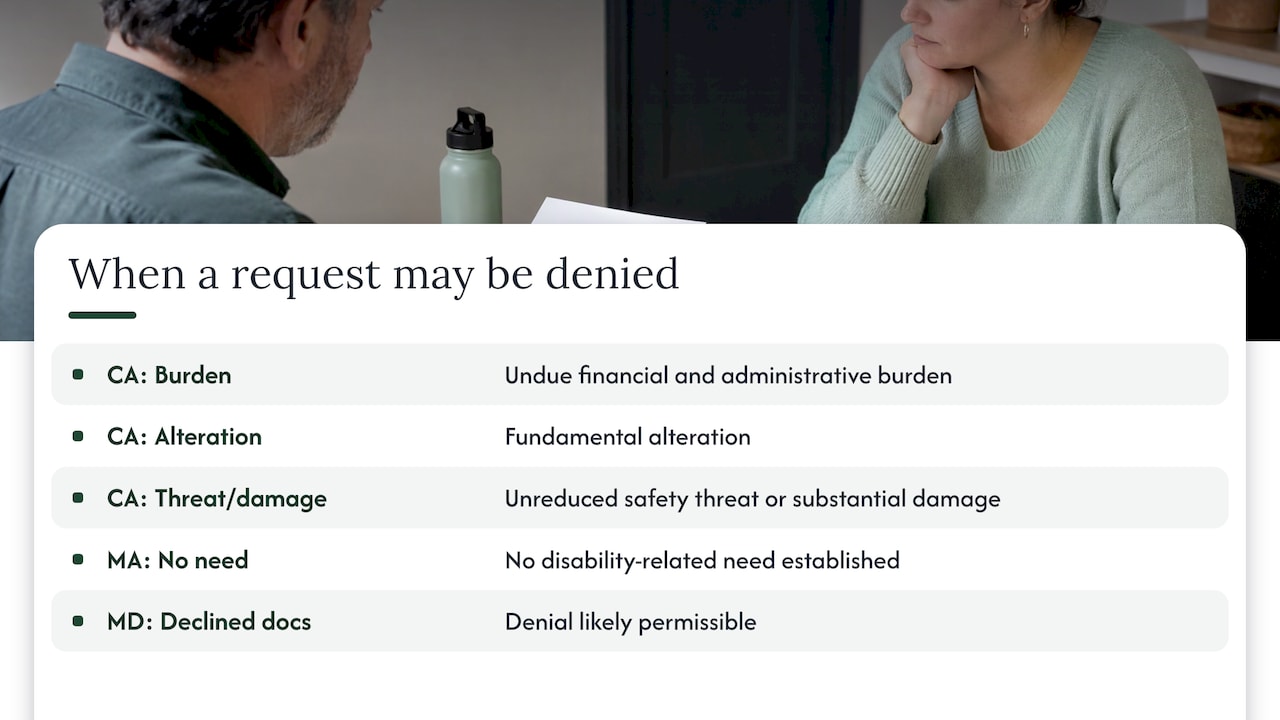
A landlord may ask for documentation when your disability or need is not obvious. California’s Civil Rights Department says that once you have shown a disability-related need, the provider may deny the request only for an undue financial and administrative burden, a fundamental alteration, or a direct threat to health or safety or substantial property damage that cannot be reduced by a reasonable accommodation. The decision must be case-specific and rest on credible, objective evidence.
Massachusetts guidance adds that a request can be denied if no disability-related need is established, and that a provider who sees a possible obstacle should discuss it with you and look for a solution in good faith. Maryland’s commission notes that if you decline to provide the requested documentation, denial will likely be permissible. So answer reasonable documentation requests promptly, and ask for any denial in writing with the reason.
The standard is need, not preference. Ithaca College draws that line, and the APA says disability means you require the animal’s presence to function or stay psychologically stable, not merely that you are fond of the animal. Your clinician’s letter should reflect your actual situation.
Perspective
Most of the trouble we hear about comes from people who bought paper instead of getting care. A registry certificate feels official, yet housing providers and universities are clear that it proves nothing on its own.
Our view is simple. The strongest file is a short, current letter from a licensed professional who knows you, a brief written request, and any animal records your housing office asks for. Nothing more is needed, and nothing less holds up.
We built Supportpet as free, plain-language education because the rules are easier than the scam sites make them look. Read your housing provider’s own checklist first, then build your file to match it.
Erik
Get the full picture before you apply
If you are still working out the steps, our rights guide to ESAs and ESA letters brings the housing, travel and letter basics together in plain language, free to read.
When you are ready to move from checklist to action, start with How to Get an ESA Letter in 2026 and bring this list to your first appointment.
FAQ
Do I need a diagnosis to get an ESA letter?
The letter needs to say you have a disability and connect it to the animal’s support, and professional guidance expects a recognized condition behind that. You do not have to disclose the diagnosis or your medical history to a private landlord. Campus offices often request more detail under their own policies.
Does my ESA need to be registered or wear a vest?
No. Federal-level and state housing guidance cited above says registrations, certificates, ID cards, vests and tags do not establish that you need an ESA. Your documentation comes from a licensed professional, not from a registry.
How long does approval take?
Private landlords have no single timeline, so ask for a written reply. Colleges publish their own windows, for example up to 15 business days at one university and up to 30 days at one community college after all documents arrive. Apply early.
Can a landlord deny my request even with a letter?
Yes, in limited cases. A provider can deny for an undue burden, a fundamental alteration, or a direct threat or substantial property damage that cannot be reduced, and the decision must rest on objective evidence about your animal. Ask for the reason in writing.
Sources
- HUD guidance on assessing requests for assistance animals (2020)
- Mass.gov: Assistance animals in housing
- American Family Physician community blog: Navigating requests for ESA letters
- American Psychiatric Association: Resource Document on Emotional Support Animals
- Ithaca College: ESA documentation criteria
- Maryland Civil Rights Commission: Disability Accommodations in Housing
- California Civil Rights Department: ESA and Fair Housing Law FAQ
- Indiana Housing and Community Development Authority: ESAs in no-pet housing
- East Stroudsburg University: ESA Packet
- Ottawa University: ESA Application Checklist
- Redlands Community College: ESA Accommodation Request Checklist
- UC Berkeley Housing: ESAs and Service Animals
- University ESA Checklist, revised August 2024
- University of Maryland ADS: ESA Housing Accommodation Request Form
Recommended
- ESA Letter Sample: What a Real Letter Looks Like (2026)
- Does an ESA Letter Expire? What U.S. Renters Need to Know
- ESA Letter Laws by State (2026): Who Can Write One, Where