
Explore this topic: Housing rights and landlord requests
A co-op board can keep a “no pets” rule, but in most places it still has to consider your request for an emotional support animal (ESA) as a reasonable accommodation for a disability. The board can ask for a short statement from a treatment provider. It can’t demand your diagnosis, charge a pet fee, or turn you down on a hunch. One thing changed in 2026: HUD, the federal housing agency, now treats untrained ESAs differently when it decides which complaints to pursue. That affects how you should prepare and where you file.
TL;DR
- A co-op’s no-pets rule is not an automatic “no.” NYC’s human rights agency says housing providers must permit an ESA as a reasonable accommodation unless it would cause undue hardship.
- If your disability isn’t obvious, the board may ask for a statement from a treatment provider. It may not ask for your diagnosis or medical records.
- Boards generally can’t charge pet fees or extra deposits for an ESA. You can still be held responsible for damage the animal actually causes.
- In May 2026, HUD stopped pursuing most complaints about untrained ESAs. State and local laws, and the Fair Housing Act itself, were not rewritten.
- Put your request in writing, keep copies, and know where to file if the board refuses.
Table of Contents
- Why co-ops feel different from rentals
- The basic rule: a no-pets policy still has to bend
- What changed in 2026: HUD’s May memo
- How to request an ESA accommodation from a board
- What the board can ask for
- When a co-op can say no
- Fees, breed limits and weight limits
- ESAs, service animals and public spaces
- If the board refuses
- Our perspective
- Start with the right letter
- FAQ
- Sources
Why co-ops feel different from rentals
In a rental, one landlord decides. In a co-op you own shares in a corporation, and a board of fellow shareholders runs it under a proprietary lease and house rules. Many of those rules ban dogs, cap their weight, or ban pets altogether. Boards often see these rules as a core part of what shareholders bought into.
That is why co-op boards are some of the most common targets of ESA disputes. Fair housing law still applies to them. Illinois’ Attorney General explains that the Fair Housing Act covers publicly and privately owned housing, including units governed by condominium or homeowners associations. Co-ops sit in the same family of housing.
The legal question is never “does the building allow pets?” It is “does this resident have a disability, and is the animal a reasonable accommodation for it?”
The basic rule: a no-pets policy still has to bend
The NYC Commission on Human Rights, in its ESA housing FAQ, says housing providers must permit an ESA as a reasonable accommodation for a disability unless doing so would cause an undue hardship. The same guidance notes that an ESA, unlike a service animal, does not need to be trained to perform a particular task.
Trade press for co-op boards says the same thing. CooperatorNews reports that a co-op may keep a no-pet policy but must allow an ESA as a reasonable accommodation absent undue hardship. It also recommends that boards word the policy as “no pets, except as a reasonable accommodation.” If your building’s house rules say that, you are looking at a rule written with this process in mind.
That is the New York picture. Other states have their own statutes and agencies, so check our state-by-state guide to ESA letter laws for where you live.
What changed in 2026: HUD’s May memo
On May 22, 2026, HUD’s fair housing office issued an enforcement memo on animals as reasonable accommodations. Two points matter for co-op residents:
- HUD says it will use the ADA’s training standard as a guide. Under that standard, emotional support, comfort, or companionship do not count as work or tasks.
- HUD will find reasonable cause for a denied pet-policy waiver only where the animal is individually trained to do work or tasks tied to the person’s disability. The memo also says waiver requests for untrained ESAs are not presumptively reasonable.
The disability rights group DREDF points out that the Fair Housing Act itself has not changed, and no court has ruled ESAs out. The memo changes what HUD staff will pursue, not the statute. State and city laws, private lawsuits, and local agencies remain open routes.
In practice, a co-op board may now feel more confident saying no to an ESA request. Your request is still a legal request, and it still deserves a documented answer. Our page on ESA housing rights after HUD’s change tracks how this is developing.
How to request an ESA accommodation from a board
No magic words are required. The Illinois Attorney General’s guide says an assistance animal request can be made at any time and needs no special wording. Still, a clean paper trail helps.
- Find the process. NYC guidance says housing providers should have written policies, with a named contact and process, for reasonable accommodation requests. Check your house rules or ask the managing agent.
- Write the request. Say you are requesting a reasonable accommodation to the no-pets rule for an emotional support animal. Name the animal and its species. You don’t need to describe your condition.
- Attach a provider statement. Ask a licensed treatment provider for a letter. Our sample ESA letter shows what a real one contains.
- Send it so you can prove it. Email plus certified mail works. Keep every reply.
- Ask for a written decision. CooperatorNews advises management to acknowledge requests promptly in writing and to hold off on enforcing the no-pets rule while it reviews.
If you don’t have a letter yet, see how to get an ESA letter the legitimate way.
What the board can ask for
The board may verify two things: that you have a disability, and that the animal helps with it. It may not go further.
| The board may | The board may not |
|---|---|
| Ask for a statement from a treatment provider if your disability or need isn’t obvious | Ask for your specific diagnosis or medical records |
| Ask how the request relates to the disability | Insist on a particular form |
| Ask for reliable documentation that the request is necessary | Reject a letter because it isn’t dated within a set time of the request |
| Expect reasonable conduct once approved | Require proof the animal was trained, for an emotional support animal |
The rows come from several sources. NYC’s agency says that when the need isn’t readily apparent, the provider may request confirmation from a treatment provider that you have a disability and the animal would help treat it, but may not require the underlying disability to be disclosed or reject requests over rigid documentation rules. Illinois guidance says a note from a medical professional should suffice. A DOJ consent decree policy appendix describes the same standard for emotional support animals: a statement from a health or social service professional that the applicant has a disability and the animal would ease identified symptoms.
The practical takeaway: a short, signed letter from a licensed provider who knows you does the job. A certificate, registry listing, or ID card bought online does not, and a board is right to ignore one.
When a co-op can say no
The duty to accommodate has limits. Illinois guidance lists the grounds: a request can be denied if it would create an undue financial or administrative burden, pose a direct threat to others’ health or safety, or cause substantial physical damage to others’ property, unless a reasonable accommodation can reduce the problem.
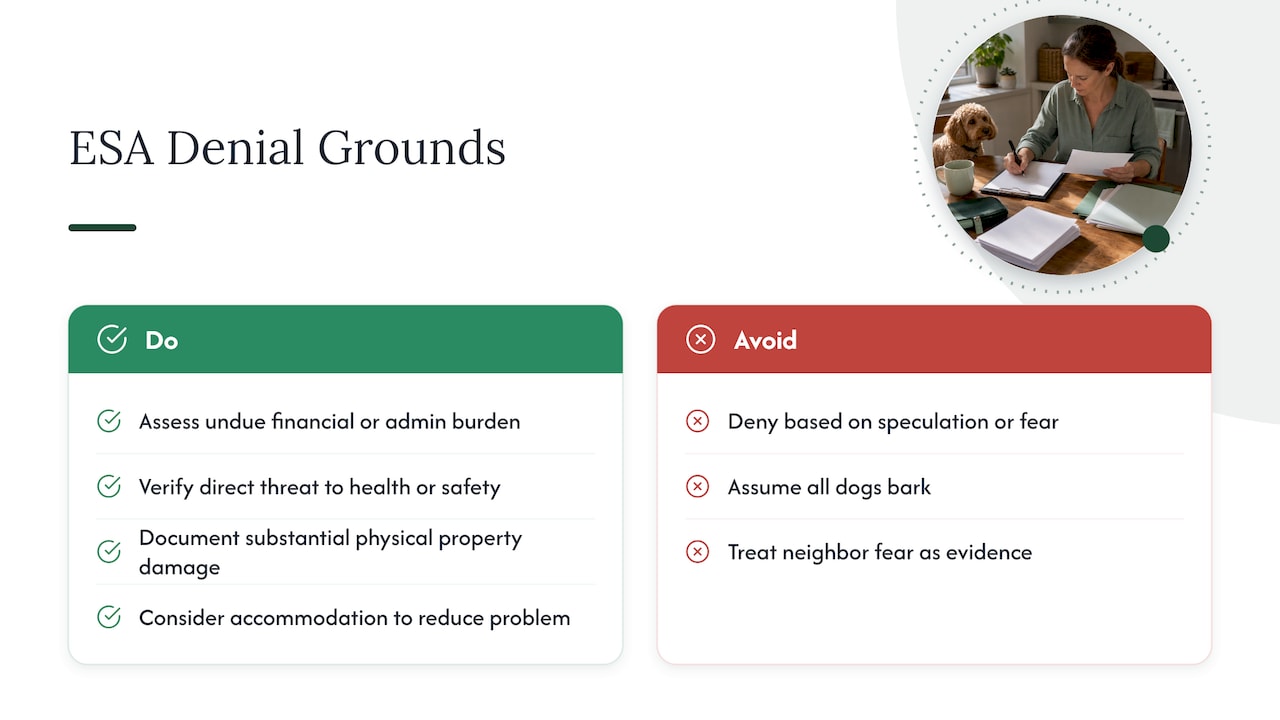
The DOJ appendix adds that a denial based on threat or damage must rest on reliable, objective evidence of the animal’s actual behavior, not speculation or fear. So a board can’t deny an ESA because dogs in general bark, or because a neighbor is nervous. It can act on a specific animal’s documented aggression or destruction.
After HUD’s May 2026 memo, expect more boards to also argue that an untrained animal isn’t covered. That is a policy position of a federal agency, not a settled holding on state or city law. If you receive that answer, ask for it in writing and read the next two sections.
Fees, breed limits and weight limits
This is where boards most often overreach. NYC’s guidance says housing providers cannot preemptively:
- charge additional security deposits or pet fees,
- require additional renter’s insurance,
- make you use a different entrance or elevator because of your ESA.
They must also exempt ESAs from breed, weight and size restrictions unless the exemption would cause undue hardship. Illinois guidance adds that a request can’t be denied solely because of a restricted-breeds policy; the board should assess the individual animal.
A 30-pound limit, then, is not a valid reason to refuse a 45-pound ESA on its own.
Approval does come with ordinary responsibilities. CooperatorNews notes boards may require reasonable measures such as leashing in common areas, cleaning up after the animal, and paying for damage it actually causes. Following those rules protects your standing if anything is disputed later.
ESAs, service animals and public spaces
The co-op rules above apply to housing. They don’t give your ESA access to stores, restaurants or lobbies where pets aren’t allowed. Housing law asks whether an animal helps with a disability; public access law asks whether a dog has been trained to do specific tasks. HUD’s memo uses the ADA’s definition, which excludes comfort and companionship from “work or tasks.”
For common areas, this means your ESA may live in your apartment but be treated as a pet in the lobby, leashed and under control. For the full comparison, see ESA vs. service dog differences. A cat that lives quietly in your unit is a very different request for a board than a large dog; our guide to emotional support cats covers that route.
If the board refuses
Start by getting the refusal in writing, with its stated reason. Then:
- Answer the reason. If it’s a fee or a size limit, point to the guidance above. If it’s about a behavior incident, ask what evidence exists.
- File a complaint. HUD says people who believe they were denied a reasonable accommodation can contact its Office of Fair Housing and Equal Opportunity or use hud.gov/fairhousing. Given the May 2026 memo, also look at your city or state human rights agency. In New York City that is the Commission on Human Rights.
- Consider local legal help. A tenant-side attorney or legal aid office can tell you which state and city laws apply to your building.
- Don’t retaliate or ignore the rule on your own. Keep the animal out of any disputed space only if counsel tells you otherwise, and keep every record.
Co-ops have been charged before. In 2015 HUD charged a large Brooklyn cooperative and its board president after a veteran with a psychiatric disability was refused an ESA and then faced eviction steps. In 2011 HUD alleged another New York co-op kept denying a no-pets exception despite letters verifying a tenant’s need. Those are allegations and charges from an earlier federal approach, not a guide to how today’s HUD would act, but they show boards are not exempt from fair housing law.
Our perspective
Co-op residents get two kinds of bad advice. One is the board that says “we’re a co-op, our rules are different.” The other is the website that sells you a registration or an ID card and promises it will force the board’s hand.
Neither is right. What moves a board is a plain written request and a short letter from a licensed clinician who actually knows you. We built this site to explain that process in plain language, and to warn you off paper that carries no legal weight.
The 2026 HUD memo makes careful preparation more important, not less. Know your state and city rules, keep your paper trail, and use the right agency. We’d rather you walk into a board meeting calm and documented than hopeful and holding a certificate.
Erik
Start with the right letter
If you’re preparing a request, begin with the basics: who may write the letter, what it should say, and what to avoid. Our ESA rights guide walks you through each step for free, and our page on spotting ESA letter scams shows what a worthless product looks like.
FAQ
Can a co-op board legally ban all dogs and still refuse my ESA?
A building can keep a dog ban as a general rule. NYC guidance says ESAs must be allowed as a reasonable accommodation unless it causes undue hardship, so a blanket ban alone isn’t a lawful reason to refuse. Since HUD’s May 2026 memo, though, federal enforcement for untrained ESAs is limited, so check your state and city law.
Does the board get to see my diagnosis?
No. NYC and Illinois guidance both say a housing provider may ask for confirmation from a treatment provider that you have a disability and the animal helps, but may not require disclosure of the specific condition or your medical records.
Can the co-op charge a pet deposit or monthly pet fee for my ESA?
NYC guidance says housing providers can’t preemptively charge extra deposits or pet fees, or require extra insurance, because of an ESA. You may still be responsible for damage your animal actually causes.
Does an online ESA registration or certificate help?
No. The documentation guidance in the sources above points to a statement from a licensed treatment provider, not a registry listing or ID card. See our guide to what a legitimate letter looks like.
How long should I expect the board to take?
The sources set no single deadline. CooperatorNews advises boards to acknowledge a request promptly in writing. Ask for a decision date in your request and follow up in writing if it passes.
Sources
- NYC Commission on Human Rights: Emotional Support Animals in Housing FAQ
- CooperatorNews: Q&A: No Pets vs. ESA Accommodations
- CooperatorNews: Reasonable Accommodations vs. Board Rules
- Illinois Attorney General: A Guide for Individuals: Assistance Animals
- DOJ consent decree, United States v. Rutherford Tenants
- HUD enforcement memo on animals as reasonable accommodations (May 22, 2026)
- DREDF: HUD’s Policy Reversal on Emotional Support Animals
- HUD Archives: HUD charges Brooklyn co-op (2015)
- HUD Archives: HUD charges New York co-op (2011)
Recommended
- ESA Letter Laws by State (2026): Who Can Write One, Where
- ESA Housing Rights in 2026: What HUD’s Change Means
- ESA Letter Sample: What a Real Letter Looks Like (2026)
- How to Get an ESA Letter in 2026: The Honest Steps