Explore this topic: Housing rights and landlord requests
There is no separate “Section 8 ESA.” A voucher pays part of your rent, and an emotional support animal is a reasonable accommodation request under fair housing law. The two run on separate tracks. Since HUD’s May 22, 2026 enforcement change, federal protection for animals that are not individually trained is much weaker. Many state and local laws still protect them, so where you live matters a great deal.
TL;DR
- A Section 8 voucher and an ESA are separate things. The voucher helps pay rent. An ESA request asks your landlord or housing authority to make an exception to a pet rule.
- On May 22, 2026, HUD said it will no longer find reasonable cause in complaints about animals that are not individually trained to perform disability-related tasks. Some state laws are unaffected.
- Documentation should come from a licensed clinician who knows you, not from an online registry or certificate.
- If a request is denied, you can use your housing authority’s appeal process, file a complaint with HUD, or look to your state’s fair housing agency. You do not have to go through the housing authority first.
- ESAs have no public-access rights in stores or restaurants. Only trained service dogs do.
Table of Contents
- What Section 8 is, and what an ESA is in housing
- Voucher approval and ESA approval are two different decisions
- Who you ask: your landlord and your housing authority
- What HUD’s 2026 change means for voucher holders
- Documentation: what a valid letter looks like
- Fees, deposits and the limits on your request
- If your request is denied
- ESAs and public places
- Where to go from here
- FAQ
- Sources
What Section 8 is, and what an ESA is in housing
Section 8 is the common name for the Housing Choice Voucher program. According to HUD, it helps low-income families, older adults, veterans and people with disabilities afford private-market housing. The subsidy goes straight to the landlord, and roughly 2,000 public housing agencies (PHAs) run the program with HUD funding.
An emotional support animal is different. In HUD’s assistance animal guidance, an assistance animal is not a pet. It works, assists or performs tasks for a person with a disability, or it provides emotional support that eases one or more identified effects of that disability. Dogs are the most common, but HUD’s 2013 notice said other animals can qualify too, and that the animal does not have to be individually trained or certified.
That last point is the one that has changed. More on it below.
Voucher approval and ESA approval are two different decisions
People often mix these up, so it helps to see them side by side.
| Section 8 voucher | ESA accommodation | |
|---|---|---|
| What it is | Rental subsidy | Exception to a pet policy |
| Who decides | Your local PHA | Your landlord, and the PHA when it is the housing provider or sets program rules |
| Based on | Income, household size, eligibility rules | Disability-related need for the animal |
| Paperwork | Pay stubs, ID, Social Security cards and similar | A letter from a licensed health care provider |
| Effect on the other | None | None |
HUD says you apply for a voucher through your local PHA. Because of long waiting lists, you may need to apply to several PHAs. Documents usually include income paperwork, proof of citizenship and Social Security cards, and the exact list varies by agency.
Having a voucher does not make an ESA request easier or harder to get. Having an ESA letter does not move you up a voucher waitlist. Treat them as two separate applications.
Who you ask: your landlord and your housing authority
With a voucher you usually deal with two parties. The private landlord owns the unit and sets the pet policy. The PHA administers your assistance. HUD’s HCV Guidebook chapter on fair housing (April 2025) says a PHA or owner must provide a reasonable accommodation when there is a disability-related need, unless the request is an undue financial and administrative burden or a fundamental alteration of the program. It also says you start the process by making a request.
A practical way to do it:
- Ask in writing. Email or letter, with a date, so you have a record.
- Name the request. Say you are requesting a reasonable accommodation to the pet policy for an assistance animal because of a disability.
- Attach your clinician’s letter. Details below.
- Send it to the right party. Usually the landlord or property manager first. If your PHA also has a reasonable accommodation policy that applies to your situation, ask the PHA what it needs.
- Keep copies of everything you send and receive.
PHAs must decide accommodation requests case by case. If there is a disability-related need, they must approve unless it would fundamentally alter the program or create an undue burden. Before denying, they must go through an interactive process to look for an alternative.
What HUD’s 2026 change means for voucher holders
This is the part most pages skip over, and it matters most for a keyword like this one.
On May 22, 2026, HUD issued an enforcement memorandum. The Maine Human Rights Commission’s guidance describes it this way: HUD will no longer find reasonable cause in housing complaints about emotional support animals. Animals that give comfort or companionship but have not been individually trained to perform specific disability-related tasks are no longer protected at the federal level. Law firm Holland & Knight reports that HUD will pursue cases only for animals trained to help with the person’s specific disability, in line with the ADA’s service animal definitions. It also reports that housing providers are no longer expected to automatically grant requests, including fee waivers, for untrained assistance animals.
Earlier, on September 17, 2025, HUD told its fair housing staff it was eliminating prior guidance, including FHEO Notice 2013-01 and FHEO 2020-01. The National Apartment Association noted that the memo says the withdrawal is not necessarily final.
For a voucher holder, three things follow.
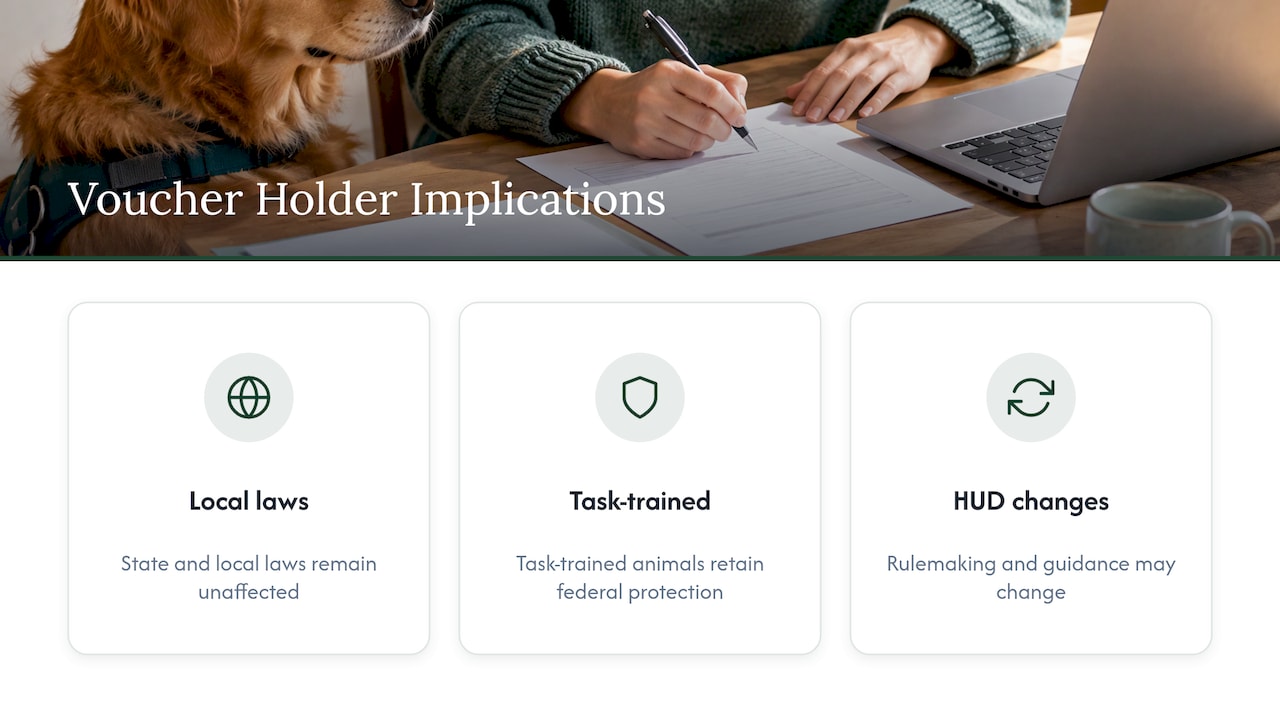
The federal rule is not the only rule. Holland & Knight notes that state and local laws are not affected by the federal change, and that HUD plans notice-and-comment rulemaking to align its regulations with the ADA. The Maine commission states that its state act expressly includes emotional support animals, is not subordinate to HUD’s enforcement priorities, and stays fully in effect. California’s civil rights agency takes the same practical view in its ESA and fair housing FAQ: when a tenant asks for an ESA as an accommodation to pet restrictions, the provider must allow it or promptly engage in the interactive process.
Individually trained animals remain protected. If your animal has been trained to do disability-related tasks, the federal framework still applies to you.
Details will keep moving. Rulemaking is planned and the 2025 withdrawal was described as not necessarily final. We track the changes on our page about ESA housing rights in 2026, and our state-by-state ESA letter guide shows how your state treats ESA letters.
Documentation: what a valid letter looks like
Your landlord or PHA may ask for documentation when your disability or your need for the animal is not obvious. California’s agency says a tenant only has to disclose enough to document the disability-related need, not the disability itself.
A legal aid guide from 603 Legal Aid says the request should go to the provider who has advised you to rely on the animal, such as a doctor, therapist or licensed social worker. A good letter:
- identifies the provider and the practice,
- confirms you are their patient,
- explains how the disability affects major life activities, without an unnecessary diagnosis,
- and says the provider recommends a particular type of animal to help manage symptoms.
The same source warns that online certificates may not be legitimate and a landlord may not have to accept them. Housing authorities say it plainly too. New York City’s housing authority says that in its admissions and occupancy policy, an online certificate from a vendor, by itself, is not acceptable proof of disability or need. Where the disability is not observable, it may ask for information from a health care professional.
You can see what a well-formed letter contains in our ESA letter sample.
Registries, ID cards, vests and “certifications” are not part of the process. They are what scam sites sell. What counts is a licensed clinician’s recommendation based on a real relationship with you.
If you are working with a therapist on anxiety or trauma, it can also help to understand how animals fit into treatment. This overview of service dogs and anxiety covers how trained dogs support people with anxiety and PTSD.
Fees, deposits and the limits on your request
Under the HCV Guidebook, a housing provider may not exclude animals by type, breed, size or age, or charge a fee or deposit for assistance animals even when it does so for pets. That guidebook is dated April 2025, before the May 2026 change, so ask your PHA how it applies the rule now. In California, the state agency says no pet deposit, pet rent or other fee may be charged for an ESA. Miami-Dade’s housing agency, for one, does not charge a pet deposit for an assistive animal in its county-owned developments.
Fair housing law has always had limits. HUD lists the grounds on which a provider can say no: an undue financial and administrative burden, a fundamental alteration, a direct threat to the health or safety of others, or significant property damage. In California and Miami-Dade, you remain responsible for damage the animal causes, beyond ordinary wear and tear.
Safe use of your accommodation means:
- keeping the animal under control and cared for,
- following normal community rules on noise, waste and neighbors,
- reporting and repairing any damage promptly.
An animal that behaves well is the best protection against a “direct threat” claim.
If your request is denied
Do not give up after one no. HUD’s HCV Guidebook says people whose requests are denied can appeal using the PHA’s reasonable accommodation policy or grievance procedures. It adds that anyone who believes a request was improperly denied may file a complaint with HUD and does not have to use the PHA’s grievance process first.
Steps to take:
- Ask for the reason in writing. A denial based on an undue burden or direct threat should be specific.
- Offer alternatives. A PHA must go through an interactive process before denying, so propose a different arrangement if there is a real concern.
- Use the PHA appeal route if the housing authority made the decision.
- Contact your state or local fair housing agency. After HUD’s 2026 change, this may be your strongest route in states that expressly protect ESAs. Maine’s commission is one example.
- Talk to legal aid. Free civil legal aid organizations often handle housing discrimination cases for low-income tenants.
Our ESA housing rights guide walks through the complaint paths in more detail.
ESAs and public places
A voucher-based ESA accommodation covers your home. It does not cover restaurants, stores or flights. HUD’s 2013 notice recalls that under the ADA a service animal is a dog individually trained to do work or perform tasks for a person with a disability, and that emotional support, comfort and companionship do not count as work or tasks. Public access is for trained service dogs only.
Our view: start with the clinician, not the certificate
We built this site because people with anxiety, depression or PTSD kept being sold paper that does nothing. A registry number does not protect a tenant. A licensed clinician’s recommendation, a clear written request and knowledge of your own state’s law do.
Voucher holders have less room for error than most renters. You are dealing with a landlord, a housing authority and sometimes a state agency, and a weak letter gives any of them a reason to say no. Our approach is simple: learn what a legitimate letter contains, find out how your state treats ESAs after the 2026 federal change, and keep every request in writing.
We do not sell certificates, registrations or ID cards, and we never will. Our job is to explain the rules in plain language so you can decide with confidence.
Erik
Where to go from here
If you are ready to find out what your state requires of an ESA letter, our free guides take you through the process step by step, from who can write a letter to what to say to your landlord. Start at the Supportpet ESA letter guide, then check your state in the ESA letter laws by state page.
The guides are free to read. We do not sell documents or registrations, so what you read is what you need to know before you talk to a licensed clinician.
FAQ
Can I have an ESA with a Section 8 voucher?
Yes, you can request one, and the voucher does not stand in the way. You ask your landlord, and your housing authority where it applies, for an accommodation to the pet policy. Whether federal law backs the request depends on whether your animal is individually trained, following HUD’s May 2026 change. Your state’s law may protect you either way.
Is it illegal for a landlord to say no to an ESA?
It depends on your state and your animal. Federal enforcement now focuses on individually trained animals. Some states, such as Maine and California, protect ESAs under their own laws. Valid reasons to refuse include undue burden, a direct threat or significant property damage.
Do I need an ESA letter to request an accommodation?
If your disability or need is not obvious, the provider can ask for documentation. The standard source is a letter from a licensed clinician who treats you. An online certificate or registry listing alone is not enough.
Will a landlord charge pet rent for my ESA?
HUD’s HCV Guidebook says providers may not charge fees or deposits for assistance animals. California’s agency says the same for ESAs. Because federal enforcement changed in 2026, confirm how your state and PHA handle it. You may still owe for damage the animal causes.
How do I get approved for Section 8?
Apply through your local PHA. Expect to provide income and identity documents, and expect waitlists. HUD notes you may need to apply to more than one PHA. Applying for a voucher is separate from requesting an ESA accommodation.
Sources
- Housing Choice Voucher Tenants, HUD
- Assistance Animals, HUD
- FHEO Notice 2013-01, HUD
- HCV Guidebook: Fair Housing and Nondiscrimination, HUD
- PHA Fact Sheet: Reasonable Accommodations in Public Housing
- Maine Human Rights Commission guidance on HUD assistance animal change
- HUD Rescinds Emotional Support Animal Guidance, Holland & Knight
- HUD Announces Key Fair Housing Updates, National Apartment Association
- Emotional Support Animals and Fair Housing Law FAQ, California Civil Rights Department
- Accommodation and Modification FAQs, 603 Legal Aid
- ACOP Chapter 14, NYCHA
- Policy on Reasonable Accommodation, Miami-Dade Housing
- How Service Dogs Help Children With Anxiety, Autism, And PTSD
Recommended
- ESA Housing Rights in 2026: What HUD’s Change Means
- Does an ESA Letter Expire? What U.S. Renters Need to Know
- ESA Letter Laws by State (2026): Who Can Write One, Where