
Explore this topic: ESA letters and documentation
Yes, an electronic ESA letter can be valid. A PDF, an emailed copy or a letter written after a video visit is not the problem. What matters is who wrote it and what it says: a licensed clinician who knows your situation, who is licensed to practice where you live, and who ties your need for the animal to a disability. Delivery format is secondary. And since 2026 there is one more thing to know: HUD changed how it handles complaints about animals that have no task training, which affects what a letter can accomplish in housing.
This guide explains what makes a digital letter valid, what a landlord may ask for, what to do about renewals, and where the 2026 change leaves you. For the housing side in more depth, see our explainer on ESA housing rights in 2026.
TL;DR
- An electronic ESA letter is valid when a licensed clinician with personal knowledge of your condition writes it. Being digital does not make it weaker.
- Registrations, ID cards, certificates and patches bought online do not establish a disability-related need, and some state laws say so in plain words.
- A good letter carries the clinician’s name, license type and number, the date, and a link between the animal and your symptoms. It does not need your diagnosis.
- Landlords may ask for reliable supporting information, but they may not demand your medical records or a notarized form.
- In May 2026 HUD said it will pursue complaints only for animals trained to perform tasks, so an untrained ESA is no longer presumed to be a reasonable request under HUD’s enforcement approach.
Table of Contents
- What “valid” actually means for an ESA letter
- Electronic and telehealth letters: what the law says
- What a valid letter should contain
- What does not make a letter valid
- How a landlord can verify your letter
- Does an ESA letter expire?
- What changed with HUD in 2026
- Outside housing: stores, restaurants and travel
- Steps to get a letter that holds up
- Why we say it plainly
- Where to go next
- FAQ
- Sources
What “valid” actually means for an ESA letter
An ESA letter is a document from a licensed health care professional. It is not a government registration, and no official registry exists. Massachusetts state guidance states that there is no recognized official registry or certification program for service dogs, emotional support animals or other assistance animals.
So validity comes down to the substance of the letter and the person behind it. Four things carry the weight:
- A licensed professional. A therapist, psychologist, psychiatrist, counselor, physician or similar clinician licensed in your state. One university’s documentation packet notes that the provider must have direct personal knowledge of you, and it explicitly allows for virtual interactions.
- A real evaluation. The clinician has assessed you, in person or by video, and knows about your condition and how it affects daily life.
- Specific content. Credentials, date, signature, and the connection between your disability and the animal.
- Something a landlord can verify. A license number and contact details let a housing provider confirm the letter is genuine.
Notice that “electronic” appears nowhere in that list. A signed PDF from a real clinician is the same document as a printed one.
Electronic and telehealth letters: what the law says
Telehealth is explicitly recognized in at least some state statutes. Florida’s housing law, section 760.27 of the 2026 Florida Statutes, lists information from a telehealth provider among the supporting information a housing provider may request. It treats that information as reliable when the provider has personal knowledge of the person’s disability and acts within their scope of practice.
The key phrase is personal knowledge. A video visit where a clinician actually evaluates you can meet it. A checkout form and a payment page cannot.
Electronic signatures are accepted by institutions that handle these letters every term. Ohio State’s disability services guidance for clinicians says the signature may be digital (timestamped) or handwritten. Other schools and landlords have their own forms and preferences, so confirm what yours accepts.
Rules differ by state, so if you live outside Florida, check your own state’s housing and licensing rules, and make sure the clinician is licensed where you live. One university packet lists state of licensure among the required details, and a clinician licensed only elsewhere is a common reason letters are rejected.
What a valid letter should contain
There is no single federal form. Still, official and university sources agree on a core set of details. Massachusetts guidance describes a best-practice letter as including:
- the professional’s name, title, organization and address, and ideally license and contact details
- the date the letter was written
- an indication of an ongoing treatment relationship
- a statement of whether your condition rises to the level of a disability
- the connection between the animal and your disability symptoms
- the species of animal, with a justification if it is an uncommon one
The same page says a diagnosis is never required. That surprises many readers. You do not have to hand your diagnosis to a property manager.
In Montana, the law goes further and requires supporting information to include the effective date, license number and type of professional license. A university packet adds the clinician’s phone, email, signature and state of licensure.
College housing offices often ask for more than landlords do. Ohio State’s guidance for clinicians, for example, asks for the length of care, how the animal eases the condition’s impact, and what difficulties arise without the animal. If you are a student, check your school’s disability services page before you book an appointment, so your clinician writes to the right checklist the first time.
A quick check of your own letter
Read your letter against this list:
| Element | What to look for |
|---|---|
| Clinician | Full name, license type, license number, state |
| Date | Issued recently, ideally within the past year |
| Relationship | Shows the clinician evaluated you and knows your situation |
| Link to the animal | Explains how the animal helps with symptoms of your disability |
| Contact details | Phone, email or office address a landlord can use to verify |
| Signature | Handwritten or digital, with a date |
| Animal | Species identified |
If something is missing, ask your clinician to add it. That is a normal request.
What does not make a letter valid
The fastest way to lose a housing request is to lean on something that looks official but is not.
Florida’s statute says an ESA registration of any kind, including an identification card, patch, certificate or similar registration obtained from the internet, is not by itself sufficient to reliably establish a disability or a disability-related need. Montana’s law says the same about registrations obtained electronically or in person. Massachusetts guidance goes further on sales sites: a letter or certificate bought from a website after a short interview is not considered sufficient documentation.
To see the pattern, think of what a legitimate evaluation involves: a conversation about your symptoms and history with someone licensed to assess them. A page that promises instant approval, a number to “register” your pet, or a vest and ID card for a fee skips that step. Our guide to ESA registration versus a letter breaks down which documents count and which are just merchandise.
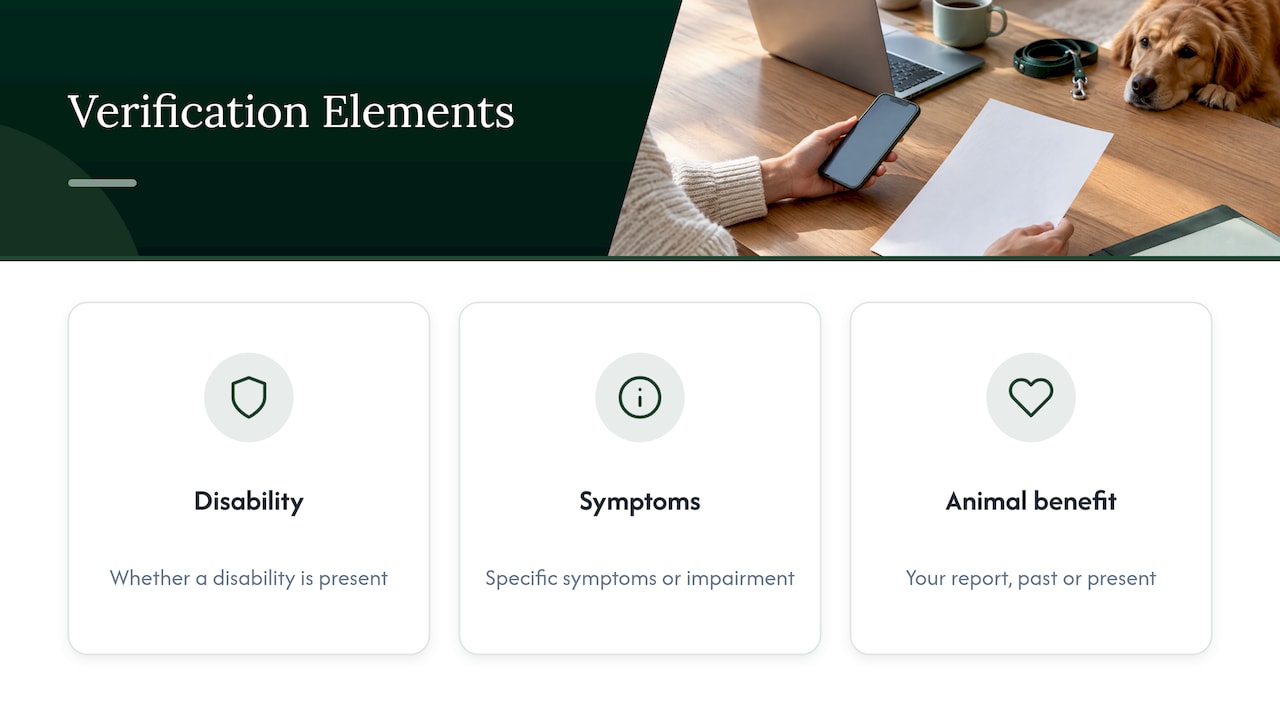
A peer-reviewed scoping review of professional guidelines in the Journal of Legal Medicine found that verification practices converge on three things: the disability, the specific symptoms or impairment, and your own report of the benefits the animal gives you, past or present. A real evaluation covers all three.
How a landlord can verify your letter
Housing providers are allowed to ask for reliable information when your disability is not obvious. Florida’s statute is a clear example of the limits. Under it, a provider may not:
- ask for information disclosing your diagnosis or the severity of your disability
- ask for medical records
- require a specific form or a notarized statement
- deny your request solely because you did not use their routine process
All of that appears in section 760.27 of the Florida Statutes. Other states have their own wording, so read yours.
In practice, verification means the landlord confirms the clinician is real and licensed, and that the letter supports a need for the animal. A license number and a working phone number or email make that easy. That is why those details matter more than any design on the page.
If you are asked for medical records, know that you generally do not owe them for this purpose, and that you have rights to your own records if you want a copy. Patient advocates explain how to request your medical records faster than the standard deadline in some cases.
Massachusetts guidance adds a practical point: many housing providers suspect that some people pass a pet off as an assistance animal. Letters with specifics about the limitations the animal addresses help reassure them. The state suggests discussing with your clinician how to describe symptoms so the letter is persuasive while protecting your privacy. That conversation is worth having before the letter is written, not after a denial.
Does an ESA letter expire?
There is no universal expiration printed on an ESA letter, and the law you live under may not set one. What the letter carries is a date, and many landlords and schools like to see a recent one, often within the past year. A current letter shows that your clinician still considers the animal part of your care.
Treat it like this:
- Put a calendar reminder 60 days before the one-year mark of the letter’s date.
- Ask your clinician whether an updated letter makes sense at your next regular visit.
- Before a lease renewal or a new school year, check whether your landlord or housing office wants a newer date.
Schools generally publish their own deadlines and forms, so look at the housing office page rather than guessing.
What changed with HUD in 2026
This is the part that has people searching for validity. HUD rescinded its 2013 and 2020 assistance-animal guidance notices on September 17, 2025. Then on May 22, 2026, its Office of Fair Housing and Equal Opportunity issued an enforcement memo. It says the office will find reasonable cause on a pet-policy-waiver complaint only where the animal is individually trained to perform work or tasks directly related to the disability. Requests to waive pet policies for untrained ESAs are not presumptively reasonable.
What that means for you:
- The letter is still a letter. It is documentation from a licensed provider, and its validity is judged by the same elements as before. The memo did not make ESAs illegal.
- HUD’s complaint process looks different. For an untrained ESA, a HUD complaint is less likely to be pursued. The memo also says HUD intends notice-and-comment rulemaking to align its regulations with the ADA.
- Other routes remain. The memo preserves the right to bring a private civil action within two years, and state and local laws may offer their own protections. Florida’s statute, for example, still lists ESA documentation among reliable supporting information.
Because this is moving, ask a housing attorney or your local fair housing organization about your situation if a landlord refuses. Our page on what HUD’s change means is where we keep the housing details current.
Outside housing: stores, restaurants and travel
A letter does not open doors in shops. Under the DOJ’s ADA Title III rules at 28 C.F.R. Part 36, providing emotional support, comfort or companionship does not count as work or tasks for a service animal. A business may ask only two questions: whether the animal is required because of a disability and what task it has been trained to perform. It may not demand certification or training documents. So a store can allow an ESA as a courtesy, but you cannot expect it as a right.
Steps to get a letter that holds up
- Start with a clinician who can evaluate you. If you already have a therapist or doctor, begin there. A clinician who knows your history can write about it from personal knowledge.
- Confirm licensure in your state. Ask for the license type and number and check them with your state board.
- Check what your landlord or school wants. Colleges often have their own forms. Our guide on what clinicians and landlords accept walks through the usual requirements.
- Review the draft. Use the table above. Make sure the date, license details and link between the animal and your symptoms are there.
- Send it simply. Email a signed PDF or upload it to the portal. Keep a copy. You do not need to notarize it or add a registration number.
- Skip the extras. Vests, IDs and registry entries add nothing legally. If you have a dog, see how renters make a dog an emotional support animal without registries or fees.
Why we say it plainly
We are a free information site. We do not sell certificates, registrations or ID cards, and we do not issue letters. That is exactly why we can tell you the same thing every time: validity comes from a licensed clinician who knows you, not from a file format or a badge. Our rights guide collects the housing, school and travel rules in one place, written in plain language.
Our view
Most of the confusion around electronic letters comes from sites that sell paperwork. They want you to think the document is the product. We see it the other way around: the care relationship is what counts, and the letter simply records it.
That is why we focus on what a clinician should write, what a landlord may ask and what is just decoration. A digital letter from a licensed professional who has evaluated you is the real thing. A certificate from a registry is not.
We keep our guides free and updated because rules, including HUD’s 2026 shift, change faster than most people can follow. Our aim is to leave you able to read your own letter and your own state’s rules with confidence.
Erik
Where to go next
If you are preparing a housing request, start with our ESA housing rights guide. It covers what HUD’s 2026 memo changes, what you can still ask your landlord for, and how to document your request.
If you want a broader overview first, the rights guide covers letters, housing, school and travel in one place.
FAQ
Is an ESA letter sent by email or PDF legitimate?
Yes, if it comes from a licensed clinician who has evaluated you and includes their credentials, license number, date and signature. A digital timestamped signature is accepted by institutions such as Ohio State. The format is not the test, the clinician and the content are.
How do landlords verify an ESA letter?
They typically check that the clinician is licensed and that the letter supports a need for the animal, using the license number and contact details. In Florida they may not require your diagnosis, your medical records or a notarized form. Other states have their own limits.
Do I need to register my emotional support animal?
No. There is no official registry, and Florida and Montana law both say a registration, ID card or certificate is not by itself enough to show a disability-related need. A letter from a licensed clinician is the document that matters.
Can a landlord deny my ESA request after HUD’s 2026 change?
Landlords can still deny requests that are not supported, and HUD’s May 2026 memo says it will pursue complaints only for animals trained to do disability-related tasks. Your state or local law and private legal options may still apply, so contact a housing attorney or fair housing group if you are refused.
Sources
- Chapter 760, Section 27, 2026 Florida Statutes
- Assistance animals in housing, Mass.gov
- Montana Code 70-33-110, Emotional support animals documentation
- Ohio State Emotional Support Animal Documentation Guidance
- Letter of Recommendation Packet for Emotional Support Animal
- Supporting Rights to Emotional Support Animals, Journal of Legal Medicine
- HUD FHEO enforcement memo, May 22, 2026
- 28 C.F.R. Part 36, ADA Title III regulations
- Request medical records faster
Recommended
- Avoid ESA Letter Scams: Which Clinicians Housing Providers Trust for Renters
- ESA Registration vs. Letter: What Actually Counts
- 3 Sample ESA Letter Templates That Pass HUD Checks
- Getting an ESA Letter for Housing Under the Fair Housing Act