
Explore this topic: Housing rights and landlord requests
You can file a housing discrimination complaint with HUD online, by phone at 1-800-669-9777, or by mail, and it costs nothing. Since May 2026, though, HUD’s enforcement office investigates animal-related complaints only when the animal is trained to do disability-related work or tasks. If your landlord denied an untrained emotional support animal (ESA), your strongest routes are your state or local fair housing agency and a private court action. Both are covered below, along with exactly what to put in a complaint.
TL;DR
- HUD takes complaints through its online portal, a toll-free line (1-800-669-9777) or a mailed form. There is no filing fee.
- As of May 22, 2026, HUD’s enforcement office will recommend charges only for trained assistance animals, and it no longer expects providers to categorically accommodate untrained ESAs.
- HUD’s guidance does not change the Fair Housing Act itself. You can still sue in court within two years, and state or local agencies can still act under their own laws.
- A strong complaint names you, the housing provider, the address, the date and exactly what was denied or demanded.
- Retaliation for filing is illegal. Keep your records in order from the first request.
Table of Contents
- What changed in 2026, and why it matters before you file
- Which route fits your situation
- How to file a HUD complaint, step by step
- The deadline: do not let it run out
- When HUD is not the right agency
- What landlords may and may not do
- Keep your records in order
- Our perspective
- Where to start with your documentation
- FAQ
- Sources
What changed in 2026, and why it matters before you file
For years, a HUD complaint was the standard answer to an ESA denial. That has shifted. On May 22, 2026, HUD rescinded its 2020 assistance-animal notice and issued new enforcement guidance. Under it, the Office of Fair Housing and Equal Opportunity (FHEO), the part of HUD that investigates discrimination, will find reasonable cause and recommend charges only for accommodations involving animals trained to perform disability-related work or tasks.
The same document sets out two points that matter for you:
- HUD Regional Directors must send all open emotional support animal cases to a senior HUD official for a case-by-case decision on the merits.
- The guidance does not affect private court actions. The Fair Housing Act lets you file a civil lawsuit in federal or state court within two years after the occurrence or end of the alleged discriminatory practice, regardless of what HUD decides internally.
Legal commentary reaches the same practical conclusion: HUD is not currently accepting these ESA complaints, but private litigants and state agencies may still bring such cases under state or local laws. The same commentary notes that because the Fair Housing Act has no explicit training requirement, courts are not obliged to follow HUD’s new enforcement policy in private reasonable accommodation lawsuits.
In short: your ESA rights did not disappear, but the place where you enforce them has moved. We explain the broader shift on our page about ESA housing rights in 2026 and in our guide for renters on how the Fair Housing Act change limits ESAs to trained animals.
Which route fits your situation
Pick the route by the kind of animal and the kind of denial.
| Your situation | Best first step |
|---|---|
| Your animal is trained to perform tasks related to your disability and the landlord refused | HUD complaint (FHEO), and optionally your state agency |
| You have an ESA with a letter from a licensed clinician and the landlord refused | State or local fair housing agency, or a private lawsuit |
| Landlord demanded pet fees, deposits or breed restrictions for your assistance animal | State or local fair housing agency, or HUD if the animal is trained |
| Landlord retaliated after you asked for an accommodation or complained | Report it to the agency handling your complaint, and keep dated records |
If you are unsure whether your animal counts as trained, our comparison of ESA vs. service dog differences explains the distinction in plain terms.
How to file a HUD complaint, step by step
HUD’s page on reporting housing discrimination lists three ways to file: the online FHEO portal, a call to the FHEO intake specialist at 1-800-669-9777, or a printed complaint form mailed to your regional FHEO office. HUD’s training materials confirm that there are no filing fees, whether you file with HUD or a participating state or local agency.
Step 1: Gather what you need before you start
HUD’s training guide lists the information a complaint involves: your name and contact information, the name and address of the person or company you are complaining about (the respondent), the location of the housing, a description of what happened, and the date. Collect these first so you can finish in one sitting.
Then pull together the supporting paper trail:
- Your written accommodation request and the date you sent it
- Any reply, denial, or demand for fees, in writing if possible
- Your letter from a licensed clinician, if you have one. Our ESA letter sample shows what a legitimate letter contains.
- Lease or application pages that show the pet policy
- Notes of phone calls: who said what, and when
Where you cannot get something in writing, write your own note the same day, with the date, time and the person’s name.
Step 2: Choose one agency
HUD’s training guide tells filers to select an agency and not file the same complaint through more than one agency. That matters now, because you have a real choice between HUD and your state or local agency. Decide first, then file once.
In practice, if HUD’s enforcement guidance means your untrained ESA complaint will not be pursued at the federal level, your state or local agency is the logical place to file, since it enforces its own fair housing law independently.
Step 3: Describe what happened, in order
Write the account as a short timeline. Good complaints read like this:
On March 3, I emailed my landlord a request to keep my emotional support dog as a reasonable accommodation for my anxiety disorder, with a letter from my licensed therapist. On March 9, the property manager replied by email that no animals are allowed. On March 10, I was told I would owe a monthly pet fee.
That example gives the date, the request, the response and the harm. It does not speculate about motives or include medical detail beyond what the request already disclosed. A landlord generally may not ask for details about your condition, so you do not need to volunteer them in the complaint either.
Step 4: Submit and keep proof
If you use the online portal, save a copy or screenshot of the confirmation. If you call, write down the date and the name of the intake specialist. If you mail the form, use a method with tracking.
Step 5: Watch for the acknowledgment
HUD’s process, as described in its training guide, is that HUD acknowledges your filing and notifies the respondent no later than 10 days after filing. The respondent may answer within 10 days of receiving that notice. HUD then assigns the case for investigation or refers it to a certified state or local agency. It may take further action if that agency consents, fails to begin proceedings within 30 days, fails to proceed promptly, or loses certification.

The deadline: do not let it run out
HUD’s guidance on the process says complaints must be filed within one year of the alleged violation. A court action is a separate clock: up to two years after the occurrence or end of the discriminatory practice.
State and local agencies set their own filing windows, and some are shorter than a year. Check your agency’s page for its deadline when you choose it, and file as soon as you have your records together. A denial that happened last week is easy to document. One from eleven months ago is not.
When HUD is not the right agency
There are several reasons to go elsewhere, and none of them means you lost your rights.
Your state or local fair housing agency
Every state has its own fair housing laws, and many are broader than the federal statute. Some state agencies investigate ESA denials directly, and HUD’s guidance does not limit them. When HUD receives a complaint it can also refer it to a certified state or local agency. Our ESA letter laws by state page shows how rules differ, including who can write a valid letter in your state.
A private lawsuit
The Fair Housing Act’s two-year window for a civil action stands independently of HUD’s enforcement choices. Remedies in fair housing cases can include actual damages, injunctive relief, attorney costs for successful complainants, and in some cases civil penalties. Punitive damages exist to punish particularly bad acts and deter others. A fair housing attorney or legal aid office can tell you whether your facts support a suit; this is a step where you should speak to a licensed lawyer rather than rely on a general article.
Housing outside the United States
HUD and the Fair Housing Act apply to housing in the United States. If your home is abroad, the complaint goes to that country’s housing or equality body. Rules for assistance animals differ widely, and nothing here should be read as universal.
Military and special housing
On-base housing follows different rules. See our guide to emotional support animals in military housing for your options.
What landlords may and may not do
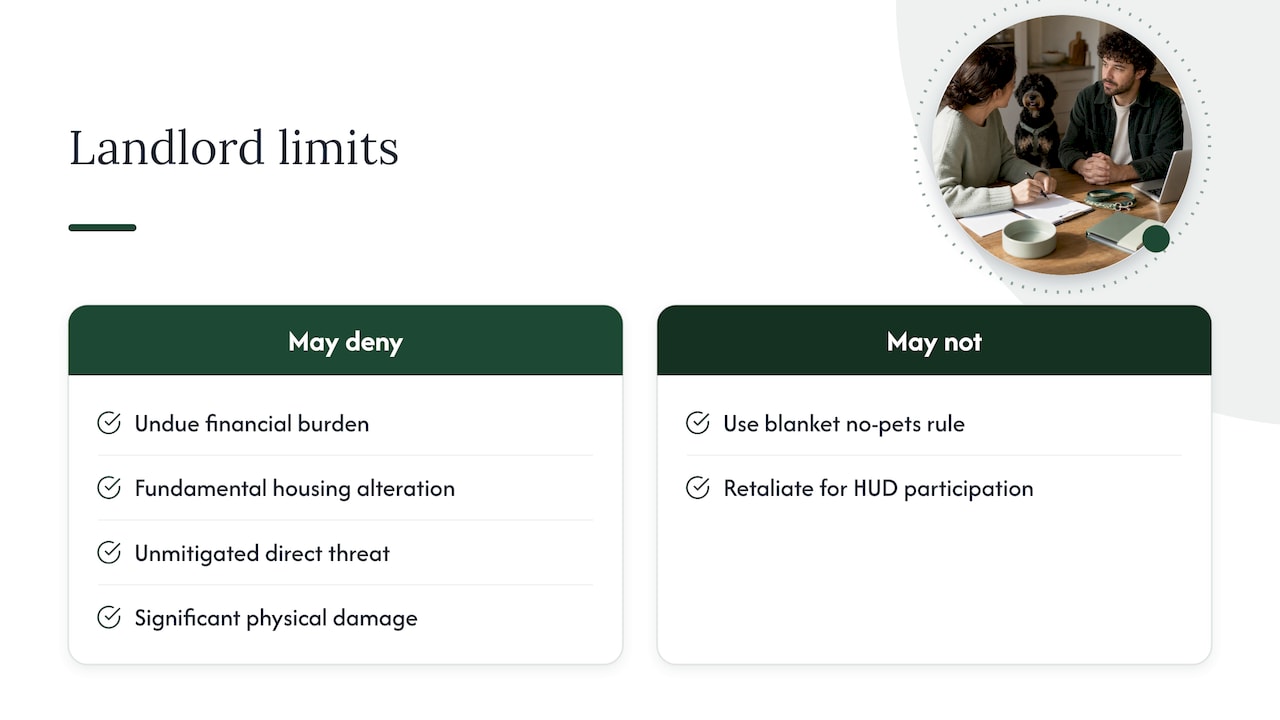
Knowing the landlord’s limits helps you describe a violation precisely. HUD’s page on assistance animals says housing providers may deny a request for undue financial or administrative burden, fundamental alteration of the housing, an unmitigated direct threat, or significant physical damage despite other reasonable accommodations. A denial should rest on one of those individualized reasons, not on a blanket “no pets” line. If you are fighting that exact line, read our piece on no-pets policies and ESA rights.
It is also illegal to retaliate against anyone for filing a complaint, testifying, or taking part in a HUD proceeding. If your landlord suddenly raises your rent, threatens eviction or stops responding to maintenance requests after you complain, add each event, with its date, to your records and report it to the agency handling your case.
Keep your records in order
A complaint is only as strong as the paper behind it. Keep a single folder, digital or physical, with the request, the replies, the letter, photos of any posted policy and your timeline. If someone else helps manage your daily needs, such as a caregiver or family member, it also helps to have arrangements around your home and animal put in writing so details are not lost between conversations.
Send requests by email or another method that leaves a timestamp. ESA requests can be made orally, but a written one gives an investigator something concrete to read.
Our perspective
We built this site because people with anxiety, depression, PTSD and other conditions are often told two opposite things: that ESA rights are everywhere, or that they no longer exist. Neither is accurate.
HUD’s May 2026 guidance narrowed what its enforcement office will pursue. It did not repeal the Fair Housing Act, it did not end private lawsuits, and it did not stop state agencies from acting under their own laws. That is why we point renters to the full set of routes instead of a single form.
The other half of a strong case is a legitimate foundation: a recommendation from a licensed clinician who actually knows your situation, not a certificate or registry purchased online. Our work is plain-language information, free to read, so you can recognize a real letter, document a request properly and know which door to knock on when a landlord says no.
Erik
Where to start with your documentation
If you do not yet have a valid letter, begin there, because every route above is stronger with one. Our page on free and low-cost ESA letter options explains how to find a licensed clinician, and the ESA letter sample shows what the finished document should contain. If you are still deciding whether a dog or cat fits your needs, we cover how a dog becomes an ESA and how a cat becomes an ESA.
For everything in one place, start at the Supportpet home page.
FAQ
Does HUD still accept ESA complaints?
You can still submit one, but HUD’s May 2026 guidance says its enforcement office will recommend charges only where the animal is trained to perform disability-related work or tasks. Legal commentary reports that HUD is not currently accepting these ESA complaints. State and local agencies and courts remain available.
How long do I have to file?
HUD’s guidance says a complaint must be filed within one year of the alleged violation. A lawsuit in federal or state court can be filed within two years. State and local agencies set their own deadlines, so check the one you choose.
Does it cost anything to file?
No. HUD’s training materials state that there are no filing fees for complaints through HUD or participating state and local fair housing agencies. Hiring a private attorney is a separate matter, though remedies can include attorney costs for successful complainants.
Can my landlord evict me for complaining?
Retaliation against someone for filing a complaint or taking part in a proceeding is illegal under the Fair Housing Act. If you notice rent increases, threats or lost services after complaining, document them with dates and report them to the agency handling your case. For an active eviction, contact a licensed attorney or legal aid office promptly.
Sources
- Report Housing Discrimination, HUD.gov
- HUD Housing Counselors Training Module 3.2 Study Guide
- HUD Housing Counselors Training Module 3.2 Study Guide (complaint timeline)
- HUD Enforcement Guidance on animals as reasonable accommodations, May 22, 2026
- Assistance Animals, HUD.gov
- HUD Issues New Emotional Support Animal Guidance, June 8, 2026
- Section 9 - Legal Remedies, Illinois Department of Human Rights
Recommended
- Protect Your ESA Housing Rights After HUD’s May 22, 2026 Memo
- U.S. Renters: HUD’s 2020 ESA Rules and a Ready Request Letter
- Don’t Lose Your ESA: Prove ESA Housing Rights After HUD’s 2026 Memo
- U.S. Renters: Defensible ESA Housing Application HUD/DOJ Checklist