
Explore this topic: ESA letters and documentation
A child or teen can be covered by an ESA letter, but only when a licensed clinician who knows the child writes it and a parent or guardian makes the housing request for the household. No registry, certificate or ID card can replace that letter. The rest of this guide shows what the letter should say, how a family gets one, what a landlord can ask for, and where an ESA does not apply, such as most K-12 classrooms.
TL;DR
- An ESA letter for a minor comes from a licensed physician or mental health clinician who has evaluated the child. A parent or guardian handles the request to the housing provider.
- A good letter names the patient, gives a date of birth, states a recognized disability and says the animal helps with it. It does not need a diagnosis or medical records shared with the landlord.
- No official ESA registry or certification exists in the US. Sites selling one are selling something that carries no legal weight.
- Fair Housing protections apply to housing. Schools decide case by case, and an ESA is not a service animal under the ADA.
- HUD withdrew its two main ESA guidance notices in September 2025. Check the rules for your state and the current HUD page before you submit a request.
Table of Contents
- Can a minor qualify for an emotional support animal?
- Who does what: the child, the parent and the clinician
- What a legitimate ESA letter for a minor should say
- How to get an ESA letter for your child, step by step
- Online ESA letters and registry scams
- Housing rights: what a landlord or dorm can and cannot ask
- What changed in 2025 and 2026
- Perspective
- Schools, travel and other countries
- Choosing an animal for a child
- Where to start
- FAQ
- Sources
Can a minor qualify for an emotional support animal?
Yes. An ESA is not defined by the age of the person it supports. It is defined by a disability-related need, documented by a professional. Children and teens with anxiety, depression, PTSD or other conditions can have that need, just as adults can. We explain the general qualifying standard in our guide on what clinicians and landlords accept to qualify for an ESA.
The American Academy of Family Physicians says an animal can be designated an ESA only with a letter or prescription from a physician or mental health clinician. It lists depression, anxiety and PTSD among reasonable diagnoses, and says the letter should state that the patient has a disability recognized in the DSM-5, the manual clinicians use to classify mental health conditions (AAFP).
Two points matter for families:
- The child does not need to be the animal’s trainer. Unlike a service dog, an ESA is not trained to perform tasks. Its role is comfort and companionship. If you are weighing both, see ESA vs. service dog: key differences.
- The need must be real and documented. A child who simply wants a pet does not qualify. A child whose clinician finds that an animal eases the effects of a disability can.
Emotional wellbeing in young people usually rests on several supports at once, including therapy, family routines and emotional development strategies for kids. An ESA is one part of that picture, and the clinician decides whether it belongs in your child’s plan.
Who does what: the child, the parent and the clinician
The process has three roles, and mixing them up is where most families go wrong.
The clinician evaluates the child and decides whether the child has a disability and whether an animal helps with it. This must be a licensed professional, ideally one who already treats the child. The Equal Housing Alliance’s fair housing guide says verification should come from a medical or other professional familiar with the patient, the disability and the disability-related need for the animal (Equal Housing Alliance).
The parent or guardian is the one who lives in the household and makes the accommodation request. Fair Housing rules speak of a household requesting an assistance animal, and the disability can belong to the tenant or a family member. ADATA says a landlord may ask the requester to certify in writing that the tenant or a family member has a disability, needs the animal for that disability and is assisted by it (ADATA). So a parent can request the accommodation for a child.
The child is the person the animal supports. Depending on age, the child may take part in the evaluation, but the paperwork and the conversation with the landlord belong to the adult.
What a legitimate ESA letter for a minor should say
A letter for a child looks like a letter for an adult, with the child as the patient. Based on the AAFP’s guidance, a valid letter should include:
- The patient’s name and date of birth.
- A statement that the patient has a disability recognized in the DSM-5.
- A statement of where the animal is allowed, for example the child’s home.
- The clinician’s license details and signature, on the clinician’s letterhead.
The AAFP lists the first three items (AAFP). License details and a signature are what let a housing provider confirm the writer is a real professional.
What the letter does not need is just as important. The letter does not have to name the specific diagnosis, describe how severe the condition is, or attach treatment records. A housing provider may not ask for those things, as the next section explains. For a visual, see our ESA letter sample showing what a real letter looks like.
How to get an ESA letter for your child, step by step
Step 1: Start with the clinician who already knows your child. A pediatrician, psychiatrist, psychologist, licensed counselor or clinical social worker who has treated your child can speak to the disability and the need. A clinician who knows the child’s history writes a stronger, more credible letter than a stranger who meets the child for ten minutes. Where it goes wrong: families skip this step and go straight to a website, and end up with a document a landlord can reject.
Step 2: Ask about the role of an animal in your child’s care. Describe how the child copes at home, and ask whether an animal would help relieve the effects of the condition. The clinician decides. You cannot ask for a letter to be issued, only for an evaluation.
Step 3: Check your state’s rules. Some states regulate who can document the need for an ESA. California, for example, bars a practitioner from documenting the need for an emotional support dog unless the practitioner holds an active license, is licensed in the relevant jurisdiction, has had a client relationship of at least 30 days (with an exception for verified homeless individuals), completes a clinical evaluation and gives a notice about fraudulent service-dog claims (California HSC §122318). Our ESA letter laws by state page shows where the rules differ.
Step 4: Review the letter before you use it. Check the child’s name and date of birth, the clinician’s license information, the statement of disability and the statement that the animal helps with it. Fix errors with the clinician before you submit anything.
Step 5: Submit a written request to the housing provider. Send the letter with a short note asking for a reasonable accommodation to the housing provider’s pet policy. Keep a copy and note the date. If you are a student in a dorm, send it to the housing office.
Step 6: Keep the animal’s care in order. Housing protections cover the accommodation, not damage or behavior problems. Keep up with vaccinations, local licensing and basic training so the arrangement works for everyone.
Online ESA letters and registry scams
Can a minor get a legitimate ESA letter online? A letter can be legitimate if a licensed clinician genuinely evaluates the patient and writes it. What cannot be legitimate is anything that sells a registration, certificate, vest or ID card as if it were official. The Equal Housing Alliance states that no official certification or registration for emotional support or assistance animals exists in the US (Equal Housing Alliance). Our explainer on ESA registration vs. letter goes into this.
For a child, the warning signs are:
- A promise of instant approval with no evaluation, or one that guarantees you will qualify.
- A “registration number” or database listing offered as the main product.
- No licensed clinician named, or no license details on the letter.
- A clinician who never speaks with you or the child.
- Pressure to buy an ID card, vest or certificate on top of the letter.
If you are comparing costs, our guide to ESA letter cost and how to verify explains what you should and should not be paying for, and our page on free and low-cost options covers the budget routes. For a minor, the safest path is still the clinician who knows your child.
Housing rights: what a landlord or dorm can and cannot ask
The Fair Housing Act is the main federal protection for ESAs in housing. According to the Housing Equality Center of Pennsylvania guide, a household may request an assistance animal despite a no-pets policy, and the housing provider must not charge pet fees or deposits for it (Equal Housing Alliance guide). Our walkthrough of how renters can make a dog a valid ESA without pet fees or registries applies the same rules.
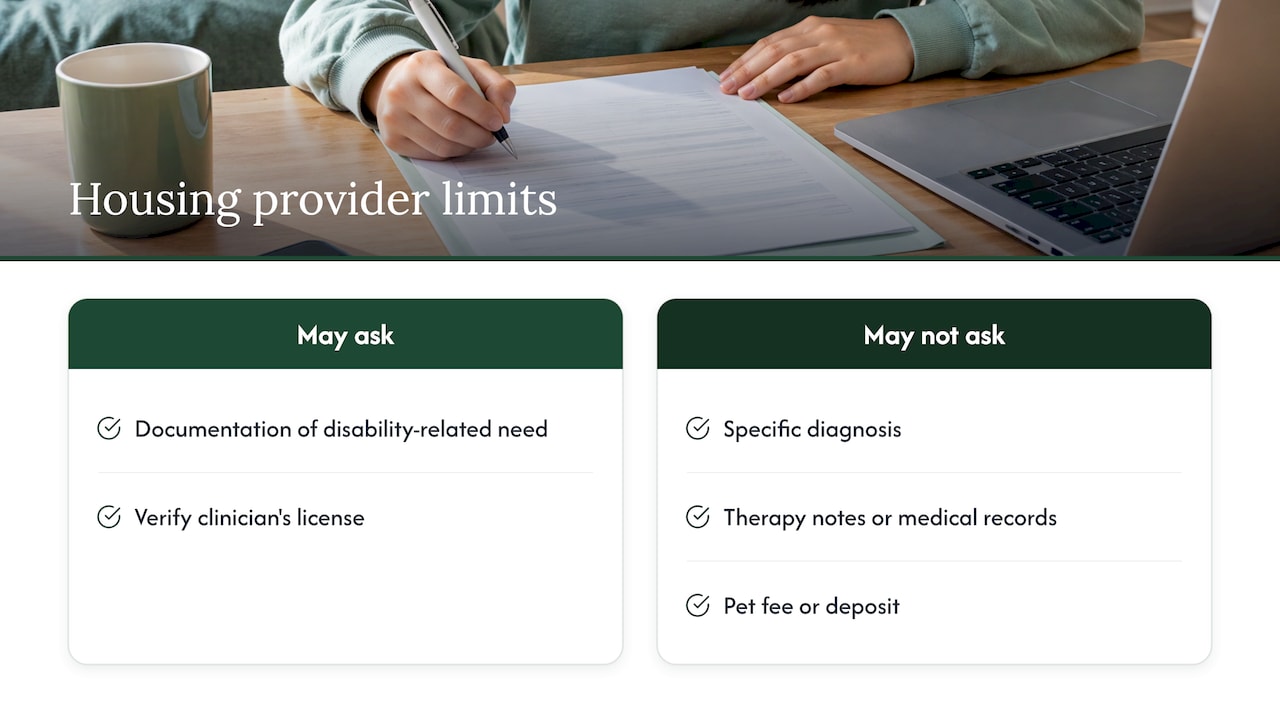
When the disability or the need for the animal is not obvious, the housing provider may ask for documentation of both. They may not ask about the nature or severity of the disability, a specific diagnosis, independent living, or a confidentiality waiver, and they may not demand medical records (Equal Housing Alliance). ADATA says the same limit applies to questions about the existence, nature and extent of the disability (ADATA).
In practice, a worked example looks like this. A family rents an apartment with a no-pets policy. Their 14-year-old has an anxiety disorder, and the child’s psychologist writes a letter stating that the child has a DSM-5 recognized disability and that a dog helps with it. The parent sends the letter with a written request. The landlord can confirm the letter is from a licensed professional. The landlord cannot ask what the diagnosis is, ask for therapy notes, or add a pet deposit.
What changed in 2025 and 2026
The federal picture shifted recently. On September 17, 2025, HUD’s Office of Fair Housing and Equal Opportunity issued a memorandum withdrawing FHEO Notice 2013-01 and FHEO Notice 2020-01, the two guidance documents on assistance animals in housing, and said they should not be relied upon while under review (HUD memorandum).
What this means for a family: the guidance notes were withdrawn, not the law. State and local fair housing agencies continue to enforce their own protections. California’s AB 468 says it does not restrict or change existing federal and state law on reasonable accommodation and equal access to housing, including FEHA, the Unruh Civil Rights Act and the Disabled Persons Act (AB 468).
Because the rules are being reviewed, a current letter from a licensed clinician who knows your child is more useful than ever. Look up your state’s rules on our state laws page and confirm the latest federal position on HUD’s own site before you apply.
Perspective
When a family comes to us about a child, the first question is almost always “where do we get the letter?” We think the better first question is “who knows my child well enough to write it?”
A letter is only as strong as the evaluation behind it. A pediatrician or therapist who has watched a child struggle and cope can describe the need honestly, and that is what makes a housing provider take it seriously. A registration number, a certificate or a vest does none of that work.
This is why we built Supportpet around plain explanations rather than documents or products. We want parents to understand the rules well enough to spot a scam on sight, to know what a landlord may lawfully ask, and to walk into a clinician’s office with the right questions. A family that understands the process protects its child, its housing and its money.
Erik
Schools, travel and other countries
An ESA’s housing protection does not automatically extend everywhere. In US public schools, the ADA allows a student with a disability to have a service animal, which is a dog trained to perform tasks. ADATA notes that IDEA and Section 504 of the Rehabilitation Act can allow an animal that is not an ADA service animal if the student’s IEP or Section 504 team decides it is necessary for a free and appropriate education. Emotional support animals are seldom allowed and are decided case by case (ADATA). If your child needs an animal at school, raise it with the school team early and bring your child’s clinician into the conversation.
For public places in general, an ESA does not have the access rights that a trained service dog has. Our page on ESA vs. service dog lays out the difference.
Outside the US, the rules differ. In the UK, for instance, the Equality Act 2010 defines an assistance dog as a dog trained to guide a blind person, assist a deaf person, or assist a disabled person with certain physical tasks, which does not include untrained emotional support animals (Equality Act 2010, section 173). Everything else in this article applies to the United States.
Choosing an animal for a child
The clinician’s letter covers the animal that supports your child, and dogs and cats are the usual choices. If a cat suits your household better, see how a cat becomes an ESA. A few practical points help the arrangement last:
- Match the animal to the child’s age and the home. A young child needs an animal that tolerates handling.
- Make the adult the one responsible for feeding, vet visits and cleanup. The letter does not shift those duties to the child.
- Read your lease and your local licensing rules before the animal moves in.
- Keep the clinician informed. If the child’s needs change, the letter may need to be updated.
If you want the clinical background first, our article on emotional support animal benefits and how to get a valid ESA walks through the evidence and the process.
Where to start
If you are unsure how all of this fits together, begin with our rights guide. It covers who qualifies, what a letter is, how housing protections work and how to spot scams, in plain language and without selling documents.
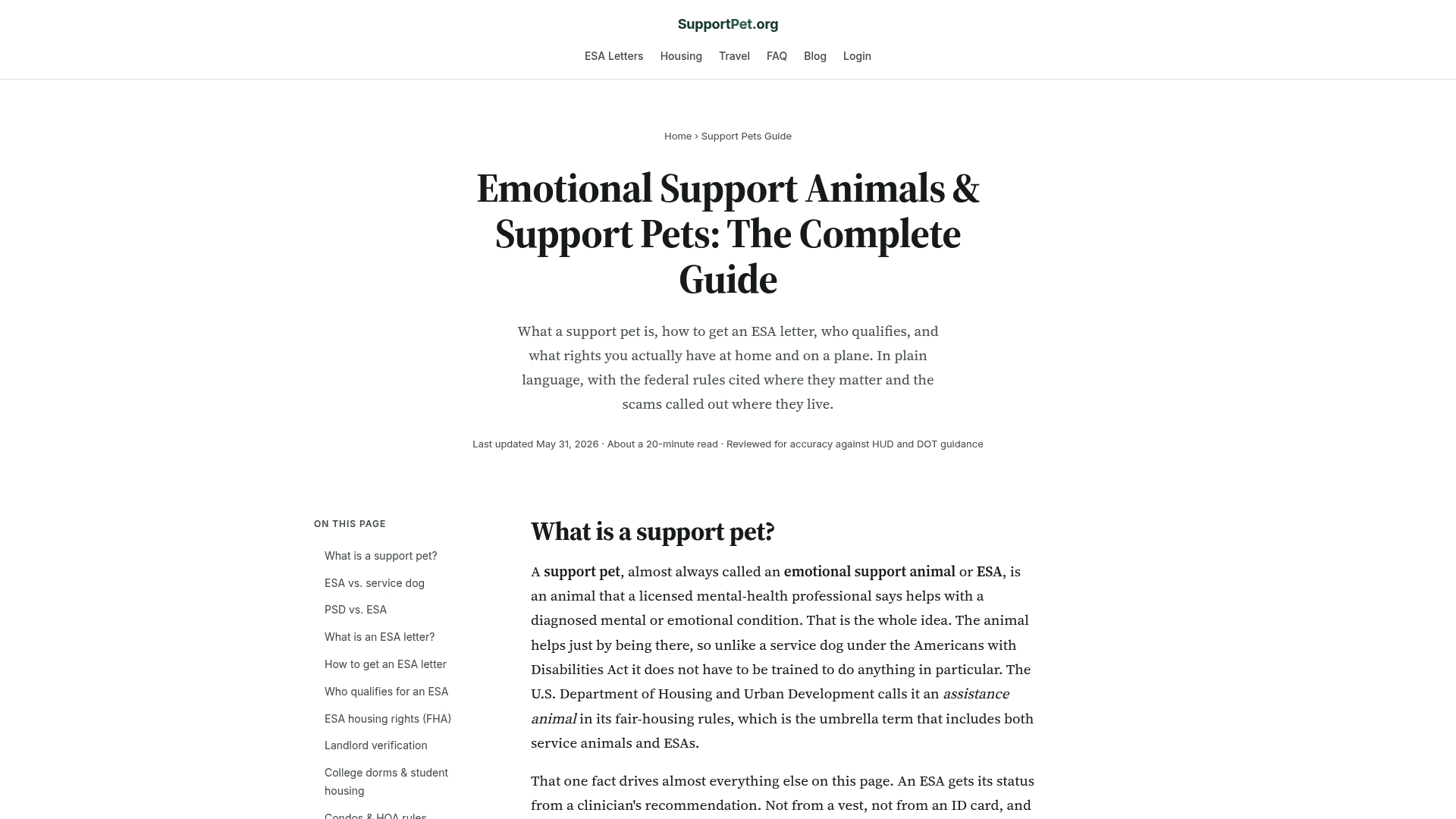
For a minor, the practical route is short: talk to the clinician who knows your child, check your state’s rules on our state-by-state page, and compare the finished letter with our real letter sample before you send it.
FAQ
Can a child get an ESA letter without a parent?
In practice, a parent or guardian is involved. The adult in the household makes the housing request, and a clinician evaluates the child. Fair Housing rules allow the disability to belong to a family member, so a parent can request the accommodation for the child.
Does a landlord have to accept an ESA letter for my child?
A housing provider may ask for documentation of the disability and the disability-related need when they are not obvious. A letter from a licensed professional who knows your child is the standard form of that documentation. The landlord may not demand a diagnosis, medical records or a confidentiality waiver.
Is an ESA registry or certificate needed for a minor?
No. The Equal Housing Alliance states that no official certification or registration for emotional support animals exists in the US. A registry listing does not replace a clinician’s letter and carries no legal weight.
Can my child bring an ESA to school?
Not automatically. ADATA says an animal that is not an ADA service animal may be allowed if the student’s IEP or Section 504 team decides it is necessary, and emotional support animals are seldom allowed. Ask the school team, with your child’s clinician’s input.
Do the rules change by state?
Yes. Some states, such as California, set requirements for the clinician, including an active license and a 30-day client relationship in most cases. Check your state’s rules before you request a letter.
Sources
- AAFP: Navigating requests for emotional support animal letters
- Fair Housing Guide to Reasonable Accommodations and Modifications
- ADATA: Service Animals and Emotional Support Animals
- California Health and Safety Code section 122318
- California AB 468, Emotional support animals
- HUD memorandum withdrawing FHEO Notices 2013-01 and 2020-01
- Equality Act 2010, section 173
Recommended
- Valid ESA Letter: Students’ Clinician Checklist and Scam Red Flags
- Avoid ESA Letter Scams: Which Clinicians Housing Providers Trust for Renters
- HIPAA and Your ESA Letter: What’s Private and What Isn’t
- ESA Dorm Documentation: What Your College Will Ask For