
Explore this topic: ESA basics and animal comparisons
An emotional support animal (ESA) letter protects your right to live with your animal. It does not protect the animal from the rules every resident follows, and persistent noise is the most common way a protected ESA ends up in a dispute. A landlord generally cannot refuse your ESA because of its breed or size, but can act on documented, repeated disturbances such as a dog that barks through the night. This guide explains where that line sits, what to do the day a complaint arrives and how to prevent the next one. We write it at Supportpet to help renters, students and pet owners understand their rights without paying for questionable certificates.
TL;DR
- Your ESA protection covers the right to have the animal, not a right to disturb neighbors. Housing providers may act on real, repeated noise.
- Regulators describe the line as an animal that disturbs others’ quiet enjoyment, for example a dog that regularly barks at night, backed by facts and not by stereotypes.
- You are responsible for your animal’s behavior, and that can include providing exercise, stimulation or training to stop barking.
- After a complaint: read it, keep records, respond in writing, fix the cause and document the fix.
- A single complaint does not cancel your accommodation. Ignoring a pattern of complaints can put your tenancy at risk.
Table of Contents
- Why noise is where ESA disputes start
- When noise becomes a housing problem
- What your ESA protection does and does not cover
- Your responsibilities as an ESA owner
- What to do when you get a noise complaint
- Practical ways to reduce barking and noise
- Two worked examples
- Students in dorms and other shared housing
- Insurance, fees and fines after a complaint
- Where we start from
- Get your documentation right first
- FAQ
- Sources
Why noise is where ESA disputes start
Most people learn about ESA housing rights in the context of “no pets” policies. Under the federal Fair Housing Act, a housing provider generally has to treat an ESA as a reasonable accommodation for a disability-related need rather than as an ordinary pet. We cover that in our guide to ESA housing rights in 2026.
That accommodation is about access. It answers the question “may this animal live here?” Noise raises a different question: “is this animal’s behavior disrupting other people’s homes?” Housing rules treat the two questions separately, and a tenant with a valid ESA can be on firm ground on the first and still face consequences on the second.
The Massachusetts state guidance on assistance animals in housing explains the logic. Residents expect quiet enjoyment of their homes, and a housing provider is expected to address noise that goes beyond usual background sound, particularly when it is lengthy or happens during quiet hours. So when your animal’s noise disturbs neighbors, for example barking at night, it becomes a housing issue like any other noise.
When noise becomes a housing problem
Not every bark is a violation. Apartments are not silent, and a dog that barks briefly when the doorbell rings is normal. Housing providers and regulators look at a few things:
- Frequency and duration. A one-off event differs from noise every evening.
- Time of day. Disturbances during quiet hours count for more.
- Impact on others. The question is whether neighbors cannot sleep, work or relax in their homes.
- Facts versus assumptions. The Maine Human Rights Commission’s assistance animal pamphlet says an animal can be removed when its conduct substantially interferes with others’ reasonable enjoyment of housing, such as a dog that regularly barks at night while other tenants are trying to sleep. It also says the decision must rest on a factual basis, not on fears or stereotypes about size or breed.
That last point works in your favor. A landlord cannot say “large dogs are loud” and refuse your ESA. They can, however, point to dated complaints from several neighbors about the same animal.
Typical triggers
The causes behind ESA noise complaints are usually ordinary and fixable:
- Separation distress when you leave for class or work, with barking or whining for hours.
- Barking at passersby, other animals or delivery people, especially from a window or balcony.
- Reactions to hallway sounds, doors and elevators in a new building.
- Boredom or too little exercise.
- Sudden loud events such as fireworks or storms.
The pattern matters because it tells you what to fix. Noise only while you are out calls for a different plan than noise that happens whenever someone walks by.
What your ESA protection does and does not cover
The California Civil Rights Department FAQ on emotional support animals and fair housing (August 2026) draws the distinction clearly. Housing providers may prohibit nuisance activity such as incessant barking and may set reasonable conditions on an ESA’s behavior. They must still allow the ESA as a reasonable accommodation unless a limited exception applies: undue burden, fundamental alteration, or a direct threat or substantial damage that cannot be reduced, shown by credible, objective evidence.
In practice:
| Question | What the protection says |
|---|---|
| Can the landlord refuse my ESA because of a no-pets rule? | Generally no. Pet prohibitions and pet fees do not apply the way they do to ordinary pets. |
| Can the landlord refuse because of my dog’s breed or size? | Not on stereotypes. The NYC Commission on Human Rights FAQ says ESAs are exempt from no-dog, breed, weight and size policies. |
| Can the landlord charge extra deposits or pet fees? | NYC’s guidance says no, though a provider may require payment for actual damage or excessive wear and tear. |
| Can the landlord require a leash in common areas? | Yes, NYC’s guidance allows leashing requirements in common areas. |
| Can the landlord act on repeated, documented noise? | Yes. Nuisance conduct is not shielded by an accommodation. |
The San Francisco Apartment Association’s FAQ, written from the property-manager side, makes the same split: pet-prohibiting clauses do not apply to ESAs, but building rules do. It adds that a barking ESA dog creates the same actionable nuisance as a barking pet, and that serious, continuous misbehavior can put the tenancy itself at risk. State and local rules vary, so check the rules where you live. The examples above come from California, New York, Massachusetts and Maine.
If your concern is a “no pets” lease clause rather than noise, see our piece on how ESA rights work with a no-pets policy.
Your responsibilities as an ESA owner
The other side of housing protection is responsibility. Massachusetts guidance says residents must keep their animal under control and follow all applicable laws, regulations and policies, noise included. It adds that a resident may be asked to provide stimulation or training to stop barking.
Campus housing says the same thing in practice. The Utah State University family housing handbook (October 2023) states that the owner is responsible for the ESA’s custody and care and must make sure it does not engage in disruptive behavior such as frequent barking, growling, making noise, offensive odors or chewing. If you live in a dorm, read your school’s ESA policy before move-in, because it may set behavior expectations in writing.
The SFAA FAQ adds common building rules: proper behavior in common areas, waste collection, no aggressive acts, and liability for any damage or harm the animal causes. None of this is a penalty for having an ESA. These are the same expectations placed on every resident.
What to do when you get a noise complaint
The first 48 hours matter. A calm, documented response usually keeps a complaint from becoming a formal dispute.

1. Read what was actually alleged
Note the dates, times, the type of noise and who made the complaint (if stated). A vague complaint with no specifics is different from one that lists dated incidents. Do not assume it is a bluff, and do not assume it is accurate either.
2. Keep the record
Save the notice, any emails or texts and the lease sections it cites. If your ESA accommodation was approved, keep that approval and your ESA letter together with it. Our guide to ESA documentation and housing rights explains what a valid letter is, so you know what you are holding.
3. Find the cause
Match the complaint to your routine. If it refers to weekday afternoons, the animal may be anxious while you are away. If it mentions late evenings, look at what happens outside your door at that time. A pet camera or a short audio recording while you are out gives you facts instead of guesses. Be aware that you may hear different noise than your neighbor does, so ask what they heard.
4. Respond in writing
A short, courteous reply is enough. Acknowledge the concern, say you are addressing the cause and name one or two specific steps. Do not argue about your rights in the first message, and do not threaten a discrimination complaint over an ordinary behavior notice. Written responses show good faith, which matters if the matter escalates.
5. Fix the cause
See the next section. Match the remedy to the trigger.
6. Document the improvement
Keep notes on what changed and when: a new walking schedule, a trainer’s plan, a veterinarian’s note. If a housing provider later claims a pattern, you can show that you acted. Ask for any follow-up in writing as well.
7. Know when the complaint becomes serious
A formal lease violation notice, a demand to remove the animal or a threat of eviction is the point to get legal advice. A tenant-rights organization, legal aid office or housing attorney in your state can read your lease and local law. If you believe a provider is refusing your accommodation without objective evidence, you can file a complaint with HUD or your state’s fair housing agency. Document everything first.
Practical ways to reduce barking and noise
Most noise problems respond to a handful of changes. Start with the least disruptive.
- Add exercise and enrichment before you leave. A longer walk or a puzzle feeder tires an animal who would otherwise vocalize.
- Manage what the animal can see and hear. If your dog barks at things outside, block the view of the street or sidewalk. The article on stopping window barking with management first lays out the idea of controlling the trigger before training around it.
- Build alone-time gradually. Short departures, extended slowly, help animals with separation distress learn that you return.
- Work through barking one cause at a time. This overview of dog barking and howling: what owners should try is a useful way to match remedy to type of barking.
- Mask background sound. A white-noise machine or radio near the door can soften hallway noise that sets off alerting.
- Talk to your own healthcare provider. If the animal’s presence supports a mental health condition, a change in your symptoms may change how your animal behaves. Your licensed clinician is the right person for that conversation.
- Rule out a medical cause. Sudden new barking or whining can signal pain or distress, so a veterinary check is sensible.
Cats and other animals have their own noise patterns, such as night-time yowling. The same logic applies: identify the trigger, change the environment and keep records. If you are considering a cat, our guide to emotional support cats covers how they qualify.
Two worked examples
These are illustrations, not real cases.
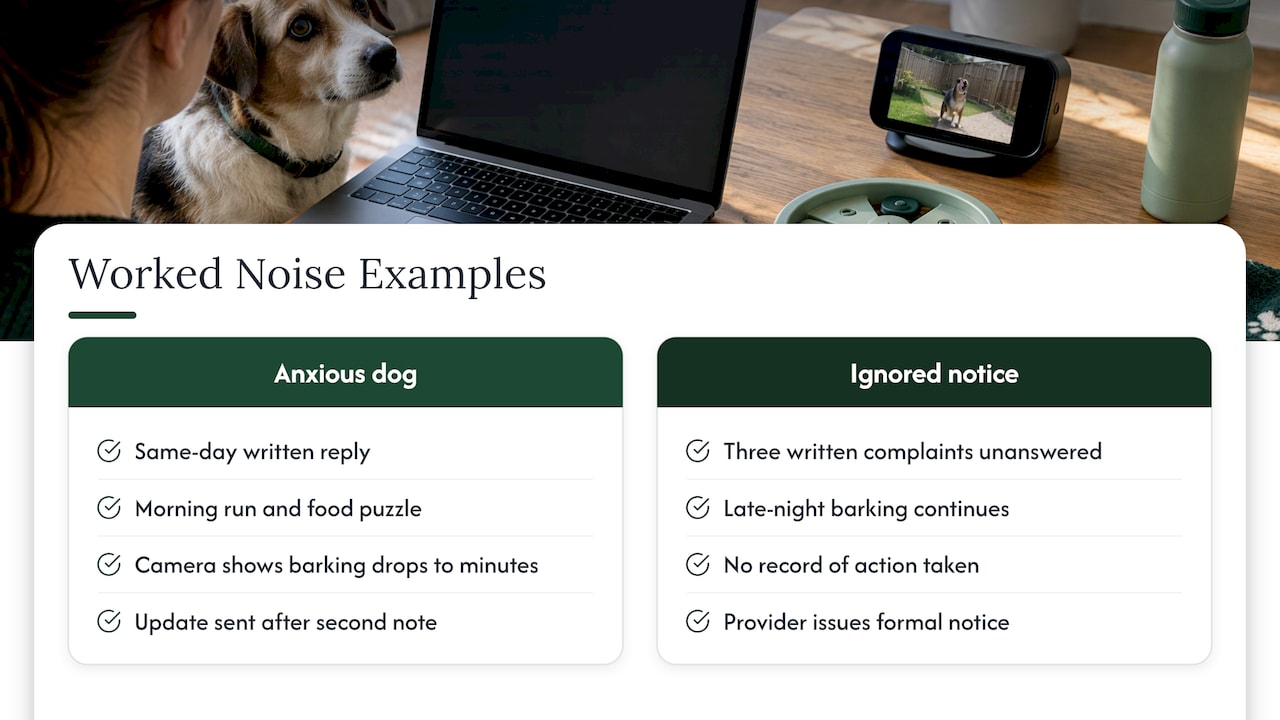
The anxious dog. A renter’s ESA dog barks for an hour after she leaves each morning. A neighbor complains in writing. She replies the same day, adds a morning run before work and a food puzzle at departure, and uses a pet camera to confirm the barking drops to a few minutes. When a second note arrives a month later, she sends a brief update with what she changed. The record shows good faith and a factual improvement.
The ignored notice. A tenant gets three written complaints about late-night barking and replies to none. He assumes his ESA letter covers everything. When the provider issues a formal notice, he has no record of any action taken. That is where the Maine standard applies: a dog that regularly barks at night, with a factual basis, can permissibly be removed. The letter did not fail him; it simply never covered the behavior.
Students in dorms and other shared housing
Campus housing, shelters and supportive housing are also covered by ESA rules in many places, as NYC’s guidance notes. Dorm life puts animals close to many neighbors at once, with thin walls and shared hallways. Check your school’s housing office for written behavior expectations, introduce your animal to the space gradually and plan how it will be cared for during classes and exams. If you live in military housing, the process differs, and we explain it in emotional support animals in military housing.
Insurance, fees and fines after a complaint
A noise complaint does not give a landlord license to add charges that ESA rules otherwise prohibit. NYC’s guidance says providers cannot charge extra deposits, pet fees or extra insurance for an ESA, though they can require payment for actual damage. Federal changes to insurance demands are covered in our article on HUD barring ESA insurance demands. If a landlord links a fee to a noise complaint, ask for the lease clause and the evidence in writing, and seek local legal advice before paying.
Where we start from
We see ESA noise problems as a documentation and expectation problem more than a rights problem. Tenants often believe a letter works like a shield against every complaint. It does not, and learning that before the first notice arrives is far better than learning it after.
The strongest position is simple. Hold a letter from a licensed clinician, not a purchased certificate or registry ID. Know your landlord’s quiet-hours rules. Respond to complaints in writing and show what you changed. Our site is free to read and does not sell registrations or documents, so our only aim is to make the rules clear enough for you to act on them.
A well-behaved animal and a clear paper trail are what keep your accommodation secure.
Erik
Get your documentation right first
A noise dispute is far easier to handle when your accommodation paperwork is solid. Our guide explains how to qualify for an ESA letter, why a licensed clinician’s recommendation is what counts and how to spot scams that sell certificates and registrations.
Start with the Supportpet ESA letter and housing rights guide, then come back to this page when you need a plan for a complaint.
FAQ
Can my landlord evict me over my ESA’s barking?
A landlord cannot evict you simply for having an ESA, but may act on documented nuisance behavior. Regulators such as the Maine Human Rights Commission say an animal that regularly barks at night can be removed when there is a factual basis. A single complaint rarely reaches that point, but ignoring a pattern can.
Does an ESA letter stop noise complaints?
No. The letter supports your request to live with the animal as a reasonable accommodation. It does not exempt the animal from quiet-hours rules or from the duty to keep it under control, which state guidance such as Massachusetts’s spells out.
Can a landlord charge a fee after my ESA is reported for noise?
Generally not a pet fee or extra deposit. NYC’s guidance says providers cannot charge these for an ESA but can require payment for actual damage or excessive wear and tear. Check your state and local rules.
Can apartments refuse an ESA?
Only in limited cases. California’s guidance lists undue burden, fundamental alteration and a direct threat or substantial damage that cannot be reduced, each shown by credible, objective evidence. Breed, size and general assumptions are not enough.
What should I do first if a neighbor complains?
Read the complaint, save it and reply in writing with the specific steps you are taking. Then fix the likely cause and keep a record of the results. If you receive a formal notice, speak with a tenant-rights organization or housing attorney in your state.
Sources
- Assistance animals in housing, Mass.gov
- Assistance Animals in Housing, Maine Human Rights Commission (October 2019)
- Emotional Support Animals and Fair Housing Law FAQ, California Civil Rights Department
- Frequently Asked Questions: Emotional Support Animals in Housing, NYC Commission on Human Rights
- New ESA Rules, San Francisco Apartment Association (2022)
- Housing Services & Residence Life family housing handbook, Utah State University (October 2023)
Recommended
- Don’t Lose Your ESA: Prove ESA Housing Rights After HUD’s 2026 Memo
- ESA Rights With a New Landlord: What Carries Over in 2026
- Roommate Conflicts Over an ESA: Your Rights and Options
- Get Your ESA Approved: Copy Ready Letter to Notify Your Landlord