
Explore this topic: ESA letters and documentation
HIPAA protects the health information your clinician holds about you, but it does not govern your ESA letter once it is in your landlord’s hands. Your landlord is not a HIPAA-covered entity. The rule that limits what a landlord can ask for, and what they do with your letter, is the Fair Housing Act. Knowing which law does what tells you what to share, what to keep back and where to complain if someone oversteps.
TL;DR
- HIPAA binds health care providers, health plans, clearinghouses and their business associates. It does not bind landlords, property managers or registry websites.
- A valid housing letter confirms a disability-related need for the animal. It does not have to name your diagnosis, and a landlord has no right to your medical records.
- If a landlord asks illegal medical questions, the path is a fair housing complaint, not a HIPAA complaint.
- Schools usually fall under FERPA rather than HIPAA, so student housing follows its own privacy track.
- Share the letter, not your chart, and keep a copy of what you sent and when.
Table of Contents
- What “HIPAA ESA letter” actually means
- Who HIPAA covers, and who it doesn’t
- Does an ESA itself have HIPAA rights?
- What a clinician puts in the letter, and what stays out
- What a landlord may and may not ask for
- Who must keep your letter confidential
- If the wrong question gets asked
- Students and campus housing: FERPA enters
- How to protect your privacy when getting a letter
- Where to go next
- FAQ
- Sources
What “HIPAA ESA letter” actually means
People search this phrase for three different reasons. Some want to know whether their ESA letter is a protected medical record. Some want to know whether a landlord can demand their diagnosis. Others see “HIPAA-compliant” on a website offering letters and wonder whether that label means the letter is legitimate.
The short answers:
- The clinical side is covered. Your evaluation, notes and diagnosis held by your clinician are health information under HIPAA.
- The letter is a different animal. Once you hand it to a landlord, HIPAA no longer follows it. Fair housing law governs how the landlord may ask for it and treat it.
- “HIPAA-compliant” is not a seal of validity. It describes how a health care provider handles data. It says nothing about whether a letter meets housing requirements. For that, see our guide to verifying ESA letter requirements.
Who HIPAA covers, and who it doesn’t
The U.S. Department of Health and Human Services says HIPAA applies to covered entities and their business associates. Covered entities are health plans, health care clearinghouses, and health care providers that transmit health information electronically in connection with standard transactions. Providers include doctors, clinics, psychologists, dentists, pharmacies and nursing homes. The Privacy Rule protects individually identifiable health information held or transmitted by those entities or their business associates, in any form.
Read that list again for what is missing: landlords, property managers, leasing offices, employers acting as employers, and websites that sell registrations or certificates. None of them is a covered entity merely because they receive a medical note from you.
| Party | Does HIPAA bind them? | What actually limits them |
|---|---|---|
| Your treating therapist or physician | Yes, if a covered entity | HIPAA, plus state licensing and confidentiality rules |
| A telehealth practice delivering care | Generally yes, as a provider or business associate | HIPAA and state law |
| Your landlord or property manager | No | Fair Housing Act, state and local fair housing laws |
| A college housing office | Usually no | FERPA for education records, plus disability laws |
| An ESA “registry” website | No | Nothing that gives the registry any legal weight |
This is also why a registry that boasts about privacy is missing the point. No private registry grants federal rights, and no registry is a covered clinician. Our piece on fake ESA letters explains how to tell the difference.
Does an ESA itself have HIPAA rights?
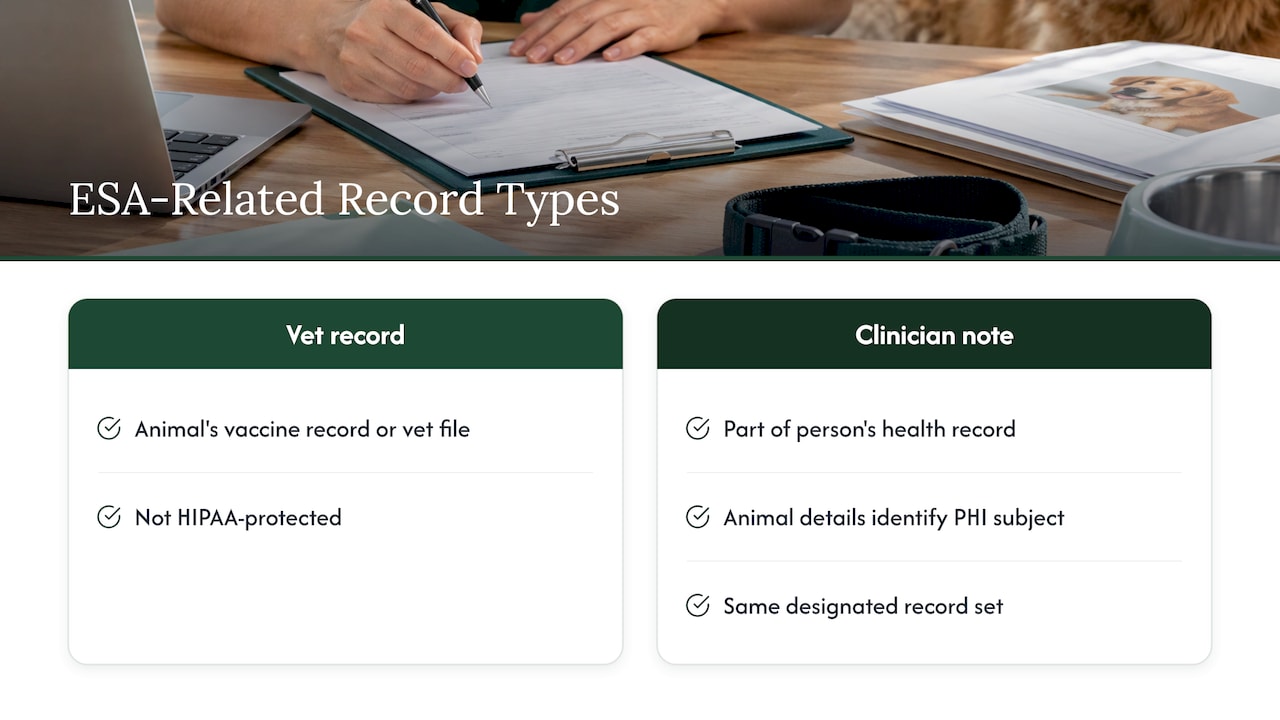
Not in the way people mean it. The HIPAA Journal explains that HIPAA applies to animals only when details about the animal could identify the subject of protected health information kept in the same designated record set by a covered entity or business associate. In other circumstances, including a veterinary medical record, it does not apply. Your animal’s vaccine record or vet file is not HIPAA-protected. Your clinician’s note that mentions the animal in your treatment file is part of your health record.
What a clinician puts in the letter, and what stays out
Housing letters exist to document a need, not to hand over your chart. Sample verification letters prepared for housing practitioners say a letter verifying a disability and related need for an animal accommodation should not disclose the diagnosis or medical records. If a housing provider wants to confirm authorship, the clinician needs only to answer whether they wrote the letter and whether the signature is theirs.
A solid letter typically carries:
- The clinician’s name, license type, license number and state of licensure
- Contact information
- Your name and the date
- A statement that you have a disability and that the animal helps with a disability-related need
What it does not need: your diagnosis, symptoms, treatment history or session notes. If your clinician offers to add more detail, you can decline. It is your information, and you decide how much to disclose. Our guide to who can write an ESA letter covers which licensed clinicians housing providers recognize, and the two federal criteria a letter has to speak to.
What a landlord may and may not ask for
Under the Fair Housing Act, a landlord may ask for reliable documentation of a disability-related need when the disability or the need is not obvious. They may not ask for the specific diagnosis, medical records or access to your providers. Several official sources say the same thing in their own words:
- The California Civil Rights Department states that a tenant need only disclose enough information to document the disability-related need, not the disability itself.
- The New York City Commission on Human Rights says a housing provider may ask for confirmation from a treatment provider that the person has a disability and that the animal would help treat it, but cannot require disclosure of the underlying disability.
- Florida law bars a housing provider from requesting information that discloses the diagnosis or severity of a disability or any related medical records, though you may share them voluntarily. The same statute says it cannot demand a specific form or a notarized statement.
- The District of Columbia’s Office of Tenant Advocacy says a housing provider may not require a tenant to reveal a diagnosis or give access to medical providers.
The Florida statute adds a point worth knowing: an ESA registration of any kind, including an ID card, patch or certificate obtained online, is not by itself enough to establish a disability or need.
A landlord may have its own paperwork, and you can use it if it asks only for what the law allows. Be wary of any form that asks for a diagnosis, session notes or a signed release for your records. You can answer with the clinician’s letter instead. For wording, our landlord scripts and the copy-ready notification letter keep the request short and within what the law allows.
Federal guidance changed, the Act did not
HUD’s guidance on assistance animals has shifted in recent years, and many readers ask whether the privacy limits went with it. The Fair Housing Act itself is a statute, and its reasonable accommodation duty stays in force. We track the practical effect in ESA housing rights in 2026.
Who must keep your letter confidential
Here the gap between HIPAA and fair housing law matters most. Your landlord is not violating HIPAA by mishandling your letter, because HIPAA does not apply to them. That does not mean they can pass it around.
Massachusetts guidance tells housing providers to treat disability information as private, share it only on a need-to-know basis, and store related records securely. Other states publish similar expectations. Treat that as the standard to point to.
Practical steps:
- Send it to one named contact. Use the person who handles accommodation requests, not a general inbox shared with a leasing team.
- Send the letter only. No chart notes, no prescriptions, no portal screenshots.
- Keep proof. Save the email or a dated copy of what you delivered.
- Ask how it will be stored. A short written reply that the document stays in a tenant file with limited access is reasonable to request.
- Watch for third-party screening demands. A request to run your letter through an outside portal that charges a fee deserves a pause. A reasonable accommodation request is a conversation with your housing provider, and you can ask them to accept your clinician’s letter directly.
If the wrong question gets asked
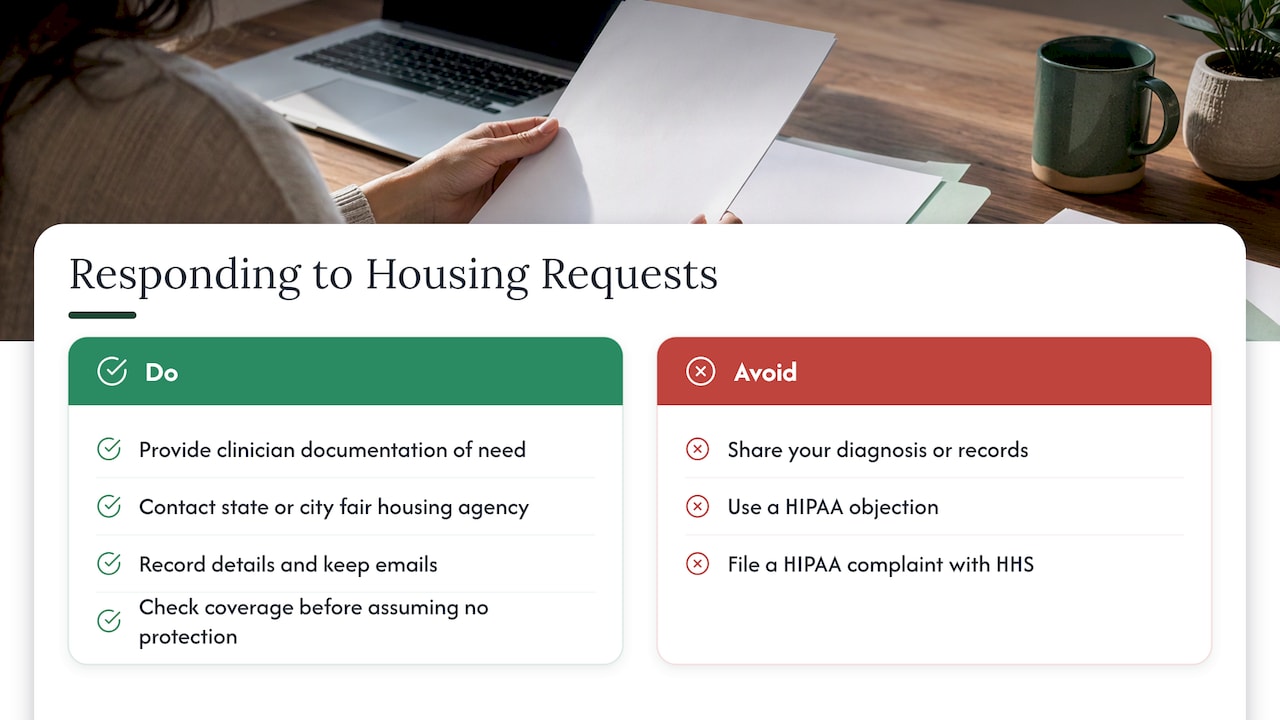
Say a leasing agent asks, “What condition do you have?” or “Can we call your therapist?” Your answer is not a HIPAA objection. Say something like: “I’ve provided documentation from my licensed clinician confirming a disability-related need for the animal. The law doesn’t require me to share my diagnosis or records.”
If the agent keeps pushing, or denies the request over it, the route is a fair housing complaint. Start with the fair housing agency in your state or city, or file with HUD. Filing a HIPAA complaint with HHS about a landlord will not work, because HHS has no authority over them. Write down who asked what, when, and in what form, and keep the emails.
Fair housing law has limits on coverage too. D.C.'s tenant advocates note the Act covers most housing for rent and sale, with exceptions that include some federally funded housing and public housing agencies, sales or leasing offices, homeowners and condominium associations, housing tied to educational institutions, and shelters. Other disability laws may still cover you in those settings, so check before assuming you have no protection.
Students and campus housing: FERPA enters
College students often assume HIPAA protects what they give the housing office. Usually it does not. HIPAA states that health information in an education record covered by FERPA is not protected health information, and the two laws never apply to the same information at the same time. A letter you hand to your university’s housing or disability services office is generally an education record under FERPA. Your treating clinician’s own file outside the school remains under HIPAA.
What this means for you:
- Give the school the letter, not your treatment records.
- Ask which office will see the request and how long it keeps records.
- Use your clinician for the clinical side, and the school’s disability or housing office for the accommodation side.
How to protect your privacy when getting a letter
The point where HIPAA truly matters is your relationship with the clinician. A few habits keep that side clean:
- Work with a licensed clinician who evaluates you. A real evaluation creates a real treatment relationship, and that is where HIPAA and state confidentiality rules protect what you say. A site that sells an instant certificate for a fee creates nothing.
- Read what you sign. Before authorizing any release of information, confirm what is going to whom. A housing letter should not need a release for your full record.
- Ask to review the letter before it is sent. You can check that it says what the law needs and nothing more.
- Keep your own copy. You control the letter after it is issued.
- Be skeptical of privacy badges. A “HIPAA-compliant” banner describes data handling, not whether the letter satisfies a landlord. The assessment process explains what a legitimate evaluation involves.
Our view on privacy and ESA letters
We built Supportpet around one idea: you should understand your rights before anyone asks you for anything. The confusion around HIPAA is a good example. Sites that stress privacy badges make a letter sound safe, while the real protection comes from two things, a licensed clinician and the Fair Housing Act.
Our approach is plain-language, free-access information, with no certificates, registrations or ID cards for sale. We think a renter who knows that a landlord can ask for documentation of a need, but not a diagnosis or records, walks into the conversation calmer and gets a better outcome.
If you take one thing from this page, make it this: share the letter, not your chart, and know which law backs you up.
Erik
Where to go next
If you are preparing a request, our rights guide lays out housing, travel and letter basics in one place, written for renters and students who want straight answers without selling anything. From there, the guides on qualifying for an ESA and multiple ESAs in housing go deeper on specific situations.
FAQ
Is an ESA letter protected by HIPAA?
The clinical records behind it are, as long as your clinician is a covered entity. The letter itself, once you give it to a landlord, is governed by fair housing law instead. Your landlord is not a covered entity, so HIPAA does not apply to how they store it.
Can my landlord ask for my diagnosis or medical records?
No. Under the Fair Housing Act, a landlord can request reliable documentation of a disability-related need when it is not obvious. They cannot require your specific diagnosis, medical records or access to your providers. State and city agencies repeat this in their own guidance.
Can I file a HIPAA complaint against my landlord?
No, because HIPAA covers health care providers, health plans and clearinghouses, not landlords. If a landlord asks illegal medical questions or shares your information, contact your state or local fair housing agency or HUD.
Does my ESA letter have to say what condition I have?
No. A housing letter needs to confirm that you have a disability and that the animal helps with a disability-related need. Sample verification letters for housing leave out the diagnosis and medical records.
Does HIPAA apply to my school’s housing office?
Usually not. Health information in a school education record falls under FERPA, and HIPAA excludes it. HIPAA can still apply to outside clinicians who treat you.
Sources
- Covered Entities and Business Associates | HHS.gov
- Summary of the HIPAA Privacy Rule | HHS.gov
- Does HIPAA Apply to Animals? | HIPAA Journal
- Emotional Support Animal Sample Verification Letters (March 2024)
- Emotional Support Animals and Fair Housing Law FAQ | California Civil Rights Department
- Emotional Support Animals in Housing FAQ | NYC Commission on Human Rights
- Chapter 760, Section 27 | 2025 Florida Statutes
- Assistance and Service Animals: What Tenants Need to Know | DC Office of Tenant Advocacy
- Assistance animals in housing | Mass.gov
- HIPAA or FERPA | Indiana Department of Education
Recommended
- HUD: 2 Things Federal Housing Law Requires for ESA Approval
- ESA Registration vs. Letter: What Actually Counts
- Avoid ESA Letter Scams: Which Clinicians Housing Providers Trust for Renters