
Explore this topic: ESA basics and animal comparisons
In most cases, a vacation rental or hotel stay is not covered by the housing rules that protect an emotional support animal (ESA) in a lease. If you are a guest staying a few nights and your home is elsewhere, the host usually does not have to waive the pet policy for an ESA. Service dogs are treated differently, and a few state laws go further than the federal baseline. Here is how it works and how to plan a trip so your animal is welcome.
TL;DR
- Federal fair housing protection for ESAs is built around a person’s residence. A short vacation stay is usually treated as temporary lodging, where ESAs generally fall outside those protections.
- Service dogs are covered by the ADA in lodging. ESAs are not, so a host can often apply the normal pet rules and fees.
- Some states read their own laws more broadly. Arizona’s guidance, for example, lists short-term rentals among places where an assistance animal request can be made.
- The safest move is to ask before you book, get the animal policy in writing, and keep your clinician’s letter ready.
- If a stay works more like a residence (a long-term rental of a hotel or resort unit), the housing rules are more likely to apply.
Table of Contents
- The short answer: it depends on whether the stay is your residence
- How this differs from housing protections under the Fair Housing Act
- Emotional support animal vs. service animal on a trip
- Where state law can go further
- What documentation a host may ask for
- Pet fees, deposits and cleaning charges
- Before you book: a practical checklist
- If your ESA is refused
- Outside the US: a quick comparison
- Get your paperwork in order before you travel
- FAQ
- Sources
The short answer: it depends on whether the stay is your residence
The core question is not whether the property is called a rental. It is whether the place is serving as a dwelling for you or as temporary lodging while you travel.
The Equal Rights Center explains that housing discrimination laws generally do not apply to hotel stays where a guest is visiting temporarily and has a primary residence somewhere else. When the property is the guest’s primary residence, fair housing laws are more likely to apply.
Disability Rights South Carolina draws the same line with a number. It says hotel or motel rentals of less than 30 days for vacation or work are normally temporary lodging covered by the ADA, while the Fair Housing Act is meant to cover a person’s residence. A hotel or resort unit rented long-term may instead qualify as a residence.
Massachusetts says much the same. Its state guidance states that short-term lodgings not serving as a primary residence do not require reasonable accommodations under fair-housing laws. Those lodgings still have ADA obligations, but those cover service dogs rather than ESAs.
In practice that gives you three common situations:
| Your situation | Typical treatment of an ESA |
|---|---|
| A few nights at a vacation rental or hotel while living elsewhere | Usually no federal duty to waive pet rules or fees for an ESA |
| A stay in a state whose law covers temporary housing | The host may have to consider an assistance animal request (check state law) |
| A long stay where the unit is effectively your home | Housing rules are more likely to apply, so ask for an accommodation in writing |
How this differs from housing protections under the Fair Housing Act
The Fair Housing Act (FHA) is the reason ESAs are well known in renting. It requires housing providers to make reasonable accommodations when a person with a disability needs them to have an equal opportunity to use and enjoy a dwelling. Under the HUD guidance issued in 2020, an assistance animal includes trained or untrained support animals that provide therapeutic emotional support for a person with a disability. That is what lets a tenant keep an ESA in a “no pets” apartment.
Two things matter for travelers here.
First, the protection attaches to a dwelling. A weekend cabin is a different animal from the apartment you sign a lease on. If you want the full picture for your own home, our guide to ESA housing rights and what HUD’s change means covers it in detail.
Second, HUD’s guidance has shifted. A 2026 Federal Register notice states that HUD withdrew its 2013 and 2020 assistance animal notices effective September 17, 2025, and that withdrawn guidance should not be relied upon as authoritative. The same notice says conduct that violates the Fair Housing Act remains subject to HUD enforcement, and people can file a civil action in federal or state court. The statute itself did not change, so the practical effect is that you should lean on the law and current court decisions, not on a guidance document as if it were binding.
Emotional support animal vs. service animal on a trip
This distinction decides most short-term rental disputes.
A service animal under the ADA is a dog (in some cases a miniature horse) trained to do work or perform tasks for a person with a disability. Public accommodations, which include lodging, must allow them with limited exceptions. An ESA provides comfort through its presence and does not need task training, so it does not get the same public-access rights. Arizona’s civil rights guide says places of public accommodation must allow service animals with limited exceptions and are not required to allow support animals.
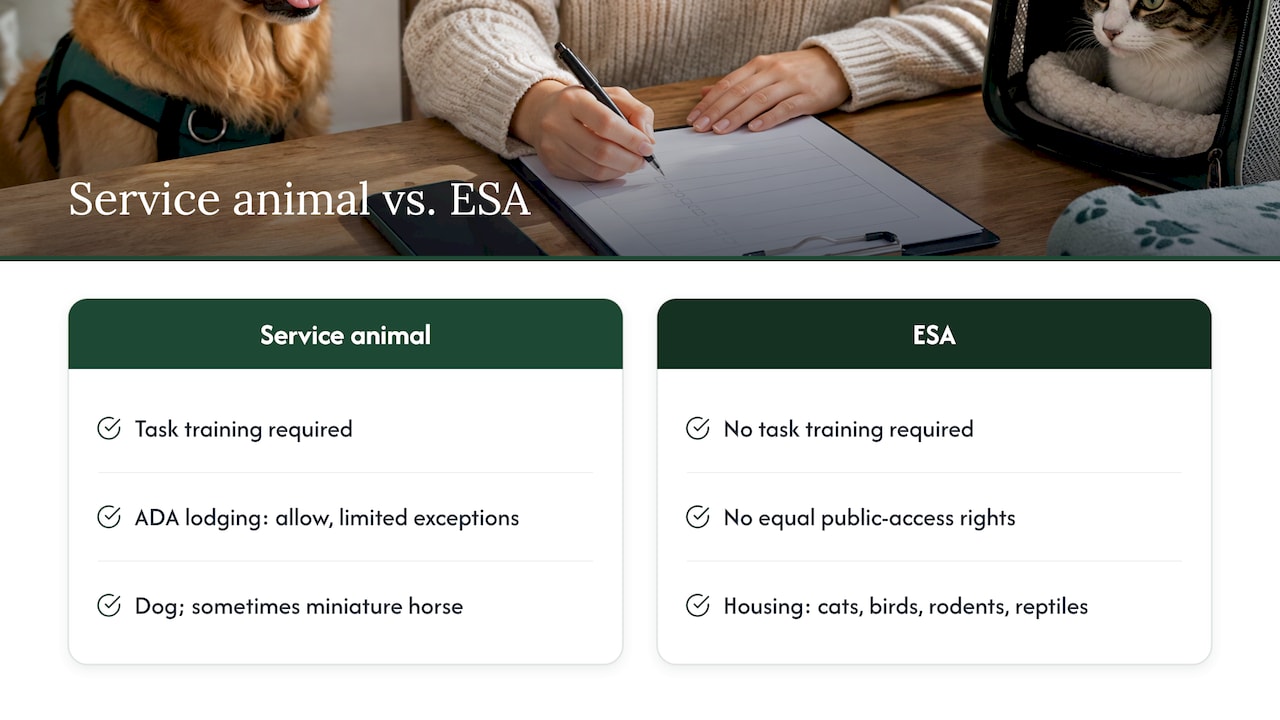
The same guide notes that in housing, a support animal is not a pet and can be an animal other than a dog or miniature horse, including cats, birds, rodents or reptiles. So the species flexibility you have at home does not automatically follow you on vacation.
If you are weighing the two categories, our comparison of ESAs and service dogs lays out training, access and legal differences side by side. Do not label an ESA a service animal to get through a door. Service status depends on trained tasks, not on how much the animal helps you emotionally.
Where state law can go further
Federal law sets a floor. States can protect more, and the wording of each state’s fair housing statute matters.
Arizona is a useful example. Its guide says state fair-housing law includes temporary housing such as hotels and short-term rentals as possible dwellings where a person with a disability may request an assistance animal accommodation. That is a request, not a guarantee: the host can still consider whether the request is reasonable and whether the animal poses a direct threat or an undue burden.
Other states take the narrower view described above. Because this varies, check three things for the state where you are staying:
- Whether the state’s fair housing or civil rights law mentions hotels, vacation rentals or transient lodging.
- Whether the state attorney general or civil rights agency publishes an assistance animal guide.
- Whether local rules or the building’s own policy add anything.
A state civil rights agency is the right place to ask. Its staff can tell you how the law applies to a specific rental type, which a general article cannot do for you.
What documentation a host may ask for
For a lease, a letter from a licensed clinician who knows your condition is the standard way to support an ESA request. That is why we always stress that a legitimate letter comes from a licensed professional and that registries, certificates and ID cards sold online carry no legal weight.
For travel, the picture is less uniform. Where no law forces the host to accommodate an ESA, a letter is a courtesy that supports your request, not a right. Where a law does apply, the host can usually ask for reliable information about the disability-related need, but not for your diagnosis or medical records.
Canada offers a helpful illustration of the principle. Alberta’s Human Rights Commission says a person may be able to show an ESA serves a disability-related purpose by means other than certification, so a certificate is not necessarily decisive. The Commission emphasizes individualized evidence and objective need over a universal ESA label. The takeaway for any traveler: a clear, specific letter from your own clinician does more for you than any badge or vest.
If you do not have a letter yet, our overview of how to get a legitimate one is on the ESA letter section of our site.
Pet fees, deposits and cleaning charges
Where housing law requires accommodation, the rules on fees are favorable. Arizona’s guide says providers generally must waive no-pet rules and pet deposits or fees for an assistance animal, subject to narrow exceptions, because the animal is distinct from a pet for housing purposes. Tenants fighting charges on a lease can read our guide on ESA pet fees and how to push back.
On a short stay where the housing rules do not apply, expect the opposite. The host may treat your ESA as a pet, which can mean a pet fee, a larger deposit or a cap on the number or size of animals. We cover how this plays out in lodging in our piece on the ESA hotel policy and why travelers may still pay pet fees.
That does not mean you are out of options. Many hosts and managers will waive or reduce a fee when asked politely with a letter in hand, and booking a pet-friendly property from the start avoids the problem entirely.
Before you book: a practical checklist
Most trouble comes from surprises at check-in. A few minutes of planning prevents it.
- Read the animal policy in the listing. Look for “pets allowed,” “no pets,” size limits, species limits and fee amounts. Note whether it mentions service animals or assistance animals separately.
- Message the host before you book. Say you travel with an emotional support animal, name the species and ask what the policy is for your stay. Keep the reply.
- Get the answer in writing. A booking-platform message thread or an email works. A verbal assurance at the door does not help if a different person is working.
- Ask about all costs. Pet fee, extra cleaning charge, deposit and whether any of it is refundable.
- Carry your documentation. Keep your clinician’s letter handy in digital and paper form. It should be on the clinician’s letterhead, signed, dated and include their license details.
- Check the property type. A private home, a condo within an HOA, and a hotel unit can all have different rules. Condo associations may have their own animal restrictions.
- Plan the stay around the animal. Bring familiar bedding, keep it off furniture if the host asks, and clean up thoroughly. A respectful guest is more likely to be welcomed back.
Booking platforms add their own layer. We list places where Airbnb must accept emotional support animals and the situations where a host’s rules may still apply, which is worth reading before you choose a listing.
If your ESA is refused
Stay calm and keep the exchange civil. A refusal at the door is stressful, but how you respond affects what you can do next.
- Ask for the reason and the policy in writing. A clear record helps whether you negotiate, complain or file a claim.
- Explain your request. Say that you have a disability-related need for the animal and offer your letter. Where state law covers the stay, that is the formal accommodation request.
- Contact the platform or the property’s management. Booking platforms and hotel chains have customer relations teams that can sometimes find another unit or waive a rule.
- Know which law you are invoking. If you actually have a trained service dog, the ADA applies and a host may ask only two questions: whether the dog is required because of a disability, and what work or task it has been trained to perform. If you have an ESA, your claim depends on state law or on the stay functioning as a residence.
- Report discrimination. For housing-type stays, HUD enforcement and civil action in court remain available, as the Federal Register notice above explains. You can also contact your state civil rights or fair housing agency.
- Have a fallback. Keep a pet-friendly alternative in mind so a refusal does not end the trip.
If the stay is long and the unit is your home for the duration, say so in your request. That fact is what moves a rental from vacation lodging toward the housing rules.
Outside the US: a quick comparison
Because our readers travel, here is how a few other countries approach it. These are separate legal systems, so do not assume US rules carry over.
- United Kingdom: VisitBritain’s business guidance says the Equality Act 2010 covers tourist accommodation and that refusing a disabled person with an assistance dog is unlawful except in exceptional circumstances. The Act has no specific reference to support, therapy or comfort animals, although providers should consider accommodating those needs and have a justifiable reason if they refuse.
- Australia: The Department of Veterans’ Affairs says the Disability Discrimination Act 1992 protects suitably trained assistance animals in public places, expressly including hotels, motels, campsites, holiday rentals and Airbnb stays, subject to exemptions.
- Canada (Alberta): The Human Rights Commission notes there is no standard definition of an ESA, and a provider’s duty depends on the circumstances, reliable medical information confirming disability and objective need, subject to undue hardship.
The pattern across all of them: trained assistance animals get the strongest protection, and ESAs depend on context and evidence.
Our perspective
We built Supportpet because people with anxiety, depression or PTSD were being sold certificates and registries that mean nothing, then told at the door that their animal was not welcome. Travel makes that confusion worse. An ESA’s strongest legal protection sits in housing, and a vacation stay is a different category. We think readers are best served by hearing that plainly.
The good news is that knowing the line gives you power. Ask early, document everything, carry a letter from a licensed clinician rather than a purchased badge, and choose properties whose written policies already welcome your animal. That approach respects hosts, protects you from surprise fees and keeps your rights intact where the law actually gives them to you.
A legitimate recommendation from a clinician who knows you is the foundation for every ESA right you have. Everything else is noise.
Erik
Get your paperwork in order before you travel
Whether you rent a home for the year or travel often, the same thing helps: a valid letter from a licensed clinician, kept current and easy to find. Our site explains what a legitimate ESA letter contains, how to spot scams, and how your rights differ between a lease and a trip.
Start with our travel and ESA resources, or read how a letter works in our ESA letter guide. We publish free, independent information and do not sell certificates, registrations or ID cards.
FAQ
Do vacation rentals have to allow emotional support animals?
Usually not under federal law. A short stay by someone who lives elsewhere is generally treated as temporary lodging, where the ADA covers service dogs but not ESAs. Some states, Arizona among them, treat short-term rentals as places where an assistance animal request can be made, so check the law where you are staying.
Can a host charge a pet fee for my ESA?
It depends on whether housing rules apply to your stay. Where they do, providers generally must waive pet fees and deposits for an assistance animal. On an ordinary vacation booking, the host may treat the animal as a pet and charge the listed fee, though many will waive it if you ask in advance.
Is an ESA letter enough to get into a short-term rental?
A letter from a licensed clinician supports your request, but it does not create a right where no law applies. It matters most when state law or a long-term residential stay brings housing protections into play. Pair it with advance written communication with the host.
What is the difference between an ESA and a service animal in a rental?
A service animal is a dog (or in some cases a miniature horse) trained to perform tasks for a person with a disability, and lodging must generally admit it. An ESA gives comfort without task training, so it has far fewer public-access rights outside housing.
What should I do if my ESA is refused?
Ask for the reason and policy in writing, offer your clinician’s letter and contact the platform or property management. If you believe a state or federal law applies, contact your state civil rights or fair housing agency. Keep a pet-friendly backup option in mind.
Sources
- Fair Housing Protections for Short-Term Renters, Equal Rights Center
- Part 5: Housing, Disability Rights South Carolina
- Assistance animals in housing, Mass.gov
- HUD FHEO-2020-01, Assessing a Person’s Request to Have an Animal as a Reasonable Accommodation
- Federal Register notice on withdrawn HUD guidance, 2026
- Civil Rights Guide, Arizona Attorney General
- Human rights in the hospitality industry, Alberta Human Rights Commission
- Equality Law: Accessibility Regulations UK, VisitBritain
- Assistance Dogs and Public Access Rights, Australian Department of Veterans’ Affairs
Recommended
- No Pets Policy for Renters: ESA Rights Survive HUD’s 2026 Shift
- Travelers: 4 Places Airbnb Must Accept Emotional Support Animals
- HUD’s May 22, 2026 ESA Guidance: 4 Steps for Tenants and Landlords
- Renters: Verify ESA Letter Requirements in 30 Seconds and Spot Scams