Explore this topic: ESA basics and animal comparisons
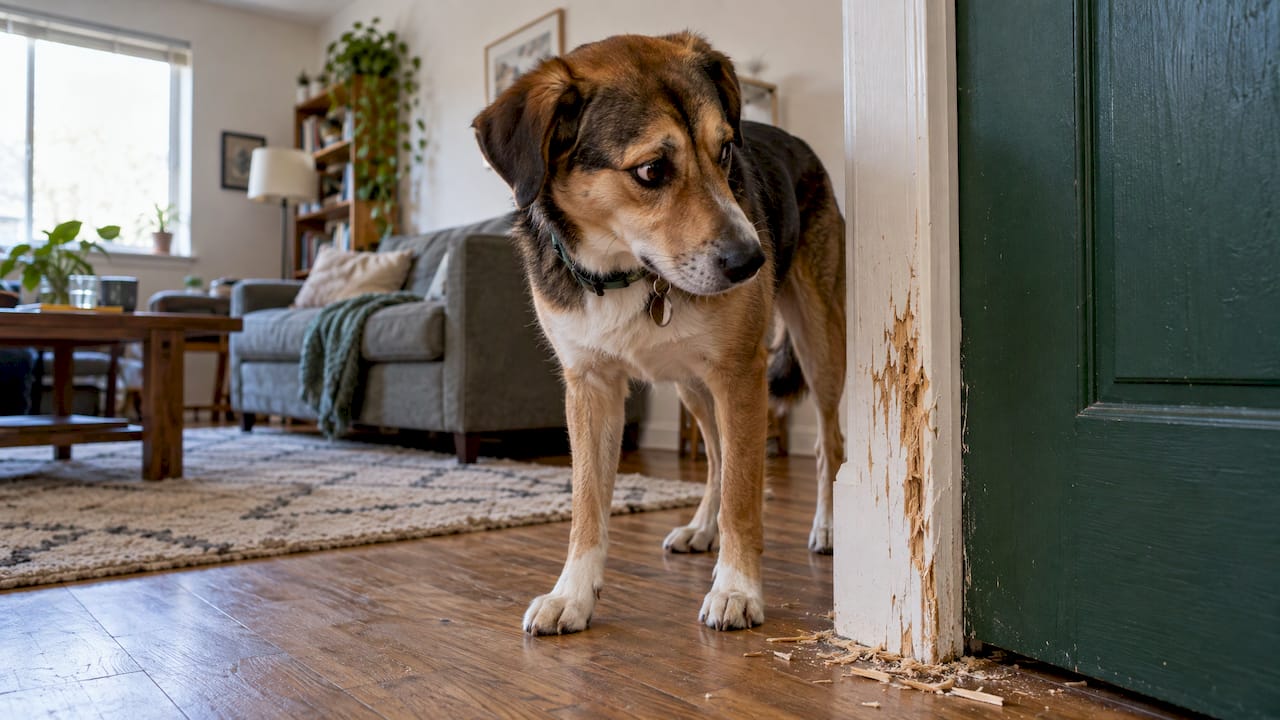
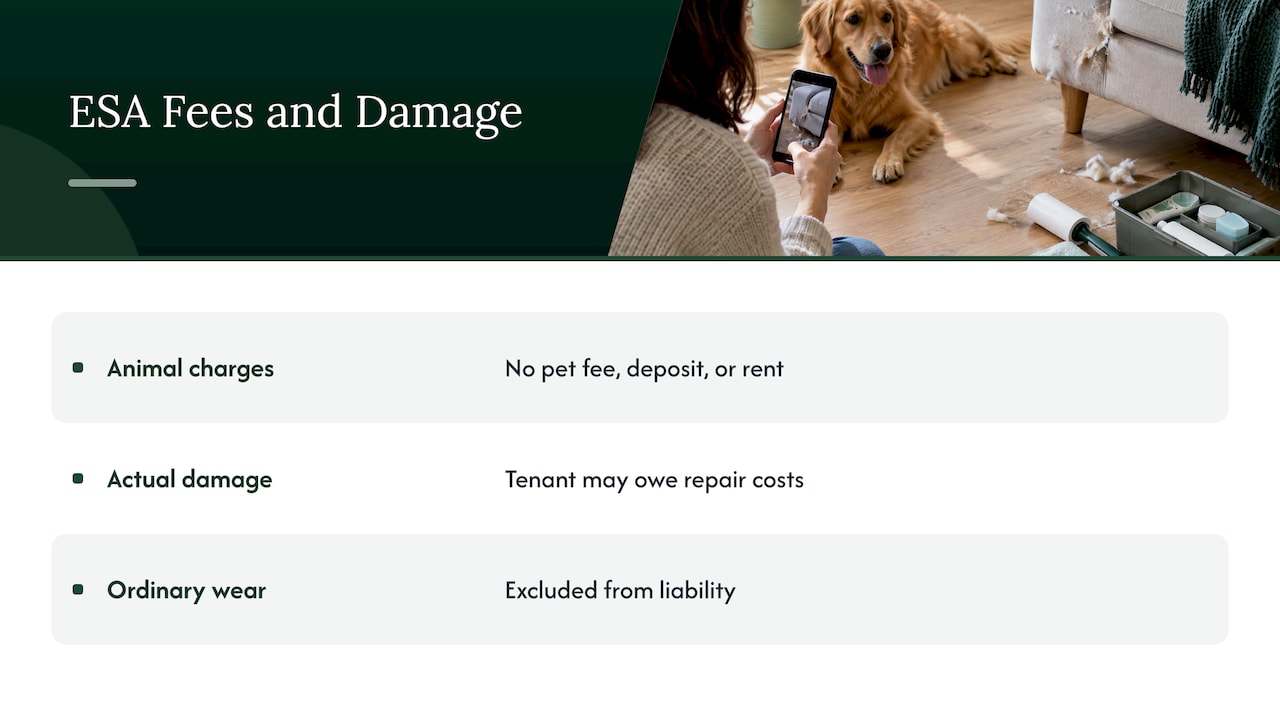
If your emotional support animal (ESA) damages a rental, you are generally responsible for the actual repair costs, beyond normal wear and tear. Your landlord generally cannot charge you a pet fee, pet rent or a pet deposit just because you have an ESA. Those two rules sit side by side, and most disputes come from mixing them up.
This guide explains what you can be billed for, what you cannot, how renters insurance fits in, and what changed when HUD (the U.S. Department of Housing and Urban Development) pulled back its ESA guidance in 2026. The details depend heavily on your state, so check your state’s rules before you act on anything below.
TL;DR
- You can be charged for actual damage your ESA causes, the same way other tenants are charged for damage, but not for ordinary wear and tear.
- Several states bar pet fees, deposits and pet rent for ESAs, and California also bars a landlord from requiring liability insurance for one.
- Standard renters policies often have limits and exclusions for animals, including breed exclusions, so read yours before a claim.
- HUD rescinded its 2020 ESA guidance on May 22, 2026, but state laws in places like California and Maine still protect ESAs.
- Document the unit’s condition at move-in and respond to any damage charge in writing, itemized and with receipts.
Table of Contents
- The core rule: no pet fees, but real damage is yours
- What counts as damage, and what is normal wear and tear
- Security deposits and itemized charges
- Insurance: what a landlord can ask and what your policy covers
- Breed, weight and size limits
- What HUD’s 2026 change means for damage disputes
- What to do if your ESA causes damage
- If you live outside the United States
- Perspective: why damage liability is a reason to document, not to worry
- Get the paperwork right first
- FAQ
- Sources
The core rule: no pet fees, but real damage is yours
Think of it as two separate questions.
The first is whether a landlord can charge you for having the animal. In states that protect ESAs, the answer is no. California’s Civil Rights Department says a housing provider may not require a person with an ESA to obtain liability insurance for the animal, or charge a pet deposit or pet rent. Maine’s Human Rights Commission says the same about fees and security deposits, noting that use of an assistance animal may not be conditioned on payment. Kentucky’s statute says a person granted an assistance-animal accommodation pays no pet fee, deposit or additional rent.
The second question is whether you can be charged for damage the animal actually does. Here the answer is yes. The same California guidance says a person with an ESA may be required to cover repair costs for damage the animal causes, excluding ordinary wear and tear. Maine’s commission says the individual remains liable for any actual damage. Kentucky ties it to a fairness test: you are responsible for physical damage if residents with pets are responsible for pet damage.
That last point matters. A landlord should be treating you the way they treat any tenant who causes damage. They should not invent a special, heavier standard for ESA owners.
What counts as damage, and what is normal wear and tear
Normal wear and tear is the slow deterioration that comes from simply living in a place. Damage is something beyond that, caused by a specific event or neglect. Using plain examples of how the line usually falls:
| Likely wear and tear | Likely damage |
|---|---|
| Carpet worn flat along walkways | Carpet torn up or soaked through with urine |
| Faded paint | Chewed door frames, trim or baseboards |
| Minor scuffs on flooring | Deep scratches gouged through a floor’s finish |
| Small nail holes from pictures | Holes dug in a yard or screens ripped out |
These are general illustrations, not a legal test. Courts and state agencies look at the age of the item, the length of your tenancy and the actual cost of repair. A ten-year-old carpet that needs replacing after a three-year tenancy has largely reached the end of its life, so a landlord generally cannot bill you its full replacement price. If you want to see what real pet-related carpet problems look like, there are examples of pet hair carpet damage that show how a minor mess differs from lasting harm.
Two habits protect you more than any argument later:
- Photograph and video the unit at move-in. Date-stamp everything, including floors, walls, window screens and the yard.
- Keep a move-in checklist signed by both sides. If the landlord doesn’t offer one, email your own list and keep the sent copy.
Security deposits and itemized charges
Because an ESA cannot trigger an extra pet deposit in protective states, the only deposit in play is the standard one every tenant pays. A landlord who wants to deduct repair costs from it should be able to show you what was damaged and what the repair cost.
Deposit deadlines, itemization requirements and penalties for improper withholding are set by state law and differ widely. Look up your state’s landlord-tenant statute or your state attorney general’s tenant page for the timeline. The practical steps are the same everywhere:
- Ask for an itemized list of deductions in writing.
- Compare it to your move-in photos.
- Ask for invoices or estimates for each repair.
- Dispute anything that is wear and tear, an unrelated issue or inflated, in writing, with your photos attached.
- If it is not resolved, you can usually go to small claims court, which is built for disputes of this size without needing a lawyer.
If you believe you were charged more because of your ESA than a tenant without one would have been, that may itself be a fair housing issue. A local fair housing organization or a lawyer who handles tenant cases is the right person to see in that situation.
Insurance: what a landlord can ask and what your policy covers
Insurance is the second big source of conflict on this topic. Many landlords assume that a policy is the safety net for damage and bites, so they ask ESA owners to buy one. For more on that fight, see our piece on insurance demands tied to ESAs. In California, as noted above, a landlord cannot require an ESA owner to carry liability insurance for the animal.
Even where you choose to carry renters insurance, it helps to know what it does and does not do.
What renters liability coverage generally covers
New Jersey’s insurance regulator explains that the liability section, Coverage E, pays to defend you in court and covers you if you are found legally responsible for someone else’s injury or property damage. Coverage F pays medical bills for people hurt on the property, and may also pay for some injuries away from the rental, such as a dog bite at a park.
The Kansas Department of Insurance notes that personal liability coverage typically pays up to $100,000 per claim, with higher limits available for an extra charge.
Where policies often fall short
- Your own animal is not your property in the policy. The same Kansas guide says most standard renters or condo policies do not cover animals, birds or fish as personal property. That means vet bills for your own ESA usually are not part of the deal.
- Damage to the unit you rent is often excluded from liability. A sample renters personal liability form on file with the Oklahoma Insurance Department, for instance, excludes property damage to property rented to or occupied by you, except damage from fire, smoke or explosion. So chewed trim or scratched floors in your own apartment may fall outside liability coverage and come out of your pocket or your deposit. Your own policy wording controls, so read it.
- Breed exclusions exist. The Maryland Insurance Administration has said insurers may exclude losses caused by specific dog breeds in homeowner’s and renter’s policies when they follow state underwriting rules. If your dog is on an exclusion list, a bite claim could be denied.
The takeaway: insurance is mainly for injuries and damage to other people’s property. It is not a reliable way to pay for damage to your own rental unit, so setting aside money for repairs is the safer plan.
Breed, weight and size limits
A common worry is that an insurer’s breed list will let a landlord turn down an ESA. California’s guidance says no: it prohibits restrictions on an ESA’s breed, size or weight, including restrictions from insurers. After you’ve shown a disability-related need, a provider may deny only for limited reasons: undue financial or administrative burden, fundamental alteration of the housing, or a case-by-case direct threat or substantial physical damage that cannot be sufficiently reduced.
Note the words “case by case.” A landlord must point to the behavior of your specific animal, not to the reputation of its breed. The earlier HUD guidance from 2020, now withdrawn, took a similar line on breed, weight and size limits, so state law is now the firmer ground for this argument.
What HUD’s 2026 change means for damage disputes
Federal rules shifted this year, and it is easy to misread the headlines.
On May 22, 2026, HUD issued a memorandum that permanently rescinded its January 28, 2020 guidance on assistance animals, and confirmed that both earlier notices had been withdrawn in September 2025. Under the new approach, HUD’s enforcement office will recommend charges only in animal-related complaints involving animals trained to provide disability-related assistance. Requests involving untrained ESAs are not presumed reasonable. The memo does not stop private lawsuits, which can generally be filed within two years under 42 U.S.C. 3613.
What this does and does not do:
- It changes what the federal agency will pursue. It is not a repeal of every ESA protection.
- State laws stand on their own. Maine’s commission says HUD’s action changes nothing in Maine, because its Human Rights Act is an independent law that expressly covers untrained emotional support animals. California’s Civil Rights Department says its ESA protections remain in full effect.
- The damage rule is unchanged in practice. Where state law protects your ESA, you also carry the duty to pay for actual damage. Where it does not, you may be treated like any other pet owner, which could mean pet fees and standard pet-damage charges.
For a fuller walkthrough, see our guide to ESA housing rights in 2026.
What to do if your ESA causes damage
Damage happens. A puppy chews a baseboard, a cat claws a door. How you handle the first few days shapes the outcome.
- Tell your landlord early, in writing. Offering to fix it yourself or pay a fair repair cost shows good faith and often prevents escalation.
- Get your own estimate. A landlord’s contractor quote is not the only valid price.
- Ask for a split by age and condition. Items like carpet and paint lose value over time, so ask how the age of the item was considered.
- Fix the cause. Crate training, chew toys, a scratching post or a behavior trainer can stop repeats, and landlords who see a plan are more flexible.
- Keep every message. If the matter ends up before a housing agency or a small claims judge, a clear paper trail matters more than memory.
If a landlord denies your request or threatens eviction over damage
HUD’s earlier approach encouraged an “interactive process,” meaning good-faith back-and-forth when a need is unclear. An equal housing organization’s manual for landlords in Pennsylvania describes the same idea. Even with federal guidance withdrawn, a calm, documented exchange is the best first move. If it fails, contact your state’s civil rights or human rights agency, or a local fair housing group. For anything involving eviction notices or a formal complaint, speak with a tenant attorney or legal aid office, since deadlines are short.
If you live outside the United States
The U.S. rules above do not apply abroad. A few examples show how much the answer shifts:
- Australia: the Disability Discrimination Act 1992 protects assistance animals but states in section 54A(7) that it does not affect liability for damage to property caused by an assistance animal.
- Saskatchewan, Canada: housing providers must accommodate disability-related support animals unless it causes undue hardship, and tenants may be liable for significant damage.
- England: emotional support animals are not legally recognized, so pet rules apply, and landlords may deduct pet damage from the tenancy deposit.
The pattern is consistent: even where an animal gets housing protection, damage responsibility usually stays with the person who keeps it.
Perspective: why damage liability is a reason to document, not to worry
Most of the questions we hear about ESAs and money come down to one confusion. People assume that because the law protects the animal from a pet fee, it also protects the tenant from a repair bill. It does not, and it was never meant to.
We think that is a fair deal. You get housing without a surcharge for something that supports your mental health. In return, you stand behind the animal the way any responsible pet owner does. When you know that bargain, you can negotiate from a calm position instead of a frightened one.
That is also why we focus on plain-language explanations and warn against sites that sell certificates, registrations or ID cards. None of those create legal rights. A letter from a licensed clinician who has assessed your need is what matters in housing, and clear records of the unit’s condition protect you whatever happens next.
Rules differ by state and have shifted in 2026, so read your own state’s guidance, and keep your paperwork in order.
Erik
Get the paperwork right first
Damage disputes are easier when your accommodation is on solid ground from the start. Our site explains, in plain language, how to qualify for an ESA, how to obtain a valid ESA letter from a licensed clinician, and how to avoid the registries and certificates that carry no legal weight. Start with our ESA letter guide, and see how an ESA differs from a service dog in our comparison.
FAQ
Can my landlord charge a pet deposit because I have an ESA?
In states that protect ESAs, generally no. California, Maine and Kentucky all bar pet fees, deposits or extra rent for assistance-animal accommodations. You can still be charged for actual damage, and your standard security deposit may be used for it. If your state has no ESA protection, ordinary pet rules may apply.
Does renters insurance cover damage my ESA does to my apartment?
Often not. Liability coverage is designed for injury or property damage to other people, and some forms exclude damage to property you rent or occupy. Standard policies also may not cover your own animal as property. Read your policy’s exclusions and call your insurer before you rely on it.
Can a landlord refuse my ESA because of its breed?
In California, no: breed, size and weight restrictions, including those from insurers, are prohibited, and denial requires a case-by-case showing such as a direct threat. Other states vary, and federal enforcement priorities changed in 2026, so check your state’s civil rights agency.
What if I think the damage charge is too high?
Ask for an itemized list with invoices, compare it with your move-in photos, and dispute wear-and-tear items in writing. Small claims court is a common next step. If you think you were charged more because of your ESA, contact a fair housing organization or tenant attorney.
Sources
- HUD memorandum, May 22, 2026
- HUD guidance, January 28, 2020 (withdrawn)
- California Civil Rights Department, ESA and Fair Housing Law FAQ
- Maine Human Rights Commission guidance, August 4, 2026
- Kentucky Revised Statutes 383.085
- Kansas Insurance Department, Home and Renters Shopper’s Guide
- Maryland Insurance Administration Bulletin 15-25
- New Jersey Department of Banking and Insurance, Renters Insurance
- Renters personal liability form, Oklahoma Insurance Department
- Equal housing manual for landlords in Pennsylvania
- Australia, Disability Discrimination Act 1992
- Saskatchewan Human Rights Commission, Policy on Support Animals
- Shelter England, Pets in private rented accommodation
Recommended
- U.S. Renters: Landlords Cannot Charge ESA Pet Fees. How to Fight Back
- Renters: Fair Housing Act Change Limits ESA to Trained Animals
- Protect Your ESA Housing Rights After HUD’s May 22, 2026 Memo
- Exotic ESA Animals: What Landlords and the Law Allow